
What's the Talk on US Stocks | A Quiet Week, but Are US Treasuries Poised for Turmoil?

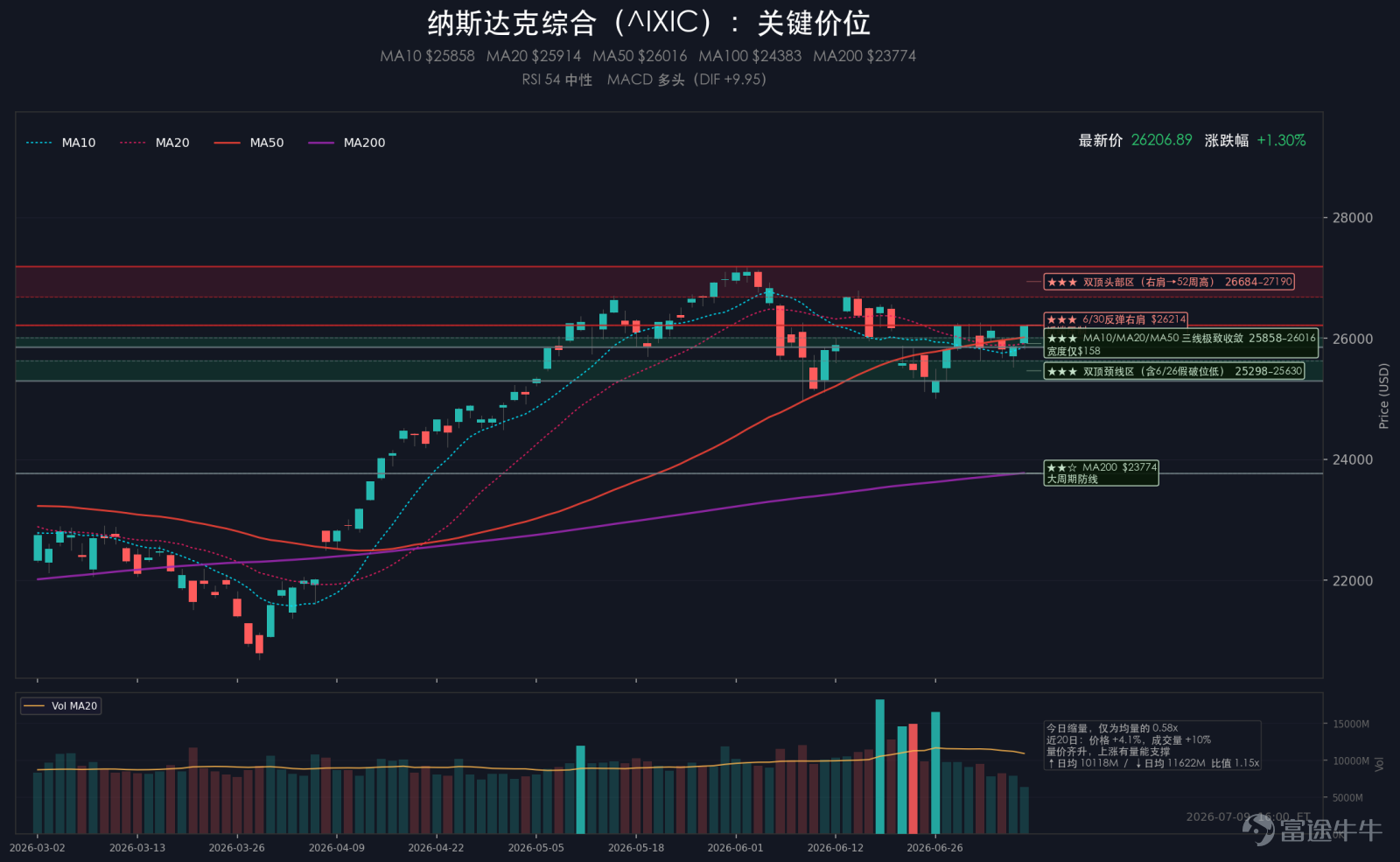
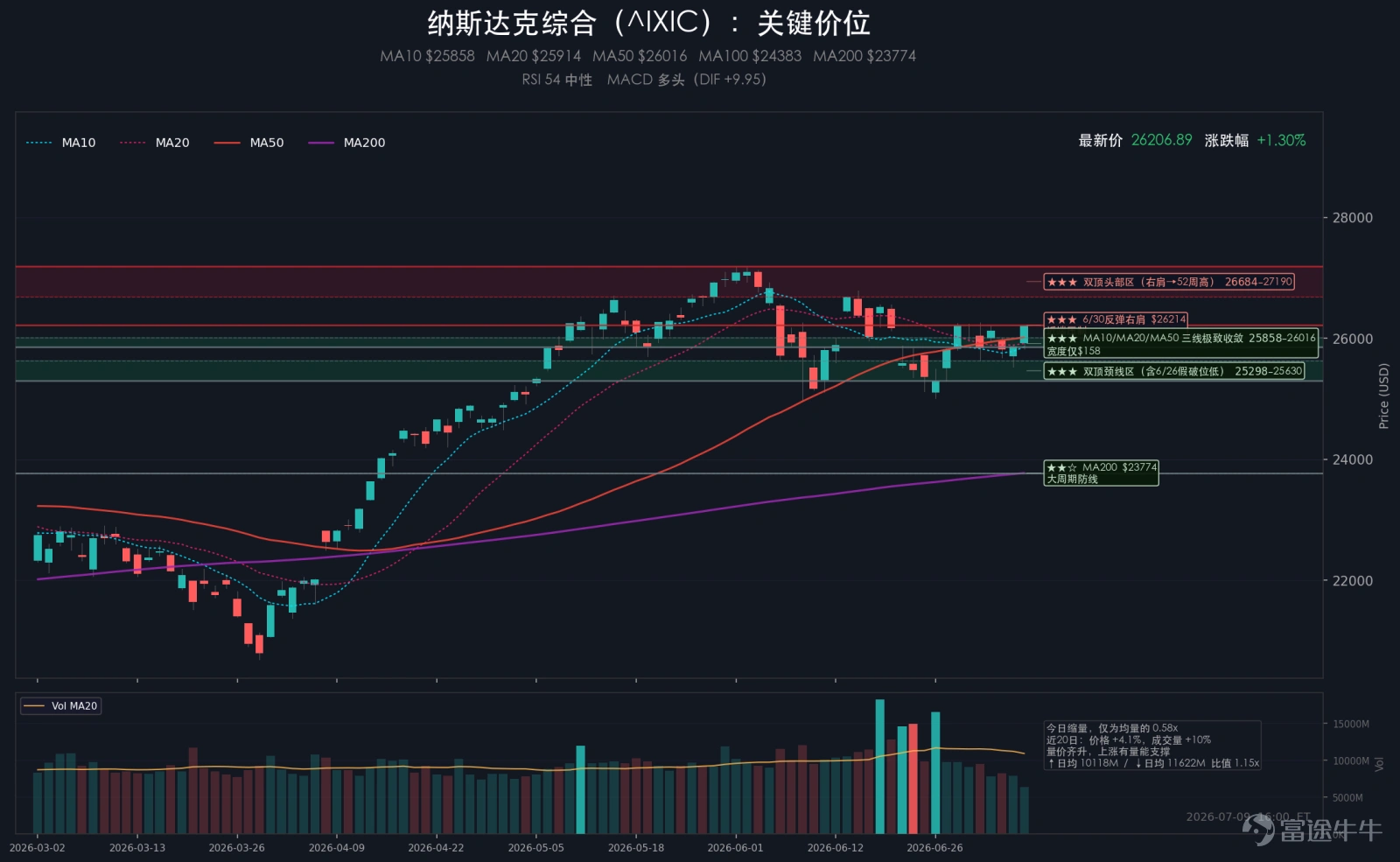
Wall Street Brief (July 10): U.S. equities rebounded across the board on Thursday, led by tech growth and small-cap stocks, with the AI supply chain regaining momentum; oil prices and U.S. Treasury yields pulled back, allowing high-beta sectors to retake market leadership.
Summary: U.S. equities staged a broad-based rebound on Thursday, with the S&P 500 rising 0.81%, the Nasdaq up 1.30%, the Dow Jones gaining 0.27%, and the Russell 2000 climbing 1.22%. The Nasdaq and Russell 2000 outperformed, signaling a clear recovery in risk appetite as tech growth and small-cap stocks reclaimed market leadership. The VIX fell to 15.84, down 6.27% for the day, reflecting improved sentiment without entering euphoric territory. Declines in crude oil prices and the 10-year Treasury yield temporarily eased inflation and rate pressures, supporting the equity rally. Within equities, tech growth, semiconductors, optical modules, and crypto-related names showed relative strength, while energy stocks lagged amid falling oil prices. Across major asset classes, the 10-year Treasury yield dropped 0.66%, gold rose 1.14%, crude oil fell 3.95%, Bitcoin gained 1.43%, and the dollar index declined 0.12%.
I. Major Events
1. Trump stated there would be no prolonged military action.
The U.S. and Iran continued exchanging strikes on July 9, but Trump indicated the latest hostilities would not escalate into a prolonged military conflict. Markets promptly reassessed the likelihood of spillover risks and disruptions to shipping through the Strait of Hormuz, leading to a reversal of the sharply elevated energy risk premium from the previous session. With crude oil and long-end yields pulling back from recent highs, equities faced notably reduced inflation and valuation pressures.
2. Meta plans to begin mass production of its in-house AI chip in September.
Meta plans to begin mass production of its in-house AI chip 'Iris' starting in September and aims to scale its total computing capacity to 14 gigawatts by next year. This new development has refocused market attention on major platforms’ AI-related capital expenditures and infrastructure build-out, leading to upward revisions in demand expectations across semiconductor equipment, memory, and optical communications supply chains.
II. Major Trends
All four major indices rose on Thursday, with the Nasdaq and Russell 2000 posting larger gains, while the Dow Jones lagged behind. The market move was more than just a simple rebound—high-beta sectors regained leadership, signaling that the prior day’s risk-off sentiment and valuation compression trades have temporarily subsided.
From a medium-term structural perspective, growth remains the dominant theme. QQQ has gained 18.66% over the past three months, continuing to outperform DIA’s 9.18%; SPYG is up 14.83% over the same period, significantly beating SPYV’s 6.38%. The relative strength of growth and tech stocks remains intact and was further reinforced during Thursday’s rally.
In the short term, SPY rose 2.37% over two weeks, maintaining its position as the more stable among major index directions; RSP gained only 0.83% over the same period, still trailing SPY, indicating that although market breadth has improved, leadership remains tilted toward large-cap mega-caps. Meanwhile, IWM is up 13.74% over three months, still ahead of SPY’s 10.85%, suggesting that medium-term risk appetite remains undamaged.
MAGS’ two-week gain widened from 4.96% to 9.32%, while XMAG showed signs of short-term consolidation, highlighting that the allure of top-tier tech names continues to strengthen. In other words, the market is simultaneously repairing risk appetite while further reinforcing its concentration in core tech assets.
III. Market Sentiment
Market sentiment notably improved on Thursday. The VIX fell to 15.84, down 6.27% on the day, indicating a clear cooldown in near-term volatility pricing and a partial easing of the prior day’s geopolitical risk-driven tension. The CNN Fear & Greed Index rose to 47, up from 44 the previous day.
CBOE’s total put/call ratio stood at 0.74, with the index options put/call at 1.04 and stock options put/call at 0.63. This suggests sentiment has recovered somewhat, though protective demand on the index side hasn’t fully dissipated—the market appears to be warming up rather than entering a state of euphoria.
IV. Market Scan
1. Index ETFs:Thursday’s ETF price action was very clear: QQQ rose 1.66%, leading all major index ETFs, while IWM gained 1.28%, indicating simultaneous recovery in both tech-growth and small-cap segments. Large-cap leaders also held steady, showing the market isn’t relying solely on defensive pockets but has returned to a risk-asset-led regime. Among country-specific ETFs, Brazil’s EWZ rose 1.60%, South Korea’s EWY gained 1.11%, Japan’s EWJ advanced 1.06%, and the UK’s EWU saw only a minor pullback—global markets broadly leaned toward recovery.
2. Sector Performance:Technology (XLK) led gains with a 2.18% rise, followed by consumer discretionary (XLY) up 1.34% and financials (XLF) gaining 1.04%—the clearest manifestation of recovering risk appetite. On the flip side, energy (XLE) dropped 1.40% and consumer staples (XLP) fell 1.41%, naturally lagging as oil prices retreated and safe-haven demand cooled.
At the subsector level, DRAM surged 3.74%, copper miners (COPX) rose 3.23%, gold miners (GDX) gained 3.06%, cybersecurity (CIBR) advanced 2.84%, and semiconductors (SMH) climbed 2.48%—all among the day’s strongest and most actively traded themes. Both AI memory and optical communications/optical modules chains saw broad-based rebounds, signaling renewed investor interest in AI hardware extension trades. The weakest performers included oil & gas exploration (XOP), which fell 1.56%, consistent with the decline in crude oil prices.
3. The Magnificent Seven Tech Stocks:Among the Magnificent Seven tech stocks, Meta led gains with a 4.70% rise, followed by Tesla up 3.17%, while Google declined 0.69%. The mega-cap tech sector did not rally across the board, but capital clearly favored companies with more direct exposure to AI narratives and higher elasticity.
4. U.S.-Listed Chinese Stocks:Chinese ADRs diverged after surging the previous day. Alibaba rose 1.98%, remaining relatively stable, while Bilibili fell 1.05%, marking the weakest performance. Overall, Chinese ADRs failed to establish an independent, cohesive trend and instead exhibited natural divergence following the prior day's strength.
5. Cryptocurrencies:Bitcoin rose 1.43%, with mining stocks showing stronger recovery—MARA surged 9.98%, while MSTR was essentially flat and CRCL declined 1.65%. This indicates a broad rebound in crypto assets, though the pace of recovery varies across stablecoins and trading ecosystem-related names.
$S&P 500 Index (.SPX.US)$ $SPDR S&P 500 ETF (SPY.US)$ $NASDAQ 100 Index (.NDX.US)$ $Invesco QQQ Trust (QQQ.US)$ $Dow Jones Industrial Average (.DJI.US)$ $State Street® SPDR® Dow Jones Industrial Average® ETF Trust (DIA.US)$ $Russell 2000 Index (.RUT.US)$ $iShares Russell 2000 ETF (IWM.US)$ $Roundhill Magnificent Seven ETF (MAGS.US)$ $USD (USDindex.FX)$ $U.S. 10-Year Treasury Notes Yield (US10Y.BD)$ $iShares 20+ Year Treasury Bond ETF (TLT.US)$ $XAU/USD (XAUUSD.CFD)$ $SPDR Gold ETF (GLD.US)$ $CBOE Volatility S&P 500 Index (.VIX.US)$ $CME-Bitcoin RR Futures (AUG6) (BTCmain.US)$ $iShares Ethereum Trust ETF (ETHA.US)$ $NVIDIA (NVDA.US)$ $Tesla (TSLA.US)$ $Meta Platforms (META.US)$ $Amazon (AMZN.US)$ $Alphabet-C (GOOG.US)$ $Microsoft (MSFT.US)$ $Apple (AAPL.US)$
Risk Disclaimer: The above content only represents the author's view. It does not represent any position or investment advice of Futu. Futu makes no representation or warranty.Read more


Comments (3)
to post a comment
6