
Who is increasing allocations to Hong Kong dollar-denominated assets?
Author | Ding Mao
Editor | Zhang Fan
On July 7, 2026, Pan Gongsheng, Governor of the People's Bank of China, clearly stated that China’s foreign exchange reserves will continue to increase their allocation to Hong Kong assets. He also revealed that over the past year or so, China’s foreign exchange reserves have been consistently allocating capital and executing investment transactions in Hong Kong. This indicates that the recent increase in foreign reserve allocations to Hong Kong assets is not a short-term market rescue measure, but rather a normalized strategic investment that has already been steadily implemented and is being progressively scaled up.
Meanwhile, Pan Gongsheng also announced a package of supporting measures aimed at comprehensively injecting long-term momentum into Hong Kong’s capital markets by 'expanding the liquidity pool' and 'enhancing the policy toolkit':
– The annual net investment quota for the Southbound Trading under Bond Connect will be raised from RMB 500 billion to RMB 800 billion, an increase of 60%;
– The range of Southbound Trading products will be expanded to include Hong Kong dollar-denominated bonds and RMB-denominated bond-related instruments;
– The scale of the Hong Kong Monetary Authority’s RMB liquidity facility will be increased from RMB 200 billion to RMB 500 billion, with the maximum tenor extended to three years;
– Five-year RMB-denominated government bond futures will be launched in Hong Kong to facilitate risk management in the offshore market.
These statements were interpreted by the market as a strong endorsement from the national government of Hong Kong’s status as an international financial center, alleviating prior concerns about uncertainty surrounding Hong Kong dollar-denominated assets.
Following the announcement of these policy tailwinds, market sentiment surged rapidly. On July 8, the Hang Seng Index jumped nearly 3% for the day, while the Hang Seng Tech Index soared by almost 5%. Core constituent stocks saw explosive gains: Alibaba surged as much as nearly 12% intraday, Xiaomi Group closed up nearly 10%, and Zhipu AI recorded a gain of 13.35%.
More notably, benefiting from the rally in Hong Kong-listed equities, related ETFs also staged a reversal. The Fullgoal China Connect Internet ETF rose sharply by 6.06% in a single day, with turnover exceeding RMB 6.9 billion—a record high since its listing. Additionally, the ETF saw net subscriptions of 2.654 billion units during the trading day, marking not only its first significant net inflow since March 2026 but also setting a new record for the highest single-day net subscription since April 8, 2025.
Why increase allocations?
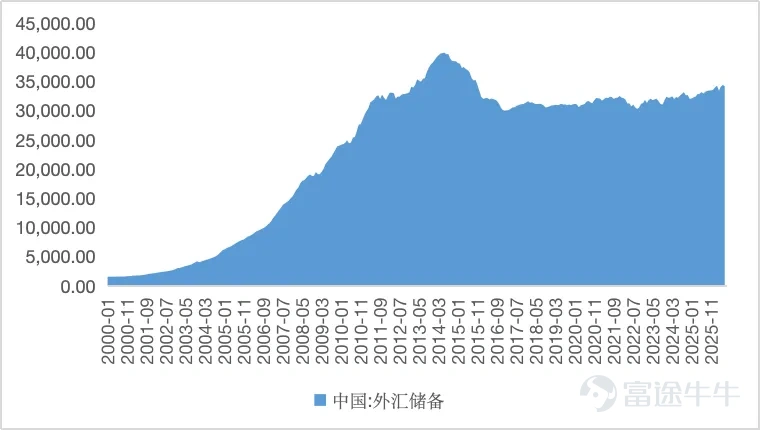
As the world’s largest holder of foreign exchange reserves, China holds approximately USD 3.4 trillion in reserves, accounting for roughly one-quarter of global foreign exchange reserves. For a long time, the primary component of China’s reserves has been U.S. dollar-denominated assets. According to estimates by international institutions, this share currently stands at around 58%–60%, primarily held in the form of U.S. Treasury securities and agency bonds. Consequently, any fluctuations in U.S. Treasuries and the U.S. dollar significantly impact China’s foreign exchange reserves.

China's foreign exchange reserves have remained stable at around USD 3 trillion. Source: Wind, compiled by 36Kr

Composition of China's foreign exchange reserve assets. Source: Wind, compiled by 36Kr
In recent years, however, escalating geopolitical tensions have triggered a global wave of 'de-dollarization.' The underlying reasons are twofold: First, the United States faces persistently high fiscal deficits and frequent inflation volatility, with its massive debt burden continuously eroding the credibility underpinning the U.S. dollar. The dollar’s aura as a global 'risk-free asset' is being rapidly undermined by its own structural contradictions. Second, amid heightened geopolitical risks, the U.S. has repeatedly weaponized the dollar, frequently imposing extreme financial sanctions—such as freezing foreign reserves or cutting off access to the SWIFT system—on other countries. This has steadily depleted the dollar’s 'public credibility,' exposing offshore assets to substantial tail risks and serving as a key external catalyst for the global move toward de-dollarization.
Driven by both internal and external factors, the U.S. dollar’s share of global foreign exchange reserves has declined from a historical peak of 72% in 2001 to 57.1% as of March 2026, remaining below the 60% threshold for 14 consecutive quarters.

The U.S. dollar’s share of global foreign exchange reserves continues to decline. Source: Wind, compiled by 36Kr
Against this backdrop, China has proactively optimized the structure of its foreign exchange reserves to reinforce financial security, enhance its voice in international monetary affairs, and support the nation’s long-term strategic development. Specifically, increasing allocations to Hong Kong dollar-denominated assets represents a 'gentle de-dollarization' strategy that leverages the Hong Kong dollar’s unique 'shadow dollar' characteristics—enhancing portfolio diversification without triggering market panic.

Chinese investors continue to reduce holdings of U.S. Treasury securities Source: Wind, compiled by 36Kr
On one hand, Hong Kong operates a currency board system, deeply anchoring the Hong Kong dollar to the U.S. dollar in terms of exchange rate, liquidity, and settlement mechanisms. For China’s vast foreign exchange reserves, a rapid large-scale shift from U.S. dollar assets to non-dollar assets could easily trigger severe turbulence in global foreign exchange markets and even result in substantial unrealized foreign exchange losses.
By reallocating a portion of assets from U.S. Treasuries, U.S. equities, and U.S. dollars into Hong Kong dollar-denominated assets, the reserve portfolio effectively maintains relative stability in dollar-linked exposures on financial statements. This approach satisfies the fundamental reserve requirements of 'high liquidity and low volatility' while subtly withdrawing funds from the direct oversight of the Federal Reserve and Wall Street—achieving a 'substantive decoupling of assets with a smooth, minimally disruptive transition on paper.'
On the other hand, Hong Kong-based assets are relatively more controllable, helping to mitigate geopolitical risks and enhance the resilience of foreign reserve holdings.
What will they buy?
Historically, China’s foreign exchange reserves have strictly adhered to the principle of 'safety first, liquidity prioritized, and moderate returns.' Internally, reserves are segmented into Tier-1, Tier-2, and Tier-3 reserve pools based on liquidity.
– The Tier-1 reserve pool primarily provides high-liquidity buffers and consists mainly of short-term debt, deposits, and money market funds;
– The Tier-2 reserve pool balances safety and returns, primarily holding sovereign long-term bonds, agency debt, and high-grade credit instruments;
– The Tier-3 reserve pool focuses on generating upside potential and mainly includes broad-based offshore equity ETFs, gold, and a small allocation to high-rated corporate bonds.
Overall, the core investment objective of foreign exchange reserves is 'preserving value and providing liquidity,' which implies an extremely low risk appetite. Consequently, asset allocation naturally favors fixed-income assets that offer stable returns and low volatility, with approximately 80% of holdings concentrated in such instruments.
However, looking at the scale of Hong Kong’s bond market, according to data from the Hong Kong Monetary Authority (HKMA), by the end of 2025, the market will primarily consist of HKD-denominated bonds, offshore RMB bonds, and G3 bonds (denominated in U.S. dollars, euros, and Japanese yen), with outstanding amounts of USD 259.2 billion, USD 229.6 billion, and USD 533.6 billion, respectively, bringing the total market size to approximately USD 1.02 trillion.

Structure and Scale of Hong Kong’s Bond Market as of End-2025 Source: CSC Financial Co., Ltd., compiled by 36Kr
Given that the primary policy objective this time is to increase allocations to HKD-denominated assets and optimize the currency composition of foreign reserves, it is unlikely that a large-scale allocation to G3 U.S. dollar bonds will occur. Excluding this segment, the total outstanding amount of bonds in the entire market falls short of USD 500 billion, and among these, the core Exchange Fund Bills and Notes—which meet the foreign reserve’s risk management requirements, support large-scale transactions, and offer high liquidity—are even smaller in scale.
Faced with the enormous size of foreign exchange reserves, the limited stock of high-quality, highly liquid HKD-denominated bonds is insufficient to fully absorb the incremental allocation. Moreover, foreign reserves themselves have an inherent need for diversification to enhance returns and mitigate risks associated with overexposure to a single asset class. Therefore, it is expected that part of the incremental capital will naturally flow into the broader Hong Kong equity market.
However, deploying foreign reserves into equities faces two rigid constraints: first, it must strictly adhere to the compliance boundaries and operational independence of central bank reserve management; second, it must minimize market volatility as much as possible. Given these institutional red lines and the imperative for market stability, foreign reserve funds will not directly invest in individual stocks. Instead, standardized, low-volatility, highly liquid passive equity instruments—such as broad-based index ETFs and high-dividend ETFs—are clearly the most suitable options. Currently, mainstream broad-based tools like the Hang Seng Index ETF hold underlying assets concentrated in internet leaders such as Alibaba and high-dividend, dividend-paying names like the three major telecom operators.
Additionally, a question worth considering is this: over the past few years, in pursuit of 'de-dollarization,' the People’s Bank of China has publicly increased its gold holdings for more than 20 consecutive months. Now, against the backdrop of expanding HKD-denominated assets within foreign reserves, will the central bank elevate Hong Kong-listed equities—which offer greater sovereign control and relatively more attractive valuations—to a similarly strategic safe-haven status?
Specifically regarding the impact on Hong Kong equities, this move to boost HKD-denominated assets within foreign reserves is expected to provide sustained benefits across multiple dimensions—capital inflows, liquidity, and market sentiment.
The most direct effect is that foreign reserve inflows will introduce stable, long-term national-level capital that can anchor core segments of the Hong Kong equity market, effectively easing liquidity pressures and dampening price volatility. In recent years, the biggest criticism of the Hong Kong market has been its lack of liquidity, which has left many high-quality stocks without sufficient buying interest and caused their prices to deviate persistently from fair valuations. Even if only a small portion of these 'long-duration' foreign reserve funds flows into Hong Kong equities, the sheer scale of committed long-term capital would be sufficient to establish a solid 'valuation floor' for the market.
Beyond this, another significant impact is that allocations by foreign reserves—a form of sovereign capital—to HKD-denominated assets will create a powerful demonstration effect and serve as implicit policy endorsement. This signals global sovereign wealth funds and international institutional investors that China affirms Hong Kong’s investment environment, potentially attracting additional external capital and creating a positive feedback loop that expands the overall Hong Kong equity market and gradually corrects its chronically depressed valuations and elevated risk premium.
*Disclaimer:
The content of this article represents the author’s views only.
Investing involves risks, and caution is advised. Under no circumstances does the information or opinions expressed herein constitute investment advice for any individual. Investors should consult qualified professionals and exercise due diligence before making any investment decisions. We do not intend to provide underwriting services or any services that require specific qualifications or licenses.
Risk Disclaimer: The above content only represents the author's view. It does not represent any position or investment advice of Futu. Futu makes no representation or warranty.Read more

Comments
to post a comment
1
2