US Stock Market Talk | The Fed Resumes Rate Hikes After a Three-Year Pause! Is a New Shift Ahead for

Hot Topics in 5 Minutes | Bank of Korea Raises Red Flag: Should You Still Touch 2x Leveraged ETFs? A Deep Dive into the 'Korea-Hong Kong Asynchrony'
In early July, the 'leverage frenzy' in South Korea's stock market is facing an abrupt regulatory slowdown. Today,the Bank of Korea has unusually issued a risk warning on single-stock leveraged ETFs linked to Samsung Electronics and SK Hynix, signaling a clear shift from its previous position.These products, approved at the end of May, became an instant hit upon launch, recording monthly trading volumes of KRW 212 trillion—accounting for over one-quarter of total ETF trading volume. Meanwhile, the version listed on the Hong Kong Stock Exchange $CSOP SK Hynix Daily Max (2x) Leveraged Product (07709.HK)$ and $CSOP Samsung Electronics Daily Max (2x) Leveraged Product (07747.HK)$ was launched even earlier, and its 2x leveraged long SK Hynix ETF became the world’s largest single-stock leveraged ETF by assets under management in May this year.
Faced with repeated warnings from regulators, the question ordinary investors care about most is: can these leveraged products still be invested in?SK Hynix is expected to officially list on U.S. markets this Friday—what impact will this have on these ETF products?
Behind the Bank of Korea’s reversal in stance
On July 5, the Bank of Korea explicitly stated in its written response to parliamentary inquiries that single-stock leveraged ETFs linked to Samsung Electronics and SK Hynix couldamplify market volatility, exacerbate concentration risk in the stock market, and reinforce one-sided trading behavior. This marks another regulatory body sounding the alarm on these high-risk products, following the Financial Supervisory Service (FSS).
Most notably, there has been a shift in stance. Just two weeks ago, the Bank of Korea’s Financial Stability Report viewed such products as helpful in 'providing domestic alternatives, curbing capital outflows, and attracting foreign investment into Korea.' The tone of this written warning is significantly more forceful, signaling a marked change in the central bank’s position. Behind this reversal lies an accumulation of multiple risk signals.
Excessive market concentrationis the primary concern. $Samsung Electronics (005930.KR)$ and $SK Hynix (000660.KR)$ Together, they account for more than half of South Korea’s total stock market capitalization and trading volume, and the existence of single-stock leveraged ETFs could further intensify this concentration risk.
One-sided trading amplifying volatilityalso worries regulators. Leveraged ETFs typically buy when prices rise and sell when prices fall to maintain their target leverage ratio—a procyclical mechanism that inherently reinforces price swings. Since May, inflows into 2x leveraged long ETFs tracking the Korean equity market have surged dramatically, far outpacing those into other leveraged ETFs and standard market ETFs.
Even more concerning is the possibility that historical cycles may be repeating themselves. 2During 2021, as South Korea's stock market peaked and entered a sustained downturn, the assets under management in leveraged ETFs continued to rise against the trend—a pattern highly similar to the current market dynamics.
The Core Mechanics of Leveraged ETFs: Structural Traps and Hidden Erosion
To understand regulators’ concerns, investors must first grasp the fundamental mechanics of leveraged ETFs. These products provide leveraged exposure to individual stocks, with daily price movements designed to be twice that of the underlying stock.On the surface, they allow investors to gain leverage without margin financing, but their underlying mechanics are far more complex than they appear.
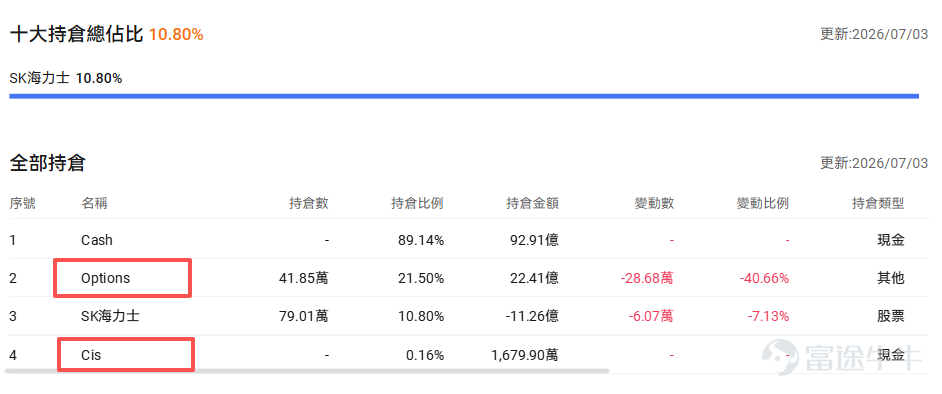
Daily Rebalancing MechanismThis mechanism is the root cause of amplified volatility. To maintain a fixed 2x leverage ratio, investment banks employ a series of complex derivatives and must rebalance their positions before the market closes each trading day—buying more when the underlying rises and mechanically selling when it falls.

Source: Futubull. Holdings of CSOP Daily Leveraged 2x Long SK Hynix
These trading activities have nothing to do with the company’s fundamentals, yet they materially impact stock prices. Wall Street refers to this phenomenon as 'the tail wagging the dog'—where derivative prices should be driven by the underlying asset,but when leveraged products grow large enough, their mechanical rebalancing ends up driving the pricing of the underlying assets themselves.
Volatility DragIt is the 'silent killer' for long-term holders. Leveraged ETFs track daily returns, not long-term cumulative performance.When held over the long term in a volatile market, actual returns tend to deviate from—and are typically lower than—the theoretical leveraged multiple of the underlying index’s price movement. Even if the underlying stock eventually returns to its starting point, the leveraged ETF may already have incurred losses.

More critically, recovering from such losses becomes exponentially difficult.The Korea Exchange imposes a daily price limit of 30%, meaning a 2x leveraged product could theoretically suffer a single-day loss of up to 60%.Under 2x leverage, the underlying asset would need to rise by 150% to fully recover from an equivalent loss.
“Asynchronous Trading Between Korea and Hong Kong”: The Additional Pricing Power of 7709
The risks of single-stock leveraged ETFs listed in Korea extend beyond the domestic market. Hong Kong also offers leveraged ETFs linked to Samsung and SK Hynix (such as 7709), creating a cross-border pricing power issue that most investors overlook.
The time difference in trading hours creates arbitrage opportunities. The Korean KOSPI market closes at 15:30 Korea Standard Time (14:30 Beijing time), while the Hong Kong market closes at 16:00 Hong Kong time (16:00 Beijing time)—approximately 1.5 hours after the Korean market.
This means any global event occurring after the Korean market closes may first be reflected in Hong Kong-listed leveraged ETFs. The closing prices of these Hong Kong leveraged ETFs effectively become a 'barometer' for the next day’s opening of Korean stocks. As a result, Hong Kong products like 7709 gain additional pricing influence, with their closing movements reflexively shaping market sentiment at the open of Korean equities the following day.

Source: Futubull.
During the final 1.5 hours, 7709 continued to trade normally in the Hong Kong market,Its price was entirely determined by market supply and demand as well as investors' expectations for future performance, potentially resulting in significant premiums or discounts.This can also cause the ETF’s gains to fall short of the expected 2x multiple when the underlying stock rises, as the previous day's premium or discount needs to be 'absorbed.' As shown on the intraday chart, trading volume tends to decline after 14:30 (when Korean markets close), but the price certainly does not move in a straight line.
This reflexivity transmits through a chain reaction:Unexpected event → abnormal movement in Hong Kong-listed leveraged ETFs during the closing session → Korean investors follow the trend at next-day open → sharp swings in Korean underlying stocks → rebalancing of locally listed Korean leveraged ETFs amplifies volatility → reflexive impact on next-day opening of Hong Kong-listed leveraged ETFs.Moreover, because locally listed Korean ETFs employ synthetic replication strategies, investment banks’ hedging activities can trigger cascading effects across markets.
Additionally, mismatched holidays between the two markets can also disrupt pricing mechanisms. Last Wednesday, Hong Kong markets were closed while Korea traded normally; combined with extreme volatility across the entire memory sector last week, this led to unusually high premiums.In such situations, investors often struggle to determine whether they are 'overpaying.' They can compare the fund company’s 'estimated net asset value for the day' (calculated after Korean market close) against the current market price (the fund company’s quote may be delayed, but Futubull displays real-time pricing) to make an informed judgment.

Data Source: CSOP
SK Hynix Lists on Nasdaq: The Battle for Pricing Power Intensifies—Where Should Retail Investors Turn?
Just as South Korean regulators are growing anxious about leveraged ETFs, SK Hynix $SK hynix (SKHY.US)$ is expected to debut on Nasdaq this Friday.This marks a new phase in the battle for pricing power over one of South Korea’s semiconductor giants—the addition of pre-market, after-hours, and overnight trading sessions in the U.S. will further extend trading hours, creating an even more complex global pricing network.
Compared with South Korean and Hong Kong stocks, U.S. equities have a more intricate trading schedule: pre-market, regular market hours, after-hours trading, and some major brokers (including Futubull) even offer overnight trading.This means that once SK Hynix lists on Nasdaq, it will effectively enable 24/7 trading. Combined with leveraged ETFs across the South Korean, Hong Kong, and U.S. markets, global investors will be able to take leveraged positions on the stock at any time, intensifying the battle for pricing power like never before.
While market attention is focused on the ADR listing itself, a wave of leveraged ETFs has already quietly lined up behind the scenes.GraniteShares is leading the pack,with two products registered and effective as of July 2 (though trading has not yet commenced): $GraniteShares 2X Long SK Hynix Daily ETF (SKUU.US)$ and $GraniteShares 2X Short SK Hynix Daily ETF (SKDD.US)$ . Another six or seven U.S.-based asset managers have collectively filed applications for leveraged and inverse products—all targeting the same stock that hasn’t even listed yet.
In this global battle for pricing power, each of the three markets brings distinct advantages: South Korea is the home market for the underlying shares and hosts several 2x leveraged ETFs, though it is influenced by the closing moves in Hong Kong and U.S. markets; Hong Kong gains exclusive pricing power through a single large ETF after the South Korean market closes; and the U.S. market, leveraging its dominance during Asian nighttime hours, significantly influences the next day’s Asian open.The interplay among the three could further amplify SK Hynix's volatility.
Faced with such a complex market landscape,how should ordinary investors—who are averse to high volatility—respond?
Returning to the underlying stocks themselves may be the most prudent choice.If one is bullish on the long-term AI narrative of Samsung Electronics and SK Hynix, investing directly in the underlying shares is far safer than engaging in leveraged products. While such equity investments may seem less 'exciting,' they avoid the persistent erosion caused by volatility decay.
Follow $Roundhill Memory ETF (DRAM.US)$Sector-specific ETFsoffer another way to diversify the risk of betting on a single stock. These products typically hold multiple memory-related stocks, including Samsung and Hynix, $Micron Technology (MU.US)$ 、 $SanDisk (SNDK.US)$ allowing investors to capture the upside from the AI supply chain while avoiding extreme swings tied to any single stock.
For investors with a higher risk tolerance who genuinely wish to participate in leveraged trading, strict position sizing and time management are essential if they must engage. Korean financial authorities have already imposed pre-investment educational requirements—even before product launch—mandating that investors complete two hours of online education and deposit a minimum initial collateral of KRW 10 million. This stringent access protocol itself underscores the product’s high-risk nature.Even so, maintaining exposure within 5%–10% of total capital, focusing primarily on intraday trades, and enforcing hard stop-loss limits remain essential disciplines to consider.
The Bank of Korea's latest public statement is expected to add significant momentum to ongoing discussions among financial regulators about tightening investment thresholds for single-stock leveraged ETFs.With the National Assembly initiating institutional reforms, and some lawmakers even calling for delisting these products, more binding regulatory interventions cannot be ruled out.
In the near term, it would be prudent to exercise caution when participating in Korean single-stock leveraged ETFs until regulatory clarity emerges. On Tuesday (July 7), Samsung Electronics will release its Q2 earnings; a result exceeding expectations could reignite optimism in the semiconductor sector but might also further inflate leveraged ETF assets, intensifying regulatory concerns.
The Bank of Korea’s warning on leveraged ETFs serves not only as a caution for the domestic market but also as an alert to global investors. The amplified returns promised by leveraged ETFs are illusory—the real amplification lies in human greed and market panic.As pricing power shifts repeatedly among South Korean, Hong Kong, and U.S. equities, retail investors must stay clear-headed—avoiding major pitfalls matters far more than chasing short-term thrills.After all, investing is a marathon, not a sprint—leverage may help you run faster, but knowledge and discipline are what enable you to go the distance.
Risk Disclaimer: The above content only represents the author's view. It does not represent any position or investment advice of Futu. Futu makes no representation or warranty.Read more


Comments (7)
to post a comment
78
159