
Will the Greenspan conundrum happen again?
By Chen Ningdi
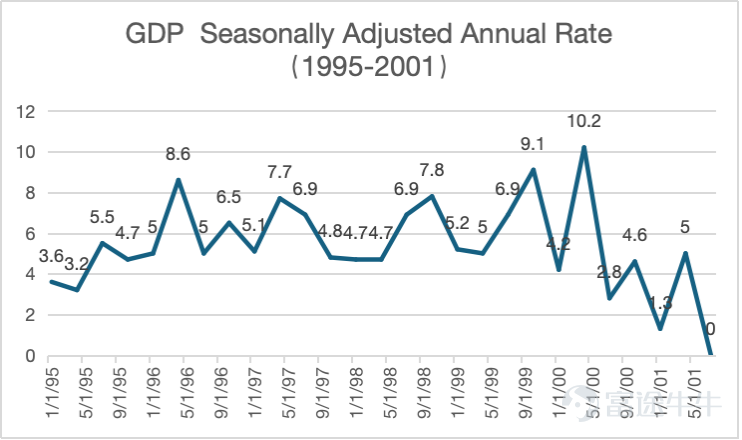
On June 22, 2026, former Federal Reserve Chair Alan Greenspan passed away. His tenure spanned from 1987 to 2006, coinciding precisely with the full cycle of the dot-com bubble. Today’s AI boom bears striking similarities to the period just before the dot-com bubble burst in 2000. From 1995 to 2000, the U.S. economy experienced a robust expansion—the longest post-World War II expansion on record. Fueled by financial deregulation, increased corporate investment, and consumer spending growth, U.S. GDP grew at around 5%. Similarly, since 2022, nominal U.S. GDP growth has also hovered around 5%.


Figure 1: U.S. GDP Growth Rate, Source: Fed
At that time, the U.S. unemployment rate declined from 7.7% in 1993 to 3.8% in 2000. Inflation also remained low, with annualized CPI staying within the 2–3% range. The U.S. economy overall was exceptionally strong, and the federal government even recorded budget surpluses.

Figure 2: U.S. Unemployment Rate, Source: MacroMicro
Against this economic backdrop, Greenspan at the time faced a dilemma—Whether or not to raise interest rates to preempt an overheating economyDue to strong economic growth, there had been persistent calls in the market for interest rate hikes. However, Greenspan believed that the internet could significantly boost productivity and lower production costs. At the time, computer technology was advancing at an extraordinary pace, with Moore’s Law in full effect—computers were becoming increasingly powerful at the same price point. Greenspan therefore viewed this as fundamentally deflationary, with no inflationary pressure. He focused closely on two indicators: retailers’ computer inventory levels and nationwide data on computer upgrades. He firmly believed that computers and the internet could revolutionize productivity. As a result, Greenspan kept interest rates steadily declining throughout 1995 to 1998.
By 1999, the dot-com bubble reached its peak, and U.S. inflation began to rise. Moreover, it became evident that the internet had not actually improved productivity or increased economic output.

Figure 3: U.S. Inflation Rate, Source: Federal Reserve
At this point, the Federal Reserve was forced to raise rates. The federal funds rate stood at 5% in 1999 and was hiked to 6.5% by March 2000, accelerating the bursting of the bubble in highly valued tech stocks.

Figure 4: Nasdaq 100 Index and U.S. Federal Funds Rate, 1995–2003
Today, Kevin Warsh faces a situation very similar to Greenspan’s back then. A new technological revolution—artificial intelligence—is now unfolding. Will Warsh treat AI as a productivity accelerator, just as Greenspan did with the internet? So far, the answer appears to be no. Instead of driving prices down, AI has caused widespread sharp increases in the prices of electronics, GPUs, cloud services, and more. U.S. inflation remains persistently high, with the May CPI rising 4.2% year-over-year—the highest since May 2023. Markets are now seriously considering the possibility that Warsh will hike rates by 50 basis points this year.

Figure 5: Both U.S. unemployment and core inflation remain elevated, Source: MacroMicro
I believe Kevin Warsh, having learned from Greenspan’s earlier experience, will not readily treat AI as a tool to suppress inflation. He also understands that if the Fed begins raising rates, it could severely disrupt the current AI investment narrative and trigger an early bursting of the bubble. Will he adjust the principle he championed before taking office—balance sheet reduction coupled with rate cuts? And will the market’s expectation of a 50-basis-point rate hike this year ultimately materialize?
Markets had previously worried that Kevin Warsh’s advocacy for balance sheet runoff would deliver a major shock to the economy. Faced with today’s complex U.S. economic landscape—characterized by both an AI bubble and inflationary pressures—Warsh signaled at the European Central Bank’s annual central banking forum on July 1 that balance sheet reduction is a long-term process, aiming to reassure markets. He said, 'It took us roughly 18 years to build such a massive balance sheet—and to reiterate, in my personal view, this has bordered on fiscal policy… It will certainly take far longer than 18 weeks to scale it back to a reasonable size.' In the foreseeable short term (six months),Kevin Warsh simultaneously reassured markets that he would not initiate balance sheet reduction., and also signals an effort to prevent a rapid bursting of the stock market bubble—lessons clearly drawn from the earlier internet bubble.
Another reason the Federal Reserve cannot shrink its balance sheet at this moment is that multiple countries are selling U.S. Treasuries. Japan, in an attempt to counter the yen’s depreciation crisis, may offload U.S. Treasuries to support its currency—selling $73.4 billion in May alone. The People's Bank of China has also sold U.S. Treasuries for three consecutive months, with its latest holdings standing at $651.1 billion, down by half from its 2013 peak. Turkey previously liquidated its entire $16 billion position in U.S. Treasuries due to rising oil prices and lira depreciation. Additionally, Taiwan and Switzerland have also been selling U.S. Treasuries. If the Fed were to proceed with balance sheet reduction now, it would exert significant upward pressure on Treasury prices, directly pushing up yields on newly issued debt and thereby increasing U.S. fiscal expenditures—an outcome neither the Fed nor the U.S. Treasury desires.Therefore, balance sheet reduction will be paused.。
As for whether the Fed will raise interest rates in the near term, we can already see Kevin Warsh attempting to buy time to create room for maneuver. Although his hawkish rhetoric has helped dampen market expectations for future inflation, weak upcoming employment data could provide him with a rationale not to hike rates. Will Alan Greenspan’s historical experience still influence Kevin Warsh? With order restored in the Strait of Hormuz and oil prices returning to lower levels, U.S. inflationary pressures are gradually easing over time, while labor market weakness is becoming more pronounced—thereby reducing the urgency for rate hikes. Meanwhile, political pressure from the U.S. midterm elections continues to build... At this stage, Kevin Warsh has already shifted his policy stance from 'likely balance sheet reduction and certain rate hikes' to 'no balance sheet reduction, possible rate hike.' As macroeconomic conditions evolve, will he eventually signal 'no balance sheet reduction and no rate hike,' or even 'possible balance sheet expansion and rate cuts'? Will the shadow of Greenspan lead him down a similar path? We shall wait and see.
"Use bronze as a mirror to straighten your attire; use history as a mirror to understand the rise and fall of dynasties; use people as a mirror to discern your gains and losses."
— Emperor Taizong of Tang, Li Shimin
Author Bio:
Ningdi Chen, a graduate of the University of Chicago with an Honors Bachelor's degree in Economics and Statistics, has over 26 years of experience in the global financial industry. He founded Delin Securities and Delin Family Office and was previously a licensed responsible person for Type 1, 4, and 6 licenses granted by the Hong Kong Securities and Futures Commission. He currently serves as Chairman of the Board, Executive Director, and Chief Executive Officer of Delin Holdings Group, Vice President of the Hong Kong Limited Partnership Fund Association, and authored 'The Era of Wealth Transformation: Discovering Counter-Cyclical Survival Wisdom.'
Disclaimer
This article is for reference purposes only. Investors should base their investment decisions solely on information disclosed in the company's official announcements.
The information and materials provided on this platform, including text, graphics, links, or other items sourced from third-party information terminals, are for general reference only. Under no circumstances shall the information published on this platform constitute investment advice.
No person may reproduce or republish any content without authorization from this official account.
Content shared via WeChat is for reference only and is the property of DL Holdings and its respective content providers. For the full disclaimer, please visit DL Holdings’ official website: https://www.dl-holdings.com/
Risk Disclaimer: The above content only represents the author's view. It does not represent any position or investment advice of Futu. Futu makes no representation or warranty.Read more

Comments
to post a comment
2