
Bai Dao Options Recap | A Dramatic Reversal! Meta's Single Comment Crushes Storage Stocks, While Precious Metals Quietly Rally
Hello, fellow investors. This week, U.S. markets traded only through Thursday, as today is Independence Day and the market is closed. This gives us a good opportunity to review what happened this week.
The biggest 'horror story' in the market this week came from $Meta Platforms (META.US)$ . First, news circulated that Meta planned to sell excess computing capacity, sending its shares soaring more than 8% that day. Then Zuckerberg admitted in an internal meeting that the development of AI agents was 'falling short of expectations,' which immediately knocked Meta’s stock down nearly 5%. To make matters worse,the entire AI hardware supply chain suffered collateral damage, with memory chips hit the hardest. Meanwhile, another long-dormant market—precious metals—quietly strengthened amid deteriorating risk sentiment.
Today, we’ll recap two instruments: a leveraged ETF in the memory sector and SLV, which tracks the silver rally.One strategy rode the wave of panic to go short; the other went long against the tide of fear—two options, two approaches, both delivering answers this week.
【📢 The 'Bai Dao Plays Options' series now has its own dedicated account! If you find this series helpful and want to see our weekly opportunity pool updates and Friday recaps as soon as they’re out, fellow investors, don’t forget to click follow~】
$Tradr 2X Long SNDK Daily ETF (SNXX.US)$ : Meta's "excess AI capacity" ghost story—halved in two days
First, let’s clarify what SNXX is—it’s a $SanDisk (SNDK.US)$ a 2x leveraged long ETF. Although it plunged this week, SanDisk’s underlying stock price remains very high, making direct options trading inaccessible for smaller investors due to high entry barriers. In contrast, SNXX is far more affordable—especially after its recent 1-for-8 split,allowing entry with just a few hundred dollars. Leveraged ETFs work like this: if the underlying stock rises 1%, the ETF rises 2%; if the underlying stock drops 1%, the ETF drops 2%. Therefore, when the storage sector runs into trouble, SNXX’s losses are magnified.
So why did the storage sector run into trouble this week? We must first understand what Meta did over the past two days.
On July 1, news emerged that Meta is exploring selling its excess AI computing capacity to external clients. At first glance, this sounds unremarkable—isn’t it normal for big tech firms to monetize surplus capacity? But the market interpreted it very differently:If Meta has so much 'excess' AI capacity that it needs to sell externally, does that mean AI demand isn’t as strong as expected? Does it suggest they’ve overbought chips and storage?
If this logic holds, the entire AI hardware sector will face a valuation reset. $CoreWeave (CRWV.US)$ It dropped 13% that day, $NEBIUS (NBIS.US)$ down 15%, with memory chips hit the hardest. To make matters worse, on Thursday, July 2, Zuckerberg personally admitted during Meta's company-wide meeting:"The development of AI agents hasn't accelerated over the past four months as we expected."Following this statement, Meta’s stock closed down 4.9%, and market confidence in AI computing demand took another hit.
Just how badly were memory chips affected? $Micron Technology (MU.US)$ 、 $Western Digital (WDC.US)$ all declined by more than 5%, SanDisk fell more than 10% for two consecutive days, and SNXX, a 2x leveraged ETF, saw its losses magnified—nearly halving from its peak within just two days.
Let’s highlight this point clearly:Memory chips used to be one of the most cyclical segments in the semiconductor industry.Their pricing doesn’t depend on "current demand strength," but rather on "whether the market expects future demand to improve." These two announcements from Meta have punctured a hole in the assumption of unlimited AI-driven demand growth—even if the actual impact isn’t that severe, the psychological blow is immediate.
Interestingly, just as panic spread, the well-known semiconductor research firm SemiAnalysis released a report refuting the 'excess compute capacity' narrative, stating that Meta's compute capacity expansion is 'far beyond imagination' and its capital expenditure next year will be 'astonishingly high.'But for now, at least in the short term, this view has been drowned out by panic sentiment. The market sold off first—reasons explained below.

(The design images displayed on the screen are for demonstration purposes only and do not constitute any investment advice or guarantee; market movements are frequent, and the option prices shown do not represent actual conditions. The filtering criterion is options with an initial price below $3 per unit.)
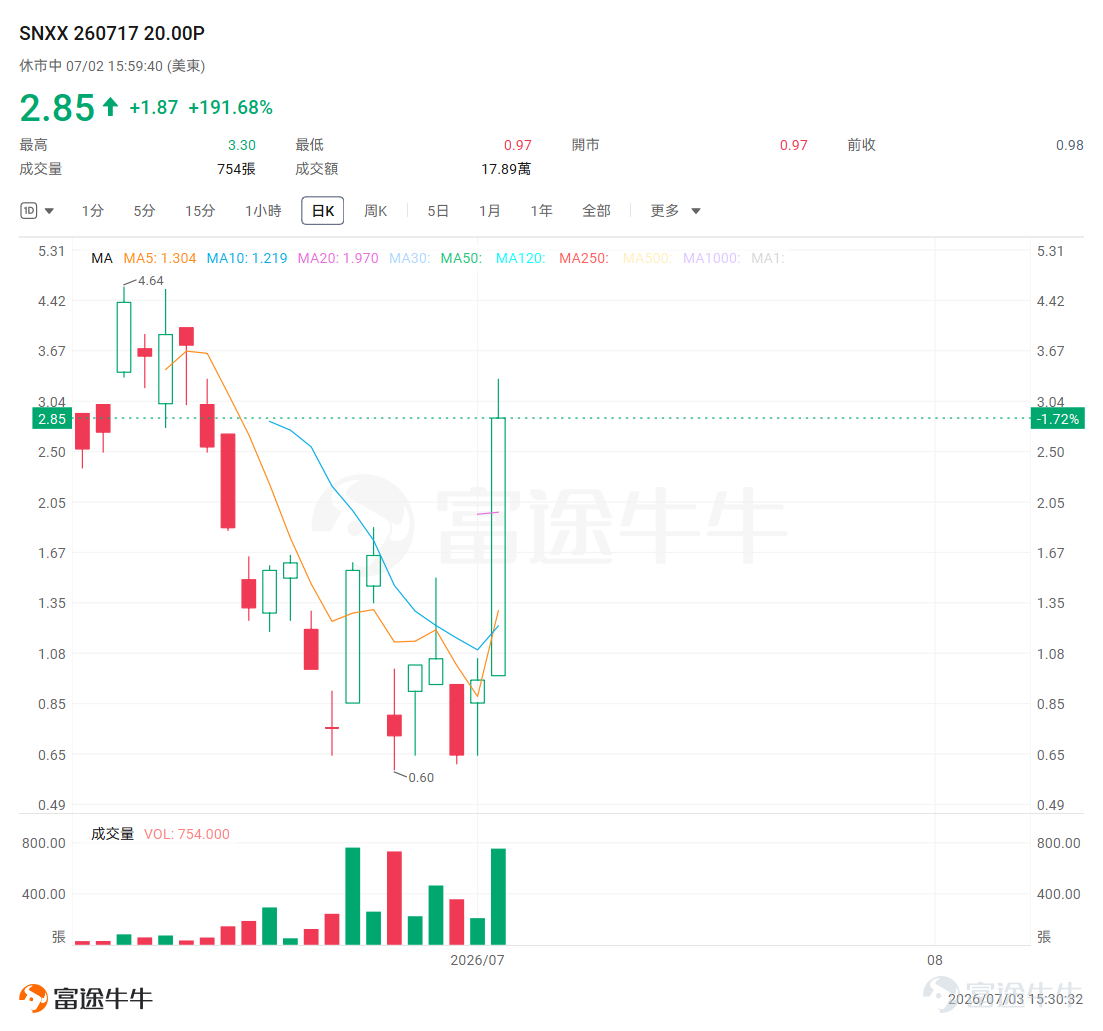
Let’s look at the SNXX July 17, 2024 $20.00 Put contract—an out-of-the-money put option expiring on July 17 with a $20 strike price.
From the daily candlestick chart in the screenshot, the fate of this put option is clearly visible:
At the end of June, the contract price bottomed near $0.60—this was before the underlying stock ran into trouble, when the put was nearly worthless.
On July 1, news broke that Meta was 'selling compute capacity,' causing the underlying stock to start falling and the put to begin rising.
On July 2, Zuckerberg confirmed that 'AI performance fell short of expectations,' triggering an accelerated decline in the underlying stock,and the put surged directly to a high of $3.30.
It closed at $2.85 on July 2, up +191.68% for the day.
Let’s do the math:
If you entered a position at the $0.60 low, the cost for one contract would have been $60—It’s still less than the cost of a hotpot meal.。
At its peak, this contract was worth $330, representing a gain of450%, nearly 4.5 times。
Even at the closing price of $2.85 shown in the screenshot, it rose from $0.60 to $2.85,a 375% increase.$60 turned into $285—one options contract netted a $225 profit.
Here’s a crucial insight: sector-wide panic often drags down individual stocks indiscriminately, but options don’t care about right or wrong—they only care about magnitude.
Is Meta truly oversupplied with AI computing power? Will demand for memory chips really be impacted?Honestly, the market simply doesn’t have enough time—over just two days—to figure out the answers. The brutal reality of options trading is that you don’t need to know the truth; you only need to anticipate how the market will react.。
Meta is a massive buyer in the AI hardware supply chain. Any bearish signal it sends triggers an immediate sell-off across the entire supplier network—this is a reflex, not rational analysis. If you grasp this, you’ll understand that when the news broke on July 1, a second wave of panic could follow on July 2.
Trading in the direction of panic offers a much higher short-term win rate than trying to catch a bottom against the tide of fear.
But a word of caution on risk:Japanese and South Korean equity markets have already rebounded today. If next week Meta’s 'excess AI compute capacity' scare story is debunked, or sentiment in the memory/storage sector recovers, this put option could also plummet sharply. Panic-driven moves tend to arrive and dissipate quickly—taking profits after capturing the initial move is often the wiser choice.
$iShares Silver Trust (SLV.US)$ : On the flip side of the sell-off, precious metals are quietly rising
While high-flying tech stocks are hemorrhaging value, one asset class has been steadily gaining strength this week—precious metals.
This week’s market narrative has centered on 'AI underdelivering expectations,' yet simultaneously, the precious metals sector has been quietly rebounding. Gold and silver prices pulled back in late June, but since entering July,rising safe-haven demand, coupled with renewed Fed rate-cut expectations following the nonfarm payrolls report, has drawn fresh capital back into precious metals。
Rate-cut expectations plus a crash in risk assets equals safe-haven flows into precious metals. This is a script that’s been written in financial markets for decades.
Silver is particularly interesting—it’s both a precious metal (with safe-haven appeal) and an industrial metal (heavily used in photovoltaics and electronics). When markets worry about an economic slowdown, expectations for silver’s industrial demand decline, but safe-haven buying surges—these two opposing forces tug against each other.This week, safe-haven buying dominated, driving silver higher in a volatile move.

(The design images displayed on the screen are for demonstration purposes only and do not constitute any investment advice or guarantee; market movements are frequent, and the option prices shown do not represent actual conditions. The filtering criterion is options with an initial price below $3 per unit.)
Let’s look at the SLV July 2, 2026, $54.00 call option—expiring on July 2 with a $54 strike price.
Note that this is aExpiring optionsoption expiring on July 2 (yesterday).
From the intraday price action on that day, let’s dissect what this call option experienced on its 'expiration day':
Previous close: $0.54; Open: $1.11—It jumped 105% right at the open.
It surged intraday to a high of $2.15, up nearly 300%.
But it then declined steadily amid volatility, dropping as low as $0.60.
It closed at $1.05, posting a daily gain of +94.44%.
Let’s do the math:
If you bought at $0.54 at the previous day's close, one contract would cost just $54.
And the next day, it reached an intraday high of $2.15, meaningone contract peaked at $215, a gain of 298%—nearly triple its value。
Even if you didn’t sell at the peak, closing at $1.05 still represented a 94% gain compared to your entry price of $0.54—$54 turned into $105, earning you $51—a near doubling of your money。
But here’s the catch: what if you chased the price and bought in at $1.11 after the market opened?
With an intraday high of $2.15, you had the chance to capture a 93% gain. But if you held and didn’t exit, it closed at just $1.05—you wouldn’t just miss out on profits—you’d actually lose 5%。
Even more brutal: this contract expired that same day. If SLV’s closing price had been below $54, this call option would have expired worthless (luckily, it didn’t).All your paper gains were just numbers on a screen.
This SLV call option is a textbook example of an end-of-life ("last-day") option. It perfectly illustrates the dual nature of such options:
The upside: extreme leverage—small capital can capture massive price swings. Entering at $54, it tripled in value at its intraday peak—a return almost impossible to achieve with the underlying stock.
The downside: time value evaporates like the last few grains of sand in an hourglass, decaying by the hour—or even by the minute. During the session, you might see your account showing a 200% unrealized gain—but if you don’t act, that could drop to just 50%, or even zero, within hours.
Let’s emphasize this once more:End-of-life options are not 'buy-and-hold' instruments—they are 'buy–monitor closely–exit decisively (take profit or cut loss)' instruments.
Many fellow investors fall into a common trap: they assume that once an option is bought, it can be left alone like a stock, waiting for it to rise. But the harsh reality of end-of-life options is this:Their value depends not only on the movement of the underlying stock but also critically on 'how much time remains until expiration.'。Even if the underlying stock is rising, if it doesn’t move fast enough or far enough, the erosion of time value will erase your profits.
This SLV call option reached an intraday high of $2.15 due to a combination of the underlying stock rallying during the session and heightened market sentiment. However, as the underlying stock's upward momentum slowed and the market approached the close, the option price naturally pulled back—even if the underlying stock didn’t drop significantly—because the market knows thatthe closer it gets to expiration, the lower the probability this 'lottery ticket' pays off, and thus the less valuable it becomes.。
Therefore, when trading options on their expiration day, you need to clearly consider several questions in advance:
Are you planning to actively monitor the position? If you buy and then go to sleep, it might not be suitable. (Although fellow investors can use trailing stop-loss/take-profit orders, for highly volatile instruments like expiration-day options, manual monitoring is still advisable.)
Do you have a clear profit-taking target? Will you exit once it doubles, or are you aiming for a triple? It’s best to make this decision before entering the trade.
Can you tolerate giving back unrealized gains? If seeing your account swing from 200% unrealized profit down to 50% would cause you distress, then your position size is likely too large.
Expiration-day options are essentially a time-limited game—they offer extreme payoff potential, but demand extreme discipline in return. Suitable traders use it to achieve outsized gains with limited capital, while unsuitable ones use it to create nightmares.
Weekly recap: Panic and rebounds both present options opportunities
This week we saw two completely opposite trading directions:
SNXX Puts rode the wave of panic—As soon as Meta’s 'excess computing capacity' horror story emerged, the storage sector was hit first and hardest. Leveraged ETFs saw amplified declines, and the Puts surged more than fourfold in just two days.Key takeaway: Sector-wide panic often drags down individual stocks indiscriminately, but options care only about magnitude—not right or wrong. Shorting along the panic wave works, but take profits promptly.
SLV Calls went against the tide of panic—While tech stocks crashed, safe-haven funds flowed into precious metals, sending weekly-expiry Calls up threefold intraday. Key takeaway:Weekly-expiry options are not 'buy-and-hold' instruments—they require active monitoring, decisive action, and predefined profit-taking targets. Unrealized gains aren’t yours until you lock them in.
One was short, the other long; one profited from sector panic, the other from a safe-haven rebound. Both approaches can be profitable—the key is to clearly understand what you're doing and what suits you best.
Entering with a hundred bucks and exiting with a thousand — options indeed offer the possibility of small capital leveraging big opportunities. Of course, high odds never come free. Choosing the right direction, timing, and managing your position size are all essential. Understand the market first, then act. When your rhythm is right, opportunities will never run out. See you next time for another review!
Not comfortable with options basics? Study up before jumping in.
If, while reading this, you're still a bit unclear about concepts like 'What is a long call?' or 'How do I read strike prices?', don't rush to place an order—spend some time solidifying your fundamentals first. Here’s a curated list of practical beginner resources; we recommend saving it for future reference:
Finally, here's a small perk for fellow Futubull investors, welcome to claim it.Options Beginner Pack
This event is exclusively for invited HK users. Click to learn more.Detailed event rules>>

Disclaimer
This content does not constitute any offer, solicitation, recommendation, opinion, or any guarantee of any securities, financial products, or tools. The risk of loss in trading options can be substantial. In some cases, losses may exceed the initial margin deposited. Even if stop-loss or limit orders such as "stop-loss" or "limit" are set, they may not prevent losses. Market conditions may cause these instructions to be unexecuted. You may be required to deposit additional margin within a short period. If you fail to provide the required amount within the specified time, your open positions may be liquidated. However, you will still be responsible for any shortfall in your account. Therefore, before trading, you should study and understand options and carefully consider whether such trading is suitable for you based on your financial situation and investment objectives. If you trade options, you should be familiar with the procedures for exercising options and the rights and obligations upon expiration, as well as your rights and responsibilities when exercising options and at expiration.
Risk Disclaimer: The above content only represents the author's view. It does not represent any position or investment advice of Futu. Futu makes no representation or warranty.Read more


Comments (16)
to post a comment
63
26