
Chip stocks lead as China's AI industry chain faces a revaluation rally?

Will the AI compute panic spill over to wafer foundries? What do SMIC and Huahong think? Can the 'triple jump' from memory to CPUs continue?
In July 2026, global technology stocks were hit by an unexpected 'late cold snap.' The trigger was news that tech giant Meta was selling off part of its computing capacity—a strategic adjustment by a single company that nonetheless sparked a butterfly effect across the AI hardware sector, which had already been marked by high valuations and crowded positioning, leading to a broad sell-off across the global compute supply chain.
Amid this indiscriminate selloff, even wafer foundries—previously seen by the market as potential 'safe havens'— $SMIC (00981.HK)$ signed a 1.2 GW fuel cell power contract with $HUA HONG GRACE (01347.HK)$ —were not spared and saw notable pullbacks in line with the broader market. What’s the connection between companies selling computing power and those manufacturing chips? Can the recent pricing power enjoyed by wafer foundries continue? Today, we’ll unpack the 'twin semiconductor giants' listed in Hong Kong.
How did the panic over computing capacity spread to wafer foundries?
When news broke that Meta was selling computing capacity, the immediate market reaction was: 'Is downstream AI demand not as strong as expected?' and 'Will compute leasing prices collapse?'These concerns quickly spread, hitting hardest the segments that had previously rallied sharply: memory chips, optical modules, and PCBs. Their representative Hong Kong-listed stocks are GigaDevice, Yangtze Optical Fibre and Cable, and KB Laminate Holdings, respectively.
Notably, this pullback was not an isolated event but rather a continuation of the heightened volatility that has gripped global chip stocks since late June.
On June 24, South Korea's KOSPI index plunged 10% in a single day, triggering a circuit breaker. On June 26, chip stocks faced another 'double whammy': Apple raised prices for Macs and iPads by up to USD 500, citing shortages of memory chips—a move interpreted by the market as a signal that upstream pricing power was being exercised at the expense of future demand; simultaneously, OpenAI signaled it might delay its IPO until 2027, dashing expectations of a USD 1 trillion valuation debut. From late June to early July, the global semiconductor sector endured a cascade of negative catalysts—the Meta compute leasing rumor was merely the final straw.
So why were wafer foundries caught in the crossfire? First, if leading cloud providers like Meta scale back procurement of GPUs, HBM, and other hardware,orders for downstream foundries will shrink, pushing capacity utilization down from current full-load levels to around 70%–80%;Second, emotionally driven 'indiscriminate selling'—when capital takes profits at elevated levels, it does not distinguish between segments of the supply chain, triggering a liquidity-driven sell-off across the entire semiconductor sector.
Under the capacity-siphoning dynamic, memory chips, CPUs, and mature-node semiconductors are experiencing a 'three-phase surge.'
Pulling focus away from short-term sentiment and back to industry fundamentals, the market has overlooked a structural shift already underway: overseas wafer fabs are proactively cutting mature-node capacity and redirecting resources toward high-margin AI-advanced nodes and packaging.
Phase One: HBM diverts capacity from NAND—Western Digital’s rally begins
HBM (High Bandwidth Memory), serving as the core fuel for AI training, generates wafer-level revenue roughly 70% that of standard DRAM but with significantly higher gross margins than consumer-grade memory. Faced with nearly insatiable procurement demand from AI chipmakers, the three memory giants—Samsung, SK Hynix, and Micron—have swiftly made the most commercially rational decision: allocating over 70% of their new or reallocatable capacity to HBM.
This has created two layers of supply compression: first, HBM directly crowds out general-purpose DRAM capacity, driving Q1 2026 contract prices for standard DRAM up 93%–98% quarter-over-quarter, with another 58%–63% increase expected in Q2; second—and more profoundly—NAND is being starved of capital expenditure. The issue isn’t lack of demand for NAND, but rather its low priority in supply allocation.
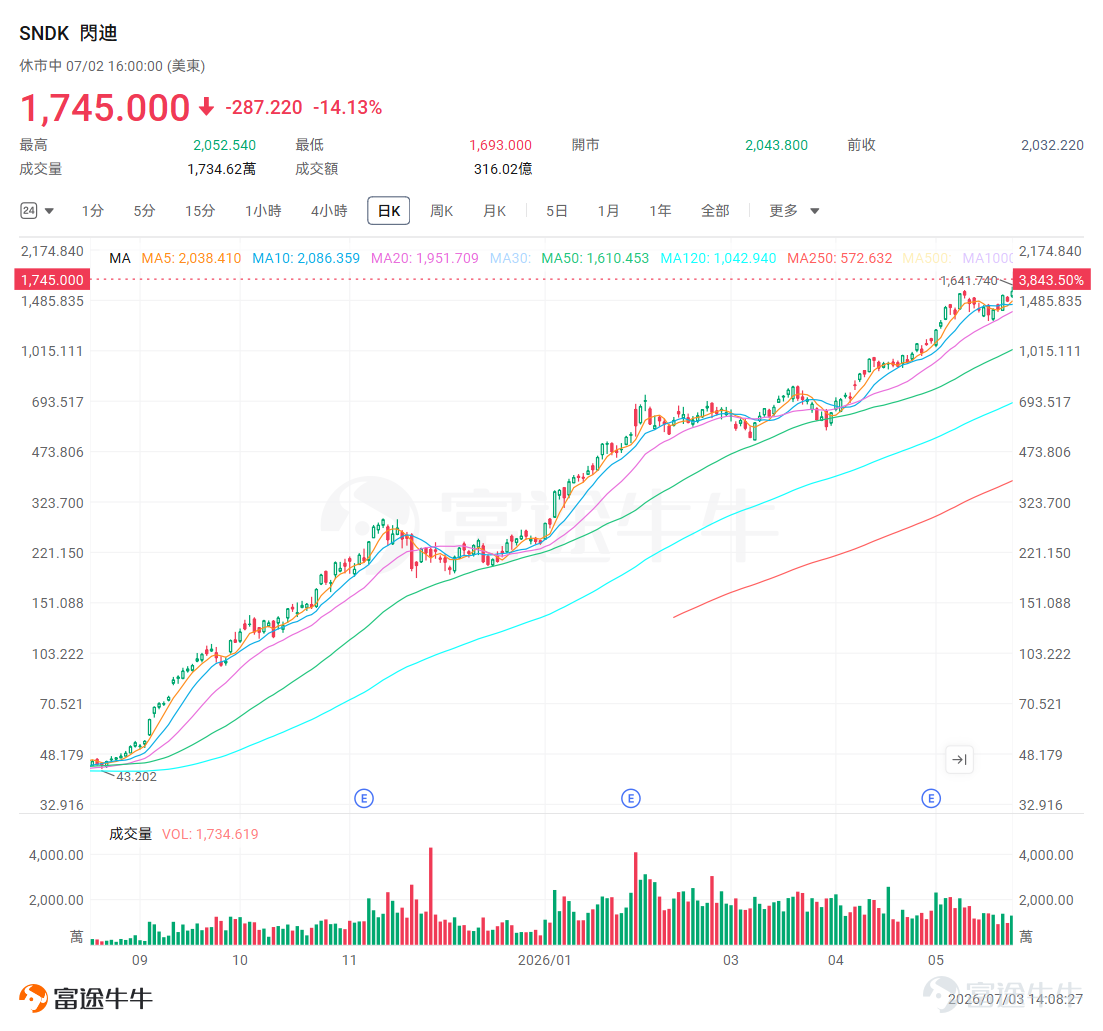
As the AI industry transitions from training to inference, massive data processing requirements are flooding in, dramatically amplifying NAND demand. $SanDisk (SNDK.US)$ As one of the world’s leading NAND flash memory producers, it stands to benefit directly from this price surge, with the rally commencing in September 2025.

Phase Two: GPU diverts capacity from CPU—Intel and AMD stage a strong recovery
AI computing demand is not only reshaping the memory landscape but also reconfiguring the CPU supply chain. In the early stages of AI development, NVIDIA’s GPUs were indispensable compute resources. However, with the arrival of the Agent era, CPUs are becoming the bottleneck in agent-based AI workflows, requiring tighter CPU-GPU integration to sustain data throughput.
Soaring GPU demand has driven strong demand for AI servers, and each AI server requires a配套 CPU—GPUs are competing for wafer fabrication capacity, not CPU market demand. As Taiwan Semiconductor's advanced-node capacity fills up with GPU and HBM orders, Intel’s own IDM capacity and AMD’s capacity allocated through GlobalFoundries and Taiwan Semiconductor have become even tighter. The CPU supply chain began attracting capital attention earlier this year, $Intel (INTC.US)$ 、 $Advanced Micro Devices (AMD.US)$ remain elevated.
Section Three: Advanced Nodes Chase, Mature Nodes Step Aside—SMIC and Huahong Face a 'Supply-Demand Reversal'
The surging demand for memory and CPUs has ultimately transmitted along the capacity-siphoning chain to the wafer foundry segment. $Taiwan Semiconductor (TSM.US)$ , Samsung, and other international giants are prioritizing their 8-inch and some 12-inch mature-node capacity for advanced packaging supporting HBM and advanced nodes for GPUs/CPUs—a cascading pressure chain moving from advanced to mature nodes.
With AI demand exploding, overseas manufacturers have realized that allocating limited capacity and cleanroom resources to AI-related advanced nodes and advanced packaging (e.g., CoWoS) generates several times more profit than mature-node production. These overseas manufacturers have started proactively cutting or even abandoning mature-node orders,shifting all capacity toward high-margin AI advanced nodes. It’s akin to a five-star hotel shutting down its entire kitchen dedicated to home-style cooking to focus exclusively on high-margin Michelin-starred cuisine.
The retreat of overseas manufacturers has directly created a massive global shortage in mature-node capacity. Orders for power management ICs, MCUs, driver ICs—previously queued at Taiwan Semiconductor—are now spilling over like a tidal wave into Chinese mainland foundries.
More importantly, this supply-demand imbalance is reflected not only in volume but also in pricing. A broad-based foundry price increase cycle has clearly begun:
Overseas players lead the way in price hikesTaiwan Semiconductor plans to raise its 3nm pricing by 15% in the second half of the year and implement further increases next year; United Microelectronics (UMC) announced selective price hikes for the second half, with full-scale renegotiation scheduled for 2027.
Domestic players follow suit with price increasesSMIC is negotiating price hikes with customers, expecting a 5–6% quarter-over-quarter increase in average selling prices (ASPs) in Q2; Hua Hong explicitly stated that its overall wafer ASPs will rise by 10–15% in 2026, with certain tight-capacity platforms (such as BCD processes) seeing increases of up to 25%. The two Hong Kong-listed semiconductor leaders began a strong rally in April this year.
Domestic AI computing power + underpriced 'inflationary segments'
As U.S.-China tech rivalry intensifies, a domestic AI computing ecosystem has taken initial shape—opening vast upside potential for SMIC and Hua Hong.
For example, Huawei’s new Kirin chip, slated for launch in fall 2026, is expected to use two advanced-node wafers bonded together—doubling wafer demand outright. Future GPUs could stack 6–8 layers, multiplying wafer consumption several-fold. SMIC’s N+3 process has already been confirmed as superior to Taiwan Semiconductor’s N6, and its next-generation N+4 node is poised to rival TSMC’s N5.
Despite utilization rates running at full capacity and widespread talk of price hikes, these industry tailwinds are still 'in transit' and have yet to be fully reflected in financial statements.
SMIC gross margin

Hua Hong Hongli gross margin

Why hasn’t profit been unlocked yet? Because wafer fabs carry substantial ongoing construction projects and depreciation burdens. Looking ahead, as price hikes take effect, the 'scissors gap' between rising revenues and falling costs will drive explosive profit growth. Taking a longer-term view—and factoring in valuation repricing of unlisted assets like ChangXin Memory—the market rally could extend further.
If you are bullish on the prospects of SMIC and Huahong, bear in mind that sentiment-driven sell-offs often trigger aftershocks; it’s best not to go all-in at once. Instead, consider adopting a 'pyramid-style' approach to gradually build positions. For example, establish an initial base position at current levels, and then add to your holdings on dips if broader market weakness drags prices lower.
Of course, even with solid industry fundamentals, one must remain respectful of potential risks. Although AI demand is currently strong and a pricing uptrend is firmly in place, a setback in the broader AI narrative—combined with a sharper-than-expected decline in traditional consumer electronics demand from sectors like smartphones and home appliances—could weigh on overall wafer fab capacity utilization. Moreover, semiconductors remain the industry most vulnerable to geopolitical tensions; any further escalation in U.S.-China trade friction or tighter U.S. export controls on equipment could delay domestic wafer fabs’ capacity expansion and localization of equipment supply. While capturing the benefits of 'capacity-driven inflation,' investors should closely monitor these variables and adjust their strategies accordingly.
Risk Disclaimer: The above content only represents the author's view. It does not represent any position or investment advice of Futu. Futu makes no representation or warranty.Read more


Comments (12)
to post a comment
68
134