
With market-stabilizing measures intensifying, will Hong Kong tech stocks continue their rebound?

Mid-Year Review | Southbound capital recorded net purchases of over HK$300 billion in Hong Kong equities in the first half, down 60% year-over-year; added over HK$35.3 billion to Tencent positions and sold Alibaba to rotate into AI-related 'hard tech' sectors such as semiconductors and PCBs
In the first half of 2026, global financial markets were marked by turbulence and uncertainty, presenting both opportunities and risks—the US-Iran conflict, Waller assuming the role of Federal Reserve Chair, and SpaceX completing the largest IPO in history are just a few of the major events that unfolded... Fellow investors are not only participants in the market but also witnesses to this historic moment. Looking back, reflecting on our experiences, we hope all our efforts in the first half will lay the groundwork for pleasant surprises in the second half.
Reviewing the first half of the year, Hong Kong stocks as a whole showed a volatile downward trend, closing on June 30 at $Hang Seng Index (800000.HK)$ down 10.73% cumulatively; $Hang Seng TECH Index (800700.HK)$ down 18.92%; $Hang Seng China Enterprises Index (800100.HK)$ down 15.21%.
Amid the dual influences of the global AI boom and shifting macroeconomic conditions, southbound capital—which has been a key source of incremental funding supporting Hong Kong equities in recent years—saw a significant slowdown in net inflows during the first half. However, capital did not withdraw entirely; instead, its allocation focus shifted markedly from internet and consumer sectors toward AI-related 'hard tech' segments such as semiconductors, PCBs, and domestic large AI models.
Southbound capital’s trading enthusiasm cooled noticeably in the first half
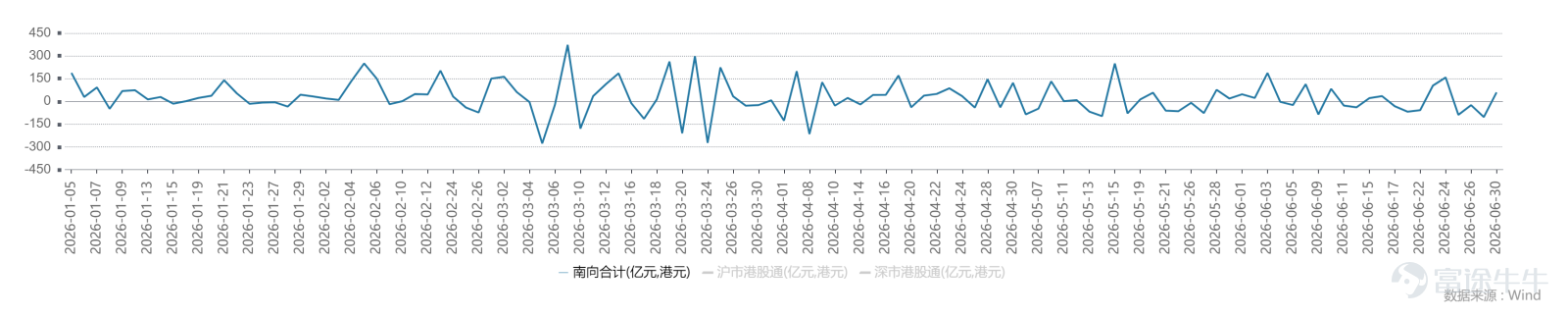
Data shows that, as of the close on June 30,southbound capital recorded net inflows of approximately HK$301.043 billion in the first half, a marked deceleration compared to HK$731.193 billion in the first half of 2025, representing a year-on-year decline of nearly 60%.
In terms of the overall trend,southbound capital flows have shown a clear 'high early, low late' pattern. At the beginning of the year, catalyzed by domestic AI large models such as DeepSeek, southbound capital surged significantly, driving the Hang Seng Tech Index to a阶段性 high in February. The first quarter also emerged as the main period of net inflows, contributing nearly HK$200 billion—approximately 74% of the total for the first half of the year.

However, due to factors such as the Fed's repeatedly shifting interest rate cut expectations, Hong Kong equities entered a volatile downtrend in the second quarter, and liquidity conditions deteriorated sharply,with net outflows exceeding HK$3.5 billion in May, marking the first monthly net outflow since June 2023.
Semiconductors and other AI-related 'hard tech' sectors gained favor
Despite the overall slowdown in flow, southbound capital exhibited clear structural preferences across sectors. Previously overweighted internet stocks underperformed the market, prompting some active selling of holdings, while semiconductor and PCB sectors—key components of AI 'hard tech'—became focal points for capital allocation.

Looking at the top individual stocks receiving southbound inflows in the first half of the year,certain technology and internet stocks remained the most favored targets for increased positions.Among them, $TENCENT (00700.HK)$Received additional southbound capital inflows exceeding HK$35.3 billion, ranking first across the entire market in terms of southbound fund inflows. $XIAOMI-W (01810.HK)$、 $KUAISHOU-W (01024.HK)$Received additional southbound capital inflows of approximately HK$21.1 billion and HK$8.7 billion, respectively.
In the second quarter, $SMIC (00981.HK)$ 、 $KINGBOARD HLDG (00148.HK)$ 、 $KB LAMINATES (01888.HK)$and$Z.AI (02513.HK)$ 、 $HUA HONG GRACE (01347.HK)$five AI supply chain companies were particularly attractive to capital,in the first half of the year, they received net southbound purchases of over HK$23.3 billion, HK$20.3 billion, HK$20.0 billion, HK$6.5 billion, and HK$6.1 billion, respectively, totaling more than HK$76.0 billion,accounting for roughly one-quarter of total southbound capital inflows for the year.
On the other hand,Technology and internet stocks also showed signs of selling pressure.As the most favored stock by southbound capital in 2025, $BABA-W (09988.HK)$it became a key target for position reduction in the first half, suffering net southbound sales exceeding HK$32.4 billion. Particularly in the second quarter, as Alibaba's share price continued to decline, funds executed broad-based portfolio adjustments and exited positions; in the past three months alone, Alibaba faced net southbound sales exceeding HK$37.4 billion.

Notably, AI hardware stocks, which performed strongly in the first half of the year, $YOFC (06869.HK)$ 、 $LENOVO GROUP (00992.HK)$ were net sold by over HK$3.3 billion and HK$700 million respectively, indicating clear profit-taking and portfolio rebalancing amid heightened market volatility.
Although southbound capital inflows weakened significantly in the first half of the year, they have remained positive toward Hong Kong stocks.As of now, cumulative net inflows via Stock Connect since its launch have exceeded HK$5.4 trillion, and it is expected to mark the 12th consecutive full calendar year of net buying since inception.
Most institutions expect total southbound capital inflows for the year to reach approximately HK$550–650 billion—well below the record level of over HK$1.4 trillion set in 2025, butstill representing the largest source of incremental capital for the Hong Kong equity market.
 Track southbound capital flows and stay ahead of the latest investment trends! Market > Shanghai-Hong Kong & Shenzhen-Hong Kong Stock Connect >Hong Kong Stock Connect (Southbound), try it out now >>
Editor/rice
Risk Disclaimer: The above content only represents the author's view. It does not represent any position or investment advice of Futu. Futu makes no representation or warranty.Read more


Comments
to post a comment
5
1