Mid-2026 Review: How to Identify the Key Themes Amidst Changing Market Dynamics?

Mid-Year Review | AI Bull Market Lifts U.S. Equity Futures! Nasdaq Logs Its Strongest Quarter in Six Years—How Should Investors Position Themselves Long or Short on the Three Major Futures for the Second Half?
Fellow investors, as the first half of 2026 wraps up, if you only traded spot assets and avoided futures, you might have simply felt that markets rose significantly; but if you traded $E-mini NASDAQ 100 Futures (DEC6) (NQmain.US)$ 、 $E-mini S&P 500 Futures (DEC6) (ESmain.US)$ 、 $E-mini Dow Futures (DEC6) (YMmain.US)$ , your experience over the past six months was probably this: harshly schooled by geopolitical tensions and oil prices in Q1, then dragged on a wild ride by the chip sector in Q2, and finally caught in June between continued chip euphoria and renewed rate-hike concerns.
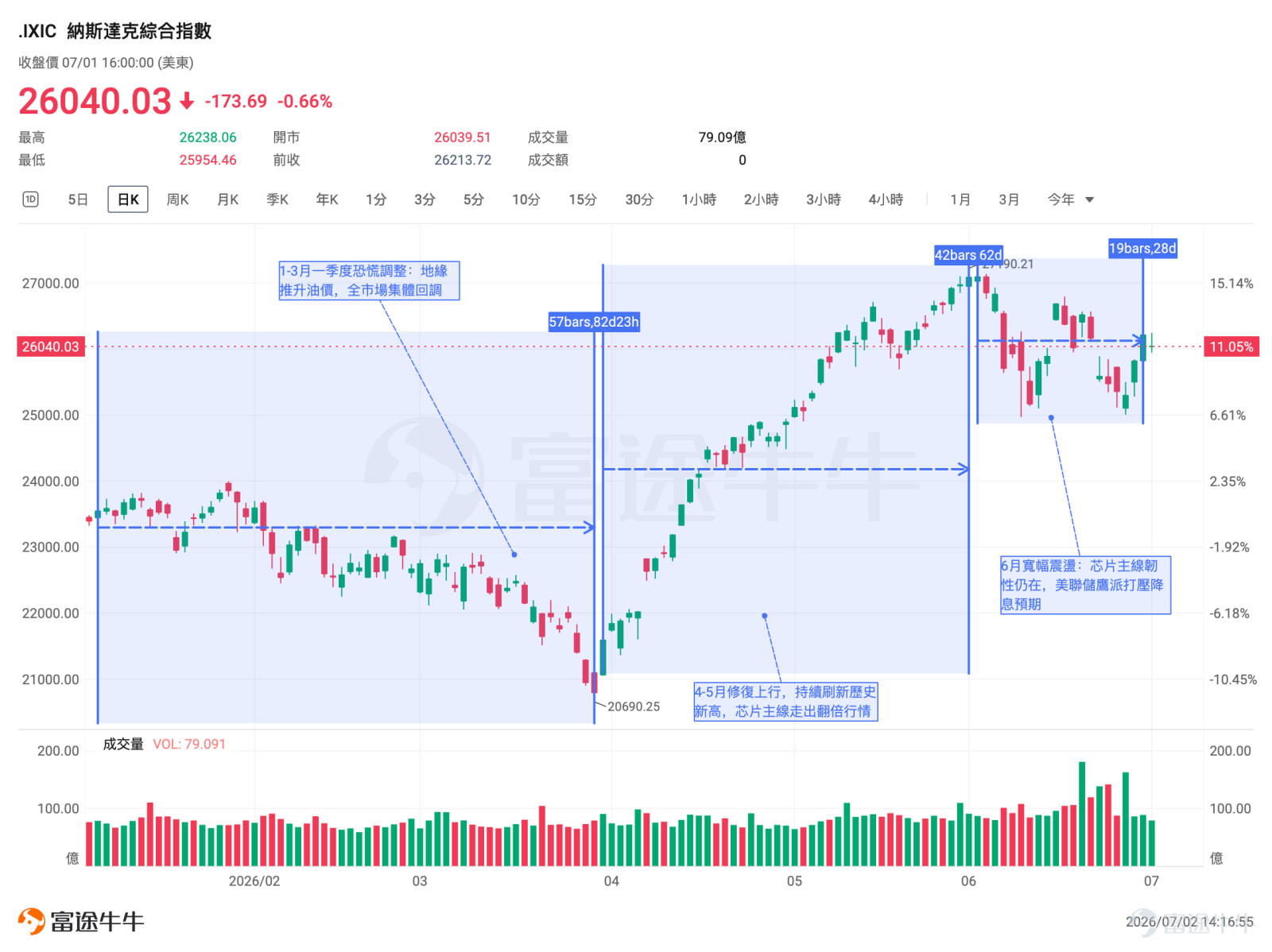
In the first half of 2026, $S&P 500 Index (.SPX.US)$ rose approximately 9.6%, $Nasdaq Composite Index (.IXIC.US)$ gained about 12.8%,$Dow Jones Industrial Average (.DJI.US)$ and climbed roughly 8.9%—the Dow posted its best first-half performance since 2021, while the Nasdaq surged around 21% in Q2, marking its strongest quarter since 2020.
I. Overview of US Equities in H1: A Rocky Start Followed by a Strong Rebound—Q2 Delivered the Best Quarterly Performance in Six Years

January–March: Panic-Driven Correction, Oil Prices Dominated Everything
2026 started off not too badly. January $S&P 500 Index (.SPX.US)$ ended slightly higher, with markets still trading the AI narrative. But in late February, after a U.S.-Israeli military strike on Iran, the situation deteriorated sharply, disrupting traffic through the Strait of Hormuz and putting roughly one-fifth of global crude oil shipments at risk of interruption.
March became a turning point: $Crude Oil Futures (DEC6) (CLmain.US)$ surged more than 50% in a single month, as soaring oil prices fueled inflation expectations, $S&P 500 Index (.SPX.US)$ closed the first quarter down about 4.6%, $Nasdaq Composite Index (.IXIC.US)$ fell approximately 7.1%, with only the energy sector gaining strength amid rising oil prices.
Investors holding major tech stocks flocked en masse to $E-mini NASDAQ 100 Futures (DEC6) (NQmain.US)$ short positions for hedging; Dow Jones industrial blue chips held up relatively well, with Dow futures showing significantly less volatility than Nasdaq futures.
April–May: repeatedly hit new all-time highs, with the chip sector delivering a doubling rally
Geopolitical tensions eased at the margins, and markets began pricing in a 'soft landing' for the U.S. economy, prompting capital to rotate comprehensively from traditional software giants into upstream AI segments such as memory and semiconductor equipment.
The core driver of the second-quarter market rally was $PHLX Semiconductor Index (.SOX.US)$ a 'doubling-style' frenzy. According to Axios, $PHLX Semiconductor Index (.SOX.US)$ the index surged 87.8% in Q2, marking its largest single-quarter gain on record; by the end of the first half, it had more than doubled year-to-date.
Individual stocks were even more dramatic:
– $Applied Materials (AMAT.US)$ 、 $KLA Corp (KLAC.US)$ leading semiconductor equipment companies such as these all doubled in the second quarter;
– $Intel (INTC.US)$ one firm jumped 216% in Q2, $Advanced Micro Devices (AMD.US)$ while another climbed over 185%.
Memory (with HBM—high-bandwidth memory—in short supply) and equipment (amid a wave of wafer fab expansions) have emerged as the strongest upstream AI investment theses. $E-mini NASDAQ 100 Futures (DEC6) (NQmain.US)$ led the rally among the three major index futures in this market move, $S&P 500 Index (.SPX.US)$ posting gains for nine consecutive weeks, with bullish swing trading becoming the dominant market strategy, index futures trading at a slight premium, and investor risk appetite continuing to rise.
June: Chip stocks kept rallying, but macro headwinds began to emerge
In June, the market showed clear divergence: memory chip stocks remained strong overall, with sufficient buying support even after intraday sharp declines; however, the Federal Reserve’s June FOMC meeting sent an unequivocally hawkish signal—the dot plot indicated a higher rate trajectory, prompting the market to significantly downgrade expectations for rate cuts this year, as investors grew concerned that persistently high rates would continue to pressure growth stock valuations.
Amid heightened volatility at elevated levels, the three major indices entered a wide-ranging consolidation phase, with faster rotation between gains and losses and frequent shifts in index futures premiums and discounts; institutional investors began taking profits incrementally on chip long positions while simultaneously adding modest short exposure to hedge unrealized gains in their equity portfolios.
Divergence: AI hardware led gains, causing clear stratification among the three major index futures

$Nasdaq Composite Index (.IXIC.US)$ dominated by technology growth stocks, the market rally in the first half of the year was driven by semiconductors—whenever the semiconductor sector surged, $E-mini NASDAQ 100 Futures (DEC6) (NQmain.US)$ the index would rally in tandem; conversely, short-term pullbacks in chip stocks significantly amplified Nasdaq volatility. $S&P 500 Index (.SPX.US)$ covering all sectors including technology, consumer discretionary, financials, energy, and industrials, $E-mini S&P 500 Futures (DEC6) (ESmain.US)$ its overall volatility remained far lower than that of Nasdaq futures; $Dow Jones Industrial Average (.DJI.US)$ is led by industrial blue chips, $E-mini Dow Futures (DEC6) (YMmain.US)$ exhibiting the most stable price action and pronounced defensive characteristics.
II. Outlook for U.S. Equity Markets in the Second Half of 2026: Three Key Variables Will Determine Market Direction
At this mid-year juncture, major Wall Street financial institutions’ $S&P 500 Index (.SPX.US)$ year-end 2026 target forecasts for the S&P 500 are densely clustered between 7,500 and 8,000 points,with most institutions expecting the S&P 500 to continue climbing, supported by robust corporate fundamentals.

However, for futures traders, the index’s ascent may not be smooth sailing,as market direction in the second half will be driven by three core macro variables:
Variable 1: The Federal Reserve’s interest rate decision schedule
This is the biggest macro uncertainty for the second half of the year.Following the June FOMC meeting, market expectations shifted from anticipating rate cuts to guarding against rate hikes. With Walsh taking over as Fed Chair, policy path uncertainty has increased. The June Fed meeting sent a clearly hawkish signal, with the dot plot showing that half of the committee members expect at least one rate hike this year. New Chair Walsh removed forward guidance and emphasized that 'inflation is a choice.' However, most institutions believe the Fed is more likely to hold rates steady in the second half.
If Middle East tensions ease and oil prices retreat, inflationary pressures could marginally subside, and any resulting downward revision in rate hike expectations would act as a catalyst for further valuation expansion in tech stocks. Conversely, if inflation remains stubbornly high under the dual pressures of lingering oil-driven effects and chip-related inflation, the impact of potential rate hikes on highly valued tech stocks could become material, weighing on equity index futures.
Variable Two: U.S. Midterm Elections and Policy Dynamics
2026 is a midterm election year, and the battle for control of Congress will create volatility in policy expectations around taxation, industrial subsidies, tariffs, and other areas. In the first half of the year, government equity stakes $Intel (INTC.US)$ , and efforts to promote $Apple (AAPL.US)$ domestic manufacturing—whether such industrial policies will continue remains to be seen.
As the election cycle progresses through the second half of the year, frequent partisan clashes over antitrust actions against Big Tech, semiconductor export controls, and corporate tax hikes will lead to repeated shifts in policy expectations. This will periodically elevate VIX volatility, increasing the risk of short-term gaps in Nasdaq futures. Traders should avoid heavy directional positions during key policy announcement windows.
Variable Three: AI Sector Earnings Validation
The surge in semiconductor stocks in the first half was fueled by narratives of surging demand and better-than-expected earnings reports. The second half marks a period of validation: can cloud giants’ hundreds of billions of dollars in AI-related capital expenditures translate into clear profit returns? Institutions broadly agree that the investment thesis for AI is shifting from 'valuation-driven' to 'earnings-driven'—the market will no longer reward aggressive upfront spending but will instead focus on verifying actual returns on investment.
If AI-related companies continue to beat expectations during the Q3 earnings season, the chip sector theme could persist; however, if signs emerge of revenue growth without corresponding profit expansion or a slowdown in capital expenditure (capex) growth, the Nasdaq 100 (NQ) may face valuation correction pressures.
III. Long/Short Positioning Strategies for the Three Major Equity Index Futures in the Second Half
$E-mini NASDAQ 100 Futures (DEC6) (NQmain.US)$: Continue to play the AI-driven upside potential
Bullish case: The AI infrastructure investment cycle is far from over—memory remains in short supply, equipment capacity expansion continues, and the SOX index trend has not reversed. If the Fed holds rates steady (rather than hikes) in the second half, valuation pressure on growth stocks should remain manageable. Investors may consider gradually building long positions during significant market pullbacks to capture potential earnings realization across the AI supply chain.
Bearish/Hedging rationale: Excessive gains in the first half have heightened technical profit-taking risks; if the Fed does raise rates, long-duration growth stocks will be hit hardest; and when doubts about AI capex returns intensify, NQ volatility will spike sharply. Investors heavily positioned in memory chips, semiconductor equipment, and tech growth stocks may consider gradually initiating short futures positions to lock in unrealized gains and hedge against downside risk from elevated valuations.
Note: Market volatility is expected to rise during the July–September window due to the U.S. election and Fed policy meetings. Strict leverage control is essential—avoid full-position directional trades. Investors may also consider using options for hedging—for example, those holding long positions could buy out-of-the-money puts for protection. Investors looking to go long on dips but unwilling to chase prices higher could sell out-of-the-money puts to acquire shares on pullbacks.
$E-mini S&P 500 Futures (DEC6) (ESmain.US)$: Core balanced allocation + tactical trading
For investors preferring broad sector diversification and long-term core holdings in U.S. equity benchmarks, the S&P 500’s sector dispersion helps mitigate single-sector volatility, making it suitable as a medium- to long-term hedging tool. Consider gradually establishing long core positions as the index approaches key support zones; when systemic risks rise, use light short positions to hedge overall portfolio drawdowns, and tactically trade range-bound markets by selling high and buying low to balance returns and stability.
$E-mini Dow Futures (DEC6) (YMmain.US)$: A defensive tool, emphasizing risk-off allocation
For conservative investors seeking portfolio stability, the Dow Jones Industrial Average exhibits relatively weak one-sided trend elasticity and is not suitable as a core speculative instrument. Instead, it is primarily used for portfolio defense—leveraging its defensive characteristics to reduce overall account volatility when the Nasdaq or S&P 500 face significant pullback risks.
Summary
In the first half of 2026, U.S. equities unfolded in three distinct phases: 'panic in Q1, a semiconductor bull run in Q2, and divergence in June.' AI-related memory and semiconductor equipment stocks delivered historic rallies, with extreme sectoral divergence directly widening performance gaps among the three major index futures.
The key determinants for the second half hinge on whether AI earnings can justify elevated valuations, whether Fed rate-cut expectations can marginally improve, and how midterm election-related uncertainties materialize. For index futures traders, navigating structural divergence and implementing effective long-short hedging strategies may prove more critical than simply taking outright bullish or bearish positions on the indices.
 Fellow investors, at this mid-year juncture, what scenario do you foresee for the US stock market in the second half?
All commodity futures, at a glance on one page,Click to start trading futures >>
Track underlying market movements in real time and seize investment opportunities!

Disclaimer
The above information does not represent Futu's views in any way and is provided for reference only; it does not constitute any investment advice. Futures trading involves substantial risk of loss, which can be very significant—in certain circumstances, losses may exceed the initial margin deposited. Market conditions may prevent stop-loss, limit orders, or other contingency instructions from being executed. Investors should thoroughly research and understand futures contracts before trading and carefully consider whether such transactions are suitable given their financial situation and investment objectives. Futures trading entails high risk and may not be appropriate for all investors. Before engaging in any futures trading strategy, investors should fully understand the associated risks and assess their own risk tolerance.
Risk Disclaimer: The above content only represents the author's view. It does not represent any position or investment advice of Futu. Futu makes no representation or warranty.Read more


Comments (5)
to post a comment
15
24