
Options Sir Breaks Down the Headlines | Meta’s Horror Story Hits—AI Rally Shakes; How to Use Options to Protect Unrealized Gains
"Meta: You've been questioning AI's ability to monetize? Well, I’ll show you how it’s done..."
Last night,$Meta Platforms (META.US)$ Reports emerged that it is building a new cloud computing business, planning to offer it externally"Excess computing capacity",This was immediately interpreted by the market as"Computing capacity oversupply",which effectively undermined the core thesis behind this wave of AI infrastructure investment.
In Sir's view,Meta's plan to sell excess AI computing capacityessentially marks the transition of massive capital expenditures from a 'pure cost center' to a phase of 'monetizing computing capacity assets,'rather than signaling weakening AI demand. It may cause short-term disruption to NeoCloud and hardware valuation narratives, but the impact on AI infrastructure fundamentals requires distinguishing between 'competitive landscape disruption' and 'actual collapse in demand'—currently leaning more toward the former.
Last night’s capital transmission mechanism was very clear:
First layer of impact—NeoCloud (an emerging cloud computing provider):$CoreWeave (CRWV.US)$ 、$NEBIUS (NBIS.US)$ It suffered the steepest decline, as its core valuation assumption—that 'compute supply is scarce and specialized cloud providers hold pricing power'—was directly undermined;
Second layer of impact—upstream AI hardware supply chain:Semiconductors, memory, and optical communications all plunged sharply, with the Philadelphia Semiconductor Index dropping more than 6%,$Micron Technology (MU.US)$ Down more than 10%,$SanDisk (SNDK.US)$ Down more than 10%,$ASML Holding (ASML.US)$ ,$Taiwan Semiconductor (TSM.US)$ fell more than 6%;
Counter-trend beneficiary—Meta itself: The market rewarded Meta for demonstrating 'financial discipline' and 'CapEx monetization capability,' adding approximately $125 billion to its market cap in a single day.
In Sir’s view, last night’s market action does not signal a collapse of the AI narrative.On the contrary, the leasing of AI compute capacity suggests GPUs are evolving from 'one-time purchase assets' into 'rentable, monetizable, cash-flow-generating productive assets.'
Going forward, what warrants closer attention is how guidance on CapEx from Meta and other tech giants may shift:
If Meta continues to ramp up capex in the future, then keep the music playing and keep dancing.
If Meta reduces capex in the future, that would be a genuine risk signal for the AI hardware supply chain.
Of course,Bull markets often experience sharp pullbacks—it gets lonely at the top.Given how far the AI rally has come, many fellow investors likely already have substantial unrealized gains in their accounts. If you're concerned that the AI narrative may become unclear ahead and markets turn volatile, you can actually usea zero-cost options strategyCometo protect your account’s profits。
Zero-cost risk management strategy: Zero Cost Collar
A Zero Cost Collar is an options strategy where, while holding the underlying asset, an investor:
– buys an out-of-the-money put option — to lock in downside protection
– Sell an out-of-the-money call option — Use the premium received to offset the cost of buying a put
Because the premium received from selling the call ≈ the cost of buying the put,the net premium is close to zero, hence it's called a 'zero-cost' strategy.
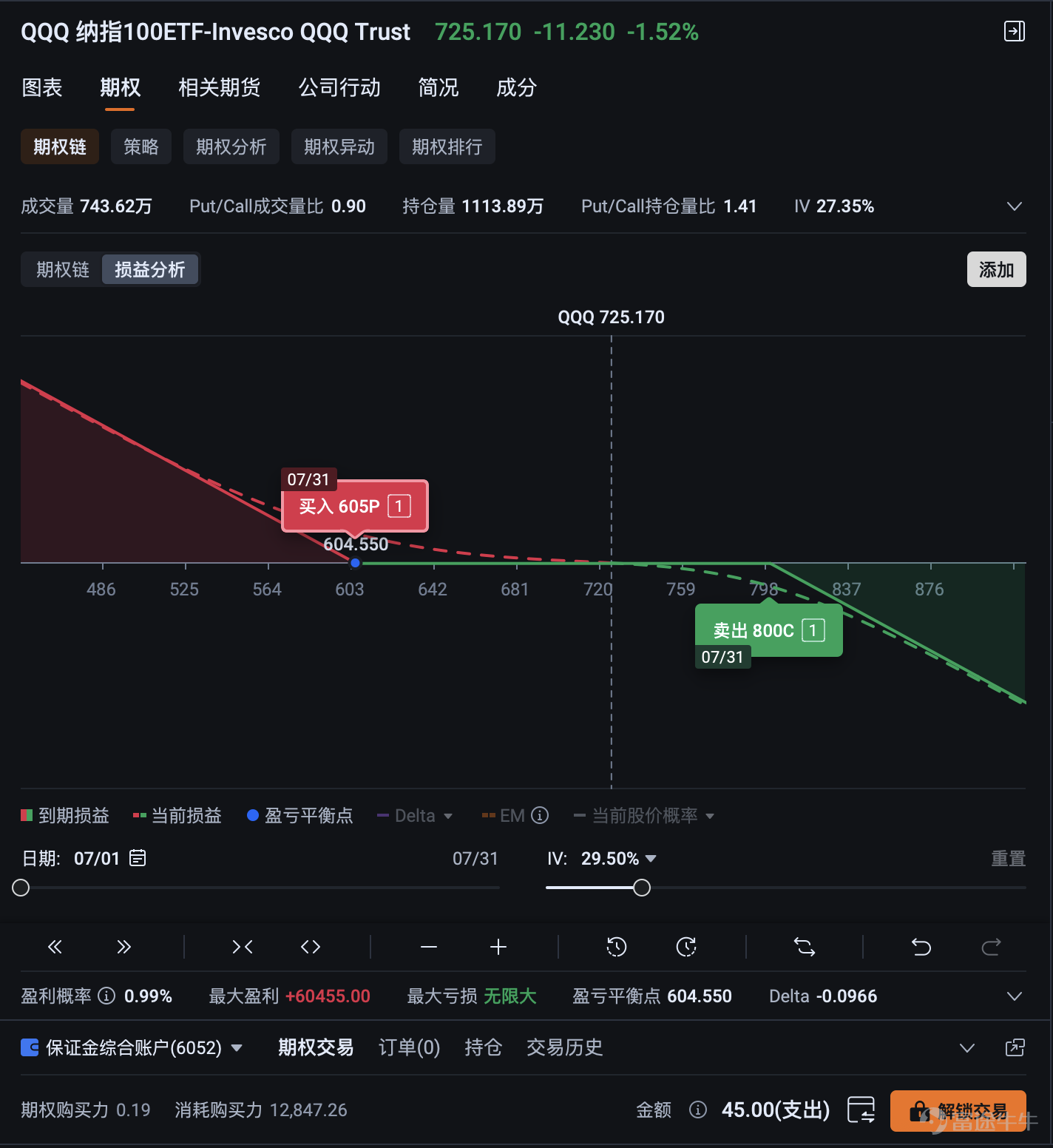
For example, a fellow investor holds a large position in AI hardware-related stocks. In this case, they could buy QQQ put options and sell QQQ call options. (Of course, the same logic applies if the underlying asset is replaced with individual stocks, SPY, SOX, or other index options.)

(The design images displayed on the screen are for demonstration purposes only and do not constitute any investment advice or guarantee; market movements are frequent, and the illustrated option prices do not represent actual conditions)
The cost of implementing this type of options strategy is almost zero.But Sir also understands that some friends might say, 'QQQ is trading at 725 now—dropping to 605 within a month seems way too extreme!' These friends overlook the essence of this strategy:Sacrifice low-probability extreme upside gains in exchange for protection against low-probability extreme tail risks.
Frankly speaking,the AI-related sectors in the U.S. equity market remain among the strongest fundamentally.. Small dips and minor volatility aren't a concern,What we truly worry about is crash-style risk.Thus, this strategy is designed to protect against such extreme monthly tail risks.
Some fellow investors might also ask: what if QQQ surges sharply? If QQQ rallies significantly this month, wouldn’t selling QQQ calls result in substantial losses? Indeed, if QQQ posts a sharp monthly gain—say, a single strong bullish candle—the strategy would incur a loss. However, we must also consider two points:
1. As in the example above, by selling slightly out-of-the-money calls, scenarios where QQQ rises more than 10% or even 15% in a single month remain extremely rare.
2. The premise of this strategy is to protect unrealized gains in portfolios heavily exposed to AI-related companies. Given the high correlation between AI-sector stocks and QQQ, a monthly surge in QQQ of over 10%—or even 15%—would likely generate significant gains in the underlying equity positions...
Of course, this strategyThe real risk lies in, assumes that the underlying holdings and QQQ do not exhibit historically unprecedented negative correlation, nor does it account for mismatches between the value of the underlying positions and the exposure implied by the options allocation.
In financial markets, newcomers always chase returns,while seasoned professionals always prioritize protection against extreme risks.
Finally, here's a small perk for fellow Futubull investors, welcome to claim it.Options Beginner Pack
*This event is exclusive to invited HK users. Click to learn more.Detailed event rules>>
Market conditions are complex and volatile,Options StrategyOverwhelmed by too many choices? Futubull helps you set up your portfolio in three simple steps.Options Strategymaking investing simple and efficient!

Option Risk Warning:An option is a contract that grants the holder the right—but not the obligation—to buy or sell an underlying asset at a predetermined price on or before a specified date. Option prices are influenced by multiple factors, including the current price of the underlying asset, the strike price, time to expiration, and implied volatility. Implied volatility reflects the market’s expectation of future price fluctuations over the life of the option and is derived by reverse-engineering the Black-Scholes pricing model. It is commonly used as a gauge of market sentiment. When investors anticipate greater volatility, they may be willing to pay higher premiums for options to hedge risk, leading to elevated implied volatility. Traders and investors use implied volatility to assess the relative attractiveness of option prices, identify potential mispricings, and manage risk exposure.
Disclaimer:This content does not constitute any offer, solicitation, recommendation, opinion, or guarantee of any securities, financial products, or tools. The risk of loss in trading options can be substantial. In some cases, losses may exceed the initial margin deposited. Even if you set contingent orders such as 'stop-loss' or 'limit' orders, these may not prevent losses. Market conditions may make such orders unexecutable. You may be required to deposit additional margin within a short period. If you fail to provide the required amount within the specified time, your open positions may be liquidated. However, you will still be responsible for any shortfall in your account. Therefore, before trading, you should study and understand options and carefully consider whether such trading is suitable for you based on your financial situation and investment objectives. If you trade options, you should be familiar with the procedures for exercising options and the rights and obligations upon exercise and expiration. Options trading carries extremely high risks and is not suitable for all investors. Investors should carefully readCharacteristics and Risks of Standardized Options。
Risk Disclaimer: The above content only represents the author's view. It does not represent any position or investment advice of Futu. Futu makes no representation or warranty.Read more


Comments (3)
to post a comment
58
125