
End of the ghost story? Zuckerberg denies Meta has excess computing capacity

Meta's move to 'sell computing power' shakes AI trades! Is the short-term volatility a 'misguided sell-off' or a genuine 'inflection point'?
Overnight, $Meta Platforms (META.US)$an announcement of its plan to 'sell excess computing capacity' completely shattered the market’s prior core belief in 'absolute scarcity of computing power.'。
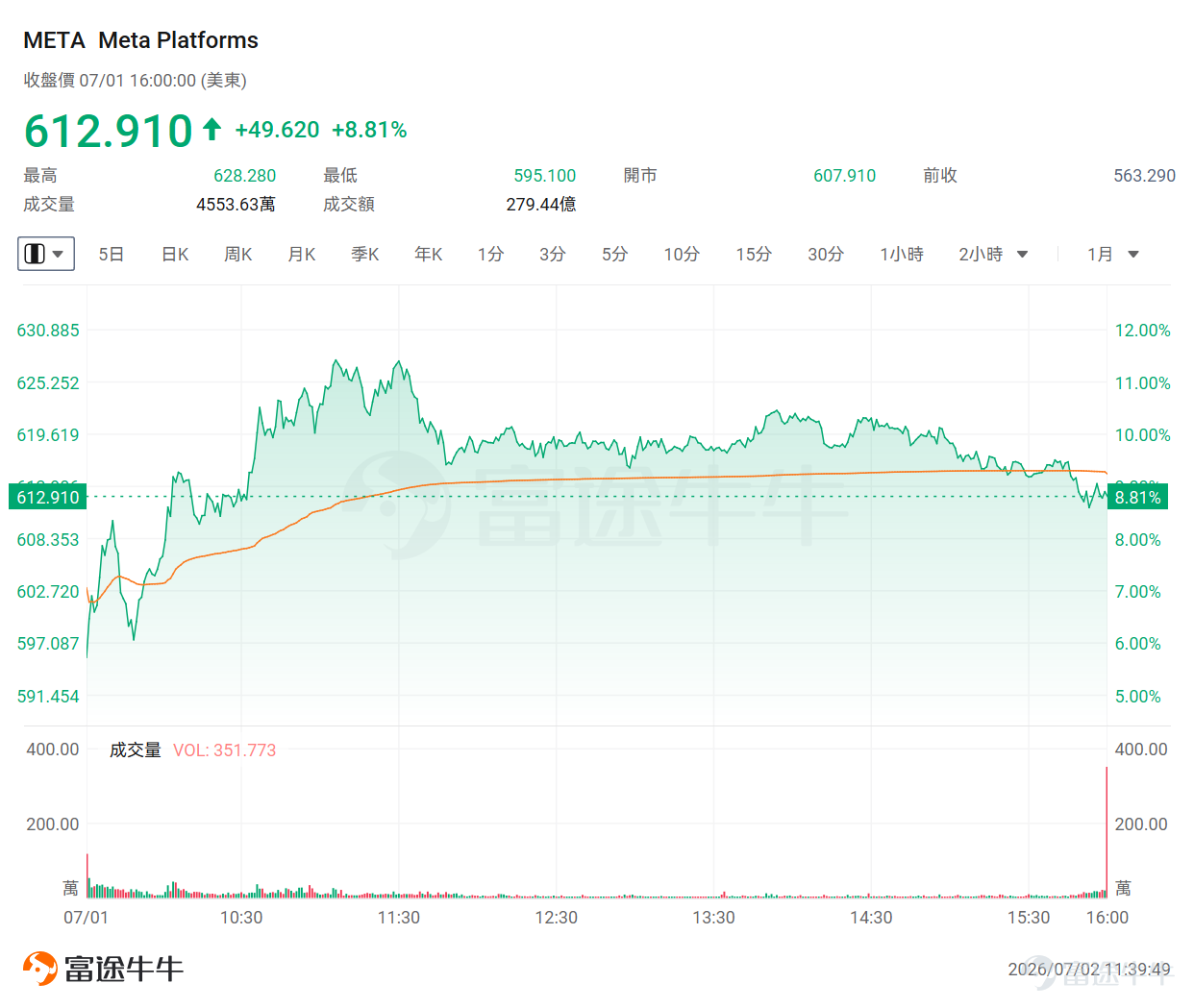
The news triggered extreme polarization in secondary markets: Meta’s stock surged nearly 9% in a single day—its best performance of the year—as it proactively signaled cost-cutting intentions, while semiconductor giants, memory chipmakers, and emerging cloud providers (Neocloud), traditionally seen as AI hardware beneficiaries, all tumbled sharply, dragging the Nasdaq into severe volatility.

This news hit hard because it undermined the most fundamental assumption underpinning AI hardware trades over the past year: that computing power is absolutely scarce and tech giants can only keep increasing their capital expenditures.
Many fellow investors are likely wondering right now:Is computing power actually scarce? Will major cloud providers reduce their capital spending? Has the supercycle for the AI hardware supply chain come to an end? This article will peel back the layers to clarify the reality behind sentiment and fundamentals.
I. Is computing power actually scarce? How should we interpret Meta’s strategic intent?
First, the core conclusion:Meta plans to sell excess AI computing capacity—not because AI demand is weakening, but because its massive AI capital expenditures are entering the 'monetization of computing assets' phase.; In the short term, this may unsettle sentiment among cloud providers and NeoCloud players, but it does not represent a fundamental negative for the AI hardware supply chain. More specifically:
1. This is not Meta halting AI infrastructure build-out, but rather 'using internally while monetizing externally.'
According to reports, Meta is still signing agreements with Crusoe for large-scale data center capacity at the 1.6GW level, indicating that it is not scaling back its AI infrastructure. Instead, it is preparing for even longer-term and larger-scale AI training and inference demands.
2. The compute capacity Meta is likely selling consists primarily of previous-generation chips like the H100/H200.
H100/H200 chips are no longer cutting-edge for model training, but they remain highly valuable for enterprise AI, inference, agent workloads, and training smaller models. Thus, Meta externalizing this capacity is essentiallyimproving asset utilization.
3. What remains truly scarce is next-generation high-end computing power.
What the market genuinely lacks is GB200/GB300/Rubin, as well as scale-up domain infrastructure, networking, optical interconnects, power, cooling, and data center capacity. These represent the core bottlenecks for the next wave of AI capital expenditure and will not disappear simply because Meta sells off some of its older computing capacity.
II. Why is Meta rising while NeoCloud is falling?
Meta’s stock is rising because the market sees a new path to monetization.
Previously, investors were concerned that Meta’s AI investments were excessively large with unclear revenue returns. Now, if Meta can lease out some of its idle or temporarily surplus computing capacity, its AI data centers would no longer be just cost centers but could become infrastructure assets generating cash flow.
In other words, Meta has added a 'residual value recovery mechanism' to its AI CapEx.
But for NeoCloud, this creates pressure.
$CoreWeave (CRWV.US)$ 、 $NEBIUS (NBIS.US)$ The core narrative of emerging compute-leasing providers is to raise capital to purchase GPUs and build data centers, then lease computing power to model companies and enterprise clients. If giants like Meta, Google, xAI, Microsoft, and Amazon also begin releasing excess capacity, the market will worry:
Increased supply of computing power;
Downward pressure on GPU leasing prices;
Clients' bargaining power in contract renewals has increased;
NeoCloud's scarcity has diminished;
Existing large clients may become competitors in the future.
Therefore, the essence of the overnight market move is not that 'AI demand has collapsed,' but rather that the market has begun reassessing:Who truly possesses scarce resources, and who is merely using high leverage to buy GPUs and rent them out.
Third, will tech giants reduce their capital expenditures?
The market’s biggest concern is this: if Meta cuts its 2027 capital expenditure due to lower-than-expected returns on investment, other cloud providers might follow suit, leading to downward revisions in earnings expectations across the entire AI hardware supply chain.
However, we cannot yet draw this conclusion outright:
On one hand, Meta renting out compute capacity may simply be a temporary measure to improve asset utilization.
If the company continues to raise its capital expenditure while monetizing temporarily excess compute capacity, this would not signal a cooling of AI infrastructure investment, but rather an upgrade in the AI infrastructure business model.
On the other hand, if Meta truly scales up its external cloud services in the future—particularly by building a model/API platform rather than merely leasing raw computing capacity—its capital expenditures could continue to rise.A full-fledged cloud business requires greater data center capacity, software platforms, enterprise customer support, and long-term operational capabilities.
Therefore, what really matters isn’t whether 'Meta will sell computing capacity,' but whether Meta, Microsoft, Google, and Amazon collectively revise down their AI-related capital expenditure (Capex) guidance in the next earnings season.
If Capex continues to be revised upward, Meta leasing out computing capacity would merely represent a temporary asset monetization strategy.
Only if Capex is collectively revised downward would this potentially signal an inflection point for the AI hardware supply chain.
IV. What impact would this have on the AI hardware supply chain?
In the short term, this news will create volatility in AI hardware trading.
Over the past year, the market’s bullish thesis has been highly linear: massive capital spending by tech giants → GPU shortages → rising memory prices → broad-based benefits for optical modules, PCBs, power supplies, cooling systems, and data centers.
Meta’s move to sell excess computing capacity has now led the market to worry about a reverse scenario:If computing power isn’t absolutely scarce, and if GPU clusters experience temporary idleness, then the valuation premium assigned to 'shovel sellers' will need to be reassessed.
This is also why overnight $Micron Technology (MU.US)$ 、 $SanDisk (SNDK.US)$ 、 $Advanced Micro Devices (AMD.US)$ and NeoCloud-related stocks saw a noticeable pullback. In particular, memory chips—previously crowded trades with high elasticity and sharp gains—would experience the most severe valuation compression once the 'compute scarcity' narrative weakens.
However, from a medium- to long-term perspective, this development may not necessarily be bearish for the AI hardware supply chain’s fundamentals.
The reason is that if GPU clusters can be leased externally and generate cash flow, it would actually bolster large tech firms’ confidence to continue purchasing GPUs and building data centers. Compute capacity would shift from a one-time capital expenditure into a productive asset that can be used internally, rented out, and monetized—extending the AI infrastructure investment cycle.
Therefore, for NVIDIA, memory, optical modules, power equipment, and the broader data center supply chain, the real litmus test isn’t whether Meta leases out compute capacity, but rather:
Whether big tech companies continue to raise their AI-related capital expenditures;
Whether next-generation GPUs and HBM remain in short supply;
Whether inference and agent applications continue to scale up;
Whether compute leasing prices continue to decline;
Whether bottlenecks in data centers, power, networking, and cooling ease.
V. The True Implication of This Development
This is not a definitive signal of an 'AI bubble bursting,' but it does indicate that AI-related trading has entered a new phase.
Previously, the market traded on the idea: everything was in short supply—just buy infrastructure with your eyes closed.
Going forward, the market will focus more on who can truly monetize and who is merely buying assets at high prices.
Meta's move is essentially about finding a second business model for its massive AI investments. It signals to the market that AI infrastructure isn't just an internal R&D cost—it can also become an external cloud service, model-as-a-service offering, and compute-leasing platform.
This will lead to two outcomes:
For Meta and similar tech giants, the ability to commercialize compute assets will enhance valuation elasticity;
For NeoCloud and highly leveraged hardware supply chains, the market will scrutinize order quality, customer stability, and pricing trends more critically.
Sixth, what metrics should we watch next?
The following four indicators are most worth tracking:
1. Capex guidance from Meta, Microsoft, Google, and Amazon
If they continue to raise their capex outlooks, it means the AI infrastructure cycle isn't over yet; if they collectively lower them, that would signal real risk.
2. Whether AI compute leasing has officially materialized
The key question is whether Meta is temporarily leasing raw compute capacity or formally entering the cloud infrastructure and model API business.
3. Leasing pricing and renewal trends for NeoCloud providers such as CoreWeave and NEBIUS
If prices decline significantly and customer renewals weaken, it signals a deterioration in the competitive landscape.
4. Whether next-generation GPUs, HBM, optical interconnects, power, and data center capacity remain constrained
If these core bottlenecks persist, the medium- to long-term investment thesis for the AI hardware supply chain remains intact.
VII. Conclusion
Meta’s sale of surplus compute capacity should not be simplistically interpreted as 'AI compute oversupply.' More accurately, it signals that AI giants are beginning to convert massive capital expenditures into operational, rentable, and monetizable assets.
In the short term, this will challenge the market’s belief in 'absolute compute scarcity' and pressure valuations of NeoCloud players and highly leveraged hardware stocks. Over the medium to long term, it could reinforce the platformization trend in AI infrastructure.
In other words,The real inflection point isn’t whether Meta sells compute capacity, but whether major tech firms reduce their AI-related capital expenditures (Capex).
If Capex remains unchanged, this merely represents an upgrade in the AI infrastructure business model.
If capital expenditures are revised downward, that would mark the beginning of a repricing for the AI hardware supply chain.
Risk Disclaimer: The above content only represents the author's view. It does not represent any position or investment advice of Futu. Futu makes no representation or warranty.Read more


Comments (125)
to post a comment
232
940