
Daily Options Outlook | AI power takes over from compute trading; Bloom Energy surges. Satellite comms M&A and index inclusion reignite expectations, SpaceX posts third straight gain
Today's Options Opportunity Preview
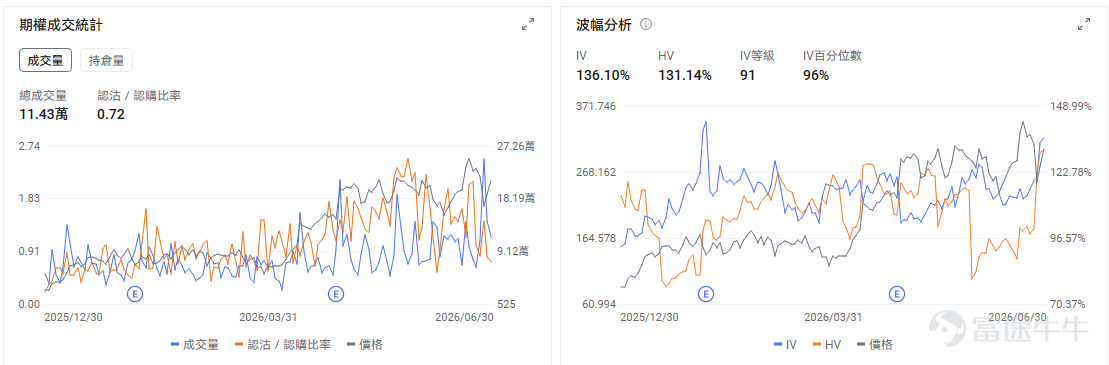
$Bloom Energy (BE.US)$ The stock rose 8.00% in pre-market trading. The immediate catalyst was the company’s financing facility with BAM being significantly expanded to $25 billion, which the market interpreted as further validation of demand for distributed energy infrastructure amid an AI data center power crunch. Microsoft’s layoffs and increased allocation toward compute capacity also reinforced the trading narrative that 'human capital budgets are giving way to AI infrastructure spending.'
Compared to chips and optical modules, distributed energy has received relatively little attention until now. Once capital starts seeking new outlets along the AI supply chain, names like BE could exhibit significant upside elasticity. On the options front, call activity is likely to heat up following the pre-market jump, though implied volatility (IV) will also rise rapidly.

$SpaceX (SPCX.US)$ The stock rose 2.2% in pre-market trading. The immediate catalyst was a rebound following a prior pullback, with renewed options buying interest, alongside continued support from satellite communications M&A and partnership expectations underpinning sentiment in the space economy sector. SpaceX remains the strongest valuation anchor in the space economy—any improvement in sector-wide risk appetite will first be reflected in SPCX.
The key for SPCX today lies in the quality of the rebound. If the stock can hold steady around $174 and call option volume continues to expand, it would signal that longs haven’t exited the core space economy theme. However, if it rallies only to retreat back toward $170, short-term traders may still be using the bounce to reduce positions. For options traders, SPCX already exhibits high volatility; chasing calls on the upside carries IV contraction risk—it’s better to wait for directional confirmation after the open.
Review of yesterday's options market
Index Options
On June 30 in U.S. Eastern Time, trading volume in the U.S. equity index options market rose, with a total of 5.97 million contracts traded. The put/call volume ratio declined to 1.02.
As the upcoming expiration date approaches, $S&P 500 Index (.SPX.US)$ Options volume distribution showed the following characteristics: peak put volume occurred at the 7,450 strike, while peak call volume was at the 7,500 strike.

Single Stock Options
$Advanced Micro Devices (AMD.US)$ rose 7.68%, with 483,500 options contracts traded, and the put/call volume ratio dropped to 0.69. Wells Fargo & Co raised its price target for AMD from $505 to $615, and the stock hit a record high.

$Strategy (MSTR.US)$ fell 6.20%, with 517,700 options contracts traded, and the put/call volume ratio declined to 1.22. Strategy announced a new capital management framework, authorizing the sale of Bitcoin and launching a $2 billion share repurchase program.

Top list of options trading volume
Among the top 10 stocks by options trading volume,$Strategy (MSTR.US)$had the highest put/call volume ratio, reaching 1.22.

The highest put/call open interest ratio is $Micron Technology (MU.US)$ , reaching 1.38. Micron Technology’s stock surged 242% in the second quarter, with the CEO citing aggressive customer price pressure leading to insufficient capacity investment, exacerbating supply-demand imbalances.

Implied volatility rankings (underlying market cap > $10 billion and options trading volume > 100,000)
$Bloom Energy (BE.US)$Implied volatilityreached the highest level at 136.10%, up 1.52% from the previous trading day. Bloom Energy and Brookfield expanded their AI infrastructure partnership to $25 billion.

$Strategy (MSTR.US)$saw the largest increase in implied volatility, reaching 112.86%, up 7.52% from the previous trading day.
Risk Warning
An option is a contract that gives the holder the right, but not the obligation, to buy or sell an asset at a fixed price on a specific date or before that date. The price of an option is influenced by various factors, including the current price of the underlying asset, the strike price, time to expiration, and implied volatility.
Implied volatility reflects the market's expectation of the option's volatility over a certain period in the future. It is derived inversely from the BS pricing model of options and is generally considered an indicator of market sentiment. When investors anticipate greater volatility, they may be more willing to pay higher prices for options to hedge risks, resulting in higher implied volatility.
Traders and investors use implied volatility to assessOption priceto enhance attractiveness, identify potential mispricing, and manage risk exposure.Disclaimer
This content does not constitute any offer, solicitation, recommendation, opinion, or guarantee of any securities, financial products, or tools. The risk of loss in trading options can be substantial. In some cases, losses may exceed the initial margin deposited. Even if you set contingent orders such as 'stop-loss' or 'limit' orders, these may not prevent losses. Market conditions may make such orders unexecutable. You may be required to deposit additional margin within a short period. If you fail to provide the required amount within the specified time, your open positions may be liquidated. However, you will still be responsible for any shortfall in your account. Therefore, before trading, you should study and understand options and carefully consider whether such trading is suitable for you based on your financial situation and investment objectives. If you trade options, you should be familiar with the procedures for exercising options and the rights and obligations upon exercise and expiration. Options trading carries extremely high risks and is not suitable for all investors. Investors should carefully readCharacteristics and Risks of Standardized Options。
This content does not constitute any offer, solicitation, recommendation, opinion, or guarantee of any securities, financial products, or tools. The risk of loss in trading options can be substantial. In some cases, losses may exceed the initial margin deposited. Even if you set contingent orders such as 'stop-loss' or 'limit' orders, these may not prevent losses. Market conditions may make such orders unexecutable. You may be required to deposit additional margin within a short period. If you fail to provide the required amount within the specified time, your open positions may be liquidated. However, you will still be responsible for any shortfall in your account. Therefore, before trading, you should study and understand options and carefully consider whether such trading is suitable for you based on your financial situation and investment objectives. If you trade options, you should be familiar with the procedures for exercising options and the rights and obligations upon exercise and expiration. Options trading carries extremely high risks and is not suitable for all investors. Investors should carefully readCharacteristics and Risks of Standardized Options。
Risk Disclaimer: The above content only represents the author's view. It does not represent any position or investment advice of Futu. Futu makes no representation or warranty.Read more


Comments
to post a comment
17
6