
Zhongji Xuchuang is now in hot IPO subscription! Around 80% of new listings in 2026 rose on their fi

We Billion Intelligence reports rising revenue but significantly volatile net profit: debt ratio climbs as Baidu cashes out and exits
Recently, Changzhou We Billion Intelligence Technology Co., Ltd. (hereinafter referred to as 'We Billion Intelligence') submitted an application to list on the Hong Kong Stock Exchange, aiming to debut on the Main Board of Hong Kong. Orient Securities International serves as the sponsor. The company initially filed its listing application as early as September 2025.
On November 14, 2025, the China Securities Regulatory Commission (CSRC) issued a request for supplementary materials regarding We Billion Intelligence’s overseas listing filing, requiring the company to provide additional clarifications on eight key issues: identification of controlling shareholders; progress in state-owned asset management procedures; reasonableness of share subscription prices paid by new investors; reasons for inconsistencies in the IPO proposal; details of equity incentive plans; business operation model; whether it actually engages in advertising activities and specific operational details thereof; and whether shares held by shareholders participating in the 'full circulation' mechanism are subject to pledges, freezes, or other encumbrances.
The proceeds from this IPO will primarily be allocated toward research and development of the company’s core technologies; establishing localized overseas sales and service networks; strategic investments and acquisitions; expanding production capacity; and working capital and other general corporate purposes.
Revenue has continued to grow, while net profit has shown significant volatility.
According to Tianyancha, WeYi Intelligent Manufacturing was founded in 2018 and is a leading enterprise in the field of embodied industrial intelligent robots. The company is dedicated to transforming manufacturing through cutting-edge technologies and shaping a new future for the global workforce. It provides globally deployable, highly flexible Embodied Industrial Intelligent Robot (EIIR) products and solutions to customers worldwide. Leveraging its self-developed full-stack hardware and software systems and comprehensive systems engineering capabilities, the company has successfully developed EIIR products capable of autonomously perceiving, learning, making decisions, and executing complex tasks.
During the historical period under review, WeYi Intelligent Manufacturing’s revenue primarily derived from the sale of EIIRs and AI-enabled intelligent and modular products.
From 2023 to 2025 (hereinafter referred to as the 'Reporting Period'), revenue from EIIR products amounted to RMB 114 million, RMB 272 million, and RMB 453 million, accounting for 26.3%, 45.3%, and 57.0% of total revenue in each respective period; revenue from AI-enabled intelligent products totaled RMB 203 million, RMB 205 million, and RMB 209 million, representing 46.9%, 34.1%, and 26.3% of total revenue; and revenue from modular products reached RMB 96.457 million, RMB 112 million, and RMB 127 million, constituting 22.2%, 18.7%, and 16.0% of total revenue.
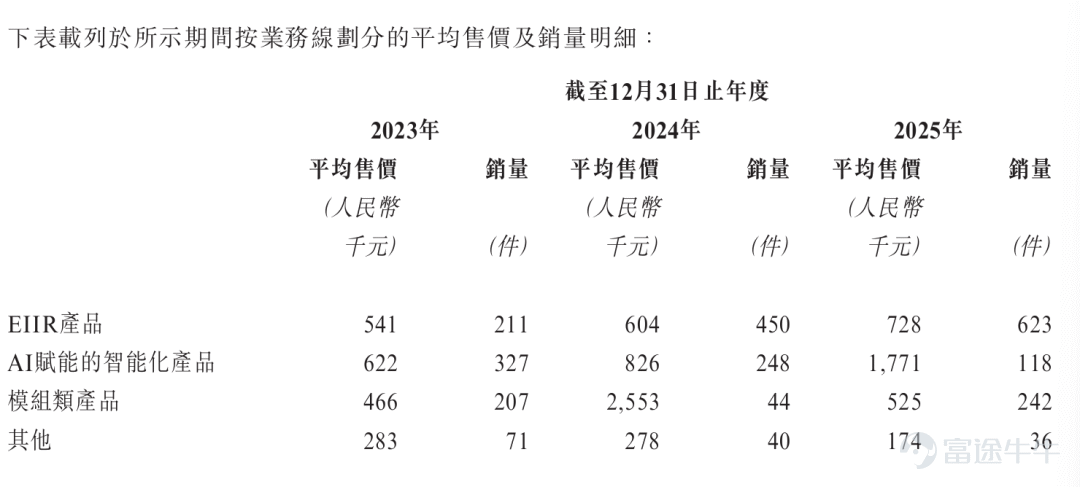
By business segment, during the Reporting Period, the average selling price (ASP) of EIIR products was RMB 541,000, RMB 604,000, and RMB 728,000, with unit sales of 211, 450, and 623 units, respectively; the ASP of AI-enabled intelligent products was RMB 622,000, RMB 826,000, and RMB 1,771,000, with unit sales of 327, 248, and 118 units, respectively—indicating rising prices alongside continuously declining sales volumes.

During the same period, the ASP of modular products was RMB 466,000, RMB 2,553,000, and RMB 525,000, with unit sales of 207, 44, and 242 units, respectively, showing significant fluctuations in both average selling prices and sales volumes over the period.
From a gross margin perspective, both EIIR products and AI-enabled intelligent products saw substantial improvements during the period. Gross margins for EIIR products were 47.9%, 55.1%, and 53.5% in each respective period, while those for AI-enabled intelligent products were 35.2%, 47.5%, and 44.4%. WeYi Intelligent Manufacturing attributes the improvement in gross margins of its core products to optimized product mix and enhanced operational efficiency driven by proprietary technology upgrades.
During the Reporting Period, WeYi Intelligent Manufacturing’s gross profit amounted to RMB 184 million, RMB 287 million, and RMB 385 million, with corresponding gross margins of 42.4%, 47.9%, and 48.4%, reflecting an overall upward trend.
Driven by improved gross profit and gross margin, as well as enhanced operational efficiency from product mix optimization and proprietary technology upgrades, WeYi Intelligent Manufacturing achieved a turnaround from net loss to net profit during the period. The company recorded revenue of RMB 434 million, RMB 600 million, and RMB 796 million in the respective years, with total comprehensive income of -RMB 114 million, RMB 15.612 million, and RMB 5.052 million. Adjusted net profit (a non-IFRS measure) stood at -RMB 28.112 million, RMB 44.146 million, and RMB 48.726 million, respectively.
In 2023, WeYi Intelligent Manufacturing reported a net loss of RMB 114 million, primarily due to intensive R&D investment of RMB 178.3 million (41% of that year’s revenue), which was focused on developing the company’s core full-stack hardware and software systems.
The company returned to profitability in 2024. In 2025, WeYi Intelligent Manufacturing’s net profit declined to RMB 51 million, primarily due to increased investment in high-performance computing resources and R&D personnel to support large model development, resulting in continued expansion of R&D expenditures.

Specifically regarding expense items, during the reporting periods, WeYi Intelligent Manufacturing’s R&D expenses were RMB 178 million, RMB 165 million, and RMB 235 million, accounting for 41.01%, 27.5%, and 29.52% of revenue for the respective periods; sales and marketing expenses were RMB 49.756 million, RMB 31.314 million, and RMB 38.791 million, representing 11.47%, 5.22%, and 4.87% of revenue; and general and administrative expenses were RMB 60.733 million, RMB 42.032 million, and RMB 80.320 million, amounting to 14%, 7.01%, and 10.09% of revenue, respectively.
During the historical period, WeYi Intelligent Manufacturing’s R&D expenses included employee benefits and share-based compensation for R&D personnel, computing power costs, depreciation expenses, raw material consumption, and other expenditures. The company’s R&D expenses increased by -7.5% year-over-year in 2023 and by 42.8% in 2024. The decline in the R&D expense ratio in 2023 was attributable to organizational streamlining and a RMB 335 million reduction in share-based compensation, which was partially offset by an additional RMB 235 million in computing power costs incurred to support ongoing deep R&D in embodied intelligence. The 2024 increase was primarily driven by intensified R&D efforts in high-speed visual servo systems for industrial robots and integrated vision inspection platforms.
Regarding the sustainability of profitability, WeYi Intelligent Manufacturing stated in its prospectus:In the near term, the company may continue to incur net losses as it is currently in a phase of rapid business expansion and operational scaling within the industrial-grade intelligent robotics industry, with sustained R&D investment. The company believes that future revenue growth will depend on its ability to (among other factors) develop new technologies, enhance customer experience, establish effective commercialization strategies, compete effectively and successfully, and develop new products and solutions. As the company continues to expand its business and operations and invest in R&D activities, its costs and expenses may continue to increase in future periods.
Song Xiangqing, Vice President of the China Society of Commercial Economics, commented: 'WeYi Intelligent Manufacturing’s profitability and cash flow challenges exemplify the typical profile of hard-tech startups—characterized by high upfront investment, long development cycles, and aggressive scaling. The core tension lies in “large-scale commercialization lagging behind initial investment.” Net profit swung from a loss of RMB 114 million in 2023 to a profit of RMB 157.39 million in 2024, before declining again to RMB 50.66 million in 2025. This volatility stems from persistently high R&D spending; continuous iteration of embodied intelligence technologies and their deployment in real-world scenarios require substantial ongoing capital outlays, rendering profitability inherently fragile.'
Operating cash flow improved, while the debt ratio rose.
In the course of its business development, WeYi Intelligent Manufacturing also exhibits a relatively high concentration among both upstream suppliers and downstream customers.
During the reporting periods, revenue from WeYi Intelligent Manufacturing’s top five customers amounted to RMB 227 million, RMB 169 million, and RMB 303 million, representing 52.4%, 28.3%, and 38.1% of total revenue, respectively; revenue from its largest single customer was RMB 58.6 million, RMB 42 million, and RMB 74.6 million, accounting for 13.5%, 7.0%, and 9.4% of total revenue, respectively.
During the same periods, purchases from the company’s top five suppliers totaled RMB 203 million, RMB 186 million, and RMB 362 million, representing 64.1%, 46.6%, and 42.4% of total procurement, respectively; purchases from its largest single supplier were RMB 51.9 million, RMB 50.3 million, and RMB 105 million, accounting for 16.4%, 12.6%, and 12.2% of total procurement, respectively.
While exhibiting a high degree of concentration among major clients, WeYi Intelligent Manufacturing also faces credit risks associated with delayed payments or defaults by customers, distributors, or related parties. As of the end of each reporting period, the company's trade receivables and bills receivable amounted to RMB 387 million, RMB 615 million, and RMB 464 million, respectively.
As of the end of each reporting period, the company’s inventory stood at RMB 457.43 million, RMB 775.53 million, and RMB 1.1 billion, respectively, with inventory turnover days of 43, 72, and 83 days, and corresponding inventory turnover ratios of 8.5, 5.1, and 4.4.
Net cash flow generated from operating activities amounted to -RMB 1.05 billion, -RMB 1.54 billion, and RMB 1.41 billion as of the end of each reporting period. The company recorded negative operating cash flows for two consecutive years in 2023–2024, followed by positive cash inflow in 2025.
Regarding the reason for the positive operating cash flow in 2025, the company stated that the net change in working capital was primarily driven by: a RMB 1.242 billion decrease in trade receivables and bills receivable, other receivables, and prepaid expenses; a RMB 973 million increase in trade payables and bills payable, other payables, and accrued expenses; and a RMB 355 million increase in contract liabilities.
Song Xiangqing noted: In terms of cash flow, the company experienced consecutive net outflows from operating activities in 2023–2024 (-RMB 1.05 billion and -RMB 1.54 billion), primarily due to a sharp rise in credit sales amid business expansion. Trade receivables accumulated to over RMB 14.6 billion over three years, compounded by slowing inventory turnover, resulting in substantial capital being tied up across the supply chain and creating a cycle of 'revenue growth → credit sales expansion → cash flow pressure.' Operating cash flow turned positive in 2025, reaching RMB 1.41 billion, signaling initial success in product scale-up. However, the quality of earnings and stability of cash flow remain to be validated. The IPO is essentially aimed at alleviating funding pressures through capital markets to support technological iteration and market expansion. Investors should closely monitor subsequent receivables collection, gross margin stability, and improvements in R&D efficiency.
In terms of solvency, the company’s current ratios as of the end of each reporting period were 0.9, 1.1, and 1.2, while its quick ratios were 0.8, 1.0, and 0.6, and debt-to-asset ratios were -21.9%, 40.8%, and 56.4%, respectively.
Other financial metrics show that during the reporting periods, the company’s interest coverage ratios were -3.3%, 1.6%, and 1.1%; debt-to-equity ratios were -40.9%, 75.3%, and 0.6%; and net debt-to-equity ratios were -39.2%, 73.8%, and 0.4%, respectively.
Potential goodwill impairment risk; Baidu exits via stake sale
As of the latest practicable date, Zhang Zhiqi and Pan Zhengyi, acting in concert, collectively held approximately 31.78% of the shares, making them the company’s controlling shareholders.
Since its establishment in 2018, WeYi Intelligent Manufacturing has completed several rounds of financing, including Series A and Series B funding, the acquisition by Jiangsu Zhiyun TianGong, financing rounds from April to May 2024, December 2024, and April 2025. The company issued ordinary shares to investors and entered into separate agreements with shareholders granting them redemption rights, anti-dilution rights, liquidation preferences, and other rights (collectively referred to as 'redeemable rights').
Regarding the acquisition of Jiangsu Zhiyun Tiangong, the details are as follows: the acquisition took place in December 2022, and following its completion, Weiyi Smart Manufacturing’s product portfolio underwent a significant transformation. Prior to the acquisition, Weiyi Smart Manufacturing’s revenue primarily came from AI-powered intelligent products; after the acquisition, the company strategically expanded into EIIR products, which have become an increasingly important contributor to total revenue.
Due to the acquisition of Jiangsu Zhiyun Tiangong, Weiyi Smart Manufacturing also incurred substantial goodwill impairment. As of the end of 2023 and 2024, the company’s intangible assets stood at RMB 222 million and RMB 218 million, respectively, with goodwill of RMB 178 million in 2023 primarily attributable to the acquisition of Jiangsu Zhiyun Tiangong. By the end of 2025, Weiyi Smart Manufacturing’s intangible assets further increased to RMB 787 million, mainly due to the recognition of RMB 5.219 billion in goodwill and RMB 507 million in technology related to the acquisition of Jiebote.

Given the substantial amount of goodwill, there is a risk of goodwill impairment if the performance of the acquired assets falls short of expectations.
In addition to Weiyi Smart Manufacturing’s own goodwill, the company’s related-party transactions with Jiangsu Zhiyun Tiangong have also drawn external attention. In 2022, Jiangsu Zhiyun Tiangong was Weiyi Smart Manufacturing’s largest customer for the period, contributing 20.9% of total revenue.
Moreover, during Weiyi Smart Manufacturing’s prior fundraising rounds, Baidu—the prominent investor—was undeniably a key topic of discussion. Baidu’s complete exit ahead of the IPO has sparked widespread commentary.
On October 31, 2019, Baidu Online subscribed for newly issued registered capital of RMB 3.0899 million at a cost of RMB 25.3 million, representing the Series A funding round. On July 8, 2022, Baidu Online transferred its 3% and 3% equity stakes in the company’s predecessor to Qingfeng Yun Gang and Zhonglou Investment, respectively, at prices of RMB 36 million each.
In May 2025, Baidu Online transferred its 2.1269%, 0.2671%, and 0.0021% equity stakes in the company’s predecessor to Wuxi Hongtai, Chongqing Transformation, and Linghang Xinghan at prices of RMB 30 million, RMB 3.768 million, and RMB 0.0292 million, respectively, for a total consideration of approximately RMB 33.7972 million.
On the same day, Changzhou Industrial Investment transferred its 0.9217% equity stake in the company’s predecessor to Songhe Angel Fund for RMB 20 million.

As a result, Baidu Online no longer holds any shares in Weiyi Smart Manufacturing, having fully exited its position, with total proceeds from its two divestments amounting to RMB 105.8 million. (Produced by Harbour Financial)
Harbor Business Observer, reporter Zifu Shi
Risk Disclaimer: The above content only represents the author's view. It does not represent any position or investment advice of Futu. Futu makes no representation or warranty.Read more
Comments
to post a comment