
ASML Holding and Taiwan Semiconductor both reported strong earnings—when will the semiconductor sell

Storage shortages spark a wave of capacity expansion: equipment stocks rally—has the memory sector reached an inflection point?
Semiconductor equipment stocks in the U.S. market rallied collectively on Monday, with key names posting significant gains: $Applied Materials (AMAT.US)$ up approximately 10.7%, $KLA Corp (KLAC.US)$ up approximately 12.0%, $Lam Research (LRCX.US)$ up approximately 8.3%, $ACM Research (ACMR.US)$ up approximately 13.9%, $Teradyne (TER.US)$ up approximately 6.3%, $ASML Holding (ASML.US)$ up approximately 4.9%.
Applied Materials hit a record high on Monday, driven by multiple brokerages raising their price targets. Cantor lifted its target for AMAT from $650 to $850, while KeyBanc raised its target from $550 to $750. The core rationale behind both upgrades was surging demand for equipment fueled by AI infrastructure expansion.
Is capital for AI capacity expansion starting to flow toward 'shovel sellers'? Could semiconductor equipment become the next key theme in the AI hardware supply chain?
How should we understand the rationale behind the rise in semiconductor equipment stocks?
On June 11, SEMI released a report revising upward its forecast for the global front-end semiconductor equipment market growth rate in 2026—from the previous 16.5% to a significantly higher 23.5%—reaching $152.2 billion. Global semiconductor equipment billings in Q1 reached $36.55 billion, up 14% year-over-year, setting a new record for a single quarter.
And$Micron Technology (MU.US)$ The latest earnings cycle shows a significant increase in capital expenditures. Micron's Q3 capex was $7.1 billion, with Q4 expected at approximately $10 billion, bringing full-year FY2026 capex to around $27 billion. More importantly,the company explicitly stated that its quarterly capex in FY2027 will exceed Q4 levels, signaling a clear capacity expansion cycle.
It’s not just Micron—the entire industry is accelerating equipment purchases and ramping up capacity.Yesterday, as part of the South Korean government’s announcement of its 'Three Major Projects,' Samsung Group declared an investment of approximately2,655 trillion Korean wonKorean investment, of which approximately210 trillion KRWis investing in semiconductors. SK Group $SK Hynix (000660.KR)$$CSOP SK Hynix Daily (2x) Leveraged Product (07709.HK)$ announced an investment of approximately210 trillion KRW, of which about110 trillion KRWwill be allocated to memory, and approximately100 trillion KRWinto AI infrastructure. The investment timeline is very long—Samsung $CSOP Samsung Electronics Daily (2x) Leveraged Product (07747.HK)$ until 2040 and SK until 2033—and the actual pace of implementation will still be influenced by the memory supply-demand cycle.
Strong AI demand → tight supply of memory and advanced chips → Taiwan Semiconductor, Samsung, Micron, and SK Hynix expand capacity → need to purchase more equipment → higher HBM stacking layers → more complex process steps → increased equipment intensity → equipment suppliers capture a greater share of value per dollar of memory Capex.
Market participants are most focused on capital flows. According to JPMorgan's consolidated estimates, this long-term plan amounts to approximatelyKRW 4,755 trillion, or about USD 3.1 trillion. Of the roughly USD 3.1 trillion long-term investment plan,approximately 60%–70% could flow into front-end wafer fabrication equipment, and about 20%–30% into infrastructure and cleanroom construction,with the remainder allocated to back-end packaging facilities.
For memory stocks: controversial in the short term, but moderately positive over the medium to long term
How should we view future capex plans and capacity expansions by major memory manufacturers? Does expansion necessarily imply higher supply and downward price pressure?
JPMorgan’s view is that if the industry were in the latter stages of a cycle, such expansion might indeed be interpreted as bearish; however, if we are still in the early-to-mid phase of an AI-driven memory upcycle, then expansion actually signals demand strong enough to necessitate increased supply.
The current situation appears closer to the latter scenario. The recent dispute between Apple and Micron reflects how rising memory prices are already impacting downstream consumer electronics makers. Profit allocation currently heavily favors memory manufacturers, but given the genuine supply-demand gap, downstream brands—even if they wish to switch to Chinese DRAM suppliers—may not secure sufficient volumes. Even if Chinese DRAM makers aggressively ramp up capex, their incremental supply may still fall short of closing the gap created by surging AI and server memory demand.
On the other hand, more than half of Micron’s increased capital expenditures through fiscal year 2027 will come from construction-related spending,That is, cleanrooms, factory buildings, and infrastructure cannot immediately be converted into equipment capacity for shipments.
Building a new fab, installing tools, testing, and ramping up production typically takes more than two years. Micron’s new Idaho facility in the U.S. won’t produce its first wafer until mid-2027, and the second plant won’t come online until end-2028; its HBM packaging capacity in Singapore will only start contributing in the first half of 2027.This means new supply will indeed begin coming online in 2027, but it usually takes additional time—through production ramp-up, yield improvements, customer qualification, and mass delivery—before it can materially impact market pricing.
Regulatory risk is another point of contention recently. In the U.S., class-action lawsuits have already been filed against the three major DRAM manufacturers, alleging they may have engineered a shortage to drive up prices. However, as of now, these remain consumer-level civil lawsuits, with no indication of formal government investigation—distinct from genuine antitrust probes.
Consumer class-action lawsuits can cause stock price volatility, but they typically require a long time for evidence gathering, litigation, and settlement. In the short term, it’s unlikely they will directly compel manufacturers to lower prices, expand capacity, or alter contract structures.
Such allegations are not uncommon in the memory industry's history; there were precedents even in earlier DRAM antitrust cases.In the early 2000s, DRAM makers paid fines and settlements over price-fixing allegations. Similar accusations of 'supply restriction' also surfaced around 2016–2017. Historical experience shows that even when such cases are substantiated, penalties or settlements usually materialize only after many years. While they may disrupt short-term market sentiment, their impact on the current supply-demand cycle remains relatively limited.
The risk warrants monitoring but is not yet an overriding factor.
Which segment benefits the most? — Front-end wafer fabrication equipment
From a capital allocation perspective, front-end wafer fabrication equipment stands to benefit most directly.
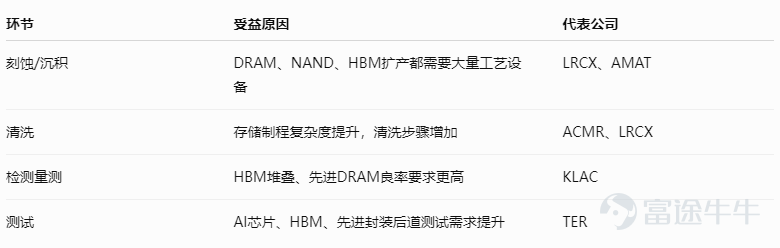
Memory capacity expansion heavily relies on front-end equipment, especially for 3D NAND—higher layer counts significantly increase the complexity of etching and deposition processes. HBM also demands more advanced DRAM manufacturing capabilities, with heightened requirements for process complexity, yield rates, and process control, substantially increasing equipment value content.
Therefore, memory capacity expansion will directly boost companies like LRCX, AMAT, and KLAC.

Front-end wafer fabrication equipment, in simple terms, refers to:Equipment used to 'fabricate' chips on wafers. This primarily includes processes such as etching, deposition, cleaning, ion implantation, thin-film formation, and inspection and metrology.

1. AMAT: The leading integrated equipment provider, excelling in its broad coverage and delivering the most balanced EPS growth
AMAT is one of the semiconductor equipment companies with the broadest coverage. It benefits not from a single process step alone but simultaneously spans deposition, etching, ion implantation, advanced packaging, and services.
Its EPS growth stems primarily from three areas.
First, expansion of the overall WFE market. According to a Citi equipment report, under a bull-case scenario, global WFE spending is expected to rise from approximately $145 billion in 2026 to around $200 billion in 2027 and further to roughly $250 billion in 2028. Given AMAT’s extensive product coverage, it stands to benefit most directly from this industry-wide expansion.
Second, demand driven by advanced packaging and DRAM/HBM. AI chips and HBM place higher demands on materials engineering, deposition, interconnects, and packaging processes. AMAT is not only a front-end equipment supplier but also has exposure to advanced packaging. AMAT’s management previously projected that its semiconductor equipment business would grow by over 30% and its packaging business by more than 50% in 2026. This indicates its growth is fueled not only by traditional wafer fab expansions but also by AI-driven packaging upgrades.
Third, service revenue enhances profit stability. After selling equipment, the company continues to generate recurring income from maintenance, upgrades, spare parts, and service contracts. A higher proportion of service revenue reduces earnings volatility for AMAT, making the market more willing to assign it a premium valuation.
2. LRCX: The most direct play on memory capacity expansion
LRCX represents the highest-leverage segment among equipment stocks in this cycle, as it is most tightly linked to memory capacity expansion.
LRCX's EPS growth drivers primarily come from three areas.
First, DRAM/HBM capacity expansion. HBM fundamentally relies on advanced DRAM manufacturing capacity. The stronger the AI server demand for HBM, the more SK Hynix, Samsung, and Micron will need to increase capital spending on advanced DRAM-related capacity, which directly boosts demand for LRCX's etch and deposition equipment.
Second, NAND equipment demand may be underestimated. A Citi report specifically highlighted that DRAM supply bottlenecks could drive more AI inference architectures to adopt NAND as a supplementary storage layer. This means the market has so far focused only on HBM and DRAM, but NAND could also see incremental equipment investment going forward. LRCX holds a clear advantage in NAND-related etch and deposition tools, giving it higher earnings elasticity.
Third, an upward revision in memory capex cycles. Lam’s latest quarterly revenue reached $5.84 billion, a record high, and management explicitly noted that AI demand is reshaping the semiconductor industry. The company derives significant revenue from China, Korea, and Taiwan, with Korea and Taiwan together accounting for a substantial share—precisely aligning with regions expanding memory and advanced manufacturing capacity.
3. KLAC: Leader in yield control, with high certainty but lower elasticity
KLAC specializes in inspection, metrology, and process control. As chips become more advanced, packaging more complex, and HBM stacking more challenging, yield control becomes increasingly critical.
Its strengths include high product quality and strong customer stickiness, resulting in relatively low earnings volatility. KLA previously emphasized that the company benefits from AI infrastructure build-out, with exposure across logic, memory, advanced packaging, and services.
4. ASML: Strongest moat
ASML is the leader in lithography tools and faces virtually no competition in EUV. Over the long term, it remains the semiconductor equipment company with the highest barriers to entry globally.
AI chips, advanced logic, and advanced DRAM all require increasingly sophisticated lithography capabilities. As long as TSMC, Samsung, and Intel continue advancing their leading-edge process nodes, ASML’s order backlog will remain well-supported.
5. Teradyne (TER): Strong elasticity in the testing segment, but the rally has been too rapid
Teradyne primarily benefits from testing demand, including AI chip testing, HBM testing, and post-advanced packaging testing. Growth is being driven by HBM and memory testing. With high stacking complexity, HBM places stringent requirements on yield and reliability, elevating the importance of the testing phase. The customer base is increasingly skewed toward AI applications. Teradyne reported Q1 revenue of $1.282 billion, up 87% year-over-year, with approximately 70% of revenue linked to AI-related demand.
6. ACM Research (ACMR): A small-cap play in cleaning equipment—highest upside potential, but also highest risk
ACMR’s prospects hinge on domestic semiconductor equipment substitution in China and demand for wafer cleaning equipment. Its most important operating entity is ACM Research (Shanghai), which has historically derived the majority of its revenue from Chinese customers.
Its key advantage lies in its small market capitalization and high sensitivity to market sentiment—if Chinese foundries ramp up capacity or enthusiasm for domestic equipment intensifies, its stock price tends to react quickly. Domestic substitution is boosting its market share. While cleaning equipment carries lower technical barriers compared to EUV lithography, etching, or deposition tools, it offers greater room for domestic substitution, giving ACMR a clear pathway to drive revenue growth through increased market share.
Risk Disclaimer: The above content only represents the author's view. It does not represent any position or investment advice of Futu. Futu makes no representation or warranty.Read more


Comments (4)
to post a comment
64
121