
Daily Options Seller Strategy | Strategic Shift Triggers Market Repricing! MSTR Surges Nearly 13%, Ending Nine Consecutive Losses—Is This a Bottom Reversal?
I. Market Barometer
All three major U.S. equity indices closed higher in the previous trading session, $Nasdaq Composite Index (.IXIC.US)$ rising 2.07% to lead the gains, $Strategy (MSTR.US)$ surged 12.6% in a single day, driven by the company's announcement of Bitcoin sales and a stock buyback program, creating a high-premium window for options sellers.
II. Focus on Hot Targets
MSTR: Strategic shift breaks the 'buy-only' myth, with a sharp rebound of nearly 13% following a deep selloff
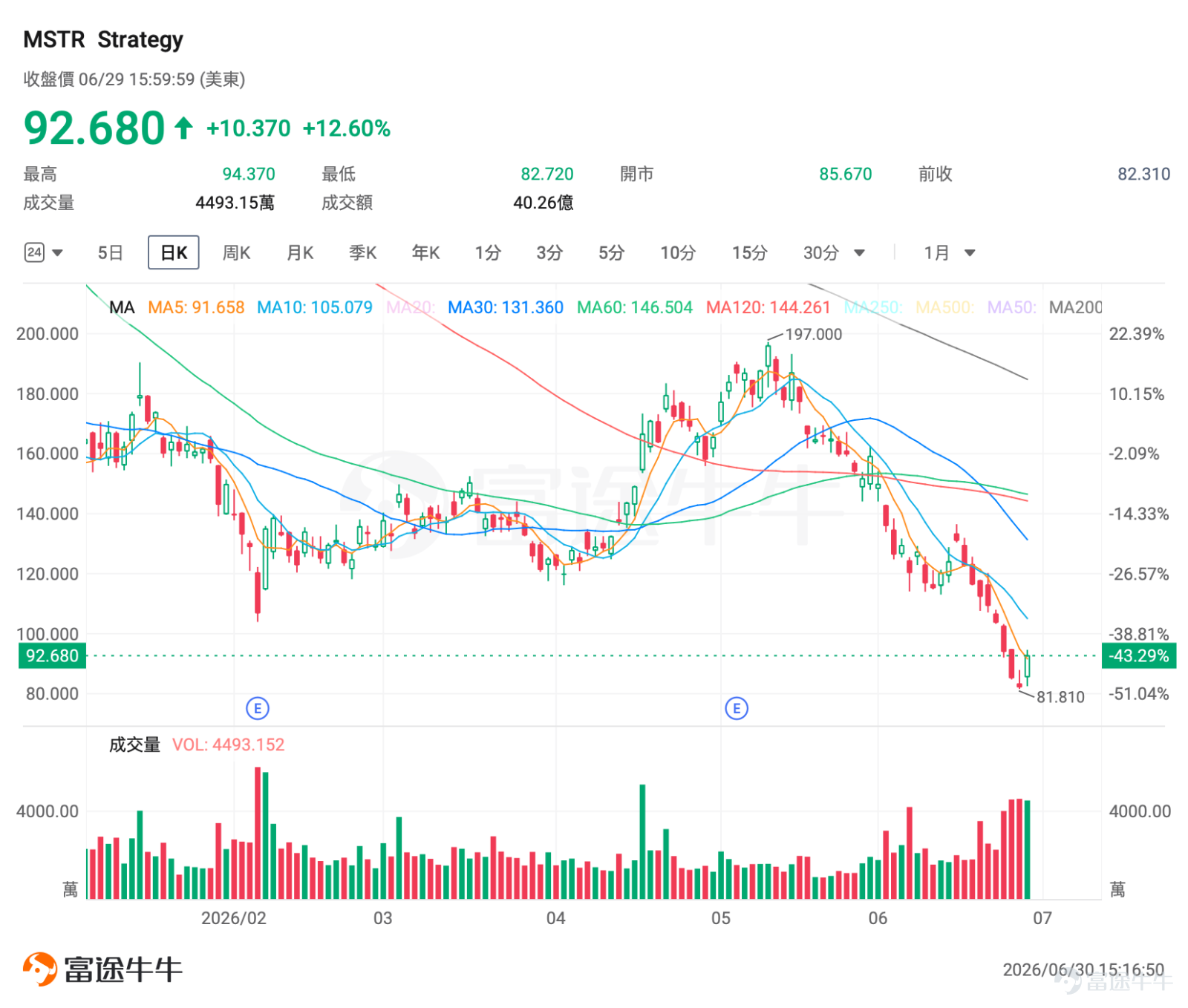
$Strategy (MSTR.US)$ The stock rose 12.6% in the previous session to close at $92.68, marking a sharp rebound after a prolonged recent plunge. The shares had declined for nine consecutive trading days prior, hitting a low of $81.81 on June 26, narrowing its year-to-date loss to approximately 39%.

From a technical perspective, the strong bullish candle with elevated volume following a sustained downtrend is a classic sign of a sharp oversold bounce.The significant increase in trading volume accompanying the long bullish candle clearly signals short-term oversold recovery, though sustainability will depend on continued volume support. Over a longer timeframe, $Strategy (MSTR.US)$ the stock remains in a deep correction phase, having retraced roughly 82% from its peak of $457.22, with the current price well below both the 50-day and 200-day moving averages.
In the options market, implied volatility has soared to 105%, and the put/call volume ratio stands at 1.25, indicating highly crowded bearish sentiment.

The core catalyst for this reversal stems from the company's announcement on Monday of its 'Digital Credit Capital Framework' and a major capital restructuring plan. The company has formally authorized the sale of up to $12.5 billion worth of Bitcoin to bolster its cash reserves and simultaneously launched two $1 billion share repurchase programs—one for common stock and another for preferred stock. This move marks Strategy’s first departure from its long-standing 'buy-only' Bitcoin philosophy, shifting its financial strategy from aggressive accumulation toward liquidity management, capital discipline, and securities repurchases.
The market interpreted this as a positive signal of proactive capital structure management amid simultaneous equity and bond sell-offs, driving a sharp rebound in the stock price.
This move comes against the backdrop that the company’s market capitalization has already fallen below $Bitcoin (BTC.CC)$ the value of its Bitcoin holdings. According to Reuters, the company currently holds 847,363 Bitcoins, valued at approximately $50.4 billion based on Bitcoin’s Sunday closing price of around $59,500, while its market cap stands at only about $29.54 billion. This deep discount trading dynamic, combined with the repurchase commitment, has triggered aggressive buying interest. The company also raised the dividend rate on its STRC preferred shares to 12% to support their market price.
On the downside, Bitcoin continues to trade below $60,000, and sentiment across the broader crypto market remains weak. All four of the company’s preferred share series are trading near historic lows, putting pressure on its funding channels. Additionally, MSTR’s medium-term downtrend has yet to reverse, and despite the single-day rebound, it still faces profit-taking pressure and ongoing trend resistance.
III. Seller Options Strategy
1. Cash Secured Put
Sell 1 contract of $Strategy (MSTR.US)$ 20260731 60P, estimated margin requirement (for reference only): $6,000 ($60 × 100)

Opportunity filtering logic:
For investors who recognize the intrinsic value of Strategy’s Bitcoin holdings but have not yet established a position, the stock has surged violently following the strategic pivot. However, short-term market sentiment remains highly unstable. The company’s holding of 847,000 Bitcoins provides a clear anchor for asset valuation, and the new capital restructuring framework is expected to alleviate market concerns over its liquidity pressures.
Nevertheless, the company’s current market capitalization is significantly below the value of its Bitcoin holdings. Investors could consider selling put options: if the stock consolidates near current levels or continues to stabilize, they can collect premium income in this high-volatility environment; if the share price retests lows due to persistently weak Bitcoin prices, they would have the opportunity to establish a position at a more prudent cost basis.
2. Covered Call

Opportunity filtering logic:
For investors already holding MSTR and facing substantial unrealized losses, although the stock has stabilized somewhat following the sharp rebound, the negative gamma environment in the options market could amplify downward price volatility in the near term.
If investors remain bullish on Bitcoin’s long-term value and the company’s position as the largest corporate holder, yet are concerned about potential near-term downward pressure on Bitcoin’s price from a strategic shift and believe market confidence will take time to recover, they could sell call options. If the stock price consolidates in the current range, the premium income would gradually lower their cost basis; if the stock continues rebounding toward the strike price—driven by expectations of the buyback program and improved liquidity—it would effectively allow them to exit at a predetermined level, achieving a staged stop-loss.
IV. Risk Control Reminder
Although the seller strategy has a high probability of success, investors must still manage risks effectively:
– Position management is key:The biggest risk for option sellers lies in black swan events. It is recommended that margin exposure for a single underlying should not exceed 20% of total capital. Never sell options beyond your capacity for the sake of greedy premiums.
– Timely rolling of covered call options: When a covered call option becomes deeply in-the-money (stock price far exceeds the strike price), and if the underlying stock is still viewed favorably, decisively 'roll' the position — that is, close the current option by buying it back and simultaneously sell an option with a later expiration date and a higher strike price to avoid having the stock called away at a low price.
– Cash-secured put options warn of 'left-tail risk':For cash-secured puts, if the stock price collapses due to deteriorating fundamentals (rather than a normal pullback), do not hold on stubbornly. At this time, stop losses should be executed, or 'rolling down' can be employed to buy time and wait for volatility to normalize.
Make good use of the options seller zone to understand the income strategies for selling optionsEarn option premiums!
Make good use of the options seller zone to understand the income strategies for selling optionsEarn option premiums!

Options Risk Warning
An option is a contract that grants the holder the right—but not the obligation—to buy or sell an underlying asset at a predetermined price on or before a specified date. Option prices are influenced by multiple factors, including the current price of the underlying asset, the strike price, time to expiration, and implied volatility. Implied volatility reflects the market’s expectation of future price fluctuations over the life of the option and is derived by reverse-engineering the Black-Scholes pricing model. It is commonly used as a gauge of market sentiment. When investors anticipate greater volatility, they may be willing to pay higher premiums for options to hedge risk, leading to elevated implied volatility. Traders and investors use implied volatility to assess the relative attractiveness of option prices, identify potential mispricings, and manage risk exposure.
Disclaimer
This content does not constitute any offer, solicitation, recommendation, opinion, or guarantee for any securities, financial products, or tools. The risk of loss in trading options can be substantial. In some cases, losses incurred may exceed the initial margin deposited. Even if you set contingency orders, such as 'stop-loss' or 'limit' orders, these may not necessarily prevent losses. Market conditions may make such orders unexecutable. You may be required to deposit additional margin within a short period. If you fail to provide the required amount within the specified time, your open positions may be liquidated. However, you will still be responsible for any shortfall in your account resulting from such liquidation. Therefore, before trading, you should study and understand options and carefully consider whether such trading suits you based on your financial situation and investment objectives. If you trade options, you should be familiar with the procedures for exercising options and the rights and obligations upon expiration. Options trading involves extremely high risks and is not suitable for all investors. Investors should read Characteristics and Risks of Standardized Options carefully before engaging in any options trading strategy.
Risk Disclaimer: The above content only represents the author's view. It does not represent any position or investment advice of Futu. Futu makes no representation or warranty.Read more


Comments (3)
to post a comment
10
6