
$100 Options Opportunity Pool | Hedge ahead of Nonfarm Payrolls? Bet on memory chip rebound? Critical decisions before Independence Day
Hello fellow investors, welcome to this week’s 'Playing Options with $100' opportunity pool! Each week we focus on clear market themes and highlight noteworthy low-barrier options opportunities. We don’t talk about once-in-a-lifetime windfalls; instead, we explain the rationale, whether it’s worth watching, and where the risks lie.
【📢 The '$100 Options Play' series now has its own dedicated account! If you find this series helpful and want to be the first to see our weekly opportunity pool updates and Friday recaps, fellow investors, remember to hit follow~
Market Focus This Week
US stock markets will have only four trading days this week—closed on Friday for the Independence Day holiday.And right on Thursday (July 2), the US will release its June nonfarm payrolls report. Remember the May report released in early June? Payroll gains far exceeded expectations, sparking market concerns that Federal Reserve rate cuts were nowhere in sight, sending all three major indices sharply lower that day.Could this month’s nonfarm payrolls report trigger a similar reaction?
Meanwhile, the memory chip sector has received another major catalyst this week:The South Korean government just announced its largest-ever industrial investment plan, under which Samsung $CSOP Samsung Electronics Daily (2x) Leveraged Product (07747.HK)$ and SK Hynix $CSOP SK Hynix Daily (2x) Leveraged Product (07709.HK)$ will each build two new chip fabrication plants, aiming to double DRAM capacity within five years.
Combined with news of SK Hynix’s upcoming US listing in July and Apple lobbying to source Chinese-made memory chips, the memory sector remains red-hot. However, Apple’s recent product price hikes briefly triggered a sell-off last week—investors feared downstream demand would suffer. After this bout of sentiment-driven volatility, can memory stocks restore confidence and regain upward momentum?
These two themes—one centered on macro-driven risk aversion, the other on sector rebound—are both ideal scenarios for expressing views via options: the former bets on direction, while the latter plays for elasticity. Let’s break them down one by one.
Target One: $SPDR S&P 500 ETF (SPY.US)$
The nonfarm payrolls report is one of the most important monthly macro events for US equities. Last month (the May report released in early June), the data came in significantly stronger than expected. The market interpreted it as 'the economy is too strong → no rate cuts in sight,' causing the S&P 500 to plunge that day, with tech stocks falling even more sharply.
The June nonfarm payrolls report due this Thursday also warrants caution: if the data comes in hot again, markets could revert to risk-off mode; furthermore, with markets closed on Friday, any panic selling at the close on Thursday would leave investors no opportunity to adjust their positions the next day, potentially amplifying volatility.
Why can SPY options be used to express a market view?
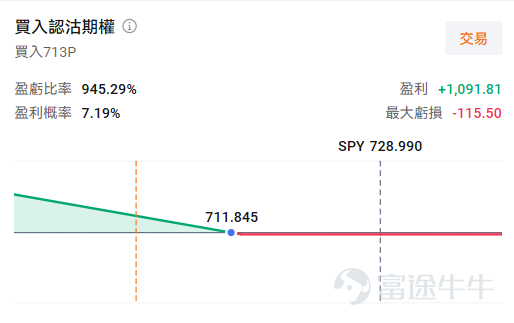
If you want to hedge your broad market exposure ahead of the nonfarm payrolls release, SPY is the most convenient tool. First, SPY is one of the most liquid ETFs globally, with exceptionally deep options markets, tight bid-ask spreads, and low transaction costs.
Second, SPY offers zero-days-to-expiration (0DTE) options, allowing you to precisely select contracts expiring on Thursday—avoiding paying for extra days of time value. Since the nonfarm payrolls data is released on Thursday, you’re betting on the market’s immediate reaction, making same-day-expiry options ideal.Finally, the volatility of a broad-market ETF like SPY is generally more predictable than that of individual stocks, reducing the risk that unexpected company-specific news derails your intended trade.

(The design images displayed on the screen are for demonstration purposes only and do not constitute any investment advice or guarantee; market conditions fluctuate frequently, and the option prices shown in the illustration do not represent actual situations. The filtering criterion is options with a unit price around 1 dollar.)
Additionally, if your portfolio has a significant concentration in technology stocks, you might also consider using $Invesco QQQ Trust (QQQ.US)$ as a hedging vehicle. Like SPY, it is a broad-market ETF, but its holdings are more concentrated in large-cap tech stocks.
Bearish rationale (the logic behind this put position’s profitability):
Fear of history repeating itself: The June nonfarm payrolls already shocked markets earlier this month. Investors now reflexively interpret strong data as a signal that rate cuts will be delayed—which they view as bearish.
Holiday liquidity trap:Markets are closed on Friday; if selling pressure emerges at the close on Thursday, short sellers will face no need to cover positions, potentially allowing the downtrend to continue on momentum.
The S&P 500 currently trades at a price-to-earnings ratio in the historically high range; if expectations for rate cuts are delayed, high-valuation sectors will be the first to face repricing pressure.
Downside risks:
Disappointing data could paradoxically become bullish: if June’s nonfarm payrolls come in weaker than expected, the market may interpret it as raising the likelihood of rate cuts, driving prices higher immediately.
The market has already priced it in: following the last nonfarm payroll shock, investors may now be psychologically prepared, leading to a muted reaction this time.
A potential oversold bounce:The S&P 500 declined for five consecutive days last week. Although the weekly loss was modest overall, the technically oversold condition may prompt bulls to push prices higher on the back of exhausted bearish sentiment following the nonfarm payroll data.
Target Two: $Roundhill Memory ETF (DRAM.US)$
Leading semiconductor companies listed on U.S. exchanges $Micron Technology (MU.US)$ 、 $SanDisk (SNDK.US)$ have surged significantly, with share prices now reaching into the thousands of dollars, making equity options prohibitively expensive. Memory chip leaders such as Samsung and SK Hynix are listed in Korea, so U.S. investors cannot directly trade their options.
The DRAM-focused memory ETF offers a precise tool for expressing views on the memory sector—more targeted than broad semiconductor ETFs—and trades at just tens of dollars, significantly lowering the barrier to options positioning.
Memory chips received a national-level catalyst this week: the South Korean government announced its largest-ever industrial investment plan, under which Samsung and SK Hynix will each build new memory chip fabrication plants, aiming to double Korea’s DRAM production capacity within five years.This is not minor corporate maneuvering, but a state-driven capacity arms race.
Meanwhile, SK Hynix has confirmed its U.S. listing in July, and Samsung is also considering following suit; the 'Korea discount' is being repriced by capital markets. $Apple (AAPL.US)$ Lobbying the U.S. government to procure memory chips from China's ChangXin Memory underscores the immense global pricing pressure in the memory market—even Apple is seeking ways to cut costs. Earlier reports of Apple raising product prices briefly triggered a sell-off in memory stocks, but the price hikes themselves signal tight supply-demand conditions, and once sentiment stabilizes, it could present a buying opportunity.

(The design images displayed on the screen are for demonstration purposes only and do not constitute any investment advice or guarantee; market conditions fluctuate frequently, and the option prices shown in the illustration do not represent actual situations. The filtering criterion is options with a unit price around 1 dollar.)
Bullish rationale:
South Korea’s national-level capacity investment: a five-year plan to double DRAM output shows the country is betting big on the memory industry, which is a long-term positive for leaders like Samsung and SK Hynix and could also lift U.S.-listed memory names like Micron.
Korea’s memory duopoly heading to the U.S.: SK Hynix will list on Nasdaq in July, and Samsung is also mulling a move, boosting capital market attention and potentially leading to a re-rating of the entire memory sector.
Apple’s lobbying = indirect confirmation of supply-demand tightness: even the world’s largest smartphone maker is scrambling to find alternative suppliers to control costs, underscoring that memory price hikes are a real pain point.
Downside risks:
Concerns about cyclical peaks: Historically, the memory industry has repeatedly followed the pattern of 'price surge → capacity expansion → oversupply → crash.' Large-scale expansion plans themselves may signal that the cycle is nearing its peak.
Macro risk spillover: If this week’s nonfarm payroll data triggers a broad market correction, memory ETFs are unlikely to remain insulated.
Important Reminder
Options may expire worthlessIf the market moves contrary to expectations before expiration, the purchased options could become worthless.
There is interlinkage among the underlying assets.: If the non-farm payroll data triggers a sharp market sell-off, memory ETFs will also be dragged down—puts on SPY may profit, but calls on DRAM stocks could simultaneously suffer. Please pay attention to your entry timing and position sizing.
Entry Timing: The non-farm payroll data is released at 20:30 Beijing time on Thursday evening. If you plan to use SPY puts for hedging,it’s advisable to establish your position before the data release rather than after (options trading is not available in pre-market sessions).—by the time the data is out, the market will likely have already fully priced it in.
Not comfortable with options basics? Study up before jumping in.
If you're still a bit fuzzy on concepts like 'What is a Long Call?' or 'How do I read strike prices?', don't rush to place an order—take some time first to solidify your fundamentals.Here’s a curated list of practical beginner resources—recommended for bookmarking:
Finally, here's a small perk for fellow Futubull investors, welcome to claim it.Options Beginner Pack~
This event is exclusively for invited HK users. Click to learn more.Detailed event rules>>

Disclaimer
This content does not constitute any offer, solicitation, recommendation, opinion, or any guarantee of any securities, financial products, or tools. The risk of loss in trading options can be substantial. In some cases, losses may exceed the initial margin deposited. Even if stop-loss or limit orders such as "stop-loss" or "limit" are set, they may not prevent losses. Market conditions may cause these instructions to be unexecuted. You may be required to deposit additional margin within a short period. If you fail to provide the required amount within the specified time, your open positions may be liquidated. However, you will still be responsible for any shortfall in your account. Therefore, before trading, you should study and understand options and carefully consider whether such trading is suitable for you based on your financial situation and investment objectives. If you trade options, you should be familiar with the procedures for exercising options and the rights and obligations upon expiration, as well as your rights and responsibilities when exercising options and at expiration.
Risk Disclaimer: The above content only represents the author's view. It does not represent any position or investment advice of Futu. Futu makes no representation or warranty.Read more

Comments
to post a comment
25
19