
Global Weekly Insights | U.S. Q1 2026 GDP significantly revised upward; China’s LPR remains unchanged for consecutive periods
On the macroeconomic front
United States: Q1 GDP significantly revised upward, economic structure diverges, and inflation persistence intensifies
Last week’s U.S. macroeconomic data revealed stronger-than-expected economic resilience, entrenched high inflation, and divergent industrial trends. The final reading for first-quarter 2026 GDP growth was sharply revised upward to an annualized 2.1% quarter-over-quarter, a notable increase from the second estimate, marking a significant rebound from the weak fourth-quarter performance and exceeding market expectations for overall economic recovery.Growth dynamics showed a clear divergence—strong investment but weak consumption—with AI-driven corporate capital expenditures rebounding substantially,becoming the core driver behind the GDP upward revision and underscoring the boost from technological transformation to U.S. industrial investment; however, consumer spending momentum continued to wane, reflecting sustained pressure on household purchasing power from high interest rates and elevated prices, suggesting that business investment alone cannot sustain economic expansion over the long term.The labor market remained steadily resilient, with nonfarm payroll gains over the past three months improving significantly, providing a floor of support for domestic demand.Inflationary pressures intensified again, with the headline PCE price index rising 4.1% year-over-year in May and core PCE climbing to 3.4% year-over-year—the highest level in nearly three years—further reinforcing the Federal Reserve’s hawkish policy stance as inflation persistence strengthens.On the industrial front, durable goods orders in May declined sharply overall, primarily dragged down by defense and transportation equipment,but core capital goods orders excluding transportation continued to grow robustly, reflecting resilient underlying demand for medium- to long-term equipment investment and industrial upgrading, further highlighting the structural divergence within the U.S. economy.
China: LPR held steady again, monetary policy focuses on mechanism optimization with limited room for easing
Domestically in China, monetary policy maintained a prudent stance, with both the one-year and five-year Loan Prime Rates (LPR) left unchanged in June, continuing their multi-month period of stability. The policy rate anchor—the seven-day reverse repo rate—has remained unadjusted for an extended period, leaving little impetus for a reduction in LPR benchmarks.Meanwhile, commercial banks’ net interest margins remain persistently low, weakening the banking system’s willingness to reduce loan pricing spreads or cut lending rates, with multiple factors supporting stable interest rates.At the policy level, the focus is on institutional reforms rather than broad-based easing. At the Lujiazui Forum, the People’s Bank of China explicitly emphasized advancing the transition toward a price-based monetary policy framework, enhancing the precision of liquidity management by narrowing the operating band for short-term rates and diversifying overnight reverse repo instruments to better align with the banking system’s short-term funding needs.Overall, China’s current monetary policy remains stability-oriented, showing restraint toward broad-based easing, with its emphasis shifting toward refining the interest rate regulation framework,and improving policy transmission efficiency, thereby reinforcing financial system stability while leaving ample room for coordinated implementation of future fiscal and industrial policies.
In the equity market,
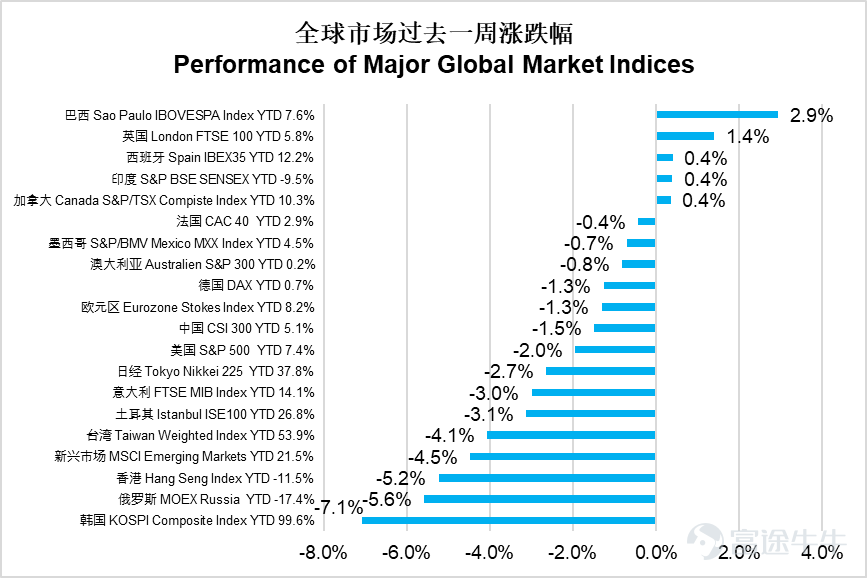
Global markets broadly corrected last week, with risk sentiment generally weakening,as most Asia-Pacific, emerging, and European markets declined in tandem, with only a few overseas markets posting gains against the trend.Asia-Pacific markets led the losses, with the KOSPI plunging 7.1%—the steepest drop globally. The MOEX Russia Index, Hang Seng Index, MSCI Emerging Markets Index, and Taiwan Weighted Index fell by 5.6%, 5.2%, 4.5%, and 4.1%, respectively, while the Nikkei 225 and CSI 300 also came under pressure. Most European markets edged lower, with Italy, the eurozone, Germany, and France all posting declines.Markets that defied the downtrend were concentrated in parts of the Americas and Latin America, with Brazil’s Ibovespa Index rising 2.9%, standing out positively,the FTSE 100 gained 1.4%, and Canada, India, and Spain posted modest gains. Overall, the market landscape showed a clear divergence: deep corrections in Asia-Pacific and emerging markets versus relative resilience in select developed markets.

Source: Wind
US equity markets broadly pulled back last week, $S&P 500 Index (.SPX.US)$ Down 2.0% for the week,Sector rotation was evident, with defensive sectors outperforming amid broad weakness in growth-oriented segments.Communication Services and Information Technology led the declines, plunging 6.2% and 5.4%, respectively, while Consumer Discretionary also fell 2.7%, reflecting significant pressure across growth-oriented sectors. Defensive sectors showed resilience, with Health Care surging 7.9% to lead all industries; Real Estate and Utilities rose 4.0% and 3.9%, respectively,Consumer Staples, Energy, Industrials, and Financials all posted gains, with only Materials posting a modest decline.Overall market risk aversion intensified, with capital clearly rotating from growth sectors into defensive and value-oriented segments.

Source: Wind
Hong Kong equities broadly corrected last week, with the Hang Seng Index down 5.2% for the week as all sectors weakened, led by cyclicals, consumer, and technology stocks,No sector finished in positive territory. Materials performed worst, plunging 14.9% for the week; Consumer Discretionary tumbled 10.5%; the Hang Seng Tech Index declined 7.6%; and Energy, Information Technology, and Industrials all dropped more than 5%. Real Estate & Construction, Telecommunications, Financials, Conglomerates, and Utilities also continued to retreat, while Health Care and Consumer Staples held up relatively better but still ended slightly lower.The market saw broad-based losses across all sectors, with cyclicals and growth stocks acting as the primary drags,Only Consumer Staples and Health Care experienced relatively limited drawdowns.

Source: Wind
Bond Market
Global bond markets continued to rally over the past week, with the Global Aggregate Index up 0.17%, the U.S. Aggregate Index rising 0.49%, U.S. investment-grade corporate bonds gaining 0.41%, and U.S. high-yield corporate bonds slipping 0.06%. The Emerging Markets USD Aggregate Index advanced 0.02%, while the China USD Credit Index rose 0.23%.

On interest rates, U.S. Treasury yields steepened in a bull-flattening move, with the 2-year yield falling 8 basis points to 4.09% and the 10-year yield also dropping 8 basis points to 4.37%.

Market outlook
– Markets were forced to shift from pricing in 'rate cuts within the year' to pricing in 'potential rate hikes,' raising the discount cost for long-duration assets.
The core market tension overseas has shifted from the earlier dynamic—'risk appetite recovery driven by fading geopolitical risk premiums'—to 'valuation headwinds stemming from sticky inflation and the Federal Reserve’s hawkish pivot.' This shift was reinforced by Waller’s unexpectedly hawkish debut remarks and the May core PCE price index jumping to 3.4%.This forced markets to pivot from expecting 'rate cuts this year' to pricing in 'potential rate hikes,' pushing 2-year Treasury yields higher.This directly increased the discounting cost for long-duration assets. The Nasdaq, Japanese and Korean equities, and emerging markets all declined—as the scenario of 'higher for longer' or even outright 'rate hikes' unfolded, AI-related computing power stocks, which had seen substantial gains and carried elevated valuations,along with tech growth and high-dividend long-duration assets, faced immediate profit-taking pressure, triggering synchronized valuation compression across global growth-style equities.
On the flip side lies heightened uncertainty surrounding geopolitics and oil prices.Although a U.S.-Iran memorandum of understanding briefly drove Brent crude sharply lower from its conflict-driven peak, effectively erasing the geopolitical risk premium,the U.S. military’s renewed strike on Iranian targets in the early hours of June 27 signaled that until a formal agreement is implemented and full navigation through the Strait of Hormuz is restored,the ceasefire remains extremely fragile, and any military friction could trigger a sharp, spike-like rebound in oil prices.This presents a double-edged sword: while falling oil prices ease inflationary pressures and boost consumer confidence, renewed tensions in the Strait that push oil prices higher could reinforce already sticky core inflation, further entrenching the Federal Reserve's hawkish stance and subjecting high-valuation assets to simultaneous pressure from rising rates and weakening earnings.
Key economic data and events this week
China will release its official PMI data for June on Tuesday;
The United States will release the ISM Manufacturing Index for June on Wednesday;
The United States will release nonfarm payrolls data for June on Thursday.
Disclaimer: The issuer of this report is E Fund Asset Management (Hong Kong) Co., Ltd. This report does not constitute an invitation or recommendation to invest in fund units. Fund unit subscriptions can only be made using application forms accompanied by the fund prospectus. Investment involves risks; fund prices may rise or fall, and past performance is not indicative of future results. Before investing, investors should carefully read the fund prospectus (including the 'Risk Factors' section) to understand the investment risks related to the fund. This report may only be distributed in certain jurisdictions. In any jurisdiction where distributing such information or making any invitation or recommendation is prohibited, or where distributing this report or making an invitation or recommendation to any person would be illegal, this report does not constitute such distribution or invitation or recommendation. This document has been exempted from prior review and approval by the Hong Kong Securities and Futures Commission, and has not been reviewed by the SFC. SFC approval does not imply promotion or endorsement of the plan, nor does it guarantee its commercial merits or performance, nor does it indicate suitability for all investors, or endorsement of suitability for any particular investor or category of investors. All rights reserved © 2026. E Fund Asset Management (Hong Kong) Co., Ltd.
Risk Disclaimer: The above content only represents the author's view. It does not represent any position or investment advice of Futu. Futu makes no representation or warranty.Read more


Comments
to post a comment
2
1