
Google raises its capital expenditure guidance—can it carry the momentum through super earnings week

Daily Options Tracker | Micron Technology weakens in pre-market after a sharp rally; RKLB up 1.87%; Intel down -3.45%, Goldman Sachs sees long-term benefits from rising server demand
Today's Options Market Outlook
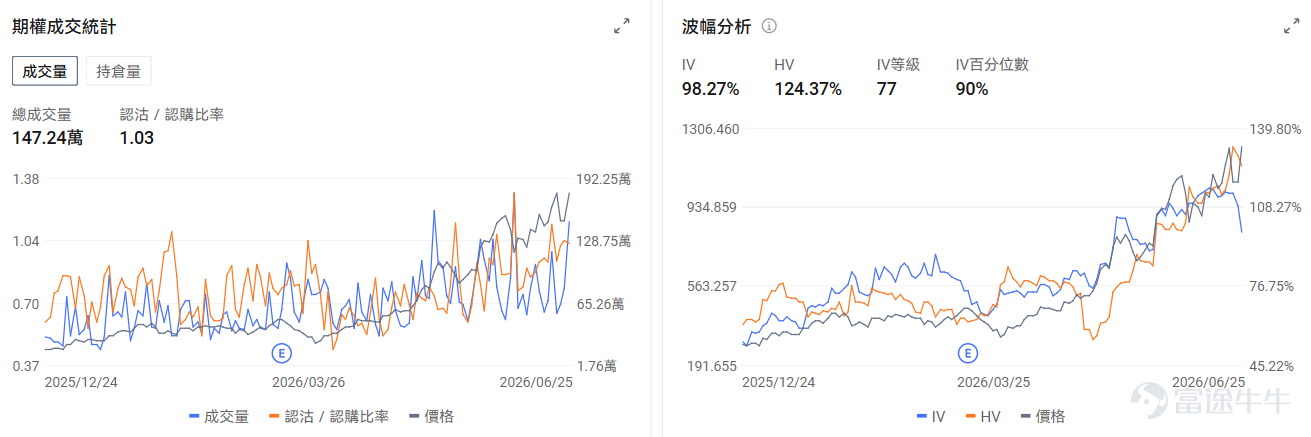
After Micron Technology’s earnings significantly beat expectations, the memory sector rose yesterday but pulled back in today’s pre-market. $Micron Technology (MU.US)$ Down -5.36%, $SanDisk (SNDK.US)$ Down -5.73%, $Western Digital (WDC.US)$ Down -4.2%. Options signals show Micron Technology's put/call volume ratio rose to 1.03 yesterday, with an implied volatility (IV) of 98.27% and IV percentile at 90%. Following a sharp post-earnings rally, the market deployed put options to hedge against potential pullback risk in the underlying stock.

$Rocket Lab (RKLB.US)$ Up 1.87% in pre-market trading. Rocket Lab will provide three Electron rocket launches for NASA’s two separate missions—PolSIR and TSIS-2—starting early next year, further differentiating its small-launch strategy from SpaceX's approach. Options signals indicate Rocket Lab’s put/call open interest ratio stands at 0.76, with an implied volatility (IV) of 87.45% and IV percentile at 32%, suggesting slightly stronger long-term bullish positioning.

$Intel (INTC.US)$ Down -3.45% in pre-market trading. Goldman Sachs initiated coverage on Intel with a 'Neutral' rating and a $150 price target. The firm expects Intel to benefit from rising server CPU demand driven by agent-based AI, forecasting that the GPU-to-CPU deployment ratio could gradually decline from 2x to approximately 1.1x–1.4x. Options signals show Intel’s put/call open interest ratio at 0.99, with an implied volatility (IV) of 96.49% and IV percentile at 98%, indicating significant expected price volatility and active use of put options for portfolio protection.

Review of yesterday's options market
Index Options
On June 25 Eastern Time, U.S. equity index options market volume declined, with a total of 6.08 million contracts traded. The put/call volume ratio rose to 1.18.
As the upcoming expiration date approaches,$S&P 500 Index (.SPX.US)$ Options volume distribution shows the following characteristics: peak put option volume at the 7,300 strike, and peak call option volume at the 7,400 strike.

Single Stock Options
$Micron Technology (MU.US)$ Closed up 15.74%, with 1.4724 million options contracts traded, and the put/call volume ratio dropped to 1.03. Micron Technology reported third-quarter revenue of $41.46 billion, up 346% year-over-year, significantly beating expectations and raising guidance for the fourth quarter.

$Strategy (MSTR.US)$ Closed down 9.35%, with 818,600 options contracts traded, and the put/call volume ratio rose to 2.18. Strategy shares have declined for seven consecutive days to $86, hitting their lowest level since February 2024, while its preferred shares (STRC) fell below par value, raising concerns about the sustainability of its financing model.

Top list of options trading volume
Among the top 10 stocks by options trading volume,$Strategy (MSTR.US)$ had the highest put/call volume ratio, reaching 2.18.


Implied volatility rankings (underlying market cap > $10 billion and options trading volume > 100,000)
$Bitdeer Technologies Group (BTDR.US)$Implied volatilityReached a high of 148.71%, up 2.22% from the previous trading day. Citizens JMP analyst initiated coverage of Bitdeer Technologies with a Buy rating and a $35 price target.

$Strategy (MSTR.US)$Implied volatility rose the most, reaching 119.33%, up 10.59% from the previous trading day.

Risk Warning
An option is a contract that gives the holder the right, but not the obligation, to buy or sell an asset at a fixed price on a specific date or before that date. The price of an option is influenced by various factors, including the current price of the underlying asset, the strike price, time to expiration, and implied volatility.
Implied volatility reflects the market's expectation of the option's volatility over a certain period in the future. It is derived inversely from the BS pricing model of options and is generally considered an indicator of market sentiment. When investors anticipate greater volatility, they may be more willing to pay higher prices for options to hedge risks, resulting in higher implied volatility.
Traders and investors use implied volatility to assessOption priceto enhance attractiveness, identify potential mispricing, and manage risk exposure.Disclaimer
This content does not constitute any offer, solicitation, recommendation, opinion, or guarantee of any securities, financial products, or tools. The risk of loss in trading options can be substantial. In some cases, losses may exceed the initial margin deposited. Even if you set contingent orders such as 'stop-loss' or 'limit' orders, these may not prevent losses. Market conditions may make such orders unexecutable. You may be required to deposit additional margin within a short period. If you fail to provide the required amount within the specified time, your open positions may be liquidated. However, you will still be responsible for any shortfall in your account. Therefore, before trading, you should study and understand options and carefully consider whether such trading is suitable for you based on your financial situation and investment objectives. If you trade options, you should be familiar with the procedures for exercising options and the rights and obligations upon exercise and expiration. Options trading carries extremely high risks and is not suitable for all investors. Investors should carefully readCharacteristics and Risks of Standardized Options。
This content does not constitute any offer, solicitation, recommendation, opinion, or guarantee of any securities, financial products, or tools. The risk of loss in trading options can be substantial. In some cases, losses may exceed the initial margin deposited. Even if you set contingent orders such as 'stop-loss' or 'limit' orders, these may not prevent losses. Market conditions may make such orders unexecutable. You may be required to deposit additional margin within a short period. If you fail to provide the required amount within the specified time, your open positions may be liquidated. However, you will still be responsible for any shortfall in your account. Therefore, before trading, you should study and understand options and carefully consider whether such trading is suitable for you based on your financial situation and investment objectives. If you trade options, you should be familiar with the procedures for exercising options and the rights and obligations upon exercise and expiration. Options trading carries extremely high risks and is not suitable for all investors. Investors should carefully readCharacteristics and Risks of Standardized Options。
Risk Disclaimer: The above content only represents the author's view. It does not represent any position or investment advice of Futu. Futu makes no representation or warranty.Read more


Comments
to post a comment
5
2