
The storage sector's big three report earnings next week! Can their high momentum continue?

Quick Recap of $100 Options Trades | Micron’s Earnings Ignite a Memory Rally—Enter via ETFs at Low Cost! Optical Communication Small-Caps Pull Back Again
Hello, fellow investors. After riding this rollercoaster market, everyone surely knows by now that the keyword for this week’s market isAmplified volatility。
On Tuesday, $Korea Composite Index (.KOSPI.KR)$ panic selling hit the market, triggering concerns about tech stocks. The market then staged a strong two-day rebound, only to face another 'Black Friday' today, with South Korean stocks halting trading again due to circuit breakers. U.S. markets haven’t been quiet either—tech stocks have seen intense sector rotation, with some selling aggressively while others are rushing in to buy.Yet in such a highly volatile environment, fundamentally strong stocks have actually presented options traders with exceptional opportunities.
After Wednesday's market close, $Micron Technology (MU.US)$delivered an earnings report that stunned Wall Street and global markets alike—not only did its results, net profit, and guidance all significantly beat expectations, but more importantly, it secured a long-term contract of extraordinary value: customers paid a $22 billion deposit upfront for non-cancellable long-term agreements and locked in a pricing framework promising the 'most profitable gross margins in history.' Bank of America went so far as to declare, 'The memory supercycle could last until 2027 or even 2030.'
But there’s a practical issue here:Micron Technology’s stock is now trading above $1,000, $SanDisk (SNDK.US)$It even broke through the $2,000 mark. For investors with a $100 budget, buying call options on the underlying stock is simply too expensive. In this case, the DRAM ETF, which tracks the memory storage sector, becomes an accessible alternative.
On the other side, the speculative stock in the optical communications sector $POET Technologies (POET.US)$ continued its roller-coaster ride this week. Against the backdrop of waning sentiment across the entire sector, put options betting on a pullback delivered double-digit returns.
Today, we’ll break down these two plays: one is a call on the memory storage industry, and the other is a put on the speculative stock’s pullback.Two directions, two strategies—both with entry barriers at the $100 level.。
【📢 The '$100 Options Play' series now has its own dedicated account! If you find this series helpful and want to be the first to see our weekly opportunity pool updates and Friday recaps, fellow investors, remember to hit follow~
$Roundhill Memory ETF (DRAM.US)$ : Micron’s earnings report ignited the memory storage sector
This DRAM ETF tracks the global memory chip industry, with holdings including Micron Technology, Samsung Electronics, $Samsung Electronics (005930.KR)$ , SK Hynix $CSOP SK Hynix Daily (2x) Leveraged Product (07709.HK)$ and other key players. Its price movement essentially serves as a barometer for the memory storage industry’s cyclical trends.
This week's key catalyst, without a doubt, isMicron Technology's earnings report。
Just how explosive is this report? Three keywords: beat on results, long-term contracts locked in, and extended cycle.
First, the results themselves—both revenue and profit exceeded market expectations. But what truly electrified Wall Street were the details of the long-term agreements—Customers have already paid a $22 billion deposit, the contracts are non-cancellable, and they’ve accepted a pricing framework that Micron describes as 'the most favorable in its history.'What does this mean? It means Micron’s financial performance is highly secured for the next few years, with little risk of order cuts or price slashing during industry downturns.
On Thursday at the open, Micron’s stock jumped sharply and surged 15% for the day, leading the entire semiconductor sector higher. Naturally, the DRAM ETF also rose alongside it.
But here’s a risk signal worth noting: on Friday, South Korea’s stock market triggered a circuit breaker again。The tech sector faced massive sell-offs for the second time in a week, $Apple (AAPL.US)$Amid news of price hikes and reports that OpenAI has delayed its IPO, global market sentiment has cooled somewhat. Whether memory stocks can withstand the pressure from this broader tech-sector pullback remains something to watch closely.
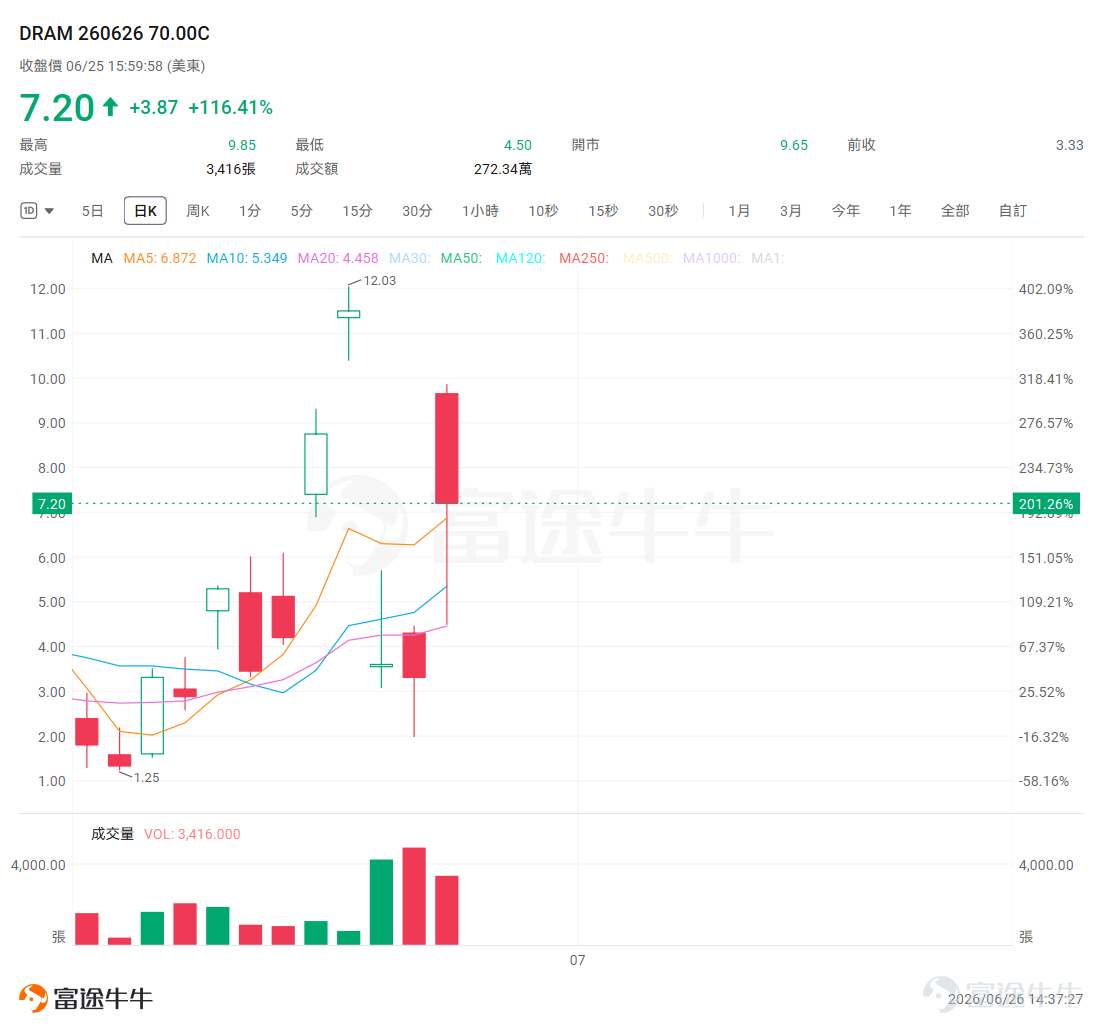
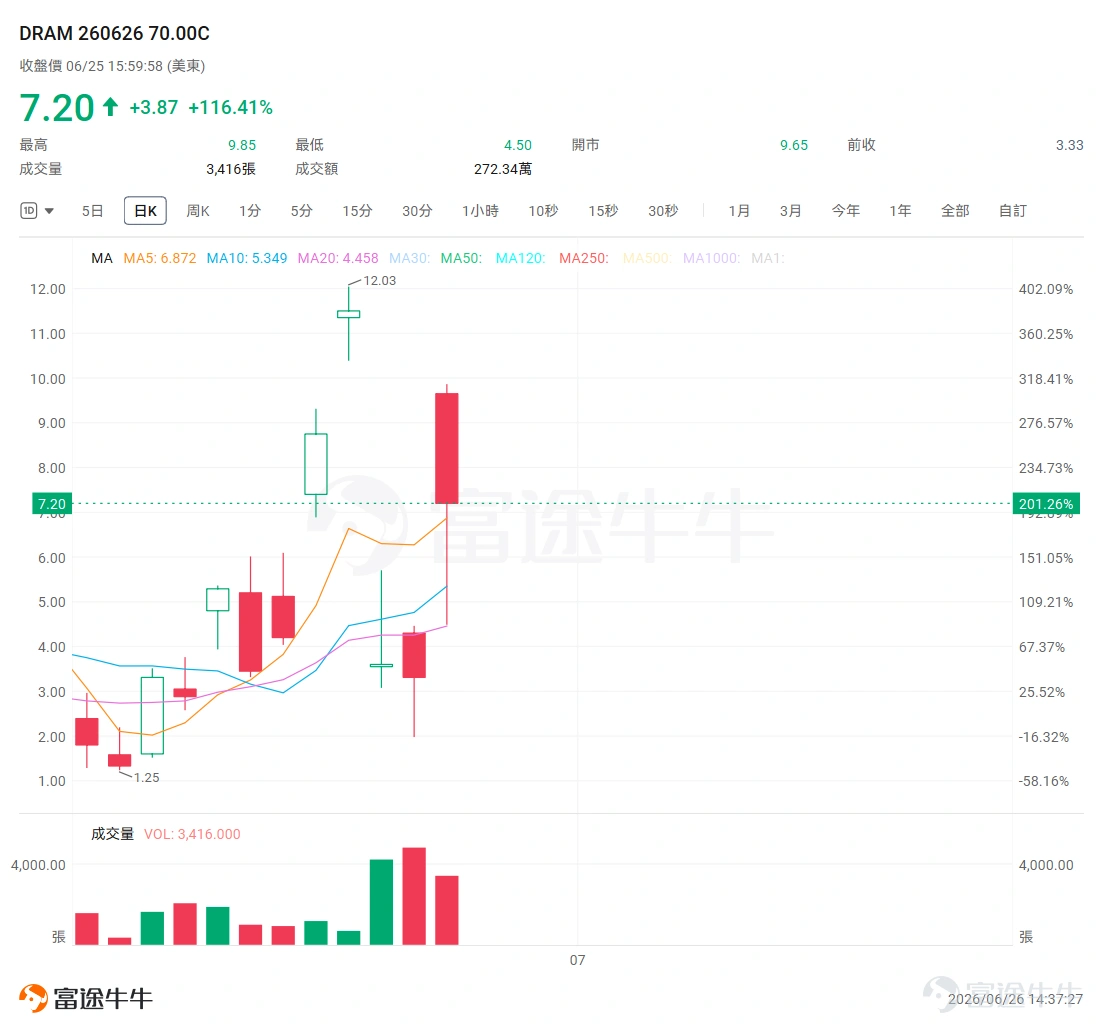
Let’s take a look at this contract:DRAM 260626 70.00C—a call option expiring on June 26 with a $70 strike price.
(The design images displayed on the screen are for demonstration purposes only and do not constitute any investment advice or guarantee; market movements are frequent, and the option prices shown do not represent actual conditions. The filtering criterion is options with an initial price below $3 per unit.)
As seen on the candlestick chart, this contract hit its lowest point around June 10$1.25. With more than two weeks left until expiration, this $70 call is out of the money (the underlying stock price is below the strike price). At $1.25 per contract, it meansone standard contract costs just $125—not much more expensive than a decent meal out.
Then, ahead of Micron Technology’s earnings release, market expectations started building, and the contract price gradually climbed into the $3–$5 range.
On Thursday, the earnings report came in, DRAM prices jumped sharply, and this call option surged instantly.. It hit an intraday high of $9.85 and closed at $7.20, surging 116% in a single day.
Let’s do the math:
– If you bought near the June 10 low at around $1.25 and held until Thursday’s close at $7.20,that’s a 476% gain—nearly sixfold.
– One contract would have grown from $125 to $720,netting a profit of $595.
– If you trimmed your position near the peak of $9.85, that would representa 688% return—close to eight times your initial investment.
Even if you didn’t enter at the absolute bottom but instead bought around $3 a few days before earnings, you’d still have gained 140% by the time it reached $7.20.
Let’s emphasize this point:The leader in the memory/storage sector has seen its share price rise so significantly that it’s become too expensive for small-capital investors; ETF options offer a more accessible alternative.. The DRAM ETF trades around $70 per share, so the absolute prices of its options are also lower.A $1.25 call option means you can risk just $125 to speculate on a sector-level event in the memory industry.
That’s the magic of options: for a cost in the hundreds of dollars, you can participate in earnings-driven moves of companies with market caps in the hundreds of billions.。
Of course, the risk is symmetrical. This contract expires tomorrow (June 26). If you don’t take profits promptly after the earnings release, even if the underlying stock trades flat afterward, time value will rapidly decay to zero.End-of-life options are like fireworks—most brilliant at the moment they explode, but you must exit before they fade out.。
Additionally, there’s also a 2x leveraged ETF version of DRAM. $Roundhill T-REX 2X Long DRAM Daily Target ETF (RAM.US)$ . Options on leveraged ETFs exhibit even greater volatility and higher payoff potential, but also suffer from larger decay—For beginners, the standard DRAM ETF is already exciting enough; proceed with extreme caution if considering the leveraged version.
$POET Technologies (POET.US)$ : Optical communications 'meme stock' pulls back
POET Technologies is a small-cap company in the optical communications space, specializing in photonic integration technology. Such companies typically feature strong conceptual appeal, small market capitalization, and high volatility—classic traits of a 'meme stock.'
Over the past few months, the optical communications sector rode the AI computing narrative for a rally, and POET Technologies was also favored by capital. But the problem is,The valuation of concept stocks relies heavily on sentiment and expectations; once the sector cools down, the sell-off can be severe.。
This week, sentiment across the entire optical communications sector has cooled somewhat.Against the broader backdrop of heightened market volatility, unless you're positioned in the market's most consensus-driven sector (this week, only memory/storage remains), small-cap speculative stocks are the first to take a hit.POET’s common stock has started retreating from its recent highs.
For such already overheated concept stocks,put options offering short-side exposure become a strategy worth considering.。
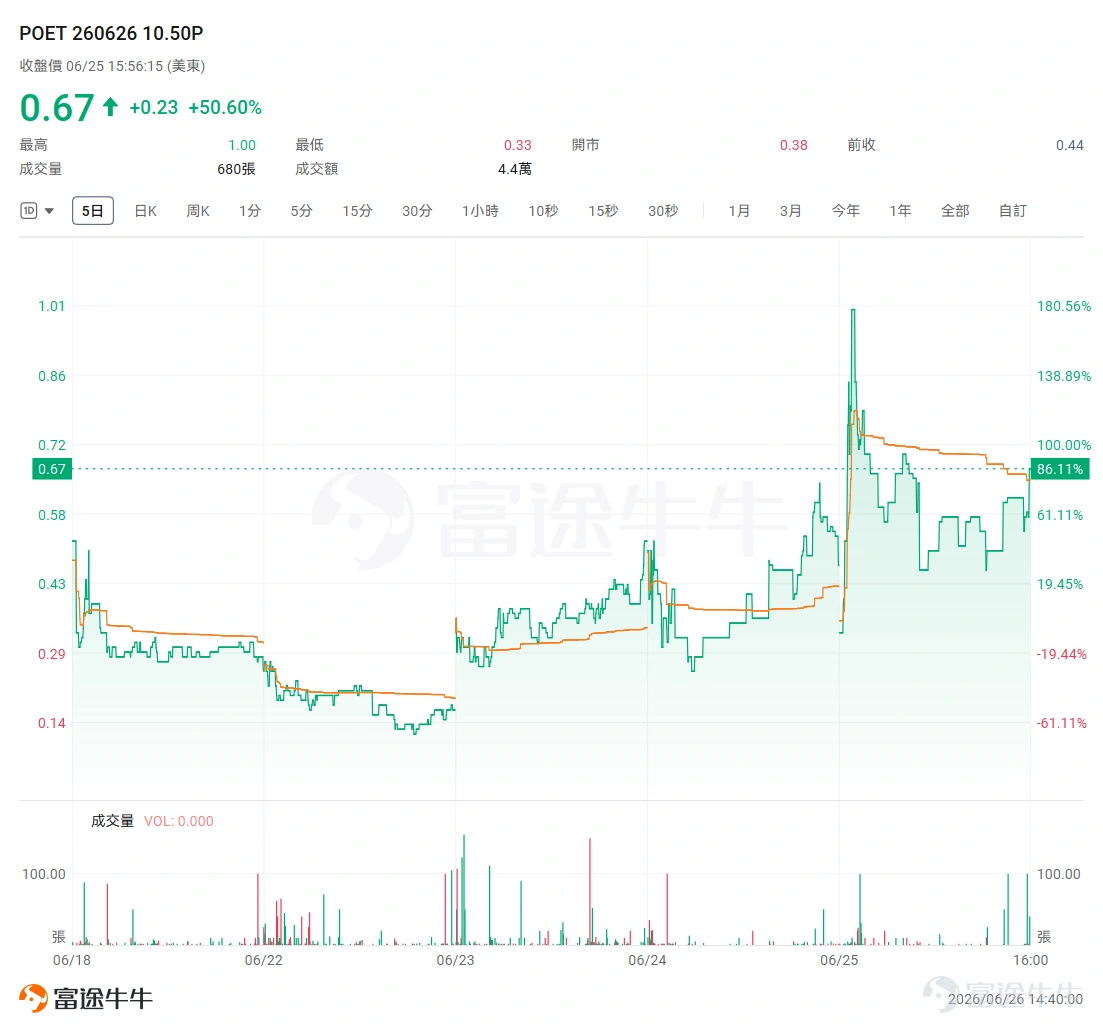
Let’s look at this contract:POET 260626 10.50P—a put option expiring on June 26 with a strike price of $10.50.
(The design images displayed on the screen are for demonstration purposes only and do not constitute any investment advice or guarantee; market movements are frequent, and the option prices shown do not represent actual conditions. The filtering criterion is options with an initial price below $3 per unit.)
On June 18, the price of this put option was aroundUSD 0.30about $0.30 per contract, meaning just $30 for one standard contract—a true 'cost of a meal' level.
Then, during this week, as the underlying stock pulled back, the put option started gaining strength. On June 25, the contract hit an intraday high of $1.00 and closed at $0.67, surging more than 50% in a single day.
Time to do the math:
If you entered at $0.30 on June 18 and held until Thursday's close at $0.67,that’s a 123% gain—more than doubling your money.
One contract went from $30 to $67,netting a $37 profit.
If you trimmed your position at the $1.00 intraday high, that would have beena 233% return—more than triple your initial investment.
Here, we need to emphasize a practical insight:Options on low-priced stocks have low absolute premiums and very accessible entry barriers, but liquidity is often an issue.。
This put option has a volume of only 680 contracts and a turnover of USD 44,000—compared with options on large-cap stocks like Micron Technology, $NVIDIA (NVDA.US)$the liquidity is several orders of magnitude worse.
What does poor liquidity mean?The bid-ask spread can be very wide—you may not get filled at your desired price when entering, and you might have to accept a discount when exiting.Therefore, for options on such small-cap stocks, it’s best to use limit orders rather than market orders that 'chase' the price.
Another characteristic is that low-priced stocks themselves tend to be highly volatile, and their options typically have high implied volatility (IV). High IV means the options are expensive, but it also means that if your directional bet is correct, the gains can be substantial.
Many beginners think of options only as 'buying calls to bet on upside,' butPuts are also a key weapon in the options toolkit.。
When you believe a stock faces near-term downside risk but want to avoid the unlimited risk of short selling via margin, buying a put offers a limited-risk alternative.Your maximum loss is limited to the premium paid for the put—unlike naked shorting, where a short squeeze could leave you questioning your life choices.。
The POET Technologies case is a classic example: after a speculative rally, a pullback was expected. A 10% drop in the underlying stock could easily double the value of the put—that’s the asymmetric payoff of options.
Of course, the risk of buying a put is that if the underlying stock rises instead of falling, your put can rapidly expire worthless.
Weekly recap: two directions, two strategies, same $100 entry barrier.
Reviewing these two positions:
Calls on DRAM, leveraging Micron Technology’s earnings report as a clear event-driven catalyst, offered a low-cost bet on the memory sector’s upcycle, with the core thesis being 'earnings realization + industry trend.'
Puts on POET Technologies, it’s about playing the pullback of a speculative stock at its high. From $0.30 to $0.67—a double in returns—the core thesis is "waning market sentiment + sector rotation."
The commonality between these two contracts is:Both have entry thresholds around the $100 level (or even lower), yet both offer the potential for returns exceeding 100%.。
Of course, high reward potential never comes for free:
If the DRAM call option isn’t taken off in time, it faces significant risk of losing all time value.
The POET put option suffers from poor liquidity, which may result in discounts on entry or exit.
Risks such as Korean market circuit breakers and tech stock pullbacks remain; whether the memory sector can sustain its strength is questionable.
$100 in, $1,000 out—options truly offer small accounts the chance to leverage big opportunities.. Of course, high reward potential never comes for free—choosing the right direction, timing, and position sizing are all essential. Understand first, then act. Get the rhythm right, and opportunities will never be in short supply. See you in our next recap~
Not comfortable with options basics? Study up before jumping in.
If, while reading this recap, you’re still unclear about basic concepts like 'What is a Long Call?' or 'How do I interpret strike prices?', don’t rush to place an order—take some time first to solidify your foundational knowledge. We’ve compiled practical beginner resources below; we recommend saving them for future reference:
Finally, here's a small perk for fellow Futubull investors, welcome to claim it.Options Beginner Pack
*This event is exclusive to invited HK users. Click to learn more.Detailed event rules>>

Disclaimer
This content does not constitute any offer, solicitation, recommendation, opinion, or any guarantee of any securities, financial products, or tools. The risk of loss in trading options can be substantial. In some cases, losses may exceed the initial margin deposited. Even if stop-loss or limit orders such as "stop-loss" or "limit" are set, they may not prevent losses. Market conditions may cause these instructions to be unexecuted. You may be required to deposit additional margin within a short period. If you fail to provide the required amount within the specified time, your open positions may be liquidated. However, you will still be responsible for any shortfall in your account. Therefore, before trading, you should study and understand options and carefully consider whether such trading is suitable for you based on your financial situation and investment objectives. If you trade options, you should be familiar with the procedures for exercising options and the rights and obligations upon expiration, as well as your rights and responsibilities when exercising options and at expiration.
Risk Disclaimer: The above content only represents the author's view. It does not represent any position or investment advice of Futu. Futu makes no representation or warranty.Read more

Comments (2)
to post a comment
17
17