
[IPO Update] Hangzhou Lingka Rushes Toward Hong Kong Listing: Revenue Surges, Profitability and Cash Flow Pressures Await Validation
Preface
On June 25, Hangzhou Lingka Technology Co., Ltd. (hereinafter referred to as 'Hangzhou Lingka') submitted an application for a main board listing on the Hong Kong Stock Exchange.
Hangzhou Lingka operates in the flexible staffing platform sector and, based on revenue in 2025, is China’s largest flexible staffing platform with a market share of approximately 17.2%. While the company has demonstrated rapid revenue growth over the past three years, its profitability quality and cash flow—metrics closely watched by Hong Kong IPO investors—remain at a stage requiring further validation.
For platform-based companies like this, the key determinant of future valuation upside lies in whether they can convert scale advantages into stable profits and consistent cash collection.
With rapidly scaling revenue, Hangzhou Lingka has already risen to the forefront of the industry.
From a business positioning perspective, Hangzhou Lingka primarily connects enterprise-side demand for flexible staffing with labor supply through its platform, serving sectors including catering, retail, tea and coffee shops, and hotels.
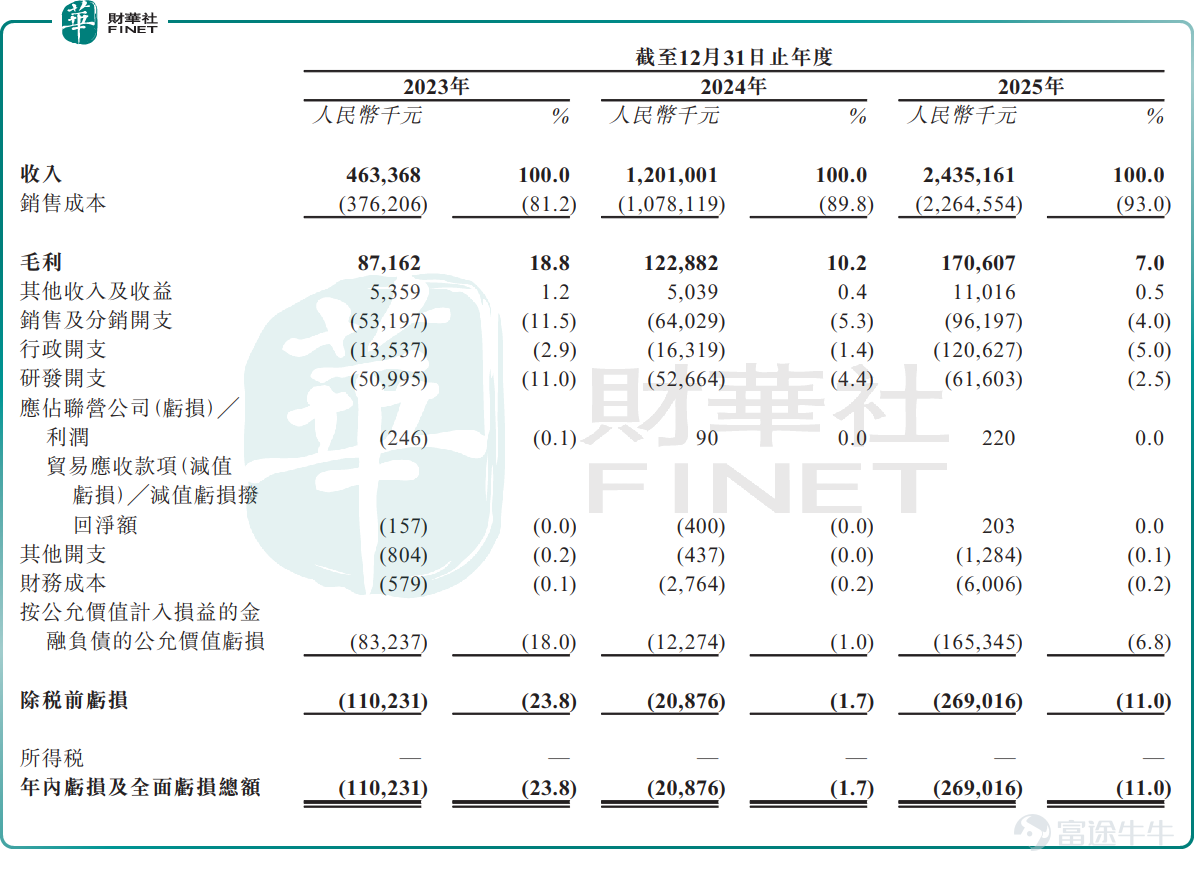
Financially, the company has shown significant revenue expansion over the past three years. From 2023 to 2025, Hangzhou Lingka’s revenue was approximately RMB 463 million, RMB 12.01 billion, and RMB 24.35 billion, respectively, demonstrating solid execution capability in client acquisition, fulfillment scale, and business ramp-up.

For the Hong Kong market, such high-growth narratives are not without appeal—particularly against the backdrop of ongoing digital transformation in services and untapped potential in human resource efficiency gains, which often draw initial interest from primary market investors toward platform companies.
However, strong revenue growth merely indicates that the company has 'gotten big'—it does not automatically prove that it has 'deepened' or 'stabilized' its operations. Hong Kong investors evaluating such businesses typically look beyond scale and focus more on whether the unit economics underlying that expansion have improved in tandem.
Declining gross margins and persistent losses show that the platform’s expansion has yet to cross the profitability threshold.
The core tension facing Hangzhou Lingka currently lies in the mismatch between its pace of growth and the quality of its profitability.
According to the prospectus, the company's gross profit margin was approximately 18.8%, 10.2%, and 7.0% in 2023, 2024, and 2025, respectively, showing a continuous downward trend. Meanwhile, the company reported net losses of approximately RMB 110 million, RMB 20.9 million, and RMB 269 million in those years. In other words, while revenue grew rapidly, gross margin did not improve correspondingly, and profitability failed to stabilize despite the scale-up.
This is particularly important for Hong Kong IPO pricing. After multiple rounds of market repricing in recent years, Hong Kong investors have adopted a more cautious approach to valuing platform-based and new economy companies. The market no longer assumes that higher market share automatically translates into future profitability. Instead, if a platform must continually offer concessions and sustain heavy investments during expansion—leading to shrinking gross margins or widening losses—investors are more likely to view such growth as 'high-cost growth' rather than 'high-quality growth.'
From this perspective, Hangzhou Lingka’s current industry leadership primarily reflects its achievement of scale, not yet the validation of its business model. To further enhance recognition from capital markets, the company must demonstrate that its revenue growth is not solely driven by high investment but can gradually translate into more stable profitability.
Persistent negative operating cash flow and high customer concentration impose additional constraints.
Cash flow often provides a more accurate reflection of a company’s true operational resilience than the income statement. Hangzhou Lingka’s performance in this regard also warrants careful scrutiny.
From 2023 to 2025, the company’s net cash used in operating activities amounted to approximately RMB 37.9 million, RMB 66.9 million, and RMB 79.4 million, respectively—marking three consecutive years of net outflows with an expanding scale. This indicates that the company has not yet developed a stable self-sustaining 'cash-generating' capability. While primary market investors in Hong Kong may tolerate losses per se, persistent operating cash outflows alongside losses prompt further questions: Is the company expanding too aggressively? Will it continue to rely on external financing? And when will its business model enter a cash recovery phase?

At the same time, Hangzhou Lingka exhibits relatively high customer concentration. From 2023 to 2025, revenue from its top five customers accounted for 59.5%, 74.1%, and 67.5% of total revenue, respectively, with the largest single customer contributing 33.4%, 41.0%, and 30.0%. This structure shows that the company’s revenue base remains heavily reliant on a few key clients. Any fluctuation in demand from core customers, changes in cooperation terms, or enhanced bargaining power could directly impact revenue stability and profit margins.
By contrast, the company’s supplier concentration is low. During the same period, purchases from its top five suppliers represented only 8.0%, 4.4%, and 2.9% of total procurement, indicating no significant dependency on the supply side. However, capital markets place greater emphasis on revenue sustainability when assessing platform businesses, making customer concentration a difficult issue for Hangzhou Lingka to avoid during its subsequent roadshow.
According to the prospectus, Hangzhou Lingka intends to allocate the proceeds from this offering across four main areas: (1) enhancing R&D capabilities and improving/expanding its platform and service offerings; (2) strengthening sales and marketing to increase market penetration and drive overseas expansion; (3) funding potential strategic investments and acquisitions; and (4) supplementing working capital and general corporate purposes.
From a Hong Kong market perspective, this fundraising rationale is understandable: platform companies typically allocate IPO proceeds toward technology, market expansion, bolt-on acquisitions, and working capital. However, what investors ultimately care about is not how the money is spent, but whether such spending genuinely enhances business quality. If continued R&D and marketing investments boost revenue without stabilizing gross margins, diversifying the customer base, or restoring positive cash flow, then the fundraising narrative will struggle to translate into meaningful valuation support.
Conclusion
Overall, Hangzhou Lingka is a flexible staffing platform with scalable operations and an established leading position in its niche segment. Its key attractions lie in rapid revenue growth, a prominent industry standing, and alignment with the broader trend of digital transformation in the service sector. However, its weaknesses are equally evident: persistently declining gross margins, three consecutive years of net losses, continuous negative operating cash flow, and high customer concentration.
Therefore, the core question raised by Hangzhou Lingka’s latest listing application is not whether it has growth potential, but rather when that growth will translate into profitability. For the Hong Kong stock market, valuation premiums for such companies hinge not on how compelling their growth story is, but on when their fundamentals are validated. Investors will likely focus on three key indicators going forward: whether gross margins stabilize, when operating cash flow improves, and whether the customer base becomes more diversified. Only with marginal improvements in these hard metrics can the company’s 'industry leader' label be credibly converted by capital markets into a genuine pricing premium.
Risk Disclaimer: The above content only represents the author's view. It does not represent any position or investment advice of Futu. Futu makes no representation or warranty.Read more
Comments
to post a comment