
Google raises its capital expenditure guidance—can it carry the momentum through super earnings week

Black Friday: Is the market offering another chance to get on board today?
On the morning of June 26, nearly the entire market plunged sharplywith the Nikkei dropping more than 4%, South Korea triggering another circuit breaker, and Hong Kong investors suffering the most—recently, Hong Kong stocks have consistently followed global declines but failed to participate in rallies.
Faced with such a panic-driven market, rational investors do not rush to sell out of fear; instead, they take the following steps:
1. Identify the underlying causes of the market move and assess the persistence of these drivers
2. Calmly review what aspects of their strategy worked well or poorly over the recent period
3. Prepare contingency plans for potential future scenarios
I. Market Movement Analysis
Today’s pullback was quite pronounced, primarily driven by two factors:
1. Persistent price increases in memory chips and upstream raw materials,have led the market to worry that downstream cloud service providers and consumer electronics firms may see profit margins squeezed under rising input costs.This is not the first time such a situation has occurred; going forward, we can monitor whether the interim reports of cloud vendors like Apple, Amazon, Microsoft, and Google show any impact on their earnings.
Take last night as an example: Micron surged while Apple fell, and executives from Apple and Micron publicly clashed over rising memory chip prices. Apple claimed that soaring memory costs forced it to raise product prices, while Micron countered that Apple had previously suppressed prices aggressively, leaving manufacturers unable to expand capacity and sowing the seeds for the current shortage.
2. The Korean market is stuck in a stalemate, with index weights nearing their ceiling, causing any rally to be mechanically sold off by index funds and pushing prices back down, while any decline triggers passive buying, creating a deadlock where neither gains nor losses can sustain. There are essentially three ways to break this gridlock:
a. First, global indices rallied strongly again, boosting market sentiment;
b. Second, awaiting the next quarterly rebalancing to adjust weightings;
c. Third, relying on buyback programs initiated by industry leaders like Samsung and SK Hynix to directly absorb selling pressure and support the index.
Looking back at previous phases of this bull market, similar situations have occurred before,sharp corrections have always been common in bull markets. If we examine the underlying logic,the revolutionary narrative around AI remains intact; it's just that profits are being pulled between upstream and downstream players. Moreover, considering that easing geopolitical tensions have driven oil prices lower,the Federal Reserve is expected to return to an accommodative monetary policy in Q3, which could usher in a trading theme centered on renewed monetary easing. With this in mind,the market volatility in June and July could actually present a good opportunity to position for the second half of the year。
However,Financial markets are always filled with uncertainty,Don't go all-in with maximum margin and triple-leveraged long positions just because someone mentions it's time to position!In the face of uncertainty, we should stay calm, review what happened, and thoughtfully plan our future strategy (see below).
II. Calmly Review What Happened
As the ancient saying goes: 'I examine myself three times each day.'We believe recent market volatility has reminded fellow investorsof the dangers of investing without protection. Sir Options has two friends: one went all-in with maximum margin and triple-leveraged long exposure, while the other consistently allocated 1% of profits each week—whenever gains surged—to buy out-of-the-money put options. After speaking with both, Sir found their cumulative returns were roughly similar, but the fellow investor who used protection clearly experienced smoother wealth growth with less volatility and slept far more soundly each night.
There’s a well-known saying in finance: Investing isn’t just about chasing returns—it’s also about sleeping well at night.
III. Prepare for Possible Future Scenarios
Scenario 1: Sustained high earnings growth + easing inflation
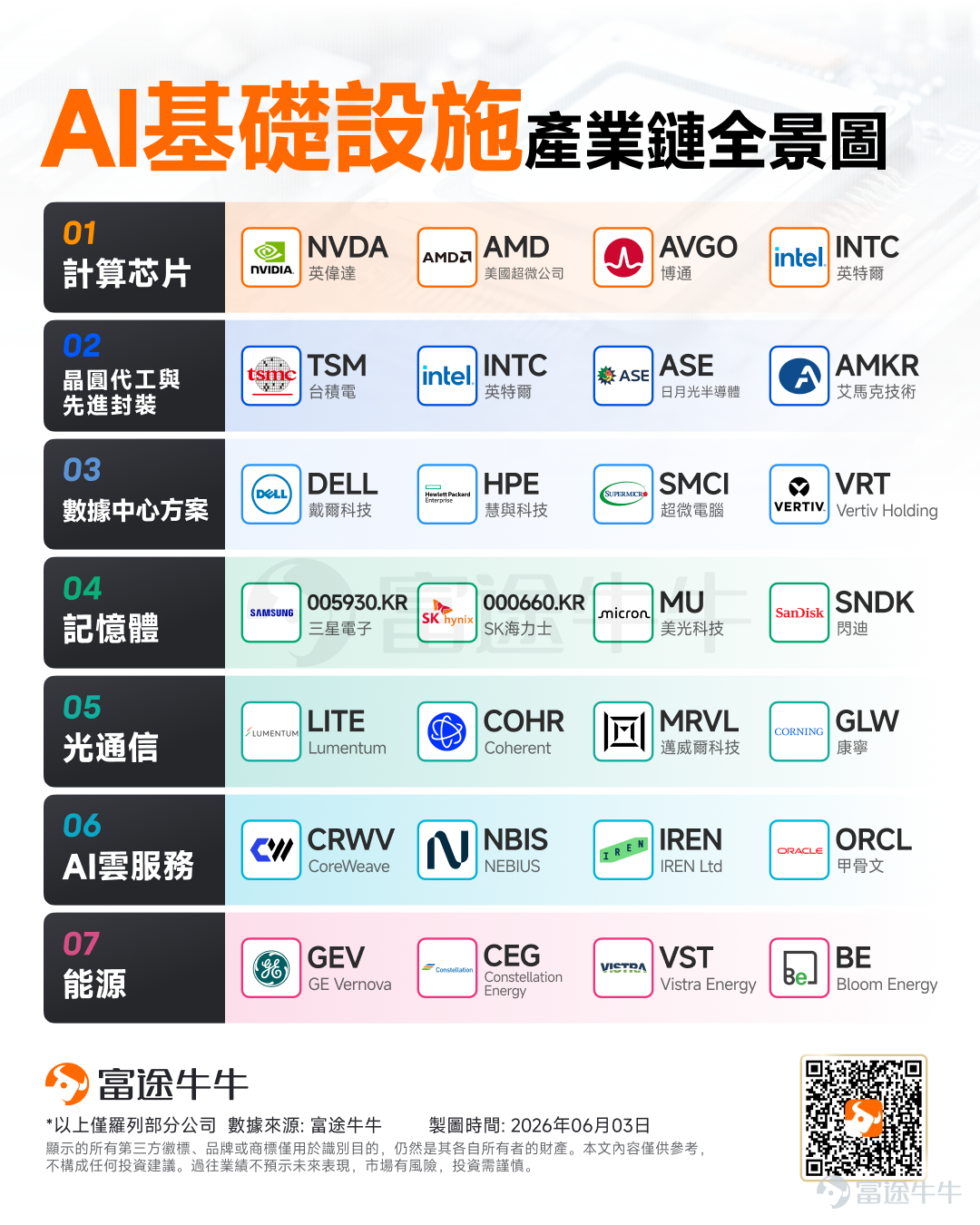
This is the most ideal scenario,Both the numerator (earnings) and the denominator (liquidity) receive a double boost.The technology sector is expected to continue hitting new highs under this scenario.AI computing power chains, cloud service providers, and others will all see rotation opportunities.Futubull previously compiled a comprehensive overview of the entire AI industry chain; fellow investors can take this market consolidation period to study it thoroughly.https://q.futunn.com/discussion/2145914000

Scenario 2: Sustained high earnings growth + sticky inflation
In this case, the market is likely to experience heightened volatility and indecision.Positive earnings momentum will clash with expectations of tightening liquidity—whichever side prevails will dictate market direction.Market volatility is expected to intensify; even sectors backed by strong earnings will likely rise in a choppy manner. Downstream segments lacking pricing power—such as consumer electronics and streaming services—will face pressure.The market index is fluctuating, but divergence among individual stocks and sectors is widening.
In this scenario, it may be prudent to focus on the AI industry chain—where earnings visibility is highest—and implement a long straddle options strategy.Leverage heightened market volatility to capture gains from increased price swings.

Scenario 3: Earnings miss expectations + inflation cools
Excessive upstream price hikes could dampen downstream demand, potentially leading cloud vendors to start reining in capital expenditures.However, a retreat in inflation would give the Federal Reserve room to cut rates quickly and significantly.This could lead to a sharp initial sell-off followed by a Fed-led rebound—a deep V-shaped recovery.Investing during such highly volatile conditions can be extremely challenging. If concerned about this scenario unfolding, investors should implement risk management measures in advance.
For investors worried about this situation, the best approach is to reduce position size,thereby shrinking exposure to risk.For a more aggressive approach, a bearish put spread strategy during a bear market can generate solid excess returns.

Scenario 4: Earnings miss expectations + sticky inflation
This is the worst-case scenario, with both earnings and liquidity exerting downward pressure on the market. If this occurs, the AI investment narrative will be temporarily disproven.Bulls retreat, bears take over,Only defensive sectors or assets—such as U.S. Treasuries, gold, and CTA strategies—would outperform the market.
In addition to adopting a multi-asset balanced allocation approach to enhance portfolio defensiveness,In such a black swan event, puts deliver the highest returns.It is a prudent choice to regularly allocate a small portion of unrealized gains—say, 1%—to purchase put options as a hedge against extreme scenarios.

Summary:
Market direction is hard to predict; volatility is the norm. As a mature investor,Go with the trend—don’t forecast, just respond.By allocating capital across different strategies, you can stay confident and agile in any market scenario—making investing a more enjoyable experience.
Finally, here's a small perk for fellow Futubull investors, welcome to claim it.Options Beginner Pack
*This event is exclusive to invited HK users. Click to learn more.Detailed event rules>>
Market conditions are complex and volatile,Options StrategyOverwhelmed by too many choices? Futubull helps you set up your portfolio in three simple steps.Options Strategymaking investing simple and efficient!

Option Risk Warning:An option is a contract that grants the holder the right—but not the obligation—to buy or sell an underlying asset at a predetermined price on or before a specified date. Option prices are influenced by multiple factors, including the current price of the underlying asset, the strike price, time to expiration, and implied volatility. Implied volatility reflects the market’s expectation of future price fluctuations over the life of the option and is derived by reverse-engineering the Black-Scholes pricing model. It is commonly used as a gauge of market sentiment. When investors anticipate greater volatility, they may be willing to pay higher premiums for options to hedge risk, leading to elevated implied volatility. Traders and investors use implied volatility to assess the relative attractiveness of option prices, identify potential mispricings, and manage risk exposure.
Disclaimer:This content does not constitute any offer, solicitation, recommendation, opinion, or guarantee of any securities, financial products, or tools. The risk of loss in trading options can be substantial. In some cases, losses may exceed the initial margin deposited. Even if you set contingent orders such as 'stop-loss' or 'limit' orders, these may not prevent losses. Market conditions may make such orders unexecutable. You may be required to deposit additional margin within a short period. If you fail to provide the required amount within the specified time, your open positions may be liquidated. However, you will still be responsible for any shortfall in your account. Therefore, before trading, you should study and understand options and carefully consider whether such trading is suitable for you based on your financial situation and investment objectives. If you trade options, you should be familiar with the procedures for exercising options and the rights and obligations upon exercise and expiration. Options trading carries extremely high risks and is not suitable for all investors. Investors should carefully readCharacteristics and Risks of Standardized Options。
Risk Disclaimer: The above content only represents the author's view. It does not represent any position or investment advice of Futu. Futu makes no representation or warranty.Read more


Comments (15)
to post a comment
69
124