
What's trending in US stocks | Earnings week for tech giants! Google, Tesla, and Intel all report re

ETF Showdown | Micron's earnings report sparks rally; SK Hynix surges to new highs! With its US listing grabbing headlines, how can you use ETFs to capture the 'memory cycle'?
This week's dramatic swings in the memory storage sector truly embody the old saying: 'The rougher the seas, the pricier the fish!' First, a sharp correction in South Korean stocks dragged down the sector, then Micron's better-than-expected earnings and SK Hynix’s U.S. listing boosted sentiment and sent memory stocks soaring again.
Why was the memory semiconductor sector so strong today?
The memory storage sector staged a broad-based rally today, with Hong Kong-listed memory-related stocks rebounding collectively, $GIGADEVICE (03986.HK)$ hitting a new all-time high, $CSOP SK Hynix Daily (2x) Leveraged Product (07709.HK)$ surging past HK$193 intraday to set a new record high and fully recoup yesterday’s losses; $CSOP Samsung Electronics Daily (2x) Leveraged Product (07747.HK)$ also jumped more than 10%.
The key catalyst behind today’s sharp rebound in memory stocks is Micron’s Q3 earnings significantly beating expectations! Micron’s earnings report essentially serves as a 'confirmation letter' of the sector’s strong cyclical momentum.。Micron’s latest FY2026 Q3 earnings report shows that robust and sustained demand for HBM (High Bandwidth Memory) from data centers drove both revenue and profits above Wall Street’s forecasts, ,and management’s guidance for next quarter also far exceeded market expectations.. This better-than-expected report directly boosted market confidence in a memory supercycle, with Micron $Micron Technology (MU.US)$ surging nearly 18% at one point after its earnings release.
SK Hynix’s U.S. listing: key takeaways for you
Beyond SK Hynix’s dramatic stock movement this week, news of its U.S. listing has also greatly lifted market sentiment.Fellow investors, here are the key takeaways:

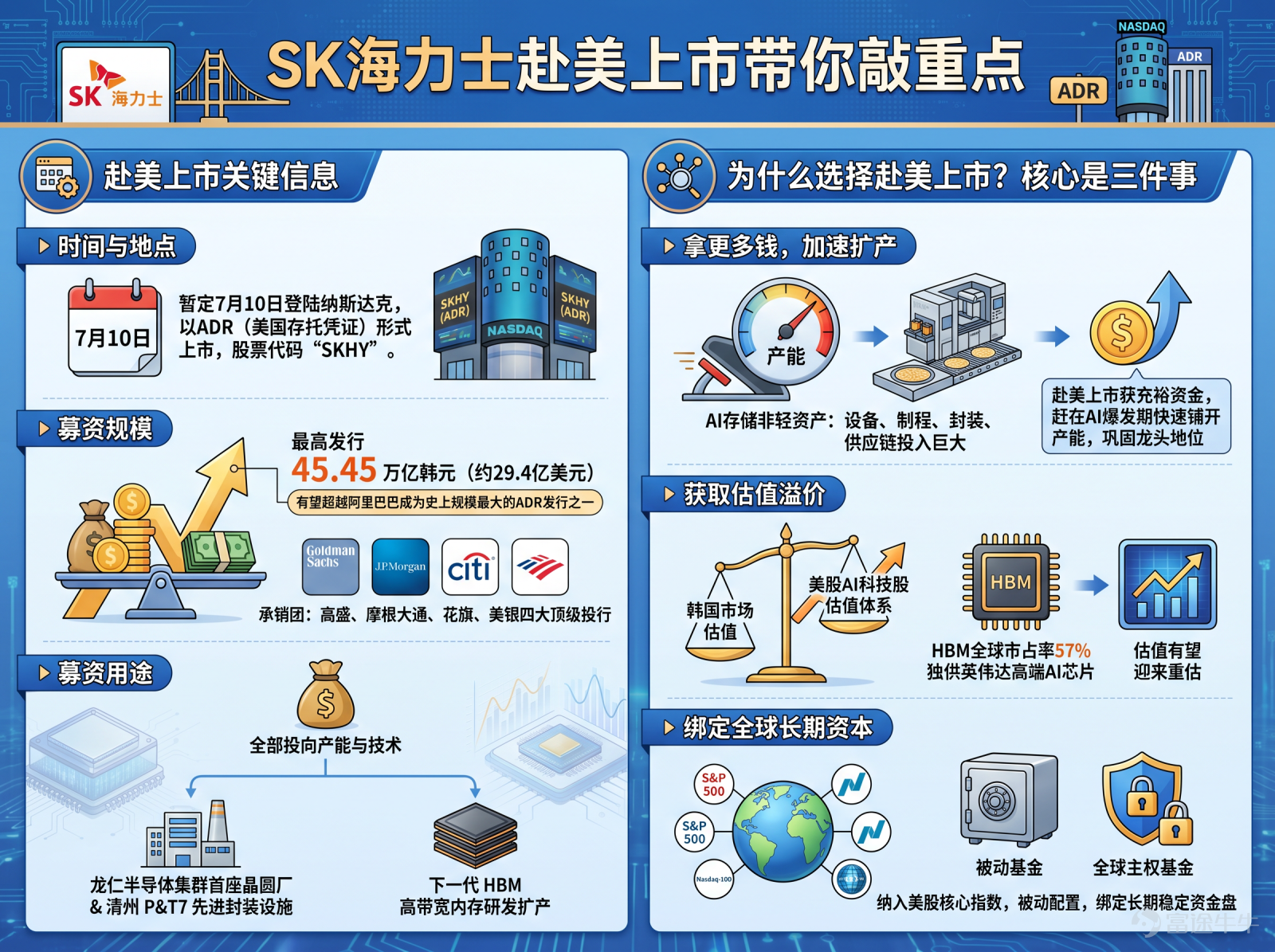
Key Information on U.S. Listing
- Time and Location:Tentatively scheduled to list on Nasdaq on July 10 via American Depositary Receipts (ADRs) under the ticker symbol “SKHY”.
- Fundraising Size:Up to KRW 45.45 trillion (approximately USD 2.94 billion). If successfully completed, it could surpass Alibaba to become one of the largest ADR offerings in history. The deal is backed by a top-tier underwriting syndicate comprising Goldman Sachs, JPMorgan, Citi, and Bank of America.
- Use of Proceeds:All proceeds will be allocated toward capacity expansion and technology advancement—specifically, the first wafer fabrication plant at the Yongin semiconductor cluster, the advanced P&T7 packaging facility in Cheongju, and R&D and production scaling for next-generation HBM (High Bandwidth Memory).
Why List in the U.S.?
–Raise More Capital to Accelerate Capacity Expansion:AI memory is not a capital-light business. Producing HBM and advanced DRAM requires expensive equipment, cutting-edge process nodes, advanced packaging capacity, and long-term supply chain investments. A single advanced HBM production line can cost tens of billions of dollars—an investment level difficult to support solely through Korean market financing. A U.S. listing provides access to significantly more abundant capital, enabling rapid capacity ramp-up during the AI demand surge and reinforcing its leadership position in the industry.
–Secure a Valuation PremiumThe U.S. equity market assigns a significantly higher valuation to AI tech stocks compared to the South Korean market. According to relevant data, SK Hynix holds approximately 57% of the global HBM market share and is NVIDIA's core HBM supplier. Its valuation is expected to be repriced upward following a Nasdaq listing.
–Anchor long-term global capital:After listing, it may be included in various core U.S. equity indices, prompting passive funds and global sovereign wealth funds to allocate capital automatically—effectively locking in a stable, long-term funding base.
🔍Explainer: What exactly is an ADR?
Many newcomers might feel confused upon hearing 'SK Hynix is issuing ADRs.'ADR stands for American Depositary Receipt. Simply put, an ADR is a 'proxy share' that allows foreign companies to trade on U.S. markets.SK Hynix deposits a portion of its locally listed shares with a custodian bank and then issues corresponding receipts in the U.S., priced and traded in U.S. dollars. One ADR represents a specified number of underlying Korean shares. The advantage is that investors can trade shares of this leading Korean memory chipmaker through a standard U.S. brokerage account without needing a Korean securities account. The downsides include minor custody fees and slight exposure to exchange rate fluctuations between the Korean won and the U.S. dollar.
Worried about volatility but still want exposure? How can beginners use ETFs to ride the memory chip boom?
Many new fellow investors are likely eager to buy memory chip stocks but may lack sufficient capital, fear picking the wrong individual stock, or struggle to withstand sharp price swings. For example, SK Hynix’s extreme volatility this week resembles a rollercoaster—if you don’t have nerves of steel and advanced trading discipline, buying individual shares as a beginner can easily lead to being whipsawed and repeatedly caught in buy-high, sell-low traps.So what should beginners do? Here’s the ultimate tip from your fellow investor: ETFs! Currently, there are two ETFs in the U.S. market that precisely target the memory chip sector, offering a one-click opportunity to gain exposure to the 'memory supercycle.'
What vehicle can you hop on? First, check the license plate number clearly!
1. For steady-and-sure investors: $Roundhill Memory ETF (DRAM.US)$(The world's first ETF focused exclusively on memory/storage)
If you believe in the massive, long-term memory/storage cycle driven by AI and want precise exposure to the world’s top three 'memory/storage leaders' as well as the entire memory/storage sector, then $Roundhill Memory ETF (DRAM.US)$ is indeed the market’s current star.
🔍Basic Information: Launched on April 2, 2026, it is the first truly pure-play memory chip themed ETF in global markets.
🔍Core holdings: Core holdings cover $Micron Technology (MU.US)$ 、 $SK Hynix (000660.KR)$ 、 $Samsung Electronics (005930.KR)$ the three major HBM (High Bandwidth Memory) leaders, with the remaining positions covering scarce, high-quality global memory sector names: $Kioxia Holdings (285A.JP)$ 、 $Western Digital (WDC.US)$ 、 $Seagate Technology (STX.US)$ 、 $SanDisk (SNDK.US)$Wait.
🔍Price performance: Since its listing in April 2026, it has at one point gained more than 190%, nearly doubling in value within just two months.
⚠️ Risk Warning:
- Concentration Risk: As the vast majority of assets are concentrated in a few leading memory storage companies, the ETF’s net asset value could experience a sharp drawdown if the memory chip industry faces overcapacity, falling prices, or adverse trade policies from major countries. It is highly exposed to the cycles of a single industry.
- Currency and Premium/Discount Risk: Since the underlying holdings include assets from non-U.S. regions such as South Korea (e.g., SK Hynix), investors are exposed to exchange rate fluctuations between local currencies and the U.S. dollar. Additionally, cross-time-zone trading may cause the ETF’s market price to deviate from its net asset value, resulting in premiums or discounts.
💡Target Investors: Medium-term investors with a 1–6 month horizon who are bullish on long-term AI computing power demand for HBM and can tolerate medium-to-high volatility; investors seeking targeted exposure to the memory segment without diversifying into equipment, foundry, or chip design sectors may consider this ETF.
Right at the critical timing of SK Hynix’s listing, T-REX and Roundhill jointly launched RAM, which officially debuted on the Cboe exchange—delivering a 'return amplifier' directly into the hands of investors bullish on the memory sector.

🔍Basic Information:
RAM is a leveraged ETF co-developed by T-REX and Roundhill Investments, designed to deliver 200% of the daily performance of DRAM before fees and expenses. However, its prospectus and fact sheet explicitly state:Investing in RAM is not equivalent to direct investment in DRAM. To achieve its objective of 200% daily leveraged returns, RAM actively manages its portfolio using total return swap agreements and related memory ETFs.
⚠️ Risk Warning:
Leverage and Daily Rebalancing Risk – Intraday 2x Doesn’t Mean Constantly 2x at All Times:This is the biggest hidden killer of leveraged ETFs! Because they compound returns daily, significant value erosion can occur during periods of high market volatility. RAM only tracks the single-day 2x return of DRAM; holding it for less than or more than one day exposes investors to compounding distortions—making it nearly impossible for long-term returns to equal twice the cumulative return of DRAM over the same period.When DRAM trades sideways with high volatility, the ETF may suffer persistent losses. Even if DRAM rises over the medium to long term, the combination of high volatility and daily rebalancing can still result in principal loss for the ETF. The longer the holding period and the higher the underlying asset’s volatility, the more severe the compounding decay becomes.
Let’s walk through an example: Assume the base index starts at 100 points. On Day 1, it drops 10% to 90 points; on Day 2, it rises 11.11% back to 100 points—ending flat overall. However, for a 2x leveraged ETF: Day 1 sees a 20% drop (from 100 to 80); Day 2 gains 22.22% (80 × 1.2222 ≈ 97.77). You’ll notice that while the base index breaks even, your leveraged ETF incurs a 2.23% loss! Thus, the longer you hold and the more volatile the market, the worse this divergence and loss become.
- Derivatives, Swaps, and Counterparty Risk:Over-the-counter (OTC) swap agreements are primarily executed with large financial institutions and lack comprehensive regulatory safeguards. Counterparties may default on payments or fail to post required collateral, potentially causing substantial losses.
- Sector, Industry, and Underlying Concentration Risk:RAM primarily tracks the performance of the memory/storage sector, which is highly concentrated and thus heavily influenced by the broader memory cycle.
Target Investors: Suitable for short-term or intraday tactical traders who are bullish on the memory upcycle, strictly manage position sizing, fully understand leveraged ETF mechanics, and can tolerate heightened risk and volatility. It is not recommended for long-term buy-and-hold investors with low risk tolerance.
How to get on board? Master the right entry strategy!
Now that we’ve identified the ticker symbol of the memory ETF, how should we get on board? Below are some balanced suggestions:
1️⃣Start with non-leveraged, then consider leveraged:Beginners are advised to first focus on the non-leveraged memory ETF—DRAM—to get a feel for the sector’s volatility rhythm. Once you become familiar with the memory cycle and can tolerate significant single-day swings, you may then allocate a small position to the leveraged ETF RAM for short-term trading opportunities.
2️⃣Avoid chasing highs or going all-in; instead, build positions gradually:The memory sector exhibits noticeable volatility. Chasing rallies and going all-in can easily leave you stranded at the top. Maintaining a reasonable position size and building exposure in stages during dips is a more prudent approach.
3️⃣Understand the risks and strictly adhere to discipline when trading leveraged ETFs:If you choose to trade leveraged products like RAM, always set a stop-loss in advance and maintain strict trading discipline. Never hold onto losing positions under the illusion of 'long-term investing,' and absolutely avoid adding additional leverage on top of an already leveraged product. These instruments are designed for short-term trading—not as get-rich-quick investment vehicles.
In conclusion
The hotter the sector, the less you should rely solely on the narrative。SK Hynix’s planned U.S. listing could indeed boost market attention and potentially lead to a higher valuation and greater funding support. However, its share price has already rebounded sharply in the short term, and future performance may still be affected by share dilution from fundraising, industry volatility, and shifts in market sentiment.For beginners or most retail investors, the key isn’t chasing every hot trend, but using the right tools to participate in broader market trends.If you're bullish on the long-term opportunity in AI memory, DRAM-themed ETFs can serve as useful instruments for observation and positioning. If you want exposure to higher-beta leveraged products such as 2x long RAM ETFs, always remember: they are suitable for short-term trading, not for buy-and-hold strategies.Building wealth gradually doesn't come from impulsively betting on the next hot trend, but from understanding market trends, choosing the right tools, and managing risk.
⚠️ Risk Disclosure: The above content is provided solely for investor education and market discussion purposes and does not constitute any investment advice. Past performance of related products is not indicative of future results. Both standard ETFs and leveraged ETFs carry net asset value volatility risks, and leveraged products may magnify losses. Please thoroughly understand the product mechanics and assess your own risk tolerance before investing.
Risk Disclaimer: The above content only represents the author's view. It does not represent any position or investment advice of Futu. Futu makes no representation or warranty.Read more


Comments (4)
to post a comment
57
79