
English
Back
Open Account
Seyond
wrote a column · Jun 25 13:05

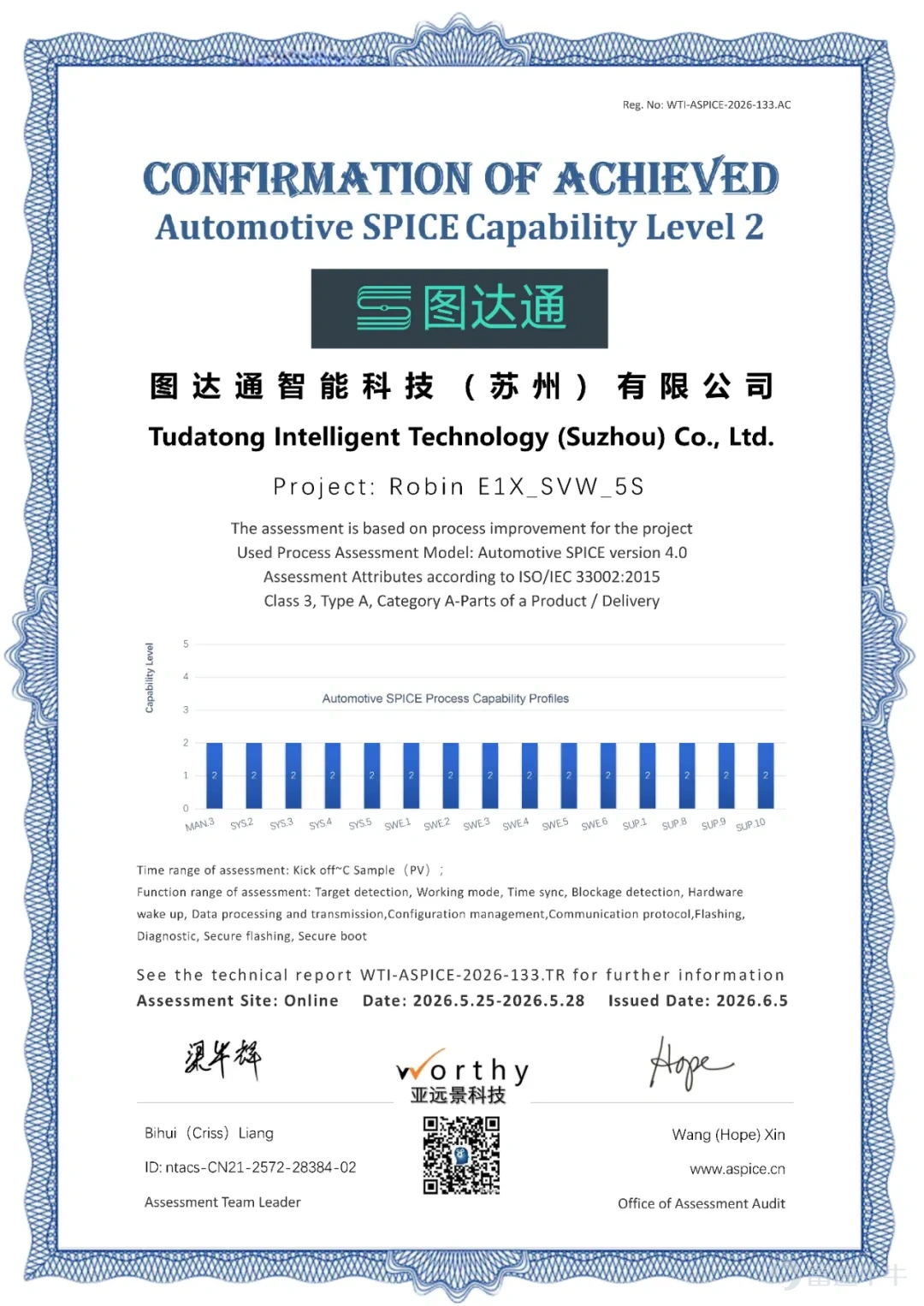
Hesai Group has achieved ASPICE 4.0 CL2 certification

Recently, Hesai Group successfully passed theASPICE 4.0 CL2 (Capability Level 2) assessment for system process improvement and capability determination in automotive software development, marking that the company’s automotive software development processes, project management, and quality control systems have reachedan internationally advanced level, fully meeting the stringent entry requirements of leading global automakers.
Recently, Hesai Group successfully passedthe Automotive SPICE 4.0 Capability Level 2 (CL2) assessment for system process improvement and capability determination in automotive software development, marking that the company’s automotive software development processes, project management, and quality control systems have reachedan internationally advanced level, fully meeting the stringent entry requirements of leading global automakers. This successful achievement of ASPICE 4.0 CL2 certification represents a significant milestone in Hesai Group’s efforts to standardize, professionalize, and internationalize its automotive software development framework, laying a solid foundation for the company’s deeper participation in the global intelligent and connected vehicle industry and expansion into overseas ADAS markets. As the globally recognized authoritative assessment framework for software development capability in the automotive industry, Automotive SPICE (Software Process Improvement and Capability Determination)is a core entry requirement for international automakers and Tier 1 suppliers, and is widely used in assessing R&D capabilities across the global high-end automotive supply chain. Specifically, ASPICE 4.0 Capability Level 2 (CL2) places stringent requirements on the standardization, traceability, and controllability of software development processes, covering critical phases such as requirements development, solution design, coding, testing and validation, defect management, and end-to-end project management. Compared with basic certification, achieving CL2 indicates that a company canimplement standardized control over its R&D processes, proactively mitigate risks, and precisely manage quality,effectively avoiding development gaps, reducing mass-production iteration costs, and enhancing product delivery stability—making it a key criterion for automakers when selecting core suppliers. ASP...
Successfully achieving ASPICE 4.0 CL2 certification marks a significant milestone for TuSimple in standardizing, professionalizing, and internationalizing its automotive software development processes, laying a solid foundation for the company to deeply engage in global intelligent connected vehicle industry competition and expand into overseas ADAS markets.
Recently, Hesai Group successfully passedthe Automotive SPICE 4.0 Capability Level 2 (CL2) assessment for system process improvement and capability determination in automotive software development, marking that the company’s automotive software development processes, project management, and quality control systems have reachedan internationally advanced level, fully meeting the stringent entry requirements of leading global automakers. This successful achievement of ASPICE 4.0 CL2 certification represents a significant milestone in Hesai Group’s efforts to standardize, professionalize, and internationalize its automotive software development framework, laying a solid foundation for the company’s deeper participation in the global intelligent and connected vehicle industry and expansion into overseas ADAS markets. As the globally recognized authoritative assessment framework for software development capability in the automotive industry, Automotive SPICE (Software Process Improvement and Capability Determination)is a core entry requirement for international automakers and Tier 1 suppliers, and is widely used in assessing R&D capabilities across the global high-end automotive supply chain. Specifically, ASPICE 4.0 Capability Level 2 (CL2) places stringent requirements on the standardization, traceability, and controllability of software development processes, covering critical phases such as requirements development, solution design, coding, testing and validation, defect management, and end-to-end project management. Compared with basic certification, achieving CL2 indicates that a company canimplement standardized control over its R&D processes, proactively mitigate risks, and precisely manage quality,effectively avoiding development gaps, reducing mass-production iteration costs, and enhancing product delivery stability—making it a key criterion for automakers when selecting core suppliers. ASP...
As the globally recognized authoritative assessment framework for software development capability in the automotive industry, ASPICE (Automotive SPICE – Software Process Improvement and Capability Determination) isa core entry requirement for international automakers and Tier 1 suppliers, widely applied in capability assessments across the global premium automotive supply chain. Specifically, the ASPICE 4.0 CL2 capability level emphasizes standardized, traceable, and controllable software development processes, imposing stringent requirements on critical stages including requirements development, architectural design, code implementation, testing and validation, defect management, and end-to-end project management.
Compared with basic certification, achieving CL2 signifies that a company canimplement standardized process control, proactively mitigate risks, and precisely manage quality, effectively avoiding development gaps, reducing mass-production iteration costs, and enhancing product delivery stability—making it a key criterion for automakers when selecting core suppliers.
Obtaining ASPICE 4.0 CL2 certification represents not just a single qualification breakthrough, but another step forward in TuSimple’s comprehensive vehicle-grade compliance system. To date, TuSimple has secured multiple top-tier international certifications, including ISO 26262 ASIL D (functional safety), ISO 21448 (SOTIF – Safety of the Intended Functionality), ISO/SAE 21434 (cybersecurity), IATF 16949 (automotive quality management), and ISO/IEC 27001 (information security), thereby establishinga comprehensive, multi-dimensional vehicle-grade compliance framework covering functional safety, intended functionality safety, cybersecurity, software development, mass-production quality, and information security, fully meeting the stringent entry requirements of leading global automakers.
In the future, TuSimple will continue to deepen its ASPICE-compliant standardized R&D system, constantly optimize hardware-software co-development processes, and enhance software iteration efficiency and product reliability, in order todeliver world-class R&D standards, exceptionally reliable product quality, and continuously innovative technical capabilities, providing global automotive OEMs with higher-performance, safer, and more adaptable imaging-grade LiDAR solutions, accelerating the intelligent driving industry toward high-quality, standardized, and safe development.
Risk Disclaimer: The above content only represents the author's view. It does not represent any position or investment advice of Futu. Futu makes no representation or warranty.Read more
12K Views
Report
Comments
Write a Comment...