
SpaceX officially joins the Nasdaq 100—can it spark a rebound rally?

Daily Options Seller Strategy | Battle Intensifies Around the $2 Trillion Market Cap Level! SpaceX Stages Sharp V-Shaped Rebound—Is This a Temporary Recovery or the Start of a New Uptrend?
I. Market Barometer
The three major U.S. equity indices faced significant pressure in the previous trading session. $SpaceX (SPCX.US)$ After its market capitalization surged to nearly $3 trillion post-listing, the stock encountered heavy selling pressure and retreated to the $2 trillion mark. On Tuesday, it staged a sharp V-shaped reversal—briefly dipping below its IPO opening price before recovering to close higher. In this high-volatility environment, options sellers are presented with a premium opportunity.
II. Focus on Hot Targets
SPCX: Mounts a Strong Comeback After Breaking Below $150—Bull-Bear Battle at the $2 Trillion Market Cap Level Heats Up
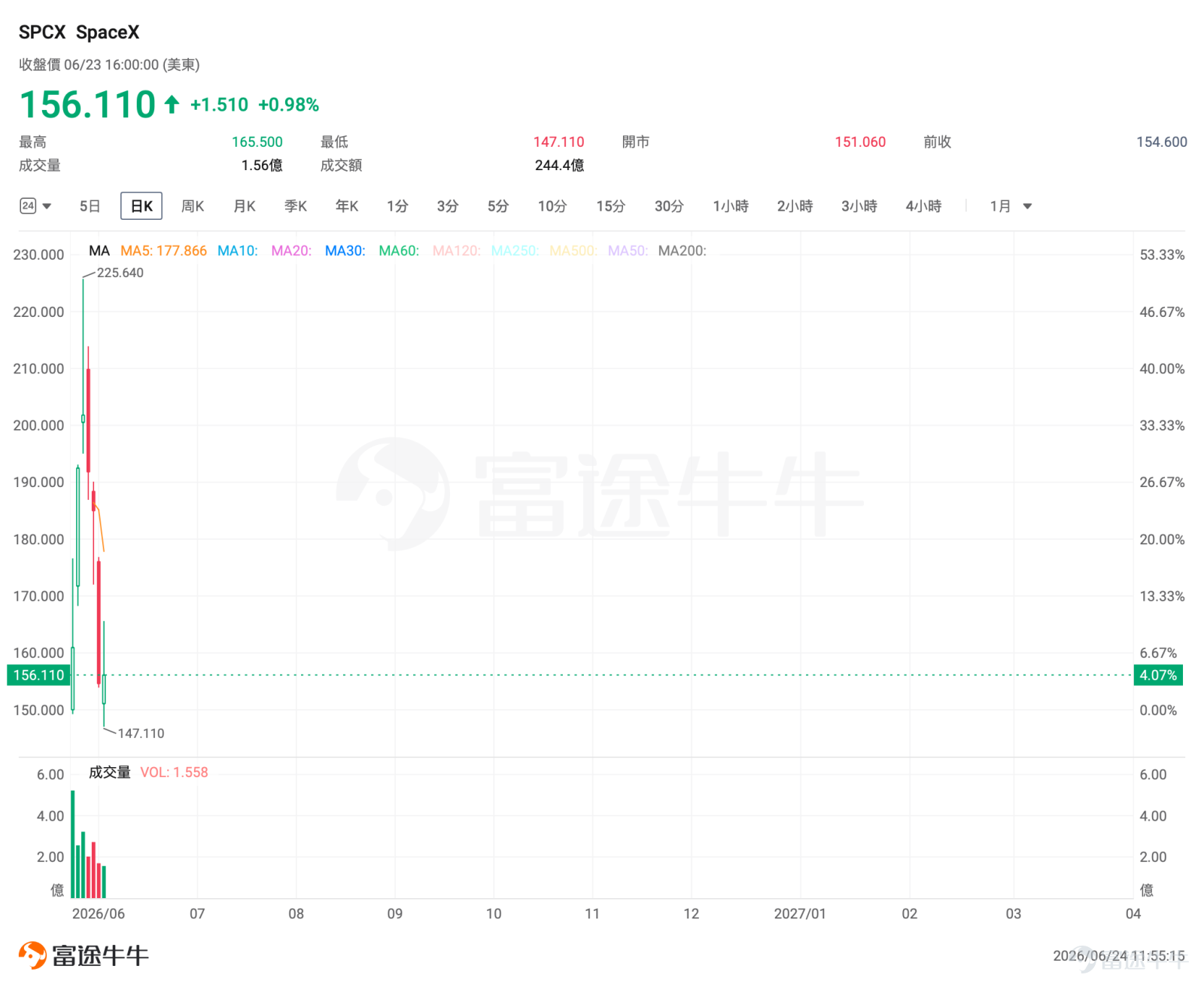
$SpaceX (SPCX.US)$ On the previous trading day (June 23), the stock price plunged as much as 4.84% intraday, hitting a low of $147.11—breaking below the IPO opening price of $150. However, bulls staged a strong rebound afterward, driving the price sharply higher to close up 0.98% at $156.11, with an intraday swing exceeding 10%. Over the prior three trading sessions, SPCX had already fallen more than 23%, erasing over $600 billion in market value.

Having been listed for only about two weeks, SPCX’s technical structure remains under formation, exhibiting pronounced wide-range volatility. The share price peaked intraday at $225.64 on June 16 before entering a continuous pullback. On June 23, it found preliminary support near the $147.11 low. The current pattern reflects a consolidation phase following the sharp decline from recent highs, with the $150 level providing initial support and the $180–$190 range facing resistance from trapped long positions. Volume patterns indicate significant divergence between bulls and bears.
Less than two weeks after its IPO, the company announced the issuance of five tranches of senior unsecured notes totaling $25 billion. Although the offering attracted nearly $90 billion in orders (approximately 3.6 times oversubscribed), this fell short of the average ~4x subscription level seen this year for investment-grade bond deals. Additionally, the 10-year notes’ credit spread remains about 50 basis points wider than that of Intel bonds with similar ratings, indicating that the bond market has not fully embraced the high valuation premium assigned by equity investors. Furthermore, S&P Global Ratings expects SpaceX to remain cash-flow negative through 2030, with its cash burn rate potentially accelerating further.
Moreover, former SEC Chair Gary Gensler noted that profit-taking could emerge after the IPO lock-up expires in August, somewhat dampening bullish sentiment. Starting mid-August, insider holdings will gradually become eligible for sale, potentially flooding the market with up to 44% of outstanding shares.
Among the six analysts currently covering the stock, the consensus recommendation leans toward 'Buy.' The average price target stands at $222.20, with a high target of $401.00 and a low target of $115.00.
III. Seller Options Strategy
1. Cash Secured Put
Sell 1 contract of $SpaceX (SPCX.US)$ July 17, 2026 $120 Put; Estimated required margin (for reference only): $12,000 ($120 × 100)

(The design images displayed on screen are for illustrative purposes only and do not constitute any investment advice or guarantee; market conditions change frequently, and the prices shown do not reflect actual market values.)
Opportunity Rationale:
For investors who believe in SpaceX’s long-term narrative around commercial spaceflight and AI infrastructure but have not yet established a position, the stock has stabilized somewhat after a three-day plunge. However, cautious sentiment in the bond market, expectations of sustained cash burn, and upcoming share unlock pressures could trigger renewed volatility. That said, the company’s fundamental pillars remain intact—the growth logic underpinning Starlink, launch services, and AI data center businesses continues to hold.
Investors can consider selling put options: if the stock consolidates near current levels, they can collect elevated option premiums in this high-volatility environment; if the price declines again toward the strike due to unlock-related selling pressure, they may acquire the shares at a more prudent cost basis.
2. Covered Call

(The design images displayed on screen are for illustrative purposes only and do not constitute any investment advice or guarantee; market conditions change frequently, and the prices shown do not reflect actual market values.)
For investors already holding SPCX positions and facing significant retracement of unrealized gains, the stock—after experiencing extreme 'roller-coaster' moves since listing—now faces both overhead resistance from trapped longs and potential selling pressure as the August share unlock approaches.
If investors remain confident in SpaceX's long-term vision and are unwilling to panic-sell their positions, yet are concerned about near-term bearish sentiment and additional selling pressure from share unlocks, they could sell call options while holding their shares. If the stock price consolidates within the current range, the premium income would help lower the cost basis of their holdings; if the stock rebounds and is exercised near the strike price, it effectively realizes a staged profit-taking near resistance levels.
IV. Risk Control Reminder
Although the seller strategy has a high probability of success, investors must still manage risks effectively:
– Position management is key:The biggest risk for option sellers lies in black swan events. It is recommended that margin exposure for a single underlying should not exceed 20% of total capital. Never sell options beyond your capacity for the sake of greedy premiums.
– Timely rolling of covered call options: When a covered call option becomes deeply in-the-money (stock price far exceeds the strike price), and if the underlying stock is still viewed favorably, decisively 'roll' the position — that is, close the current option by buying it back and simultaneously sell an option with a later expiration date and a higher strike price to avoid having the stock called away at a low price.
– Cash-secured put options warn of 'left-tail risk':For cash-secured puts, if the stock price collapses due to deteriorating fundamentals (rather than a normal pullback), do not hold on stubbornly. At this time, stop losses should be executed, or 'rolling down' can be employed to buy time and wait for volatility to normalize.
Make good use of the options seller zone to understand the income strategies for selling optionsEarn option premiums!
Make good use of the options seller zone to understand the income strategies for selling optionsEarn option premiums!

Options Risk Warning
An option is a contract that grants the holder the right—but not the obligation—to buy or sell an underlying asset at a predetermined price on or before a specified date. Option prices are influenced by multiple factors, including the current price of the underlying asset, the strike price, time to expiration, and implied volatility. Implied volatility reflects the market’s expectation of future price fluctuations over the life of the option and is derived by reverse-engineering the Black-Scholes pricing model. It is commonly used as a gauge of market sentiment. When investors anticipate greater volatility, they may be willing to pay higher premiums for options to hedge risk, leading to elevated implied volatility. Traders and investors use implied volatility to assess the relative attractiveness of option prices, identify potential mispricings, and manage risk exposure.
Disclaimer
This content does not constitute any offer, solicitation, recommendation, opinion, or guarantee for any securities, financial products, or tools. The risk of loss in trading options can be substantial. In some cases, losses incurred may exceed the initial margin deposited. Even if you set contingency orders, such as 'stop-loss' or 'limit' orders, these may not necessarily prevent losses. Market conditions may make such orders unexecutable. You may be required to deposit additional margin within a short period. If you fail to provide the required amount within the specified time, your open positions may be liquidated. However, you will still be responsible for any shortfall in your account resulting from such liquidation. Therefore, before trading, you should study and understand options and carefully consider whether such trading suits you based on your financial situation and investment objectives. If you trade options, you should be familiar with the procedures for exercising options and the rights and obligations upon expiration. Options trading involves extremely high risks and is not suitable for all investors. Investors should read Characteristics and Risks of Standardized Options carefully before engaging in any options trading strategy.
Risk Disclaimer: The above content only represents the author's view. It does not represent any position or investment advice of Futu. Futu makes no representation or warranty.Read more


Comment (1)
to post a comment
6
8