
US Stock Market Chat | NVIDIA reports earnings tomorrow; can it avoid a drop this time?

Bullish Tech Intel Briefing | NVIDIA's $200 Defense Battle! Could the Shareholders' Meeting Be the Turning Point?
$NVIDIA (NVDA.US)$ The 2026 annual shareholder meeting is scheduled to be held online at 00:00 Beijing time on June 25.It is one of the most market-watched event milestones this week.The meeting comes as NVIDIA’s stock price has steadily retreated from its May 14 high of $236.26 to the key psychological level of $200, prompting cautious market sentiment and offering multiple focal points worth monitoring.
The pace of Blackwell capacity ramp-up is the top agenda item for this meeting.The Blackwell series remains in short supply. NVIDIA has already secured nearly 60% of Taiwan Semiconductor’s CoWoS advanced packaging capacity, yet high-bandwidth memory (HBM) and full-chain advanced packaging capacity continue to be the core bottlenecks limiting output.Whether 'customer delivery lead times have meaningfully shortened' and whether 'new suppliers beyond Taiwan Semiconductor and SK Hynix have been onboarded' could become key questions for investors.
Progress updates on Vera Rubin represent the second major focus.At the GTC conference, Jensen Huang projected that Blackwell and Rubin together would generate over $1 trillion in revenue between 2026 and 2027. The Vera CPU is positioned as the 'next major growth driver,' currently in its production ramp-up phase, with initial deliveries to core customers expected to begin in the second half of 2026.
The third dimension the market will closely scrutinize is the closed-loop validation of AI commercialization.If revenue from data center operations continues to grow as a share of total sales, it would strongly signal NVIDIA’s successful transition from merely selling chips to offering full-stack AI infrastructure solutions.
For further analysis of key highlights from the upcoming shareholder meeting and related opportunities across the supply chain, interested fellow investors can read more on Niu Niu Classroom:Focus Tonight! NVIDIA's Shareholder Meeting Is Here—Three Key Highlights and Supply Chain Opportunities to Watch
The broader market faced multiple headwinds that day:NVIDIA’s market capitalization dipped below the $5 trillion mark; on June 23, a sharp sell-off left the stock barely closing above the psychological $200 level; and the semiconductor sector broadly declined (down 6.16%) that day, adding further downward pressure. However, whether NVIDIA’s share price can stabilize will largely hinge on forward-looking guidance communicated at its upcoming conference. Below, we will systematically analyze NVIDIA’s current price structure and key technical levels.
NVIDIA (NVDA)
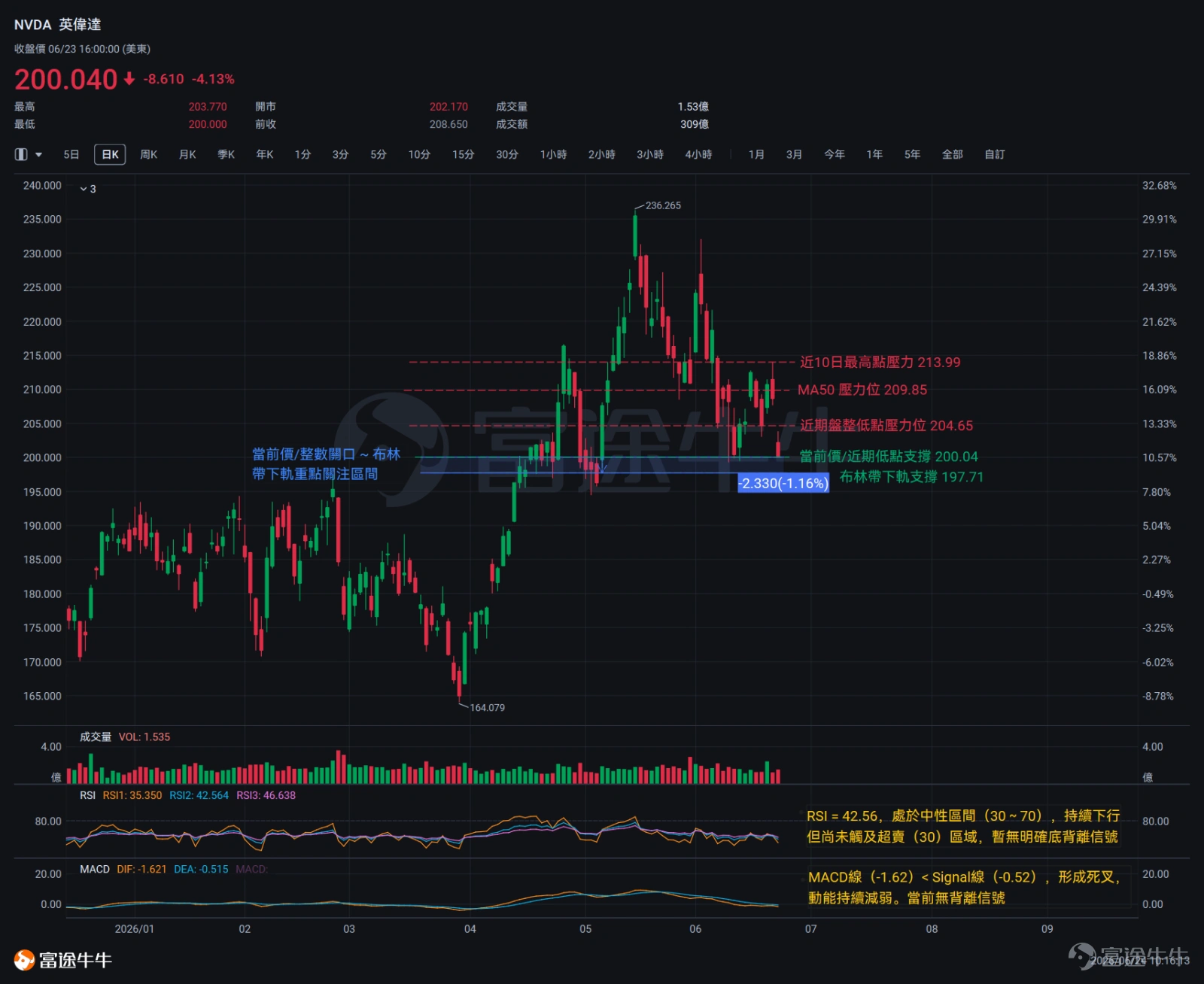
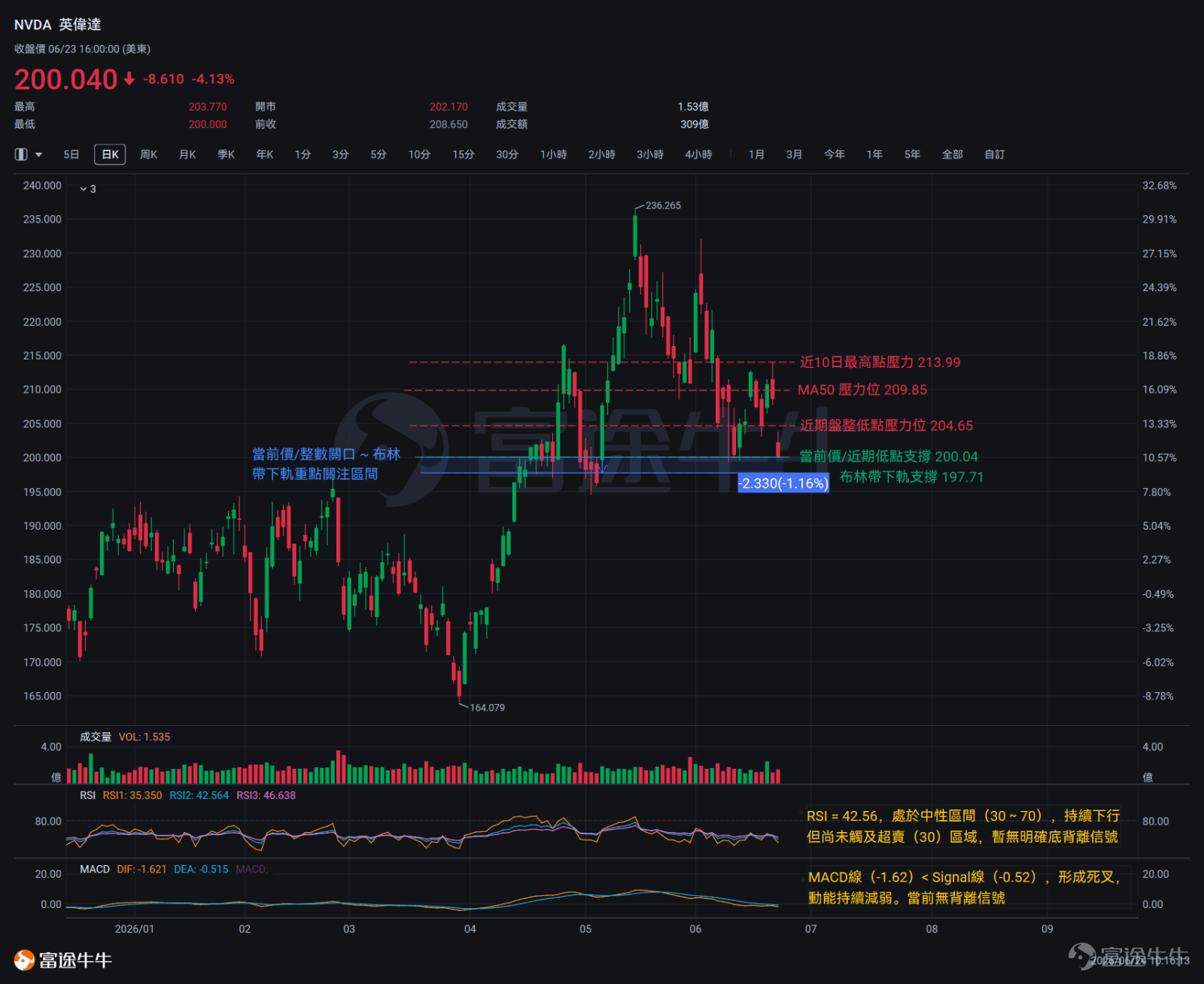
NVIDIA’s current price action exhibits characteristics of a downtrend interspersed with consolidation phases.The current price of $200.04 has broken below both the 20-day moving average (MA20 at $210.40) and the 50-day moving average (MA50 at $209.85). These two moving averages are close in value and have not yet formed a death cross,indicating that a definitive bearish confirmation on the higher timeframes has not yet materialized, though a near-to-medium-term bearish bias is already evident.
On the candlestick chart, bulls attempted a rally on June 22 within the $213–$214 range but were clearly repelled by strong selling pressure. On June 23, a gap-down opening followed by a large bearish candle confirmed the downtrend: the stock opened at $202.17, closed at $200.04, and briefly tested the $200 psychological support level. The candle featured a large real body with an extremely short upper wick and showed no meaningful intraday rebound—underscoring clear bear dominance.
Looking back at June 9–11: after a sharp decline on June 9, a small bearish candle on June 10 found support near $199.92, hinting at a potential bottom. A modest bullish candle on June 11 closed at $204.87, forming an early-stage reversal pattern. However, the third candle lacked follow-through strength, and the subsequent rally peaked at only $212.45 before retreating again—rendering the pattern ineffective in reversing the prevailing weakness. No complete bullish engulfing or hammer candlestick patterns have emerged recently,If the next trading session opens lower but closes strongly higher—with a large bullish candle finishing above $202—it would constitute one of the key conditions needed to trigger a reversal.
Key Technical Indicators Interpretation
Moving Average (MA):The 20-day moving average (MA20) is at $210.40, and the 50-day moving average (MA50) is at $209.85. The stock price is trading below both moving averages. Although a death cross has not yet formed—given that MA20 and MA50 are very close in value—the price remains under bearish pressure below the moving averages. MA20 is slightly above MA50, indicating the short-term moving average is still above the long-term one, and no major death cross has occurred on the higher timeframes.
RSI:The current RSI reading is 42.56, which falls within the neutral range (30–70) but leans slightly toward the weaker side. No clear bullish divergence signal is present at this time. However, if the price continues to decline while the RSI fails to make a new low, potential bullish divergence could emerge and warrant attention.
MACD:The MACD line (-1.62) is below the signal line (-0.52), confirming a bearish crossover. Both lines remain below the zero axis, indicating persistently weakening momentum. No divergence signals are currently observed.
Bollinger Bands:The current share price ($200.04) is trading between the Bollinger Bands’ middle band ($210.40) and lower band ($197.71), closer to the lower band. Bandwidth is relatively expanded, reflecting recent volatility release, with downside pressure still evident.
Technical Comprehensive Analysis
Support levels are structured in two tiers below.The first support zone lies between $199.34 and $200.00.—This area has seen three distinct lows on June 9, June 10, and June 23, all clustering tightly within this range.The round-number psychological level of $200 also carries defensive significance from a market sentiment perspective.If this zone is tested repeatedly without a decisive breakdown, its support validity will be further reinforced. Should the price stabilize here and form a clear bullish reversal candlestick pattern, it may serve as a short-term entry signal.The second layer of support is the Bollinger Bands’ lower band at $197.71, which acts as a dynamic support level. A confirmed break below this level would trigger further bandwidth expansion and accelerate volatility release, necessitating close monitoring for any signs of accelerating downside momentum.
Upward resistance is distributed across three levels.USD 204.65 marks the lower boundary of the recent consolidation range formed by the June 17 closing price,serving as the first hurdle for a short-term rebound;the USD 207.41–208.65 range represents a dense trading zone established by the closing prices on June 16 and June 22, where short-term trapped long positions are relatively concentrated—any rebound into this zone may encounter significant selling pressure. The USD 209.85–210.40 range constitutes a dual moving average resistance band formed by the 50-day and 20-day moving averages,and serves as the critical juncture determining whether the current bearish structure can be repaired—a sustained close above USD 210.40 is required to confirm an improvement in structure; otherwise, the suppressive effect of the moving averages will persist.Additionally, the near-10-day high of USD 213.99 set on June 15 acts as a reference level for a potential intermediate-term top. If prices stage a rebound below the dual moving average band, it will be essential to monitor whether trading volume expands concurrently; otherwise, the sustainability of upward momentum remains questionable.

Risk Disclaimer: The above content only represents the author's view. It does not represent any position or investment advice of Futu. Futu makes no representation or warranty.Read more


Comment (1)
to post a comment
9
29