
Tech giants are releasing earnings reports en masse this week—AI trades face their 'moment of truth'

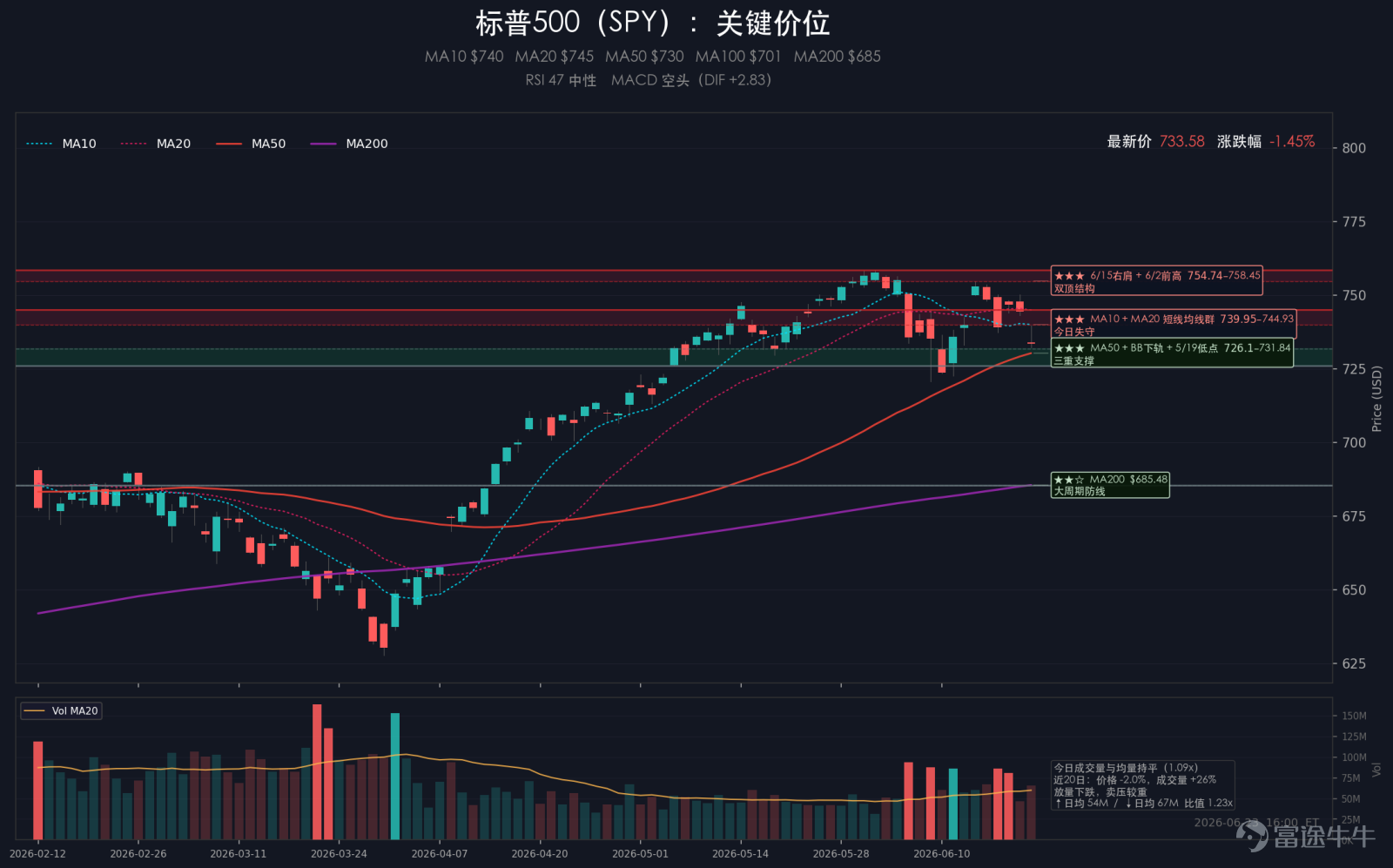
Wall Street Brief (June 24): US equities broadly declined on Tuesday, with semiconductor and AI memory supply chains facing valuation compression and mega-cap tech stocks continuing their correction; the market did not experience a full-scale sell-off, as the Dow closed flat and defensive sectors held up relatively well.
Summary: US equities broadly declined on Tuesday. The S&P 500 fell 1.44%, the Nasdaq dropped 2.21%, the Dow Jones Industrial Average declined 0.09%, and the Russell 2000 slid 0.96%. The Nasdaq underperformed significantly, while the Dow nearly closed flat—selling pressure was concentrated in tech and semiconductors rather than across the entire market. The VIX rose to 19.49, up 12.79% on the day, reflecting markedly higher demand for risk hedging. Two key factors drove market pricing: first, stronger-than-expected US June PMI data led markets to reassess interest rate and dollar expectations as tighter; second, SpaceX finalized terms for a $25 billion bond issuance, and Korea’s two major memory chipmakers plunged sharply, exposing acute financing and valuation pressures across the AI supply chain. On a sector basis, consumer staples, real estate, and healthcare held up relatively well, while technology, industrials, and materials came under pressure. In broader asset classes, the 10-year Treasury yield rose 0.94%, gold fell 0.62%, crude oil declined 0.48%, Bitcoin edged up 0.06%, and the US Dollar Index gained 0.37%.

I. Major Events
1. Stronger-than-expected US June PMI prompts markets to reprice interest rate expectations tighter
The US composite PMI rose to 52.2 in June, with manufacturing PMI climbing to 55.7 and services PMI reaching 51.3, as manufacturing output and new orders continued to strengthen. The data indicate that the US economy has not shown clear signs of cooling, leading markets to dial back expectations for near-term monetary easing and repricing both interest rates and the US dollar stronger—highly valued tech stocks were hit hardest as a result.
2. SpaceX finalizes terms for $25 billion bond issuance
SpaceX finalized terms for a $25 billion bond issuance to repay bank loans and fund future expenditures. This heightened market concerns about the heavy reliance of AI infrastructure investments on external financing and cash flow, placing additional pressure on tech and high-beta AI-related stocks.
3. South Korea's memory chip duopoly plunged sharply, dragging down valuations across the semiconductor and AI memory supply chain.
SK Hynix and Samsung Electronics both fell more than 12% on the Korean stock market, triggering a chain reaction of declines across global memory and semiconductor sectors. In the U.S. market, memory-related stocks such as Micron and Western Digital dropped significantly, with DRAM plunging 14.25% and the Semiconductor ETF (SMH) falling 7.01%, becoming a key drag on the Nasdaq.
II. Major Trends
From a single-day perspective, Tuesday’s decline wasn’t a broad-based collapse but was led by technology and semiconductors. The Nasdaq fell 2.21%, the S&P 500 dropped 1.44%, the Russell 2000 declined 0.96%, and the Dow Jones Industrial Average slid just 0.09%. Capital clearly exited high-valuation growth stocks first, leaving the more defensive-heavy Dow relatively resilient.
Over a three-month horizon, growth-style assets still maintain a medium-term edge. QQQ rose 21.50%, significantly outperforming DIA’s 12.24% gain; SPYG advanced 15.81%, continuing to beat SPYV’s 8.29% increase. While recent short-term declines have heightened volatility, they haven’t overturned the medium-term leadership of growth-oriented strategies.
Looking at the past two weeks, mega-cap tech stocks continue to adjust. MAGS fell 3.84% over two weeks, indicating that crowded AI-weighted trades are still unwinding. Meanwhile, IWM remains the strongest performer among the four major indices over this period, suggesting short-term style rotation hasn’t fully returned to large-cap tech names.
Structurally, the divergence between defensive and growth sectors has widened further. Consumer Staples (XLP) rose 1.87%, while Real Estate (XLRE) and Health Care (XLV) each gained 1.41%. In contrast, Technology (XLK) dropped 4.14%, Industrials (XLI) fell 2.01%, and Materials (XLB) declined 1.45%. Capital is rotating from high-valuation tech into more stable sectors.
III. Market Sentiment
The VIX closed at 19.49, up 12.79% on the day, signaling a clear rise in demand for risk hedging. CNN’s Fear & Greed Index fell to 28, down from 32 the previous session, reflecting continued caution in sentiment. Demand for protective options is also rising: the CBOE total put/call ratio stood at 0.80, the index options put/call ratio reached 1.00, and the equity options put/call ratio was 0.71. The index side has shifted into a stronger defensive stance, but individual stocks haven’t entered panic-driven disorder—this appears more like a targeted decongestion of crowded high-valuation tech and semiconductor positions.
IV. Market Scan
1. Index ETFs:On Tuesday, ETFs tracking the four major U.S. indices all retreated, with the Dow’s DIA showing the smallest loss, while the S&P 500’s SPY and Nasdaq-100’s QQQ posted more pronounced declines. The Russell 2000’s IWM also weakened in tandem. The market isn’t solely reacting to fears of economic slowdown but is primarily repricing tech-heavy, high-valuation segments.
2. Sector Performance:Consumer Staples (XLP) led gains with a 1.87% rise, while Real Estate (XLRE) and Health Care (XLV) each climbed 1.41%. Technology (XLK) was the weakest, falling 4.14%, followed by Industrials (XLI) down 2.01%, Materials (XLB) down 1.45%, and Discretionary (XLY) down 1.03%. Defensive sectors showed relative strength, while growth and cyclical areas faced greater pressure. At the sub-industry level, Medical Devices (IHI) rose 1.61% to lead all gainers, and Regional Banks (KRE) added 1.57%, also holding up relatively well. On the downside, DRAM plunged 14.25%, Semiconductors (SMH) fell 7.01%, Copper Miners (COPX) dropped 6.37%, Gold Miners (GDX) declined 4.64%, Robotics (BOTZ) fell 4.41%, Solar (TAN) dropped 4.17%, and Uranium (URA) slid 2.61%.
3. The Magnificent Seven Tech Stocks:Among the Magnificent Seven tech stocks, Microsoft (MSFT) rose 1.80%, making it the relative outperformer, while Tesla (TSLA) tumbled 5.79%—the worst performer—and NVIDIA (NVDA) fell 4.13%. Not all mega-cap tech stocks declined simultaneously, but within the AI ecosystem, the most sensitive heavyweight names remain under the greatest pressure.
4. U.S.-Listed Chinese Stocks:China-concept stocks traded broadly weaker, with Baidu (BIDU) down 1.43%, the smallest decline among the group. Bilibili (BILI) fell 4.77%, marking the weakest performance, followed by JD.com (JD) down 3.33%, Alibaba (BABA) down 2.26%, the KraneShares CSI China Internet ETF (KWEB) down 2.24%, and Futu (FUTU) down 2.07%. With risk appetite retreating, China-concept stocks failed to form a distinct strong sector.
5. Cryptocurrencies:As of the most recent trading day, Bitcoin was up 0.06% as of June 24, while related concept stocks were notably weaker. Riot Platforms (RIOT) edged up 0.21%, barely ending in positive territory, whereas Circle (CRCL) dropped 5.34% and MicroStrategy (MSTR) fell 5.13%. This indicates that investors have adopted a significantly more cautious stance toward proxy assets and high-beta concept stocks.
$S&P 500 Index (.SPX.US)$ $SPDR S&P 500 ETF (SPY.US)$ $NASDAQ 100 Index (.NDX.US)$ $Invesco QQQ Trust (QQQ.US)$ $Dow Jones Industrial Average (.DJI.US)$ $State Street® SPDR® Dow Jones Industrial Average® ETF Trust (DIA.US)$ $Russell 2000 Index (.RUT.US)$ $iShares Russell 2000 ETF (IWM.US)$ $Roundhill Magnificent Seven ETF (MAGS.US)$ $USD (USDindex.FX)$ $U.S. 10-Year Treasury Notes Yield (US10Y.BD)$ $iShares 20+ Year Treasury Bond ETF (TLT.US)$ $XAU/USD (XAUUSD.CFD)$ $SPDR Gold ETF (GLD.US)$ $CBOE Volatility S&P 500 Index (.VIX.US)$ $CME-Bitcoin RR Futures (JUL6) (BTCmain.US)$ $iShares Ethereum Trust ETF (ETHA.US)$ $NVIDIA (NVDA.US)$ $Tesla (TSLA.US)$ $Meta Platforms (META.US)$ $Amazon (AMZN.US)$ $Alphabet-C (GOOG.US)$ $Microsoft (MSFT.US)$ $Apple (AAPL.US)$
Risk Disclaimer: The above content only represents the author's view. It does not represent any position or investment advice of Futu. Futu makes no representation or warranty.Read more


Comments
to post a comment
8
1