
Google raises its capital expenditure guidance—can it carry the momentum through super earnings week

Daily Options Outlook | Cerebras’ First Earnings Report Since IPO Drops After-Hours; Semiconductors Under Pressure in Pre-Market
Today's Options Opportunity Preview
In today’s US pre-market session, semiconductors emerged as the focal point for risk unwinding.
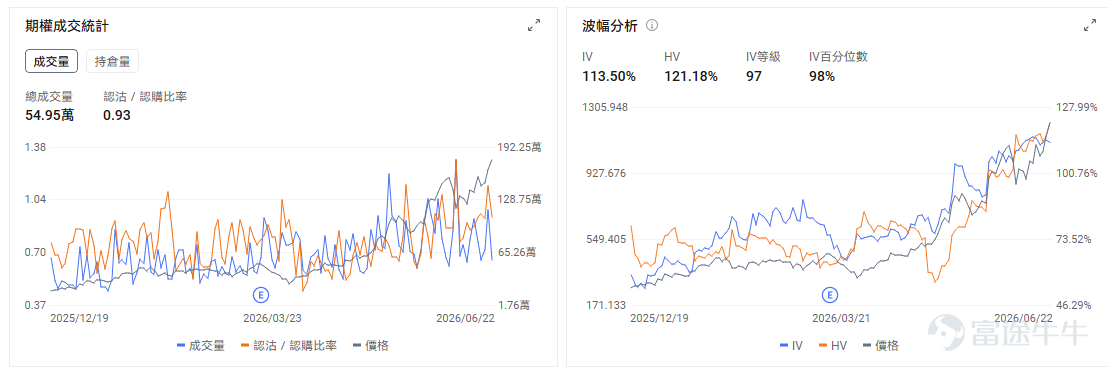
$Micron Technology (MU.US)$ The stock fell approximately 8.5% in pre-market trading, positioning this week’s earnings release as the key validation window for the AI memory trade. The company will report earnings after the market close on June 24. Markets have already priced in extremely high expectations around HBM sell-outs, DRAM price hikes, and surging AI server memory demand.
At the options level, implied volatility (IV) is typically elevated ahead of earnings. Buying single-leg calls or puts requires strong directional conviction—especially after a sharp pre-market drop, chasing puts risks facing elevated pre-earnings volatility and potential short-covering rebounds. In high-IV environments, outright call buying carries significantly higher risk. If participating, using spread structures, protective puts, or waiting until after the initial wave of post-open panic subsides before making directional bets would be more prudent than chasing positions pre-market.
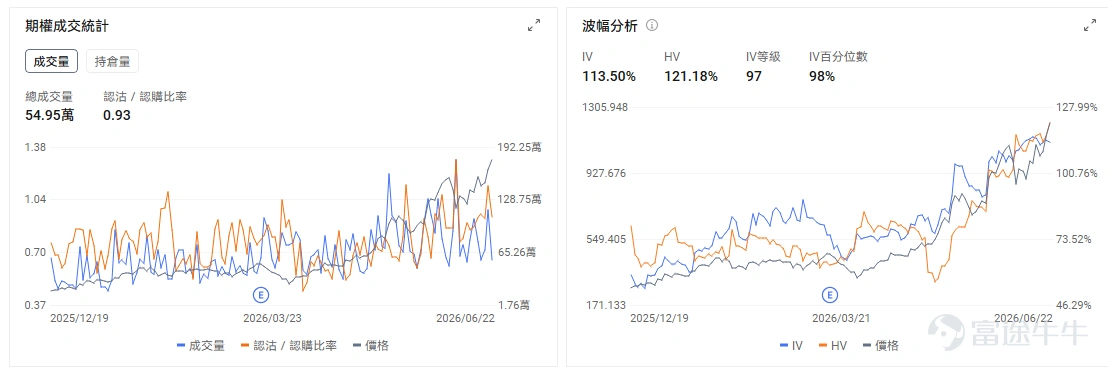
$Cerebras Systems (CBRS.US)$ The stock fell about 4% in pre-market trading. Its first earnings report since going public will be released after market close tonight, and the market sees this as a reality check for the 'NVIDIA challenger' narrative. Compared to $NVIDIA (NVDA.US)$ established leaders like NVIDIA whose earnings have already been fully realized, Cerebras relies more heavily on revenue growth rate, order quality, and customer concentration to justify its valuation.
Today’s key focus for CBRS is whether management can convince the market that its AI chip commercialization path is sufficiently clear. If the earnings report shows revenue growth, strong order backlog, and improving gross margins that support the 'NVIDIA alternative' narrative, the stock could recover amid high volatility; if the results fail to justify its post-IPO valuation, losses may widen further. On the options side, such newly listed stocks tend to exhibit high earnings-related gamma, along with potentially unstable liquidity and wide bid-ask spreads—making them better suited for small-position event-driven trades.
Review of yesterday's options market
Index Options
On June 22 Eastern Time, U.S. equity index options market volume declined, with a total of 5.74 million contracts traded. The put/call volume ratio decreased to 1.09.
As the upcoming expiration date approaches, $S&P 500 Index (.SPX.US)$ Options volume distribution showed the following characteristics: peak put volume occurred at the 7,450 strike, while peak call volume was at the 7,500 strike.
Single Stock Options
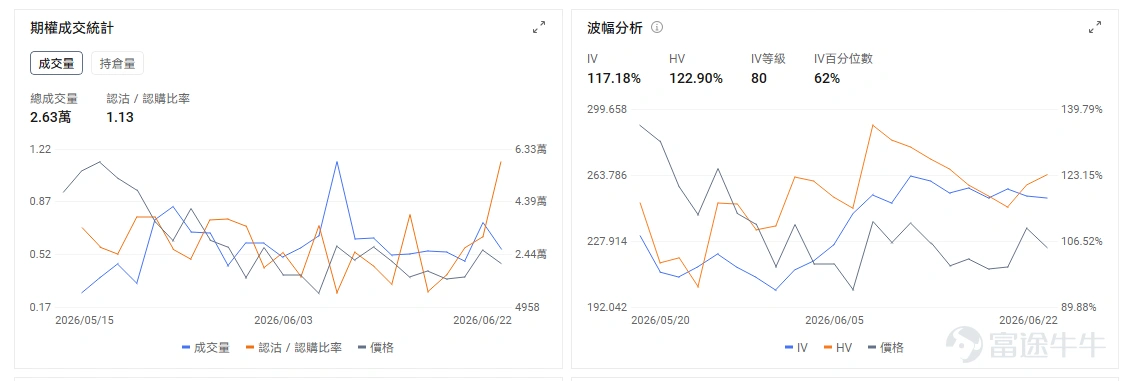
$Intel (INTC.US)$ Intel rose 5.19%, with 621,900 options contracts traded, and the put/call volume ratio increased to 0.54. Intel's share price gained after Trump mentioned on social media a potential agreement between Apple and Intel to design and manufacture chips in the U.S.
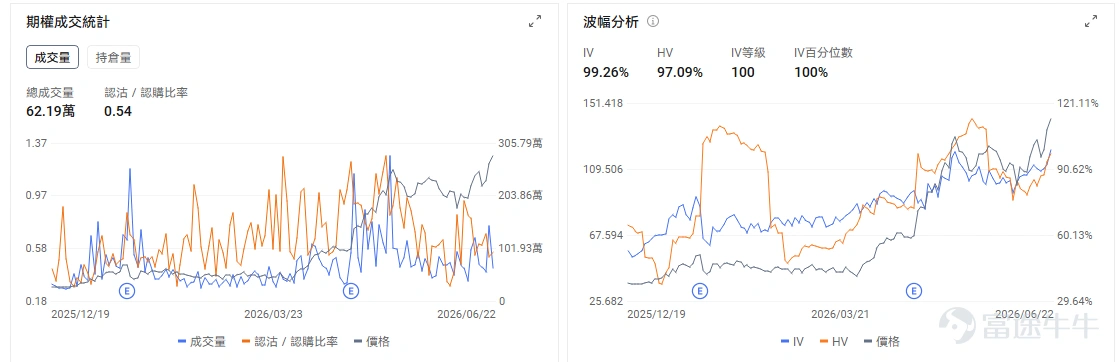
$SpaceX (SPCX.US)$ The stock dropped 16.43%, with 1,217,700 options contracts traded, and the put/call volume ratio fell to 0.87. Reflection will begin paying SpaceX $150 million per month starting July 1, amounting to approximately $6.3 billion if the agreement continues through 2029.
Top list of options trading volume
Among the top 10 stocks by options trading volume, $Apple (AAPL.US)$ Apple had the highest put/call volume ratio, reaching 0.87. Apple CEO Tim Cook stated that rising memory costs make iPhone price increases unavoidable.
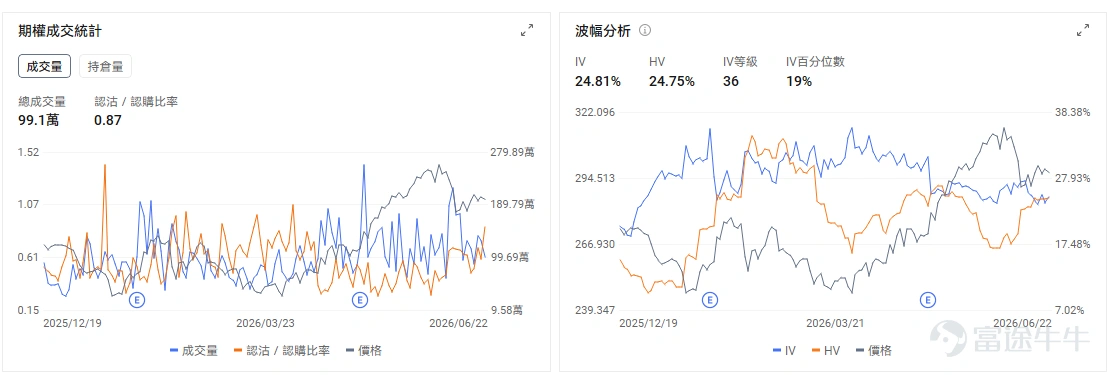
Implied volatility rankings (underlying market cap > $10 billion and options trading volume > 100,000)
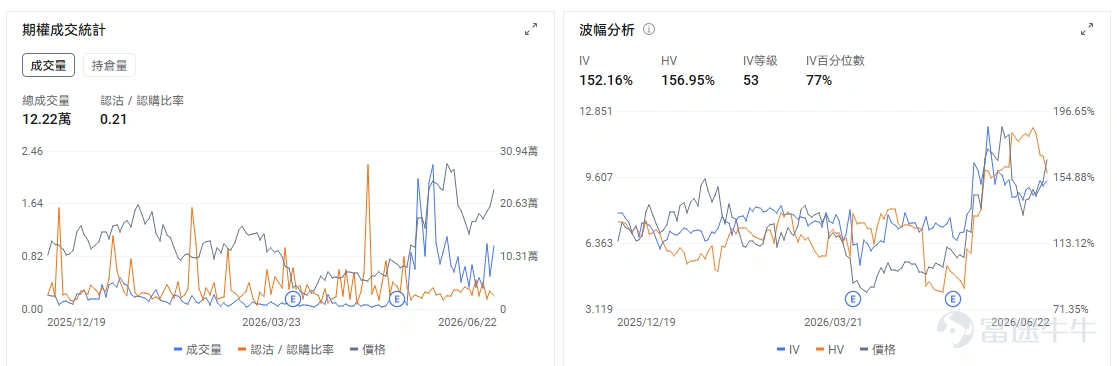
$T1 Energy (TE.US)$Implied volatilityReached a high of 152.16%, up 2.23% from the previous trading day. Bernstein assigned T1 Energy a Market Perform rating with a $9 price target, following the company's acquisition of Kore Power and receipt of an A-grade rating for its solar module facility.
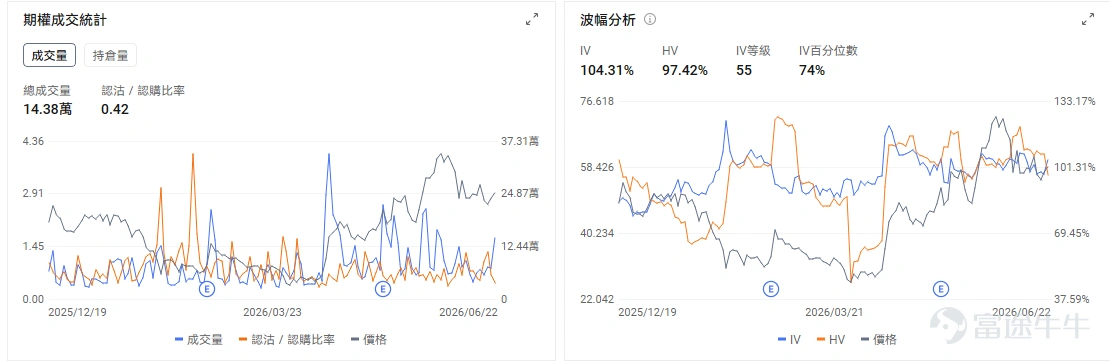
$IonQ Inc (IONQ.US)$Implied volatility rose the most, reaching 104.31%, up 6.60% from the previous trading day. Northland Capital Markets maintained its Buy rating on IonQ and raised its price target from $55 to $70.
Risk Warning
An option is a contract that gives the holder the right, but not the obligation, to buy or sell an asset at a fixed price on a specific date or before that date. The price of an option is influenced by various factors, including the current price of the underlying asset, the strike price, time to expiration, and implied volatility.
Implied volatility reflects the market's expectation of the option's volatility over a certain period in the future. It is derived inversely from the BS pricing model of options and is generally considered an indicator of market sentiment. When investors anticipate greater volatility, they may be more willing to pay higher prices for options to hedge risks, resulting in higher implied volatility.
Traders and investors use implied volatility to assessOption priceto enhance attractiveness, identify potential mispricing, and manage risk exposure.Disclaimer
This content does not constitute any offer, solicitation, recommendation, opinion, or guarantee of any securities, financial products, or tools. The risk of loss in trading options can be substantial. In some cases, losses may exceed the initial margin deposited. Even if you set contingent orders such as 'stop-loss' or 'limit' orders, these may not prevent losses. Market conditions may make such orders unexecutable. You may be required to deposit additional margin within a short period. If you fail to provide the required amount within the specified time, your open positions may be liquidated. However, you will still be responsible for any shortfall in your account. Therefore, before trading, you should study and understand options and carefully consider whether such trading is suitable for you based on your financial situation and investment objectives. If you trade options, you should be familiar with the procedures for exercising options and the rights and obligations upon exercise and expiration. Options trading carries extremely high risks and is not suitable for all investors. Investors should carefully readCharacteristics and Risks of Standardized Options。
This content does not constitute any offer, solicitation, recommendation, opinion, or guarantee of any securities, financial products, or tools. The risk of loss in trading options can be substantial. In some cases, losses may exceed the initial margin deposited. Even if you set contingent orders such as 'stop-loss' or 'limit' orders, these may not prevent losses. Market conditions may make such orders unexecutable. You may be required to deposit additional margin within a short period. If you fail to provide the required amount within the specified time, your open positions may be liquidated. However, you will still be responsible for any shortfall in your account. Therefore, before trading, you should study and understand options and carefully consider whether such trading is suitable for you based on your financial situation and investment objectives. If you trade options, you should be familiar with the procedures for exercising options and the rights and obligations upon exercise and expiration. Options trading carries extremely high risks and is not suitable for all investors. Investors should carefully readCharacteristics and Risks of Standardized Options。
Risk Disclaimer: The above content only represents the author's view. It does not represent any position or investment advice of Futu. Futu makes no representation or warranty.Read more

Comments
to post a comment
3
6