
South Korea’s Top Two Memory Chip Players: Outlook Under Leverage Rules & Central Bank Tightening

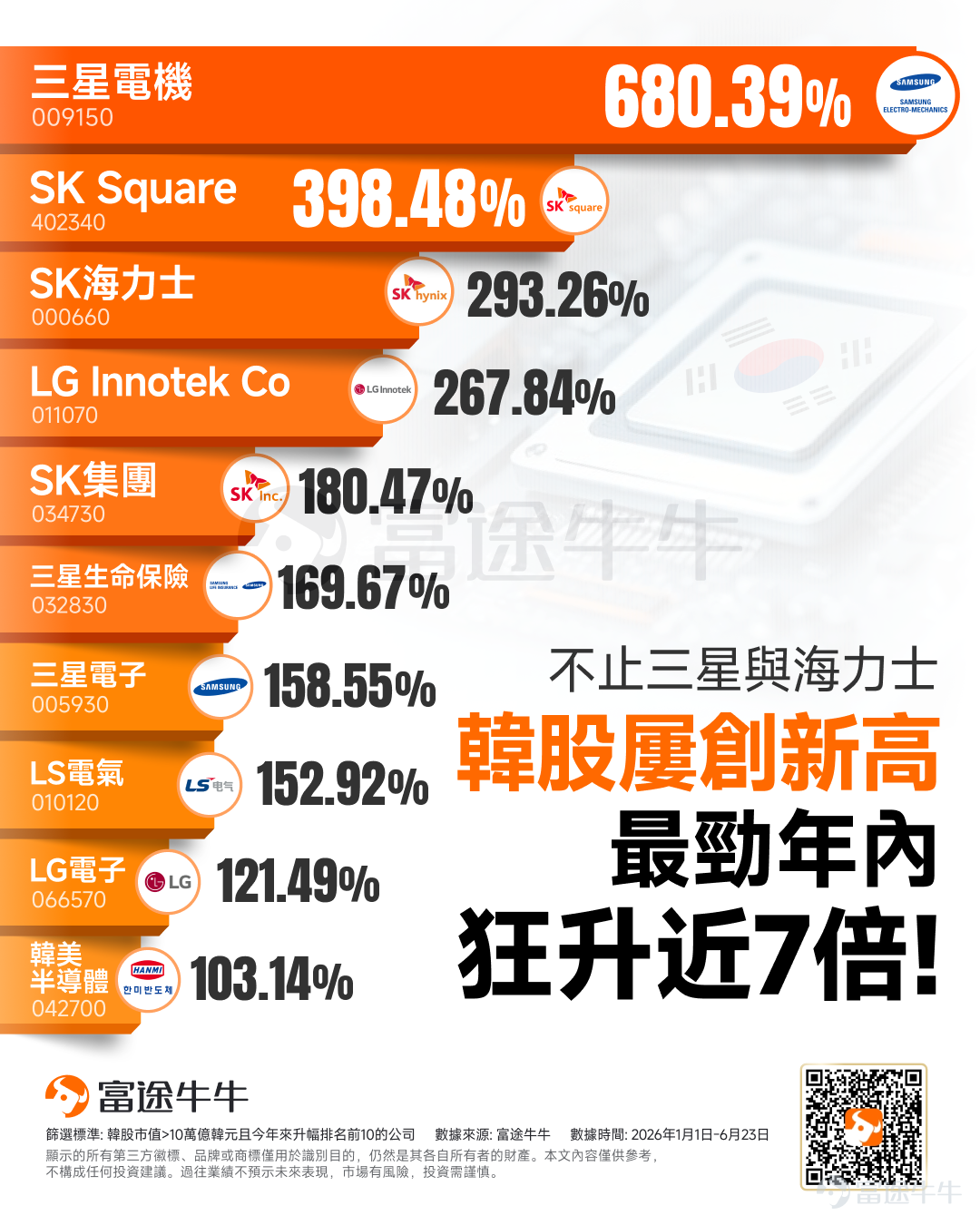
It’s not just Samsung and SK Hynix! Are these Korean stock dark horses leading the 2026 super bull market?
The Korean stock market in 2026 is entering an unprecedented super bull market.
On the surface, the driving force behind this capital bonanza appears to be simply attributable to two giants: $Samsung Electronics (005930.KR)$and$SK Hynix (000660.KR)$。Amid the global AI computing boom, these two semiconductor leaders have indeed acted as the 'stabilizing anchors' holding up the broader market. However, a deeper look into market structure reveals that this is not a duopoly performance—it’s a far grander constellation of shining stars.
Fueled by the powerful synergy of three key themes—'AI infrastructure expansion,' 'advanced manufacturing upgrades,' and the 'Corporate Value-Up Program'—a group of exceptional multibagger stocks has emerged in the market.

Below is an in-depth analysis of the four major investor groups and their core holdings driving this historic bull market:
I. The Invisible Champion Leading Gains: Advanced Packaging & Investment Giant
$Samsung Electro-Mechanics (009150.KR)$— Year-to-date gain: +680%
As this year's absolute dark horse, Samsung Electro-Mechanics has surged nearly sevenfold, outpacing all peers. Previously valued merely as a 'mobile component supplier,' it has now transformed into a core player in AI hardware. Samsung Electro-Mechanics is one of the few companies in the market today that simultaneously possesses top-tier MLCCs, FC-BGA packaging substrates, and silicon capacitor technologies.
More importantly, Samsung Electro-Mechanics is the undisputed leader in the glass substrate field, not only in Korea but globally. The company has already launched a pilot production line at its Sejong plant in South Chungcheong Province and, in 2025, transferred its glass substrate business from the Central R&D Institute to the Packaging Solutions Division, fully initiating preparations for commercialization.
$SK Square (402340.KR)$— Year-to-date gain: +398%
As an investment holding company under the SK Group and the largest shareholder of SK Hynix, SK Square’s surge is largely driven by its role as a 'leveraged proxy' for Hynix. Investors buying SK Square not only gain exposure to the HBM (High Bandwidth Memory) boom at a more attractive valuation but also speculate on IPO prospects of other AI and semiconductor materials subsidiaries within its portfolio, as well as its massive share buyback and cancellation program launched in response to the Value-up initiative.
II. Computing Power Foundation: The Core Engine of Semiconductors and Memory
$SK Hynix (000660.KR)$ — Year-to-date gain: +293%
The 'ultimate enabler' behind NVIDIA’s AI chips. As the undisputed leader in the HBM memory market, SK Hynix virtually monopolizes high-end AI server memory supply. Its technological moat and capacity advantage were fully priced in by the market in 2026, with a gain exceeding 300% serving as the clearest testament to its industry dominance.
Notably, on June 22, SK Hynix’s market capitalization briefly surpassed that of Samsung Electronics during intraday trading. Samsung had held the title of South Korea’s most valuable company since 2000. This temporary dethronement stems from SK Hynix’s focused business on memory chips, whereas Samsung Electronics also operates in logic chips and consumer electronics manufacturing.
$Samsung Electronics (005930.KR)$ — Year-to-date gain: +158%
The cornerstone of the Korean stock market. Although initially pressured in the early HBM race, Samsung has rapidly caught up in HBM3E products thanks to its deep R&D capabilities. Its self-developed Mach-series AI inference accelerators have gained traction among cloud customers. Meanwhile, improved yields in its GAA (Gate-All-Around) process technology within the foundry division, coupled with recovering demand for DRAM and NAND memory, have created a 'triple-engine' growth momentum.
$Hanmi Semiconductor (042700.KR)$— Year-to-date gain: +103%
A quintessential 'pick-and-shovel' play. Hanmi Semiconductor is a global leader in TC Bonder (Thermo-Compression Bonding) equipment—a critical tool indispensable for HBM memory production. Capacity expansions by both Hynix and Samsung have directly translated into a flood of equipment orders for Hanmi Semiconductor.
III. Cross-Industry Pioneer: From Traditional Consumer Electronics to AI Infrastructure
$LG Innotek (011070.KR)$ — Year-to-date gain: +267%
The market previously viewed the company primarily as a core camera module supplier for Apple. However, this year, it successfully expanded its business boundaries by ramping up in new growth areas such as autonomous driving sensors and AI-related high-end substrates, reducing reliance on a single product line and achieving a powerful valuation re-rating—what investors call a 'double boost' from rising earnings and multiples.
Notably, LG Innotek is positioning its semiconductor substrate business as its next-generation growth pillar. The company plans to shift its packaging solutions—historically centered on smartphones—toward high-value markets such as AI servers, data centers, and autonomous vehicles.It aims to achieve KRW 1 trillion in operating profit by 2031.
$LS Electric (010120.KR)$ — Year-to-date gain: +152%
At the end of AI lies computing power; at the end of computing power lies electricity. Fueled by the global data center construction boom and the aging U.S. power grid, ultra-high-voltage transformers and power distribution systems are facing a multi-year supply-demand imbalance. LS Electric, a South Korean power equipment giant, has capitalized precisely on this trend with its robust overseas manufacturing footprint and rapid delivery capabilities, securing massive ‘AI infrastructure’ orders in North America and entering a once-in-a-decade super-cycle.
$LG Electronics (066570.KR)$ — Year-to-date gain: +121%
LG Electronics has successfully transformed itself from a traditional home appliance maker into one of the most closely watched AI-related stocks in Korea. Its standout achievement lies in breakthroughs in 'immersion liquid cooling technology for data centers,' which enabled entry into the supply chains of major North American CSPs (Cloud Service Providers). Additionally, the company has deeply integrated with NVIDIA’s Omniverse platform for digital twin simulations in smart factories and continues to set new records in market share for its software-defined vehicle (SDV) in-car systems.
IV. Policy Tailwinds: Direct Beneficiaries of the Value-up Initiative
$SK (034730.KR)$ — Year-to-date gain: +180%
As the controlling parent company, SK Group’s rally has been driven not only by strong performance in its semiconductor and renewable energy businesses but also by the South Korean government’s 'Corporate Value-Up Program.' The group has actively improved corporate governance and increased shareholder returns, attracting substantial long-term capital seeking stable growth.
$Samsung Life Insurance (032830.KR)$ — Year-to-date gain: +169%
For a long time, South Korean financial stocks have suffered from the 'Korea discount' phenomenon (extremely low price-to-book ratios). Under policy expectations of aggressive dividend payouts and share buybacks driven by the government, Samsung Life Insurance—which holds significant undervalued core Samsung assets—has experienced a sharp valuation re-rating.
What’s ahead for the Korean stock market?
The Korean equity market currently stands at a historic inflection point where fundamental strength meets structural revaluation. On one hand, foreign investment banks are extremely bullish on earnings prospects; on the other, markets are eagerly anticipating South Korea’s potential inclusion into developed-market benchmarks.
First,In its latest research report, Citigroup raised its KOSPI target from 8,500 to 10,000 points,citing sustained profit growth in memory chips and strong fiscal stimulus measures introduced by the South Korean government. Citi highlighted three tailwinds supporting this upgraded outlook: robust semiconductor exports, spillover effects from the sector, and expansionary fiscal policy.
Citi expects earnings growth in 2027 to broaden beyond artificial intelligence into robotics, exporters, and manufacturing companies, while ongoing tight supply conditions in memory are forecast to persist, further extending the sector’s upcycle.
Beyond surging fundamentals, can the Korean stock market finally shed the long-standing 'Korea discount'?The MSCI annual market classification review on June 23 is currently the most closely watched market event for global investors.
According to 15 investors and strategists interviewed by Bloomberg, most expect MSCI to maintain South Korea’s emerging market status this time, citing that recent reforms still need time to demonstrate their sustainability.However, if an upgrade does materialize, BNP Paribas Securities estimates it would trigger approximately $30 billion in passive capital inflows and could help narrow the persistent valuation discount that has long plagued South Korean equities.
Despite positive reform signals, most surveyed investors still anticipate that this review is unlikely to bring immediate change. Young Jae Lee, Senior Portfolio Manager at Pictet Asset Management, stated: 'This is more a matter of timing. My base-case expectation is that South Korea will become a developed market within the next few years.'
This also means thatthe direction is no longer in doubt—only the timeline remains debated—and June 23 will serve as the latest reference point for investors to gauge the pace of progress.
Summary
South Korea’s stock market in 2026 is undergoing a historic transformation. Driven by the dual engines of the 'AI computing boom' and the 'Value-up policy,' the entire industrial chain—from semiconductors to infrastructure—is flourishing, while the longstanding 'Korea discount' is rapidly eroding, catalyzing a profound structural re-rating of Korean equities.
Yet behind this unprecedented prosperity, investors should remain vigilant about the following three key risks:
Reversal in AI demand: If global cloud giants reduce capital expenditures or if advanced capacity becomes oversupplied, highly valued tech stocks could face sharp sell-offs.
Policy implementation falling short of expectations: Without substantive tax incentives or if chaebol governance reforms lag, the anticipated 'revaluation' could evaporate, triggering capital outflows.
Geopolitical and macroeconomic volatility:Any shifts in global geopolitics or macroeconomic conditions could severely impact South Korea’s export-dependent stock market.
📣 Friendly reminder: Futu's Korean stock trading feature is coming soon—stay tuned!
Before the new feature officially launches, fellow investors interested in the Korean stock market are welcome to click below to review our previous in-depth analyses:
Risk Disclaimer: The above content only represents the author's view. It does not represent any position or investment advice of Futu. Futu makes no representation or warranty.Read more


Comments (4)
to post a comment
63
178