Wall Street Brief (June 23): U.S. stocks diverged on Monday, with notable selling pressure in tech heavyweights dragging the Nasdaq lower; short-term defensive demand rebounded, but the broader market hasn't weakened, as capital rotated into small caps and cyclical sectors
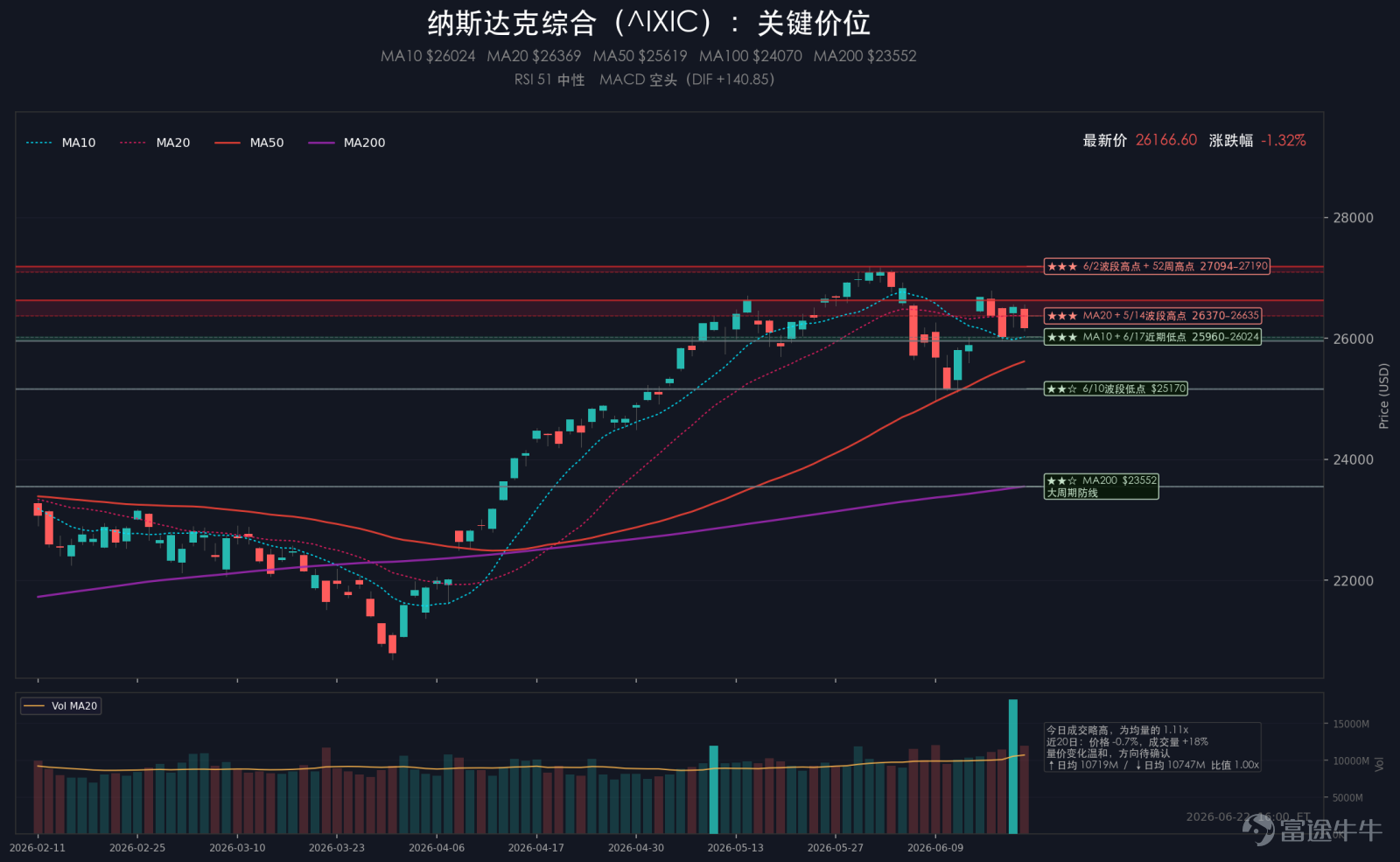
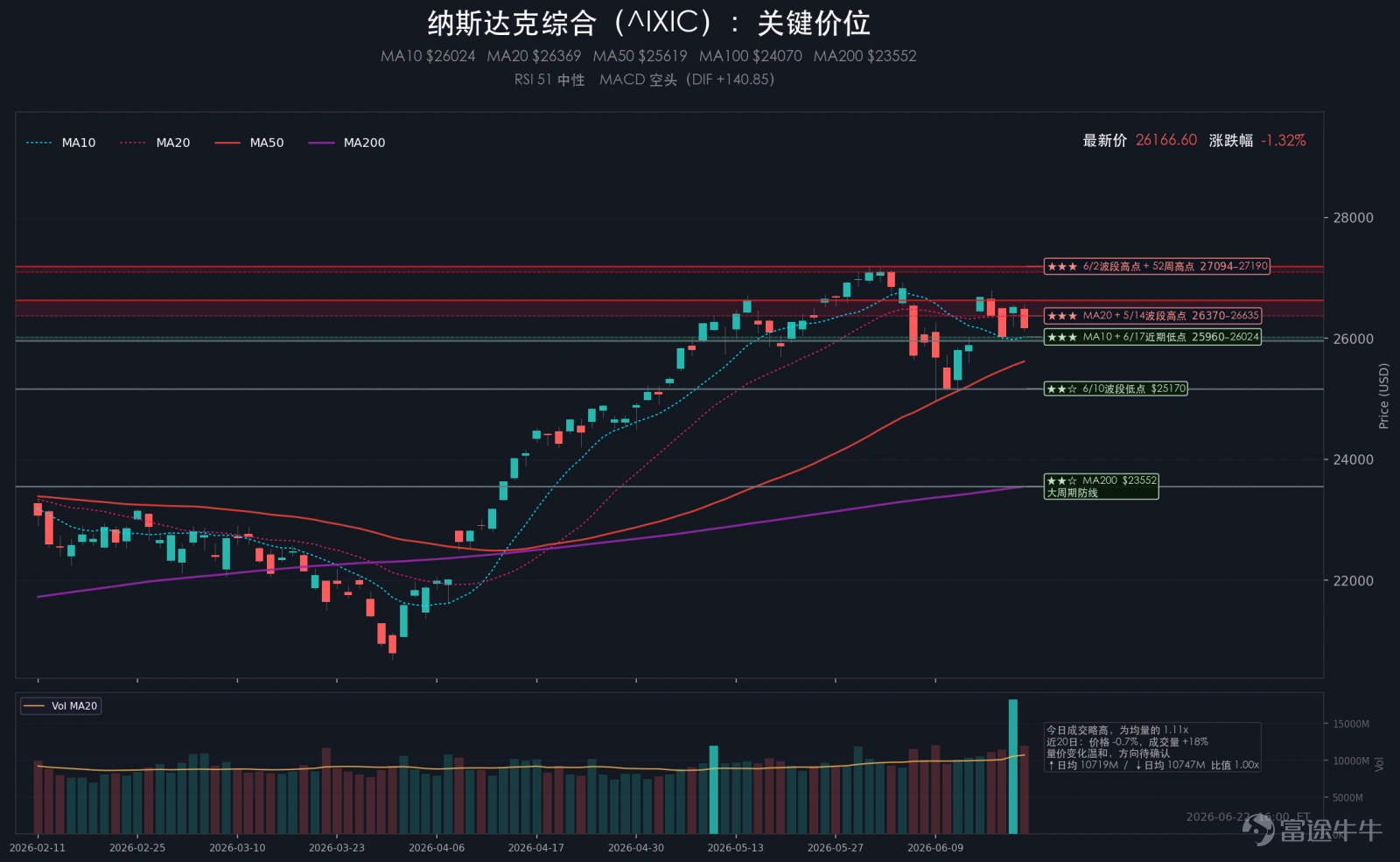
Summary: US stocks diverged on Monday. The S&P 500 fell 0.37%, the Nasdaq dropped 1.32%, the Dow Jones rose 0.29%, and the Russell 2000 gained 0.83%. The Nasdaq significantly underperformed, while the Dow and Russell 2000 held up relatively well, indicating that selling pressure was concentrated in large-cap tech rather than reflecting broad market weakness. The VIX rose to 17.28, up 5.37% on the day, signaling a modest uptick in short-term risk-off sentiment. Two key drivers shaped market pricing: first, ongoing US-Iran negotiations reduced Middle East risk premiums, pushing oil prices lower; second, Alphabet, Google’s parent company, plunged on concerns over AI talent attrition, dragging down large-cap tech and communication services. Within sectors, energy and real estate outperformed, while communication services and consumer discretionary lagged. Across major asset classes, the 10-year Treasury yield rose 1.30%, gold declined 0.76%, crude oil fell 0.32%, Bitcoin gained 0.25%, and the dollar index rose 0.23%.
I. Major Events
1. US-Iran talks set a 60-day roadmap, oil prices continue to retreat
The US and Iran agreed during negotiations in Switzerland to pursue a final agreement within a 60-day timeframe, with Qatar and Pakistan acting as mediators. As talks shifted from ceasefire discussions to concrete arrangements, markets immediately reduced Middle East supply risk premiums, leading to declines in both crude oil prices and inflation expectations.
2. Alphabet, Google’s parent company, hit by AI talent exodus concerns
John Jumper of DeepMind has moved to Anthropic, and Noam Shazeer, head of Gemini, has joined OpenAI, prompting the market to reassess Google's AI competitiveness. As a result, capital is rotating out of the most crowded large-cap tech names, with the Nasdaq and Communication Services sector under more noticeable pressure.
II. Major Trends
On a single-day basis, Monday’s weakness was not broad-based but driven by large-cap tech dragging down the indices. The Nasdaq fell 1.32%, the S&P 500 dropped 0.37%, the Dow Jones rose 0.29%, and the Russell 2000 gained 0.83%. Capital hasn’t fully exited the market but is shifting from mega-cap tech into small caps, cyclical sectors, and a more diversified set of holdings.
Over a three-month horizon, growth-style assets still maintain their intermediate-term advantage. QQQ is up 26.94% over three months, significantly outperforming DIA’s 13.84% gain; SPYG has risen 20.00%, continuing to beat SPYV’s 9.16% increase. The recent short-term tech pullback hasn’t yet altered the medium-term leadership picture.
Looking at the past two weeks, small caps and the Dow have shown clearer relative strength. IWM is up 5.20% over two weeks, and DIA has gained 1.88%, both notably outperforming the MAGS basket of mega-cap tech stocks, which declined 3.77% over the same period. The market is broadening beyond concentrated exposure to big tech.
From a top-down perspective, mega-cap tech is still digesting near-term pressure. MAGS is up 9.68% over three months but has already fallen 3.77% over the past two weeks. Large-cap tech hasn’t lost its intermediate-term trend yet—only the short-term overcrowded trades are cooling off.
III. Market Sentiment
The VIX closed at 17.28, up 5.37% on the day, indicating a modest rebound in short-term hedging demand. The CNN Fear & Greed Index rose to 35 from the previous session’s 32, reflecting continued caution in sentiment but no further deterioration.
Options activity remains mixed. The CBOE total put/call ratio stood at 0.78, with the index options put/call at 1.10 and the equity options put/call at 0.66. Demand for downside protection persists on the index side, while individual stocks show no signs of outright panic—the market appears to be rotating out of mega-cap tech rather than entering broad risk-off mode.
IV. Market Scan
1. Index ETFs:On Monday, the four major index ETFs showed clear divergence: Russell 2000 ETF (IWM) led gains, Dow Jones ETF (DIA) edged higher, S&P 500 ETF (SPY) pulled back, and Nasdaq-100 ETF (QQQ) posted the largest decline. Small caps and traditional blue chips held up relatively well, while mega-cap tech weighed most heavily on the market.
2. Sector Performance:Energy (XLE) rose 1.26%, making it the strongest sector, while Communication Services (XLC) fell 2.11%, the weakest performer. Consumer Discretionary (XLY) dropped 1.70%, and Real Estate (XLRE) gained 1.24%. Capital isn’t retreating broadly but is showing clear caution toward large internet and consumer names. Within sub-sectors, DRAM surged 5.23%—the top performer—followed by biotech (XBI) up 3.75%. Software (IGV) declined 2.00%, cloud computing (SKYY) fell 1.77%, and homebuilders (XHB) dropped 1.58%. AI-related optical communications and optical modules remained relatively strong, and AI memory continued its recovery.
3. The Magnificent Seven Tech Stocks:Among the Magnificent Seven tech stocks, Tesla (TSLA) rose 1.14%, making it the relative outperformer, while Netflix (NFLX) tumbled 5.82%, the worst performer. Alphabet (GOOG) fell 5.08%, Microsoft (MSFT) dropped 3.18%, and Meta (META) declined 2.32%. Pressure within mega-cap tech remains concentrated, particularly in communication services and internet platform segments.
4. U.S.-Listed Chinese Stocks:U.S.-listed Chinese stocks continued to diverge. Futu (FUTU) led gains with a 3.45% rise, while Tencent Music (TME) was the weakest performer, down 4.47%, and Bilibili (BILI) fell 2.56%. Risk appetite has not returned uniformly; stock-specific divergence remains dominant within the U.S.-listed Chinese equity space.
5. Cryptocurrencies:Bitcoin rose 0.25%, while crypto-related stocks diverged. MARA gained 4.43%, MicroStrategy (MSTR) dropped 2.73%, and Circle (CRCL) declined 0.35%. The cryptocurrency sector has yet to establish a clear consensus theme, with capital rotating primarily among select high-beta names.
$S&P 500 Index (.SPX.US)$ $SPDR S&P 500 ETF (SPY.US)$ $NASDAQ 100 Index (.NDX.US)$ $Invesco QQQ Trust (QQQ.US)$ $Dow Jones Industrial Average (.DJI.US)$ $State Street® SPDR® Dow Jones Industrial Average® ETF Trust (DIA.US)$ $Russell 2000 Index (.RUT.US)$ $iShares Russell 2000 ETF (IWM.US)$ $Roundhill Magnificent Seven ETF (MAGS.US)$ $USD (USDindex.FX)$ $U.S. 10-Year Treasury Notes Yield (US10Y.BD)$ $iShares 20+ Year Treasury Bond ETF (TLT.US)$ $XAU/USD (XAUUSD.CFD)$ $SPDR Gold ETF (GLD.US)$ $CBOE Volatility S&P 500 Index (.VIX.US)$ $CME-Bitcoin RR Futures (JUL6) (BTCmain.US)$ $iShares Ethereum Trust ETF (ETHA.US)$ $NVIDIA (NVDA.US)$ $Tesla (TSLA.US)$ $Meta Platforms (META.US)$ $Amazon (AMZN.US)$ $Alphabet-C (GOOG.US)$ $Microsoft (MSFT.US)$ $Apple (AAPL.US)$
Risk Disclaimer: The above content only represents the author's view. It does not represent any position or investment advice of Futu. Futu makes no representation or warranty.Read more


Comments
to post a comment
11