
"AI Bottleneck Trade" Ignites Upstream Sector—Who’s Raking in the Profits?
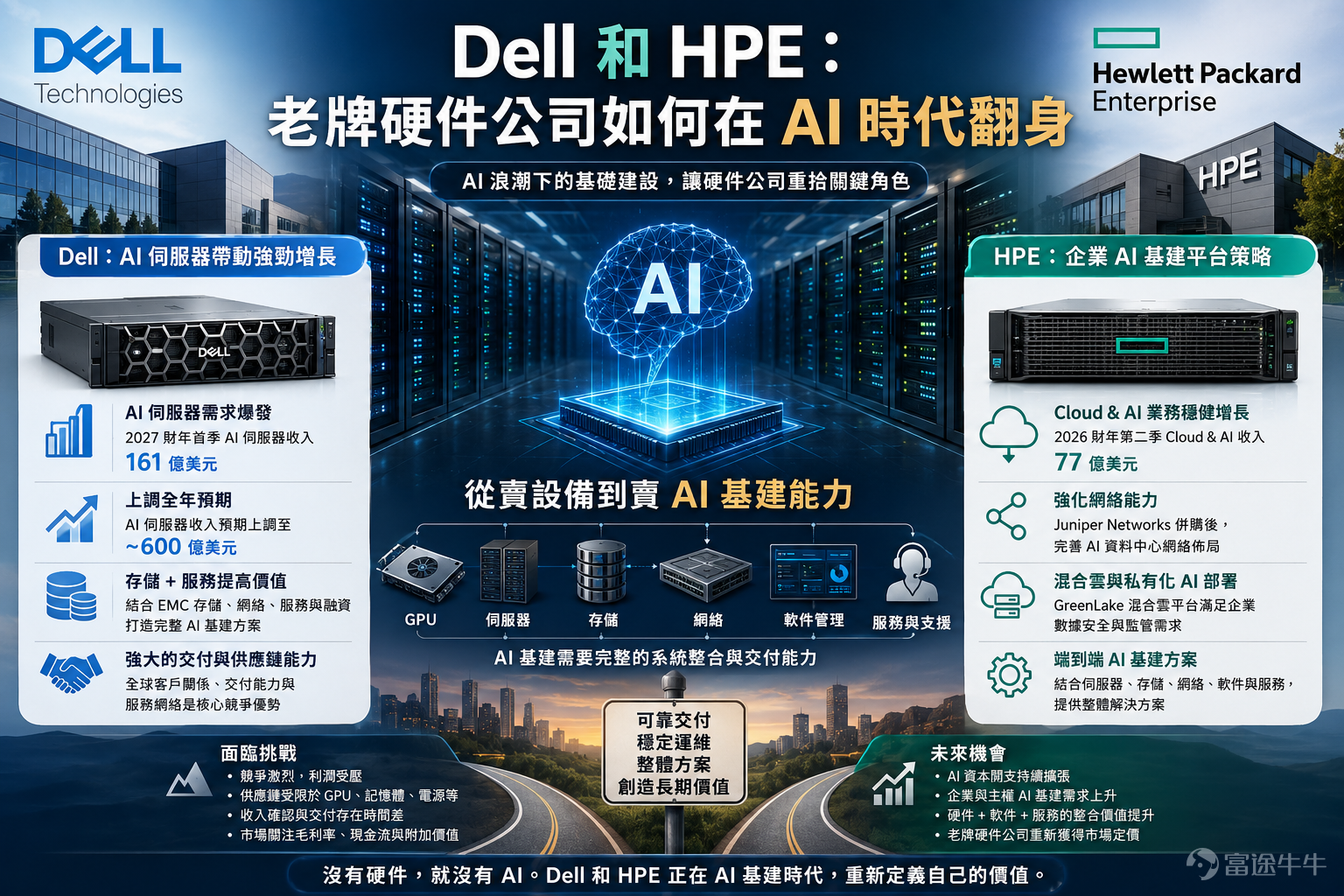
Dell and HPE: How Legacy Hardware Companies Are Making a Comeback in the AI Era

For much of the past decade, hardware companies were viewed by the market as the tech equivalent of old-economy firms: their growth lagged behind cloud providers, their gross margins trailed software companies, and their valuations fell short of platform businesses. However, the wave of AI-related capital spending has changed all that. As large cloud providers, sovereign wealth funds, and enterprise customers all rush to build AI computing capacity, GPUs are just the starting point. To actually deploy AI infrastructure, they also need servers, storage, networking, cooling, racks, deployment services, maintenance, and financing solutions. These seemingly mundane hardware capabilities have suddenly become indispensable links in the AI supply chain.
In recent years, Dell has moved beyond its legacy PC image, driven primarily by surging demand for AI-optimized servers. In its latest quarter, Dell reported strong revenue growth, with AI server sales and orders becoming a key market focus. Management has even raised its full-year AI server revenue forecast to approximately $60 billion. This isn't a typical hardware cycle recovery—it reflects a shift in AI data center construction from chip procurement to integrated system delivery. Customers aren’t just buying individual GPUs; they’re purchasing fully operational, scalable, and maintainable AI factories. Dell’s strengths lie in its supply chain management, customer relationships, delivery capabilities, and global service network. When GPUs, HBM memory, and power become bottlenecks, the company that can assemble components into deliverable systems gains greater influence in the AI infrastructure boom.
More importantly, Dell isn’t relying solely on 'selling iron' to stage its comeback. While AI servers themselves may not carry software-like gross margins, profitability improves significantly when bundled with storage, networking, maintenance, financing, and enterprise solutions. AI model training and inference require massive data flows, making storage and data management critical—not just supporting roles. This dynamic is causing the market to re-evaluate assets Dell acquired years ago through its EMC purchase. Once seen as a heavy burden, Dell’s enterprise storage business has now emerged as a second-layer demand driver—right after compute power—in the AI era. This re-rating doesn’t stem from Dell suddenly becoming a software company, but rather from the market finally recognizing the scarcity value of hardware integration capabilities.
From Selling Equipment to Selling AI Infrastructure Capabilities
HPE’s story is slightly different. Unlike Dell, which captured market attention through explosive AI server growth, HPE’s turnaround is more aligned with positioning itself as an 'enterprise AI infrastructure platform.' Its Cloud & AI business, GreenLake hybrid cloud model, ProLiant servers, Cray supercomputing heritage, and enhanced networking capabilities following the Juniper Networks acquisition together form a comprehensive offering—from servers, storage, and networking to private-cloud AI deployment. Not all enterprise AI workloads will run on public clouds or hyperscale data centers. Industries such as finance, government, healthcare, manufacturing, and telecommunications often require on-premises or hybrid AI architectures due to data security, regulatory compliance, and latency constraints. HPE is betting precisely on this demand.
Juniper is especially critical for HPE. Bottlenecks in AI data centers aren't just about GPU count—they also include network latency, bandwidth, cluster management, and failure rates. Training large models requires tens of thousands of GPUs working in concert; if the networking infrastructure can't keep up, these expensive chips won't operate at full efficiency. By integrating Aruba, Juniper, Mist AIOps with its own servers and hybrid cloud capabilities, HPE aims to evolve from a traditional server vendor into a provider of AI data center networking and enterprise AI platforms. In other words, HPE's turnaround hinges not on selling individual products, but on securing a higher-value position within AI infrastructure.
Of course, a turnaround by an established hardware company doesn't mean it’s without risk. First, while AI server revenue is growing rapidly, competition is equally intense—Super Micro, Lenovo, ODM manufacturers, and cloud giants building their own capabilities will all compress profit margins. Second, supply chains remain constrained by shortages of GPUs, memory, power supplies, and thermal solutions, creating a time lag between order placement and revenue recognition. Third, for hardware companies to truly be re-rated, the market looks beyond top-line revenue to gross margins, cash flow, and service attach rates. If AI servers amount to nothing more than high-revenue, low-margin contract manufacturing, any valuation uplift won’t be sustainable; only by driving storage, networking, software management, and long-term services can a solid foundation for re-rating be established.
From a capital markets perspective, Dell and HPE offer an intriguing insight: the AI era doesn’t reward only cutting-edge chip designers—it also revalues companies capable of engineering, productizing, and scaling complex technologies for delivery. Over the past decade, investors favored asset-light, platform-based, high-margin software businesses; in the coming years, the realities of AI infrastructure may compel the market to rediscover respect for hardware, supply chains, and systems integration. Computing power isn’t just a slogan—it’s built rack by rack, data center by data center, with networks and storage systems stacked one on top of another.
(Chips & Compute Power Series #75)
Risk Disclaimer: The above content only represents the author's view. It does not represent any position or investment advice of Futu. Futu makes no representation or warranty.Read more

Comments
to post a comment
1