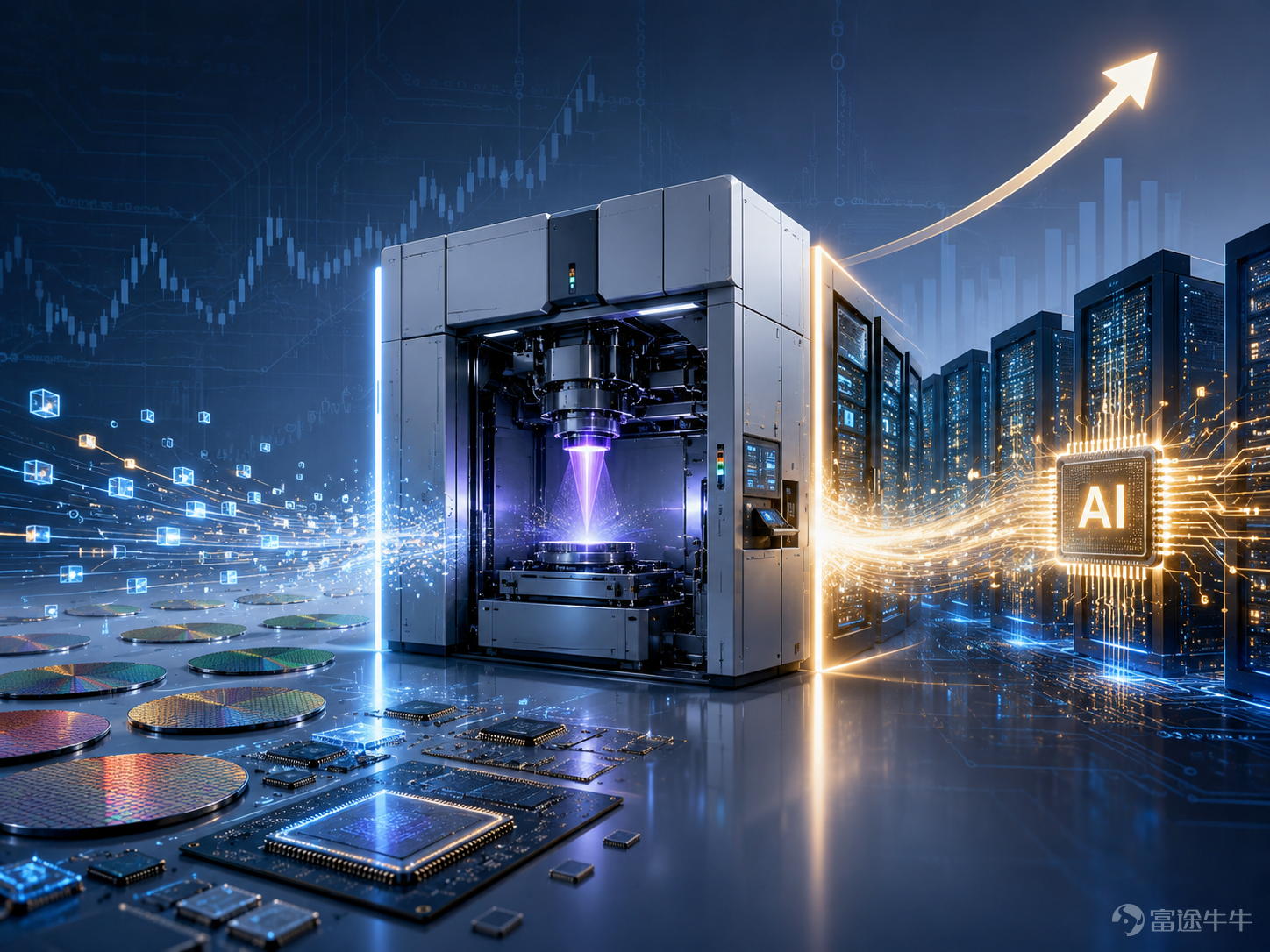

"AI Bottleneck Trade" Ignites Upstream Sector—Who’s Raking in the Profits?

ASML: The Gatekeeper of AI Capacity

In this latest AI boom, the market has tended to focus on Nvidia, Broadcom, AMD, and the capital expenditures of cloud giants. GPUs are the most easily understood protagonists, data centers the most visible setting—even HBM memory has become a hot trading theme due to supply shortages. But if we push one step further upstream in the AI supply chain, what truly determines whether advanced chips can be mass-produced, scaled up, or maintain generational leadership isn’t any particular AI accelerator—it’s the EUV lithography machines manufactured by ASML, one after another.
ASML is not an AI stock in the typical sense. It doesn’t design models, operate cloud infrastructure, or directly sell AI chips. However, all advanced logic chips and high-end memory chips targeting 5nm, 3nm, or even more advanced nodes rely critically on extreme ultraviolet (EUV) lithography. Without sufficient EUV capacity, Taiwan Semiconductor, Samsung, and Intel cannot rapidly expand their advanced manufacturing output; and without that advanced capacity, no matter how strong the demand from Nvidia and other AI chip designers may be, it remains confined to the demand curve. From this perspective, ASML acts more like the gatekeeper of AI capacity than a peripheral player in the AI concept stock universe.
The value of this gatekeeper lies in the fact that it faces virtually no real alternatives. EUV lithography machines are among the most complex industrial systems in the world, integrating light sources, optics, precision mechanics, vacuum systems, software, and intricate supply chain coordination. Each machine is not only extremely expensive but—more importantly—has a long delivery lead time, difficult installation and calibration processes, and requires extended customer ramp-up periods. Purchasing an EUV tool doesn’t mean a wafer fab can instantly boost its advanced capacity the next day; it must align with process roadmaps, yield ramp schedules, engineering teams, and upstream/downstream materials and equipment. This time barrier means ASML’s order book doesn’t just signal future revenue—it effectively previews the semiconductor capacity landscape for the next several years.
AI’s impact on ASML isn’t limited to logic chips alone. Large GPUs, ASICs, and custom accelerators require the most advanced process nodes, while HBM and advanced DRAM are also increasing their use of EUV layers. Historically, memory makers’ demand for lithography equipment has been highly cyclical—when smartphone and PC demand weakened, capex would sharply contract. But AI servers have tightly coupled high-bandwidth memory, advanced packaging, and logic chips together, transforming 'advanced nodes' from a single-chip race into a full-system AI competition. As a result, ASML benefits simultaneously from both logic and memory demand streams.
However, ASML’s investment narrative shouldn’t be oversimplified as 'the hotter AI gets, the higher the stock price rises.' Its revenue remains subject to wafer fab capex cycles, features high customer concentration, and faces timing mismatches between order booking and revenue recognition. More importantly, ASML sits at the epicenter of geopolitical tensions. EUV exports to China have long been restricted, and even some advanced DUV tools now face export control pressures. This means ASML enjoys pricing power from its technological monopoly while simultaneously bearing policy-related risks. The market buys its scarcity—but must also price in geopolitical uncertainty.
For ASML, the most nuanced aspect is that while it isn’t the biggest beneficiary on the demand side, it represents the hardest-to-bypass bottleneck on the supply side. Nvidia can enjoy explosive growth from a blockbuster GPU generation, and cloud giants can rewrite their valuation logic as AI applications monetize; ASML’s growth, by contrast, is slower, more engineering-driven, and more constrained by delivery capacity. Yet precisely because of this, its moat resembles 'industrial infrastructure' more than 'product cycles.' The market may question whether a particular AI application is overhyped, but it’s hard to deny that advanced chip manufacturing capability remains central to competition among nations, corporations, and supply chains.
High Numerical Aperture EUV—High-NA EUV—is the next key observation point. These tools are even more expensive and technically challenging, designed to enable future, finer process nodes. However, they won’t immediately drive explosive profits, as early adoption involves customer validation, yield ramp-up, and fab reconfiguration. Investors who judge ASML solely by short-term orders risk overlooking the company’s true value: its 'generational switching rights.' Every time advanced semiconductor processes advance, ASML stands at the gate collecting tolls.
Therefore, ASML’s valuation shouldn’t hinge solely on whether it qualifies as an 'AI stock,' but rather on whether AI is extending the capital expenditure cycle for advanced semiconductor processes. If AI training, inference, enterprise automation, sovereign AI, and edge computing continue to expand, wafer fabs’ investments in EUV lithography will not be a one-off restocking event but part of a long-term capacity expansion. ASML’s earnings may still fluctuate, but its strategic position will increasingly resemble that of an 'infrastructure tollbooth' in the semiconductor world.
Yee Hap Holdings Investor Relations Department
(Chip & Compute Series #74)
Risk Disclaimer: The above content only represents the author's view. It does not represent any position or investment advice of Futu. Futu makes no representation or warranty.Read more
Comments
to post a comment