
USD 950 billion collaboration plus major player rankings—can they reignite confidence in memory stoc

Earnings and Options Strategy | Micron Technology faces more than just earnings pressure as a supercycle collides with high expectations
$Micron Technology (MU.US)$ will release its third-quarter FY2026 earnings after the U.S. market close on June 24, for the fiscal quarter ended May 28.
This will be one of the most important tech earnings reports in the U.S. market this week. It matters not only for Micron Technology’s stock but also for market sentiment regarding the AI hardware supply chain, semiconductor industry cyclicality, the memory price upcycle, and valuations of high-flying tech stocks.
Micron currently trades under a unique backdrop: fundamentals are exceptionally strong, and so is the stock price; earnings expectations are very high, and so is the implied volatility in options.
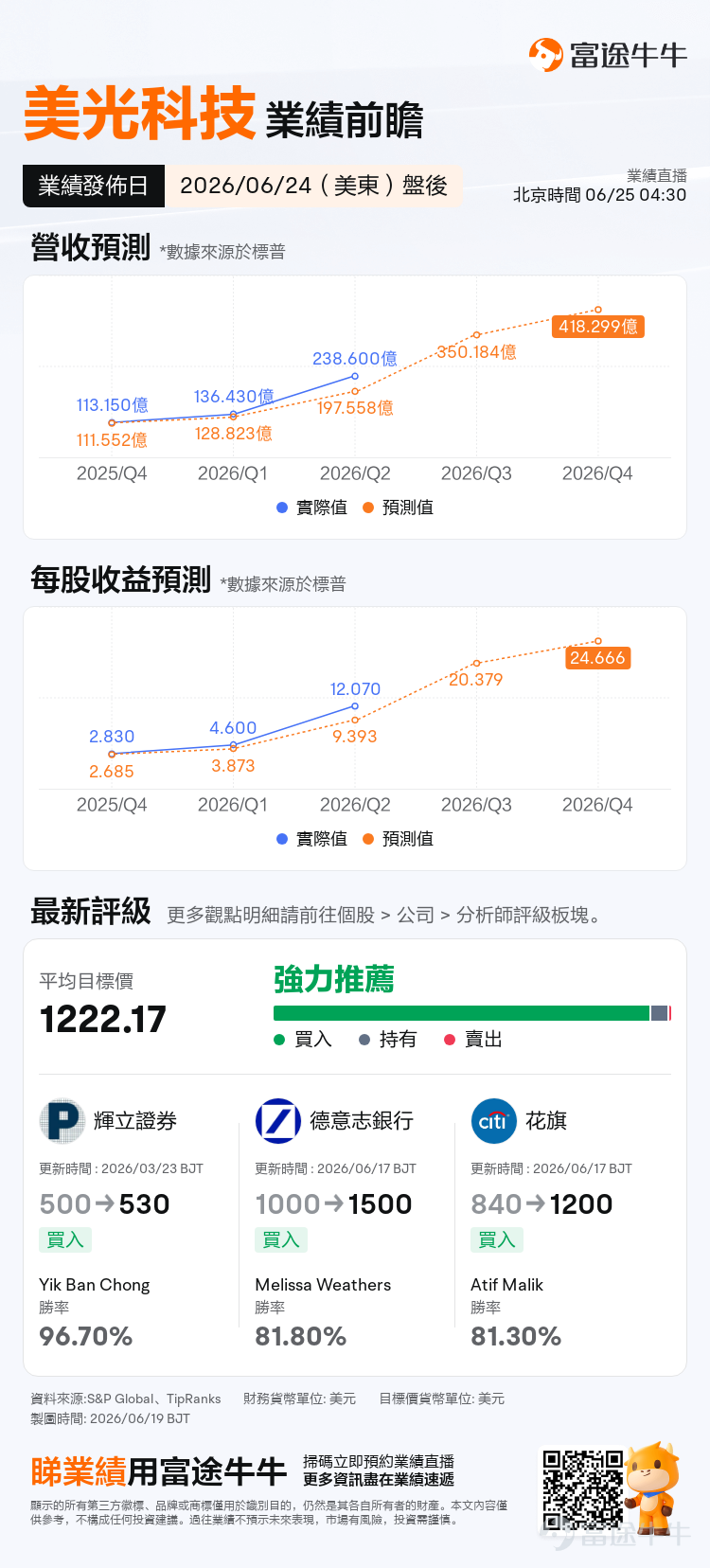
Consensus estimates project Micron’s revenue at $35.018 billion and EPS at $20.379, both reflecting a multi-quarter upward trend. Compared with the guidance provided for FYQ2, current market expectations are notably more optimistic.

Therefore, what truly matters this time is whether actual results and forward guidance can continue to surpass already elevated market expectations, further reinforcing—or even extending beyond—the market’s optimistic view of the industry cycle.
If management continues toraise subsequent guidance, confirms sustained tightness in HBM supply-demand dynamics, and maintains gross margins at elevated levels, Micron will still have a solid foundation to sustain its strength.. For options sellers, Micron’s currently sky-high implied volatility offers an opportunity to collect substantial option premiums, but such earnings-sensitive stocks carry significant risk of large post-earnings gaps,so options strategies must prioritize tail-risk mitigation.。
Revenue is expected to increase by over 40% quarter-over-quarter.
First, review Micron Technology's actual results for the previous quarter and its guidance for the current quarter.
In fiscal Q2 2026, Micron Technology reported revenue of $23.86 billion, Non-GAAP EPS of $12.20, a Non-GAAP gross margin of 74.9%, operating cash flow of $11.9 billion, and adjusted free cash flow of $6.9 billion. This quarter already represents historically strong performance for the company.
The company’s official guidance for fiscal Q3 2026 is even more aggressive:
Based on the midpoint of guidance, fiscal Q3 2026 revenue is projected at $33.5 billion, up approximately 40% sequentially, with Non-GAAP EPS rising roughly 57% quarter-over-quarter.
Year-over-year changes are even more dramatic. In fiscal Q3 2025, Micron reported revenue of $9.301 billion, Non-GAAP EPS of $1.91, and a Non-GAAP gross margin of 39.0%. Using the midpoint of the company’s guidance for fiscal Q3 2026, revenue is expected to surge approximately 260% year-over-year, and Non-GAAP EPS is forecast to jump about 903%.

This explains why the market is paying such close attention to MU: the current state of the memory industry is no longer a typical cyclical recovery but rather a fundamental earnings re-rating driven simultaneously by AI data center demand, HBM shortages, DRAM/NAND price increases, and expanding gross margins.
Three key focal points: HBM, price increases, and gross margins
HBM: The core driver behind Micron’s valuation repricing
HBM remains the most critical valuation driver for Micron Technology (MU) at present.
HBM (High Bandwidth Memory) is used in AI accelerators to enhance data transfer efficiency and reduce latency. Compared with standard DRAM, HBM is more complex to manufacture, has a slower production ramp-up, requires longer customer validation cycles, and exhibits stronger growth characteristics.
According to prior media reports, Micron has already sold out its entire HBM supply for 2026, and its next-generation HBM4 product has already entered production. Micron has finalized allocations for its 2026 HBM3E and HBM4 supply, with shipments of HBM4 to NVIDIA’s Vera Rubin platform commencing in March 2026 and ramping faster than the previous generation.
Progress in HBM operations should be closely monitored during earnings calls, focusing on four key questions:
– Will HBM capacity remain fully allocated throughout 2026?
– Will visibility into 2027 HBM orders continue to improve?
– Is the HBM4 production ramp progressing smoothly?
– – Can long-term customer agreements, prepayments, and capacity-locking mechanisms mitigate traditional memory market cyclicality?。
If management continues to reinforce messaging around 'HBM supply-demand imbalance, customers locking in long-term capacity, and sustained pricing support,' MU’s position as a core asset in this AI cycle could further strengthen.

DRAM/NAND: Will price increases spread from HBM to the broader industry?
HBM carries the strongest narrative, but Micron Technology's true profit elasticity still hinges on overall DRAM and NAND pricing.
Driven by the AI hyperscale data center infrastructure cycle, demand for HBM, DRAM, and NAND continues to outstrip supply, with industry supply tightness expected to persist beyond 2026. This is critically important: if AI demand only lifts HBM, Micron’s re-rating would be confined to a single high-end product line; however, if HBM capacity crowds out traditional DRAM supply—pushing up prices for server DRAM, data center SSDs, and NAND—Micron’s earnings elasticity would be further amplified.
Key points to watch closely in this earnings report include:
– Whether DRAM ASP continued to rise sequentially;
– Whether NAND price increases continue to be driven by data center demand;
– Whether cost pressures are emerging in PC and mobile segments;
– Whether data center customers continue to lock in supply ahead of time;
– Whether management hints that supply will remain tight into fiscal year 2027.
What truly supports Micron’s continued upside isn’t just strength in HBM alone, but a persistently tight supply-demand balance across the entire memory market. The latest data from TrendForce, Omdia, Gartner, and IDC collectively indicate that AI server demand is crowding out capacity for HBM, server DRAM, and enterprise SSDs, driving rare sequential surges in DRAM and NAND contract prices.A sequential price increase of approximately 60% is expected for Q2 2026.For original equipment manufacturers like Micron Technology, the core driver of earnings elasticity stems from 'supply scarcity + rising ASPs + an improved high-end product mix.'

Gross margin: Is 81% the new normal or a cyclical peak?
The most sensitive figure in this earnings report is the gross margin. In FY2025 Q3, Micron’s non-GAAP gross margin was only 39.0%; by FY2026 Q2, it had risen to 74.9%; and the company’s guidance for FY2026 Q3 points to a further increase to approximately 81%.
This is highly unusual within the traditional memory storage industry framework.
The bullish argument is as follows:
Higher HBM revenue share, long-term contracts, customer order lock-ins, and surging AI data center demand are transforming Micron’s historically highly cyclical profit structure. If a gross margin around 80% can be sustained,Micron should no longer be valued using the simplistic framework typically applied to cyclical stocks.。
The bearish concern is equally straightforward:
The higher the gross margin, the more it incentivizes capacity expansion. If supply and the company’s capital expenditures surge in the future, industry supply expectations could catch up with demand, potentially pushing the memory sector back into a price-down cycle.
Therefore, the most critical question to watch during this earnings call is:Will management hint that a gross margin of around 80% could extend into Q4 FY2026 or even FY2027??
If the answer is relatively positive, the stock price may continue to find support.
If management characterizes the current gross margin as a short-term peak, the market could quickly lower valuation levels and expectations.
A critical observation window for the AI-driven market theme
Undoubtedly, the market has already labeled Micron’s upcoming earnings report as a pivotal window to gauge the momentum of the AI rally. The rationale is that the AI investment frenzy has already lifted U.S. equities and the semiconductor sector, and the market now needs to validate—through core supply-chain companies like Micron Technology—whether demand for data centers and AI chips continues to accelerate.
Some institutions emphasize that demand for HBM, DRAM, and NAND continues to outstrip supply, and industry-wide supply constraints could persist beyond 2026. Meanwhile, Micron’s revenue and gross profit forecasts for DRAM and NAND have been significantly revised upward from the previous quarter, making its earnings guidance a key signal for the trajectory of the entire memory cycle.
At the same time, many analysts are also focusing on valuation and diverging views. Several Wall Street firms have recently raised their price targets for Micron, with TD Cowen and Cantor Fitzgerald lifting theirs to around $150, citing strong AI memory demand, tight HBM supply-demand dynamics, and long-term customer agreements as supportive of higher profitability. However, the market is also growing concerned that the stock’s recent sharp gains and overheated technical indicators may mean strong earnings have already been priced in.
Taken together, these perspectives represent the core bullish-bearish divergence on Micron right now: bulls are betting on a supercycle in AI memory and further upward revisions to FY2027 earnings, while bears are watching whether the high stock price, elevated expectations, and lofty gross margins can be sustained.
Options market: High implied volatility has already priced in 'significant moves'
From an options perspective, Micron’s upcoming earnings are certainly not expected to be low-volatility. Based on current market data, the implied move for the June 26 expiration week is approximately ±14%.

The options market has already priced in a large post-earnings gap move for Micron Technology (MU). This raises the bar for both buyers and sellers.
The buyer's dilemma is this: even if they get the direction right,the actual move must be large enough to offset the post-earnings IV crush.。
The seller's concern is this: while premiums are indeed rich, with a stock like MU—characterized by strong momentum, high institutional interest, and significant analyst divergence—the biggest fear is that results could immediately jump outside the expected range.
Options strategy: High premiums are attractive, but tail risk must be managed first.
What makes MU’s upcoming earnings particularly appealing to option sellers is its elevated implied volatility (IV) and wide implied move range. Based on current Micron options data—IV level, IV rank, and IV percentile—all metrics sit at historically extreme highs, with IV reaching 114%.

However, such earnings-driven stocks shouldn’t be simplistically viewed as 'sell just because IV is high.' MU currently exhibits strong trend momentum, commands intense institutional attention, and faces sharply divided bullish/bearish views. Should earnings significantly beat expectations or guidance weaken materially, the resulting gap move could substantially exceed historical averages.
Sellers are better served by using defined-risk structures rather than naked short positions.
1) Slightly bearish-to-neutral seller: Iron Condor
Suitable outlook:
After the earnings release, the stock price is unlikely to break out of the options-implied range, as the market has already priced in excessive volatility.
Investment Strategy:
Sell an out-of-the-money Put Spread and simultaneously sell an out-of-the-money Call Spread to construct an Iron Condor. The primary objective is to profit from the post-earnings implied volatility crush and time decay.

Applicable conditions:
– Believe Micron Technology’s earnings are likely strong, but not so strong as to cause another significant gap up;
– Believe current implied volatility is relatively expensive;
– Do not wish to take on the unlimited risk of a naked straddle short.
Risk points:
– If Micron Technology’s stock surges or plunges significantly beyond the expected range after earnings, a loss will occur in either direction;
– If the stock gaps directly beyond the short leg of the spread after earnings, it becomes difficult to exit with a stop-loss;
– Must predefine maximum loss tolerance; unsuitable for heavy position sizing.
A more conservative approach:
Place the short leg outside the implied range of the options market—for example, above approximately USD 1,300 on the upside or below approximately USD 940–970 on the downside—and then select strike prices with better liquidity based on real-time option chains.
2) Bullish seller: Sell a Put Spread
Suitable outlook:
You are bullish on Micron Technology's medium-term fundamentals but do not want to chase the stock higher ahead of earnings or take on the risk of selling naked puts.
Investment Strategy:
Sell an out-of-the-money put while simultaneously buying a lower-strike put for protection, constructing a Bull Put Spread.

(The design images displayed on the screen are for demonstration purposes only and do not constitute any investment advice or guarantee; market movements are frequent, and the illustrated option prices do not represent actual conditions)
Applicable conditions:
– You believe the AI-driven memory cycle is still intact;
– You expect that even if the stock pulls back after earnings, the decline will not significantly breach key support levels;
– You aim to collect premium by taking advantage of elevated implied volatility (IV).
Risk points:
– If the market concludes after earnings that the high gross margin is unsustainable, the stock price could gap down below the short put strike price immediately.
– Micron Technology’s stock price is already at elevated levels; valuation and technical pullback risks cannot be ignored.
– Although selling a put spread carries limited risk, excessive position sizing can still amplify losses.
A more suitable execution approach:
Avoid placing the short put too close to the current market price. Instead, select a strike range based on the lower bound of implied volatility and technical support levels. If your intent is simply to express 'I’m willing to buy if it drops,' selling a put spread is more prudent than selling a naked put.
3) Stockholder as option seller: Covered Call / Collar strategy
Suitable outlook:
You already hold Micron Technology shares with substantial unrealized gains and are concerned about a post-earnings sell-off or IV crush, yet you don’t want to sell the stock outright.
Option 1: Covered Call
Hold the underlying shares while simultaneously selling an out-of-the-money call to collect premium from elevated implied volatility.
Advantages:
– This can generate additional income on your existing position;
– If the stock price trades sideways or rises modestly after earnings, call option premium decay works in your favor;
– Suitable for investors who don’t mind having their shares called away at a higher strike price;
Risks:
– If Micron Technology surges sharply after earnings, upside gains on the underlying stock will be capped by the short call;
– If the stock plunges post-earnings, the call premium received only partially offsets losses on the underlying position;

(The design images displayed on the screen are for demonstration purposes only and do not constitute any investment advice or guarantee; market movements are frequent, and the illustrated option prices do not represent actual conditions)
Option 2: Collar Strategy
Hold the underlying stock, sell an out-of-the-money call, and simultaneously buy an out-of-the-money put for downside protection.
Advantages:
– Ideal for shareholders who already have substantial unrealized gains and want to lock in profits;
– Use the premium from selling the call to subsidize the cost of buying the put;
– Provides protection if the stock gaps down after earnings;
Risks:
– Upside potential is limited;
– If the chosen put strike is too far out-of-the-money, the downside protection is limited;
– If the chosen call strike is too close to the current price, upside gains may be capped prematurely.
Conclusion: At its core, this is a showdown between strong fundamentals and rich valuation.
Micron Technology remains one of the most critical earnings plays in the current AI hardware supply chain. The fundamental thesis is very clear: AI data center expansion is driving a surge in HBM demand, and tight HBM supply is crowding out capacity for traditional DRAM/NAND.Rising memory prices are boosting gross margin and EPS leverage, and long-term customer agreements may help mitigate the historically high cyclicality of the memory industry.。
However, market pricing is already quite elevated. Therefore, the key focus of Micron’s upcoming earnings report will be whether guidance for Q4 and fiscal year 2027 continues to be revised upward, justifying the current valuation.
Finally, here's a small perk for fellow Futubull investors, welcome to claim it.Options Beginner Pack
*This event is exclusive to invited HK users. Click to learn more.Detailed event rules>>
Market conditions are complex and volatile,Options StrategyOverwhelmed by choices? Futubull helps you build a portfolio in three steps.Options Strategymaking investing simple and efficient!

Option Risk Warning:An option is a contract that grants the holder the right—but not the obligation—to buy or sell an underlying asset at a predetermined price on or before a specified date. Option prices are influenced by multiple factors, including the current price of the underlying asset, the strike price, time to expiration, and implied volatility. Implied volatility reflects the market’s expectation of future price fluctuations over the life of the option and is derived by reverse-engineering the Black-Scholes pricing model. It is commonly used as a gauge of market sentiment. When investors anticipate greater volatility, they may be willing to pay higher premiums for options to hedge risk, leading to elevated implied volatility. Traders and investors use implied volatility to assess the relative attractiveness of option prices, identify potential mispricings, and manage risk exposure.
Disclaimer:This content does not constitute any offer, solicitation, recommendation, opinion, or guarantee of any securities, financial products, or tools. The risk of loss in trading options can be substantial. In some cases, losses may exceed the initial margin deposited. Even if you set contingent orders such as 'stop-loss' or 'limit' orders, these may not prevent losses. Market conditions may make such orders unexecutable. You may be required to deposit additional margin within a short period. If you fail to provide the required amount within the specified time, your open positions may be liquidated. However, you will still be responsible for any shortfall in your account. Therefore, before trading, you should study and understand options and carefully consider whether such trading is suitable for you based on your financial situation and investment objectives. If you trade options, you should be familiar with the procedures for exercising options and the rights and obligations upon exercise and expiration. Options trading carries extremely high risks and is not suitable for all investors. Investors should carefully readCharacteristics and Risks of Standardized Options。
Risk Disclaimer: The above content only represents the author's view. It does not represent any position or investment advice of Futu. Futu makes no representation or warranty.Read more


Comments (2)
to post a comment
71
249