
Baidu Options Quick Recap | Intel takes off again, crude oil tumbles on US-Iran deal! Did you understand this week’s one Call and one Put?
Hello fellow investors, welcome to this week'sHundred-Dollar Options Recap。
The most interesting aspect of the U.S. stock market this week was that 'event-driven' catalysts emerged simultaneously in two directions.
On one side, semiconductors. Intel was reignited once again by the narrative of 'Apple collaboration + U.S.-made chips,' as the market began re-pricing this legacy chipmaker with renewed upside potential, sending its share price directly back to new highs.
On the other side, crude oil. The U.S. and Iran signed a temporary agreement, raising expectations that the Strait of Hormuz would reopen and Iranian oil supply would return to the market. This caused risk premiums on oil prices to drop sharply, naturally impacting oil-sensitive ETFs like USO.
So in this episode, we’ll recap two options positions that are particularly suitable for beginners to understand:
one is an INTC Call, which captures the upside momentum of the underlying stock continuing to rally after a news catalyst; the other is a USO Put, betting on the elasticity of oil prices continuing to decline after geopolitical risks ease.
One is going long on a chip sector revaluation, the other is shorting the risk premium in crude oil. This is the most typical use of options:You don't have to predict an entire year—just express a directional view over a specific period.
$Intel (INTC.US)$ : Veteran chip stocks are being pulled back to the table by the 'Made in America' narrative
Let’s start with Intel.
This week, the dominant theme for INTC has been very clear: the market suddenly started trading again onApple, Intel, and U.S.-made chips—these key terms.
According to media reports, Trump said Apple would partner with Intel to design and manufacture chips in the United States. What excited the market most about this news wasn’t the immediate revenue boost for Intel, but rather the significant upside potential it created for Intel:
If top-tier customers like Apple are willing to use Intel's manufacturing capabilities, the market may reprice the credibility of Intel's foundry business.
The market has had many concerns about Intel in the past:
Its chip design segment has been under pressure from NVIDIA and AMD;
Its manufacturing segment has long been playing catch-up with Taiwan Semiconductor;
It has been telling a transformation story for years, but execution has consistently lagged.
What’s different this time is that the market is pricing in 'customer validation.'
For wafer foundry services, what matters most isn’t how advanced you claim your technology is—it’s whether major customers are willing to place real orders with you. If Apple truly partners with Intel, even if it’s only for certain chips or a portion of capacity, it would be a strong endorsement of both Intel’s 18A process and U.S.-based manufacturing capabilities.
Therefore, this call option warrants a closer look.
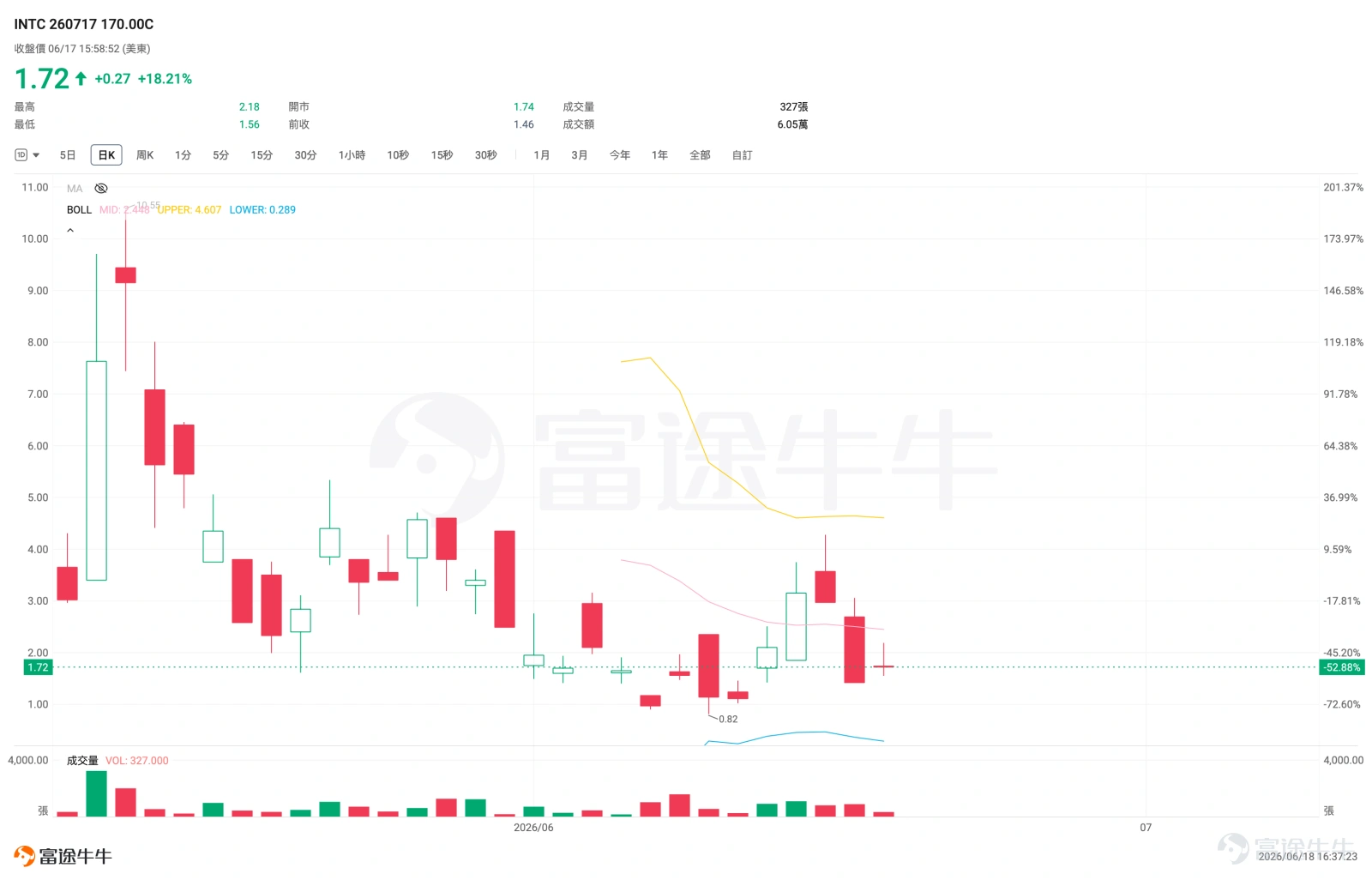
(The design images displayed on the screen are for demonstration purposes only and do not constitute any investment advice or guarantee; market movements are frequent, and the option prices shown do not represent actual conditions. The filtering criterion is options with an initial price below $3 per unit.)
This options trade perfectly illustrates a key concept every beginner must understand:
An out-of-the-money call doesn’t bet on the present—it buys the chance that the stock could rise to that level in the future.
The $170 strike price is still some distance away from Intel's current share price. It has little intrinsic value right now; its price mainly reflects the market’s expectation of future upside.
If more confirming signals emerge—such as Apple and Intel officially announcing a partnership, Intel 18A gaining additional customer validation, or the 'U.S.-made chips' narrative continuing to gain traction—this call option’s leverage will become much more pronounced.
However, if subsequent developments amount to nothing more than rhetoric—without formal agreements, specific order details, or a clear path to earnings contribution—this deep out-of-the-money call will quickly erode due to time decay.
New investors should remember one key point:
A cheap call option does not mean it is a safe call option.
Its advantage lies in low upfront cost per contract, with maximum loss limited to the premium paid;
but its drawback is equally clear: if the underlying stock doesn’t keep rising, time works against you every single day.
The key takeaway from reviewing this Intel call isn’t whether it can keep soaring—it’s what it tells us:
When an old stock is suddenly reignited by a new narrative, call options trade on imagination first—but for that imagination to turn into profit, confirmation must follow.
Going forward, watch these three signals for Intel most closely:
First, whether Apple and Intel issue further official confirmation;
Second, whether the 18A process secures more orders or validation from major customers;
Third, whether the stock price can hold above this week's highs and continue driving higher options volume.
If these three signals fail to materialize, calls could shift from 'story-driven plays' to 'time decay traps.'
$United States Oil Fund LP (USO.US)$ : Once the U.S.-Iran deal is signed, the crude oil risk premium gets immediately priced out.
Now look at USO.
The biggest event in the crude oil market this week was the signing of a temporary agreement between the U.S. and Iran. What the market is pricing in isn’t whether 'the war has fully ended,' but a much more immediate question:
Can shipping through the Strait of Hormuz stabilize again? Will Iranian crude supply return to the market?
For crude oil, these two questions are absolutely critical.
Previously, a significant portion of the oil price rally came from geopolitical risk premiums. In simple terms, the market was concerned that Middle East tensions would escalate, the Strait of Hormuz would be disrupted, and crude supply would tighten—so it was willing to pay a higher price for oil.
But after the agreement was signed, the market began to trade in reverse:
Geopolitical risk has declined;
Shipping routes have resumed;
Iranian supply could return to the market;
The 'war premium' embedded in oil prices is being squeezed out.
This is also why both WTI and Brent have seen a noticeable pullback, and crude-oil-linked ETFs like USO are naturally under pressure.
So what’s more instructive to review this time is USO Put。
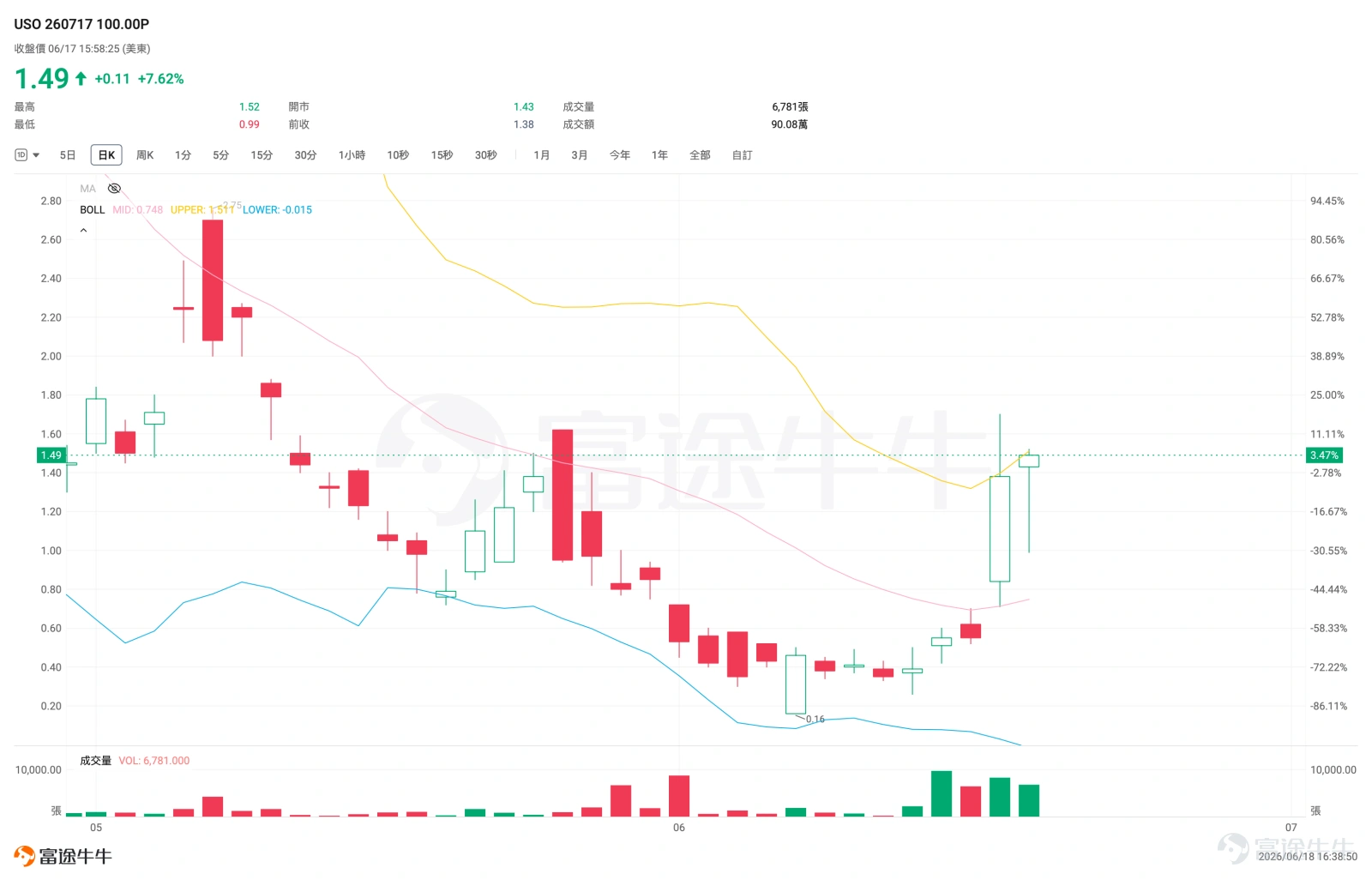
(The design images displayed on the screen are for demonstration purposes only and do not constitute any investment advice or guarantee; market movements are frequent, and the option prices shown do not represent actual conditions. The filtering criterion is options with an initial price below $3 per unit.)
The option price for this put rose from around $0.55 on Monday to $1.49 at Thursday’s close, nearly tripling from Monday to Wednesday this week.
This put is ideal for illustrating a very important options concept:
Puts are not just used for 'shorting stocks'—they can also express a bearish view on commodity prices.
USO itself is highly correlated with WTI crude oil prices. It is not a stock of an oil company, but rather a product that tracks oil price movements through instruments such as crude oil futures.
Therefore, when the market expects oil prices to fall, USO often comes under pressure;
When investors want to express the view that 'oil prices will continue to decline' at a low cost, USO Puts become a relatively straightforward tool.
The rationale behind this USO Put trade is very clear:
First, the interim U.S.-Iran agreement has reduced geopolitical risk;
Second, expectations of the Strait of Hormuz reopening have eased concerns about supply disruptions;
Third, anticipated resumption of Iranian oil exports is adding downward pressure on supply;
Fourth, the risk premium previously built into oil prices is now being unwound.
But it’s crucial to address the risks here.
Crude oil isn't a regular stock—it's most vulnerable to conflicting news headlines.
If the agreement implementation runs into trouble, or if the U.S. and Iran resume blaming each other, or if the resumption of shipping through the Strait of Hormuz lags behind expectations, oil prices could rebound sharply. Once oil prices bounce back, USO puts will come under immediate pressure.
Moreover, there's another issue with USO that beginners often overlook:
It doesn’t hold physical barrels of crude oil directly but instead gains exposure through crude oil futures and similar instruments.
This means that, beyond the direction of oil prices themselves, factors like futures roll yield, term structure, and market volatility can all affect USO’s performance. In the short term, it’s well-suited for expressing directional views on crude oil; however, if held for too long, its performance can’t be simplistically assumed to mirror oil price moves one-for-one.
This USO put position offers us the following lesson in post-trade review:
Commodity options may appear to trade based on price, but fundamentally, they’re trading event-driven expectations.
In this case, the event was the U.S.-Iran agreement.
The more stable the agreement, the more likely oil’s risk premium continues to decline;
the more volatile the agreement, the more likely oil prices are to surge again.
So for the USO put, there are three key variables to monitor going forward:
First, whether the agreement actually moves into the implementation phase;
Second, the status of shipping through the Strait of Hormuz and the resumption of tanker operations;
Third, whether WTI continues to break below critical price ranges, rather than merely experiencing a one-off pullback driven by news.
If oil prices drop only briefly on the initial news but then stabilize without further weakness, the put option will gradually lose value due to time decay.
With one call and one put, what’s the most valuable lesson to take away this week?
This week, Intel and USO tell two completely different stories.
Intel is driven by positive catalysts.
The market suddenly priced in expectations around 'Apple partnership + U.S. manufacturing + a turnaround in wafer fabrication,' creating room for call option trades.
USO, on the other hand, is driven by negative catalysts.
The temporary U.S.-Iran agreement has reduced crude oil supply risks, squeezing out the risk premium in oil prices and creating trading room for Puts.
One is betting on a rise, the other on a decline.
But the methodology behind them is actually the same:
Options are best suited for expressing clear, short-term catalysts.
INTC’s catalyst is its partnership with Apple and U.S.-based chip manufacturing;
USO’s catalyst is the U.S.-Iran agreement and expectations of restored shipping through the Strait of Hormuz.
Here’s a critically important point to recap:
With options, the issue isn’t big directional moves—it’s fuzzy logic.
If you buy an INTC Call, you must be clear that you’re buying into 'Intel’s foundry business being repriced';
If you buy a USO Put, you must be clear that you’re buying into 'the unwinding of geopolitical risk premium in crude oil.'
The clearer the logic, the clearer the profit-taking and stop-loss levels become.
Once the logic is proven false, you shouldn't stubbornly hold on just because the contract appears cheap.
Not comfortable with options basics? Study up before jumping in.
If, while reading this recap, you're still unclear about concepts like 'What is a Long Call?' or 'How to interpret strike prices,' don't rush to place orders—take some time first to solidify your foundational knowledge.Here’s a curated list of practical beginner resources—recommended for bookmarking:
Finally, here's a small perk for fellow Futubull investors, welcome to claim it.Options Beginner Pack
*This event is only open to invited HK users, click to learn more.Detailed event rules>>

Disclaimer
This content does not constitute any offer, solicitation, recommendation, opinion, or any guarantee of any securities, financial products, or tools. The risk of loss in trading options can be substantial. In some cases, losses may exceed the initial margin deposited. Even if stop-loss or limit orders such as "stop-loss" or "limit" are set, they may not prevent losses. Market conditions may cause these instructions to be unexecuted. You may be required to deposit additional margin within a short period. If you fail to provide the required amount within the specified time, your open positions may be liquidated. However, you will still be responsible for any shortfall in your account. Therefore, before trading, you should study and understand options and carefully consider whether such trading is suitable for you based on your financial situation and investment objectives. If you trade options, you should be familiar with the procedures for exercising options and the rights and obligations upon expiration, as well as your rights and responsibilities when exercising options and at expiration.
Risk Disclaimer: The above content only represents the author's view. It does not represent any position or investment advice of Futu. Futu makes no representation or warranty.Read more

Comments (2)
to post a comment
10
21