
From Disruptor to Shadow Market: The Crypto Market Is Becoming a Colony of Traditional Finance


Author: Zhou, ChainCatcher
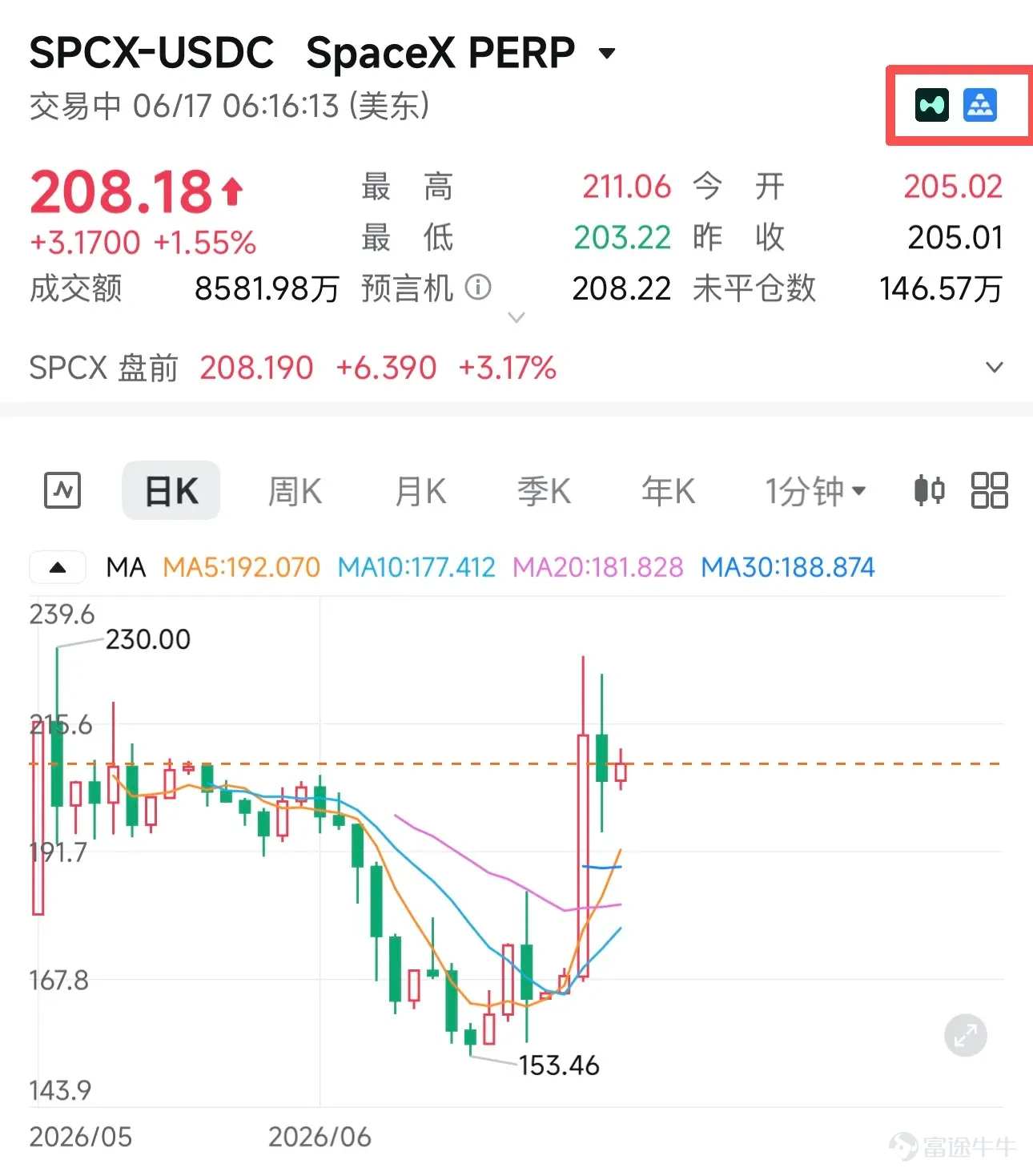
Recently, moomoo, under Futu, officially integrated Hyperliquid’s on-chain perpetual contract data for U.S. stocks into its app, allowing nearly 30 million global users to directly access real-time on-chain derivatives pricing within a traditional brokerage interface.
Prior to this, platforms such as trade.xyz had already offered pre-IPO perpetual contract pricing and trading for newly listed companies like Cerebras and SpaceX.
Discussions around the 'crypto-equity linkage' have been ongoing for several years. Initially, this referred to the synchronized movements between Bitcoin and the Nasdaq Composite; later, it expanded to include mining stocks and corporate treasury holdings fluctuating with crypto prices.
This article argues that the 'crypto-equity linkage' has evolved through three distinct phases: macro correlation (1.0), unidirectional spillover of sentiment and capital (2.0), and a new phase (3.0) in which on-chain perpetual contracts—traded 24/7—provide round-the-clock sentiment signals for traditional assets.
ImageSource:AI Generate
Before 2020, Bitcoin showed generally low correlation with the Nasdaq Composite, often exhibiting little to no correlation—or even slight negative correlation—indicating that the two markets largely moved independently.
After the pandemic shock, the situation changed markedly. According to CryptoQuant data, between 2020 and 2022, the 30-day rolling correlation coefficient between Bitcoin and the Nasdaq repeatedly surged above 70%.
During this period, global central banks engaged in massive liquidity injections, and the same pool of risk-seeking capital flowed simultaneously into tech stocks and the crypto market, with both sharing liquidity expectations as their common macro denominator.
In 2022, the Federal Reserve aggressively raised interest rates, pressuring risk assets across the board, and Bitcoin (BTC) and the Nasdaq once again fell sharply in tandem.
Correlation declined somewhat after 2022, but the trend was not unidirectionally downward. In January 2025, around Trump’s inauguration, macro sentiment resonated once more, pushing the 30-day correlation coefficient back up to 0.70—the highest level in two years.
As the event-driven sentiment faded, the correlation broke down again. By June 2026, this figure had fallen to approximately -8.86%, essentially entering a zone of zero correlation.
This evolving pattern shows that the correlation between Bitcoin and the Nasdaq is not fixed; rather, it adjusts in response to shifts in the macro environment and market structure.
As the crypto market continues to expand, the relationship between the two markets has begun to evolve anew. Sentiment and capital flows from the crypto market are no longer merely passively following U.S. equities; instead, they are now exerting one-way influence on certain segments of the U.S. stock market.
An increasing number of retail investors are now active in both markets, leading to more frequent resonance between market themes. This marks the arrival of version 2.0 of crypto-equity linkage.
Mining stocks offer the clearest example. Shares of companies like Marathon and Riot move in close sync with Bitcoin prices, due to direct business linkages. When Bitcoin rises, miners’ revenue expectations increase, driving their stock prices higher—and vice versa. This linkage stems not from sentiment transmission but from hard-wired fundamental ties.
Treasury companies represent another channel. In 2024, MicroStrategy’s share price climbed steadily as the market increasingly embraced its 'Bitcoin-leveraged exposure' pricing logic. As this model spread, more traditional listed companies began proactively adding crypto assets to their balance sheets. Bitmine emerged as one of the most aggressive treasury firms in this regard, making large Ethereum (ETH) purchases in 2025 and still sitting on an unrealized loss of roughly 50%—meaning movements in the crypto market now directly impact such companies’ asset valuations and stock price trajectories.
Notably, the share price movements of Treasury Holdings often precede those of cryptocurrencies themselves. Market speculation over its position size and financing expectations sometimes drives its stock price to react even before cryptocurrency prices begin to move, introducing a degree of directional complexity into this Version 2.0 linkage.
Overall, however, the linkage remains unidirectional. Capital and sentiment flow from the crypto market into U.S. equity thematic sectors, without forming a stable two-way feedback loop. An information gap between the two markets persists during U.S. market holidays—a structural shortfall that Version 2.0 has never resolved.
Traditional equity markets operate within fixed trading hours, with limited liquidity during pre-market and after-hours sessions and a complete halt over weekends. On-chain perpetual contracts break through these constraints, enabling market sentiment to be reflected more continuously through 24/7 trading.
On June 9, before U.S. markets opened for regular trading, Micron’s (MU) perpetual contract on trade.xyz had already priced in that day’s upward move, breaking above $999.40 and nearing the $1,000 mark, with $243 million in 24-hour trading volume.
During Korean market trading halts, trade.xyz and Binance jointly provided continuous quotes for SK Hynix, with combined open interest across both platforms exceeding $170 million.
According to Hyperliquid’s HIP-3 ecosystem data, the cumulative trading volume of stock-linked perpetual contracts has surpassed $18.8 billion—more than double the combined $7.66 billion volume of crude oil and Brent crude perpetual contracts.
This continuous pricing capability is precisely why moomoo chose to integrate Hyperliquid’s market data. As trading volumes on these platforms grow, on-chain stock perpetual contracts are becoming an essential window for gauging asset sentiment.
According toMoomooInterfaceShow,ItsOracle prices are weighted averages derived from multiple external price sources, serving as reference prices for underlying assets and anchoring mark prices to prevent distortion from anomalous quotes in any single market.
Four years ago, perpetual contracts of this type were still seen as catering to a pseudo-demand niche. According to crypto KOL qinbafrank, individual US equities inherently lack futures instruments, and on-chain perpetuals for these assets function similarly to the interplay between altcoin spot and futures markets, offering significant operational opportunities for certain capital players.
For pre-IPO assets, on-chain perpetual contracts carry even greater significance. In traditional IPO processes, retail investors typically cannot participate in price discovery ahead of time, whereas on-chain perpetuals make this process continuous.
In May 2026, Cerebras Systems listed on Nasdaq, but pre-IPO perpetual contracts for the company had already been trading on trade.xyz several weeks earlier. Just before the official listing, the on-chain contract price surged rapidly from around $290 to $380, with hourly trading volume nearing $1 billion—while Nasdaq was still in its pricing phase, and retail investors couldn’t officially participate until 1 a.m.
SpaceX presents another representative case. Three weeks before its IPO, the daily trading volume of the xyz:SPCX perpetual contract on Hyperliquid averaged only about $26 million. However, on the day SpaceX officially listed on Nasdaq last Friday, xyz:SPCX’s trading volume spiked to $1.4 billion, accounting for 30% of the platform’s total HIP-3 trading volume. Similarly, Binance saw a sharp increase in volume for its equivalent contract; as of June 13, the 24-hour trading volume of SPCXUSDT exceeded $5.6 billion, making it the platform’s second-most traded instrument after Bitcoin perpetuals.
However, limitations persist both in scale and mechanism.
On one hand,,on-chainPlatformofdataGrowth remains concentrated in a few select assets, and the overall scale is still very small compared to traditional markets.
According to Hyperinsight monitoring, trade.xyz singleTotal weekly trading volumeApproximatelywas $1.5 billion0 , equivalent to approximately 0.201% of the total volume in traditional markets. At the individual stock level, on-chain contract trading volumes for MU and Marvell accounted for roughly 0.39% and 0.75%, respectively, of their real-world equity trading volumes in global traditional securities markets.,On-chain perpetuals currently struggle to exert substantive pricing impact.
On the other hand, Pre-IPO The segment also exhibits certain vulnerabilities at the mechanism level. SpaceX's Pre-IPO contract previously triggered a price adjustment due to an update in share capital data, forcing multiple platforms to temporarily delist and reprice. On Kraken's xStocks platform, allocations for SpaceX's pre-IPO offering fell far short of expectations, with some users receiving allocations worth only approximately USD 600 and subsequently receiving refund notices.
This process shows that while on-chain perpetual contracts provide continuous pricing, their issuance and distribution remain constrained by the supply limitations of traditional underwriting systems.
Overall, what on-chain perpetual contracts currently achieve is extending sentiment for traditional assets and supplementing price signals during non-trading hours. They have not yet altered the underlying pricing logic, but they are already demonstrating tangible value in specific assets and contexts.
Crypto-equity linkage has already entered its 3.0 phase.,This time, the core is no longer about the strength of macro correlation, but rather that on-chain perpetual contracts provide a continuous sentiment observation dimension long missing from traditional markets.
Pre-market, after-hours trading, weekend halts, and IPO pricing blackout periods—these former information vacuums are now being filled by round-the-clock, 7×24 on-chain prices.
AlthoughCurrent on-chain trading volumes remain far smaller than those in traditional markets,It is not yet a contender for pricing power, but it has already become an additional observational window beyond traditional asset prices.
AndIn areas like Pre-IPO offerings—where traditional pricing mechanisms are inherently weak—on-chain perpetuals have alreadyStartbegun playing a genuine role in price discovery and sentiment transmission, representing the clearest real-world application of the 3.0 phase so far.
Risk Disclaimer: The above content only represents the author's view. It does not represent any position or investment advice of Futu. Futu makes no representation or warranty.Read more
Comments
to post a comment