
Are PCBs becoming a critical bottleneck? KB Bellwether repeatedly raises prices

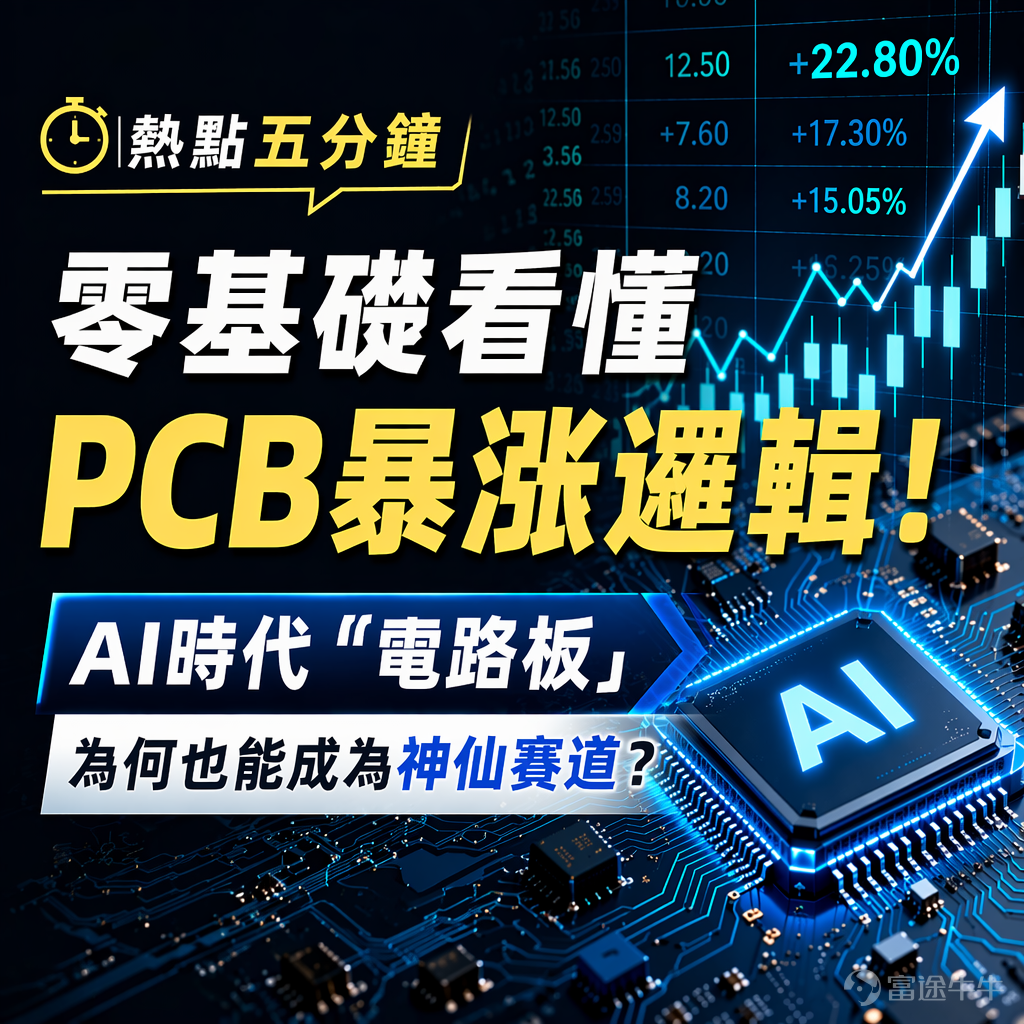
Hot Topic in 5 Minutes | Understand the PCB Surge Logic with Zero Background! Why Has the 'Circuit Board' Become a Star Sector in the AI Era?
Recently, PCBs have become the market's 'hot trend indicator.'Many new fellow investors might be completely baffled: What exactly is a PCB? It sounds like an obscure manufacturing segment—how did it suddenly become the market’s darling?In fact, this sector has truly been on a winning streak lately: Hong Kong-listed $PCB concept (LIST24125.HK)$stocks have surged nearly 200% year-to-date, and core Hong Kong-listed PCB names $KB LAMINATES (01888.HK)$have nearly sextupled so far this year!Institutional money is pouring in aggressively, and product prices are rising across the board—what wealth code lies behind all this? Today, Bull Bull will dig deep into this 'star sector': PCBs.。
What exactly is a PCB? It sounds like an obscure manufacturing segment—how did it suddenly become the market’s darling?In fact, this sector has truly been on a winning streak lately: Hong Kong-listed $PCB concept (LIST24125.HK)$stocks have surged nearly 200% year-to-date, and core Hong Kong-listed PCB names $KB LAMINATES (01888.HK)$have nearly sextupled so far this year!Institutional money is pouring in aggressively, and product prices are rising across the board—what wealth code lies behind all this? Today, Bull Bull will dig deep into this 'star sector': PCBs.。![Recently, PCBs have become the market's 'hot trend indicator.'Many new fellow investors might be completely baffled:[Shocked]What exactly is a PCB? It sounds like an obscure manufacturing segment—how did it suddenly become the market’s darling?In fact, this sector has truly been on a winning streak lately: Hong Kong-listed $PCB concept (LIST24125.HK)$stocks have surged nearly 200% year-to-date, and core Hong Kong-listed PCB names $KB LAMINATES (01888.HK)$have nearly sextupled so far this year!Institutional money is pouring in aggressively, and product prices are rising across the board—what wealth code lies behind all this? Today, Bull Bull will dig deep into this 'star sector': PCBs.[Trick]。 What exactly is a PCB, and why can’t we do without it in the AI era? PCB, short for Printed Circuit Board, is known in Chinese as the printed circuit board.It serves as the structural foundation for electronic components and the medium through which electrical connections between them are established. The industry has even given it a nickname: “the mother of all electronics”, implying that no electronic device can function without it. Imagine a computer, a smartphone, or an AI server as a bustling metropolis—its various chips (CPUs, GPUs), capacitors, and resistors are like critical buildings within the city. How do these buildings exchange resources and communicate? They need 'highways' and 'interchanges' to connect them, enabling the flow of electric current and data signals...](https://nnqimage.futunn.com/sns_client_feed/999960/20260617/web-1781688564577-k3VdtfH6tZ.png/big?area=2&is_public=true&imageMogr2/ignore-error/1/format/webp)
What exactly is a PCB, and why can’t we do without it in the AI era?
PCB, short for Printed Circuit Board, is known in Chinese as the printed circuit board.It serves as the structural foundation for electronic components and the medium through which electrical connections between them are established. The industry has even given it a nickname: “the mother of all electronics”, implying that no electronic device can function without it.
Imagine a computer, a smartphone, or an AI server as a bustling metropolis. Inside, various chips (CPUs, GPUs), capacitors, and resistors are like critical buildings in the city. How do these buildings exchange resources and communicate? They need 'highways' and 'interchanges' to link them together, enabling electric current and data signals to zip between them at high speed.That’s where the PCB comes in—it forms the 'foundation' and 'road network' beneath this city. Composed of insulating materials (such as resin and fiberglass cloth) and conductive metal (primarily copper foil), it not only physically supports these electronic components but also acts as the device’s 'nervous system.'In short, any powered smart device—from national strategic assets like aerospace systems and today’s red-hot AI servers, down to the smartwatch on your wrist—relies on it.
You might say: Isn’t this just a circuit board? How technically advanced can it really be?That used to be true. PCBs for ordinary consumer electronics typically had only 2–8 layers, used simple manufacturing processes, were inexpensive, faced intense industry competition, and carried very thin margins.But the core driver of this market rally is high-end PCBs! AI servers demand high-speed data transmission, high power consumption, superior heat dissipation, and extreme reliability—requirements that push PCB technology to new heights: more layers, higher-grade materials, finer circuitry, and lower signal loss.High-layer-count PCBs used in AI servers commonly reach 20–40 layers, with some premium models exceeding 70 layers. Requirements for material precision and signal integrity rise exponentially. The PCB value in a single high-end AI server is over five times that of a standard server—akin to upgrading from an ordinary highway to a maglev track, where materials, manufacturing processes, and costs operate on entirely different scales.
![Recently, PCBs have become the market's 'hot trend indicator.'Many new fellow investors might be completely baffled:[Shocked]What exactly is a PCB? It sounds like an obscure manufacturing segment—how did it suddenly become the market’s darling?In fact, this sector has truly been on a winning streak lately: Hong Kong-listed $PCB concept (LIST24125.HK)$stocks have surged nearly 200% year-to-date, and core Hong Kong-listed PCB names $KB LAMINATES (01888.HK)$have nearly sextupled so far this year!Institutional money is pouring in aggressively, and product prices are rising across the board—what wealth code lies behind all this? Today, Bull Bull will dig deep into this 'star sector': PCBs.[Trick]。 What exactly is a PCB, and why can’t we do without it in the AI era? PCB, short for Printed Circuit Board, is known in Chinese as the printed circuit board.It serves as the structural foundation for electronic components and the medium through which electrical connections between them are established. The industry has even given it a nickname: “the mother of all electronics”, implying that no electronic device can function without it. Imagine a computer, a smartphone, or an AI server as a bustling metropolis—its various chips (CPUs, GPUs), capacitors, and resistors are like critical buildings within the city. How do these buildings exchange resources and communicate? They need 'highways' and 'interchanges' to connect them, enabling the flow of electric current and data signals...](https://nnqimage.futunn.com/sns_client_feed/999960/20260617/web-1781688454901-6SXiDAn7Ni.png/big?area=2&is_public=true&imageMogr2/ignore-error/1/format/webp)
Therefore, AI servers aren’t just about using ‘a few more boards’—they simultaneously increase both the per-unit PCB value and technical barriers. The more advanced the equipment, the higher the PCB requirements and the greater its value.
Why are PCB stocks surging? Three key drivers from the supply chain perspective
In investing, a sector’s breakout often stems from a dramatic shift in supply-demand dynamics.This recent surge in PCB stocks isn’t merely speculative hype—it reflects a powerful combination of exploding demand and constrained supply, driven by solid fundamentals across the industry.From a supply chain standpoint, the PCB industry can be broadly divided into three segments:Upstream materials, midstream manufacturing, and downstream applications。
1. Upstream: Raw material prices are rising across the board, and supply shortages continue to widen.
Just as cooking requires buying ingredients, producing PCBs also depends on raw materials. This round of PCB market dynamics has a very direct catalyst:Key raw materials are in short supply.
The upstream segment of PCBs includescopper-clad laminates (CCL), copper foil, electronic-grade glass fabric, resin, and fiberglass clothand other raw materials.High-end PCBs require low-loss, high-performance materials. Approximately 70% of PCB costs come from raw materials and related semi-finished goods, with copper-clad laminate (CCL) being the most critical component—it serves as the PCB’s 'skeleton' and 'insulating layer,' formed by hot-pressing copper foil, electronic-grade fiberglass cloth, and resin.
Since the beginning of this year, upstream raw materials have entered a 'frenzied price-hike mode': global CCL leader KB Special Laminate has raised prices four times this year alone, with cumulative increases exceeding 40%; electronic-grade glass fabric prices have continued to climb, with five rounds of price hikes already implemented this year; meanwhile, copper prices remain elevated and supply of high-end resins is tight, continuously pushing up upstream costs. Crucially, this price surge reflects not just cost pressures but a seller’s market driven by supply-demand imbalances.Capacity expansion for high-end materials has a long lead time—it’s not something that can be ramped up at will. Downstream customers are rushing to lock in orders, giving leading manufacturers pricing power and enabling them to smoothly pass costs down the chain, thereby actually improving profit margins.
2. Midstream: High-end PCB capacity is tight, and new capacity additions won’t yield immediate results.
Midstream refers to PCB manufacturers. In the AI era, the global PCB industry has entered a phase of high-end and value-added development. Demand for high-layer-count, high-frequency, and high-speed premium PCBs is surging, but high-end capacity cannot be built today and start production tomorrow. According to reports, some leading PCB manufacturers already have order backlogs extending up to one year, with lead times for premium products exceeding six months and a capacity shortfall of over 20%. It has become commonplace to have money but no available supply. This means thatestablished market leaders will enjoy the benefits of a 'tight supply-demand balance' for an extended period. Industry prosperity is not a short-term spike, but rathera potentially sustained industrial trend.。
3. Downstream: AI computing power surges, shifting PCB demand from 'sufficient' to 'high-spec.'
The core driver behind this major cycle is ultimatelythe explosive demand driven by AI computing power.。
Low-end PCBs are like ordinary roads, while high-end PCBs are the high-speed rail of the AI era.In the past, growth in the PCB industry was primarily driven by gradual adoption in traditional consumer electronics such as smartphones and computers;but this cycle is entirely different—global tech giants are aggressively building AI data centers, triggering explosive demand for servers, high-speed switches, and optical modules, all of which rely heavily on high-end PCBs.According to reports, the PCB content value in NVIDIA’s next-generation Rubin rack has significantly increased compared to the previous GB300 generation, making PCBs one of the fastest-growing segments in the AI hardware supply chain.
In other words: in the past, when the market looked at AI, it focused first on chips; now, the market has realized that servers aren’t just about chips—they also involve an entire hardware ecosystem behind them, including PCBs, CPOs, connectors, power supplies, thermal solutions, and more. As a result, PCBs have quietly stepped out from being a 'supporting actor backstage' into the spotlight.
Fellow investors who are new can also use the handy Futubull AI feature to instantly uncover opportunities in the PCB industry chain. Click here to ask with one click.Futubull AI, which breaks down the upstream, midstream, and downstream segments of the PCB industry chain for you one by one.
![Recently, PCBs have become the market's 'hot trend indicator.'Many new fellow investors might be completely baffled:[Shocked]What exactly is a PCB? It sounds like an obscure manufacturing segment—how did it suddenly become the market’s darling?In fact, this sector has truly been on a winning streak lately: Hong Kong-listed $PCB concept (LIST24125.HK)$stocks have surged nearly 200% year-to-date, and core Hong Kong-listed PCB names $KB LAMINATES (01888.HK)$have nearly sextupled so far this year!Institutional money is pouring in aggressively, and product prices are rising across the board—what wealth code lies behind all this? Today, Bull Bull will dig deep into this 'star sector': PCBs.[Trick]。 What exactly is a PCB, and why can’t we do without it in the AI era? PCB, short for Printed Circuit Board, is known in Chinese as the printed circuit board.It serves as the structural foundation for electronic components and the medium through which electrical connections between them are established. The industry has even given it a nickname: “the mother of all electronics”, implying that no electronic device can function without it. Imagine a computer, a smartphone, or an AI server as a bustling metropolis—its various chips (CPUs, GPUs), capacitors, and resistors are like critical buildings within the city. How do these buildings exchange resources and communicate? They need 'highways' and 'interchanges' to connect them, enabling the flow of electric current and data signals...](https://nnqimage.futunn.com/sns_client_feed/999960/20260617/web-1781687426242-cz1JD0dvAz.png/big?area=2&is_public=true&imageMogr2/ignore-error/1/format/webp)
Missed out on PCB stocks and feeling frustrated? How can beginners get on board properly?
The PCB industry has now transitioned from being 'cyclical' to 'growth-oriented,' and this current high-demand cycle could last at least two to three years.At this point, many fellow investors are probably already eager to jump in: 'I understand the basic logic—but what should I actually focus on?' If you want to capitalize on the PCB rally, don’t miss this essential 'onboarding strategy':
![Recently, PCBs have become the market's 'hot trend indicator.'Many new fellow investors might be completely baffled:[Shocked]What exactly is a PCB? It sounds like an obscure manufacturing segment—how did it suddenly become the market’s darling?In fact, this sector has truly been on a winning streak lately: Hong Kong-listed $PCB concept (LIST24125.HK)$stocks have surged nearly 200% year-to-date, and core Hong Kong-listed PCB names $KB LAMINATES (01888.HK)$have nearly sextupled so far this year!Institutional money is pouring in aggressively, and product prices are rising across the board—what wealth code lies behind all this? Today, Bull Bull will dig deep into this 'star sector': PCBs.[Trick]。 What exactly is a PCB, and why can’t we do without it in the AI era? PCB, short for Printed Circuit Board, is known in Chinese as the printed circuit board.It serves as the structural foundation for electronic components and the medium through which electrical connections between them are established. The industry has even given it a nickname: “the mother of all electronics”, implying that no electronic device can function without it. Imagine a computer, a smartphone, or an AI server as a bustling metropolis—its various chips (CPUs, GPUs), capacitors, and resistors are like critical buildings within the city. How do these buildings exchange resources and communicate? They need 'highways' and 'interchanges' to connect them, enabling the flow of electric current and data signals...](https://nnqimage.futunn.com/sns_client_feed/999960/20260617/web-1781688325592-S7ewS2TU1j.png/big?area=2&is_public=true&imageMogr2/ignore-error/1/format/webp)
✅Step 1: Build a 'sector observation watchlist'—don’t just fixate on one hot stock.
The PCB rally isn’t driven by a single company’s story but by the combined momentum of 'upstream materials → midstream manufacturing → downstream AI computing demand.' Upstream players benefit from material price hikes, while midstream firms profit from high-end manufacturing—each segment follows a distinct logic. We need to systematically identify industry leaders along the value chain, build a comprehensive watchlist of relevant stocks, avoid betting on a single name, and allocate positions across the产业链.
1. Upstream: Who supplies raw materials for PCBs? Focus on key inputs like copper-clad laminates, copper foil, and resins.
Rising raw material prices are a key catalyst in this cycle, and suppliers of PCB-related materials directly benefit during such upswings. In the Hong Kong market, consider watching:
– $KB LAMINATES (01888.HK)$:The world's largest rigid copper-clad laminate (CCL) manufacturer, as the industry leader in CCL, possesses flexible pricing power during upcycles and can pass on rising raw material costs—such as copper foil—to downstream customers. Its stock has surged nearly 600% year-to-date!
– $KINGBOARD HLDG (00148.HK)$:Parent company of Kingboard Laminates, with a fully integrated supply chain spanning from upstream raw materials to downstream PCBs. Its stock has risen over 300% year-to-date!
However, it’s worth noting that when analyzing the upstream segment, three key indicators should be closely monitored:Whether material prices continue to rise, whether the company's gross margin shows improvement, and whether downstream orders remain robust. If price increases are only short-term but demand fails to keep pace, prices may subsequently retreat.
2. Midstream: Who is truly producing 'high-end boards'? Focus on leading high-end PCB manufacturers
In the PCB sector, due to the extremely high technical barriers for high-end PCBs, smaller players struggle to produce them, allowing industry leaders to capture most of the profits. Market capital is currently focused on top-tier companies with both expansion capacity and core technological capabilities. In the Hong Kong market, consider:
– $VGT (02476.HK)$:A global core supplier of PCBs for AI and high-performance computing, specializing in advanced HDI and high-layer-count boards, with high-end production capacity and strong technological moats, deeply integrated with leading clients.
– $HANS CNC (03200.HK)$:The global leader in PCB-specific equipment, holding a dominant position worldwide in high-precision, high-value-added drilling equipment and ranking #1 in China’s PCB equipment market share for 16 consecutive years. Revenue and profit growth both exceeded 100% year-over-year in Q1 2026.
– $DELTON (01989.HK)$:A core domestic supplier of AI computing PCBs and an NVIDIA partner, specializing in PCBs for AI servers and computing infrastructure. Its Q1 2026 net profit growth significantly beat expectations and it has been designated by multiple institutions as a key domestic substitution play in the PCB sector.
However, it’s worth noting that for the midstream segment, it’s not just about having a 'PCB concept'—what really matters is:Does it have high-end production capacity? Does it serve high-quality customers such as AI servers, communication equipment, and automotive electronics? Has gross margin improved? Is capacity expansion proceeding smoothly?
3. Downstream: Who is driving PCB demand? AI servers, communications, and automotive electronics are the main drivers.
Downstream segments are the ultimate source of PCB demand and profit fromthe growth in AI applications and computing power demand.This primarily includes AI cloud computing/servers (e.g., Tencent, Alibaba), telecom operators (e.g., China Mobile, China Telecom, ZTE), and automotive electronics (e.g., BYD Electronics, Li Auto, XPeng Motors). Notably, tight supply of high-end PCBs and rising raw material costs have a structural impact on downstream PCB companies—generally bearish overall. The actual impact depends on each downstream company’s pricing power and ability to pass on cost increases within the supply chain. Therefore,downstream cloud providers’ capital expenditures and investments in AI infrastructure also serve as key indicators for assessing PCB industry sentiment.
✅Step two: Avoid chasing highs; prioritize participation with 'small positions + phased observation.'
PCB stocks have recently attracted significant attention, with many related concept stocks posting substantial gains year-to-date.Blindly taking large positions by chasing high prices carries considerable risk.For fellow investors who haven’t yet entered the PCB space, a more prudent approach would be:Start with a small position to test the waters and enter in batches.Avoid buying at peak sentiment and avoid overconcentration in a single thematic sector. Observe carefully when prices are relatively low, stay disciplined during periods of overheated sentiment, and don’t rush in only after seeing a sharp rally.
✅Step three: Set profit-taking and stop-loss levels, and validate your investment thesis with earnings reports.
The most common mistake beginners make is ‘focusing only on the concept without checking actual execution.’ No matter how hot PCBs become, fundamentals ultimately matter: Is revenue growing? Are gross margins improving? Are orders genuine? Can capacity expansion actually be implemented? If you’re considering entering—or have already entered—the PCB sector,be sure to set clear profit-taking and stop-loss levels based on your risk tolerance: Don’t chase rallies; buy only when your predefined conditions are met. Don’t hold losing positions stubbornly; sell strictly according to your rules.After a strong rally, consider taking profits in stages to avoid giving back gains.
In conclusion
One thing is certain:PCBs are not a short-term speculative story—they are a foundational piece of AI hardware upgrades! This current rally in PCBs is fundamentally driven by the confluence of surging AI computing demand, rising prices for high-end materials, and industry-wide capacity expansion and upgrades.This isn’t just about speculating on a circuit board—it’s about revaluing the hardware infrastructure underpinning the AI era. However, as the saying goes, ‘the bigger the waves, the pricier the fish.’ For new investors,what matters most isn’t chasing the fastest gains, but understanding the supply chain, identifying segments that truly benefit, and managing position sizing and risk. Building your own investment framework and then gradually applying it in the market is the sustainable path to long-term success.Follow BullBull on the path to gradual wealth—you'll get rich slowly together with us!
!Risk Warning: The content of this article is provided for general market information and investor education purposes only. It does not constitute an offer, solicitation, recommendation, commitment, or investment advice relating to any securities, financial products, or instruments, nor should it be regarded as a basis for any investment decision. Market views, data, charts, and related information referenced herein are derived from publicly available sources or third-party providers, and their accuracy, completeness, timeliness, or suitability is not guaranteed.
Risk Disclaimer: The above content only represents the author's view. It does not represent any position or investment advice of Futu. Futu makes no representation or warranty.Read more


Comments (23)
to post a comment
84
80