
SpaceX's second wave of lock-up expirations is here; how should investors position themselves in spa

Bullish Volatility Hunter | SpaceX’s Record-Breaking Options Debut: $2 Billion in Premiums from 1.8 Million Contracts in a Single Day Reveals Where the 'Smart Money' Is
I. The Biggest Options Debut in History

On June 16, Eastern Time, $SpaceX (SPCX.US)$ options contracts officially began trading on Cboe. This day rewrote the history of the U.S. equity options market.
On that day, Henry Schwartz, Vice President of Global Markets at Cboe, stated: “SpaceX options are setting a new record for first-day trading volume—approximately 10,000 contracts were traded per minute during early trading hours, and the total for the day could approach 2 million contracts.”SpaceX’s total options volume on June 16 reached approximately 1.8 million contracts, with total option premiums amounting to roughly $2 billion.
Compared with historical top trading volumes, Reuters reported, “SpaceX’s first-day options volume was about five times that of Meta (formerly Facebook)’s record on its debut day in 2012.” As of June 16, the VIX had declined to 16, indicating overall calm market sentiment. SpaceX’s extreme volatility and trading performance were entirely driven by this single underlying asset’s exceptional activity. Moreover, this milestone was achieved under conditions of zero historical options data and extremely limited tradable float, making it even more historically significant.
II. Tracking Large Anomalous Options Orders
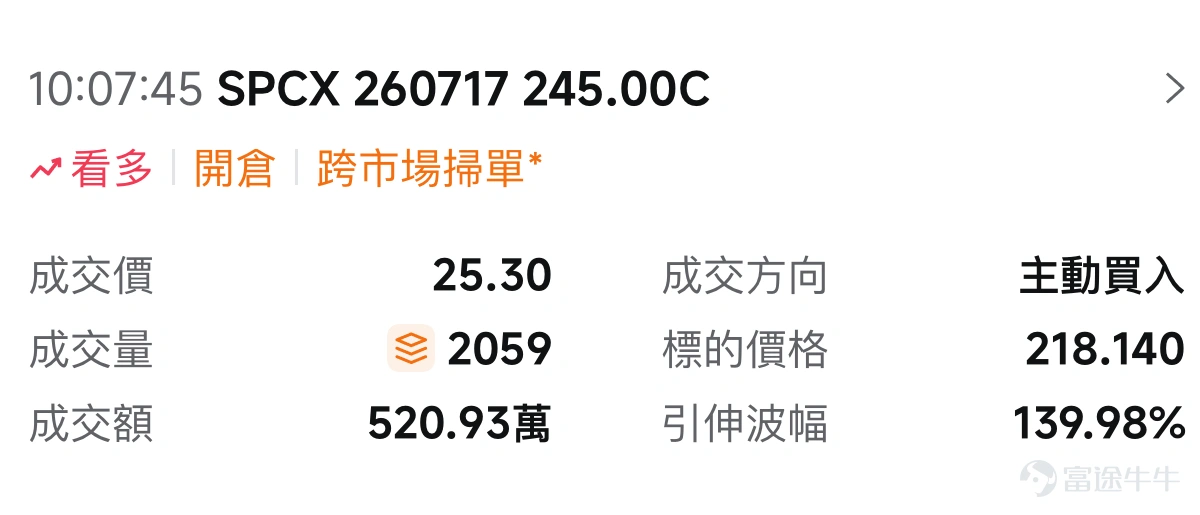
This is the largest single directed trade publicly captured on June 16: the buyer paid a premium of $5.2 million to bet that SPCX—a stock listed for only four days—would rise another 24% within one month (expiring July 17), with a strike price of $245.
Notably, no significant large-scale single-direction put option sweeps or institutional-level short-position establishment were found in any publicly available data. A Put/Call ratio of approximately 0.7 indicates that put option volume was only 70% of call volume, and these puts were dispersed across various short-term hedging activities, showing no concentrated signal of major bearish positioning.
III. Implied Volatility (IV) Analysis: The Fourfold Structure Driving Up Volatility
On June 16, SpaceX’s implied volatility (IV) stood at 115.08%. Seeking Alpha described it as an 'extreme structural pricing anomaly accompanied by massive trading volume.' Some analysts had estimated SpaceX’s volatility prior to its listing using proxy assets linked to SpaceX, arriving at an approximate figure of 84%, whereasthe actual value has significantly exceeded this estimate. SpaceX’s high IV is collectively driven by several key factors.
Factor One: Historical Volatility Is Nearly Zero
Since its IPO, SpaceX has traded for only three days, making it impossible to establish a reliable historical volatility (HV) benchmark. For newly listed stocks, initial IV levels are often not an 'objectively rational' measure of volatility; rather, they reflect market makers saying, 'I don’t yet know where fair value lies.'Therefore, IV readings during this phase often include a premium component.
Factor Two: Limited Float Amplifies Price Moves Through Gamma Hedging
SpaceX's Class A outstanding shares account for only about 5% of the company's total shares.When a large volume of call options is bought, market makers are forced to sell calls and simultaneously buy the underlying stock to hedge—but limited float means each hedging action pushes the stock price higher, which in turn triggers another wave of call buying, creating a gamma squeeze;However, once implied volatility becomes overheated and concentrated selling emerges, market makers will rapidly reduce their positions, triggering a reverse gamma crush.
Reason three: Convergence of the FOMC meeting week and the June triple witching window
The first FOMC meeting under newly appointed Federal Reserve Chair Kevin Warsh will be held in the early hours of June 18 Beijing time,Key interest rate decisions and the dot plot have drawn market attention, elevating volatility.
Meanwhile, the June triple witching day arrives this Thursday, June 18 (with U.S. markets closing early on Friday),which typically leads to significantly higher trading volumes and price volatility in equities.
IV. 'Smart Money' Time-Limited Opportunity Strategy
In the current market environment, implied volatility will remain elevated or even rise further, substantially increasing the holding cost for option buyers.However, periods of high implied volatility (IV) are fleeting—this is a time-limited window for sellers to collect elevated premiums.Below are three core seller strategies for SpaceX, along with an analysis of their applicable scenarios.
Strategy 1: Covered Call (Position Enhancement)
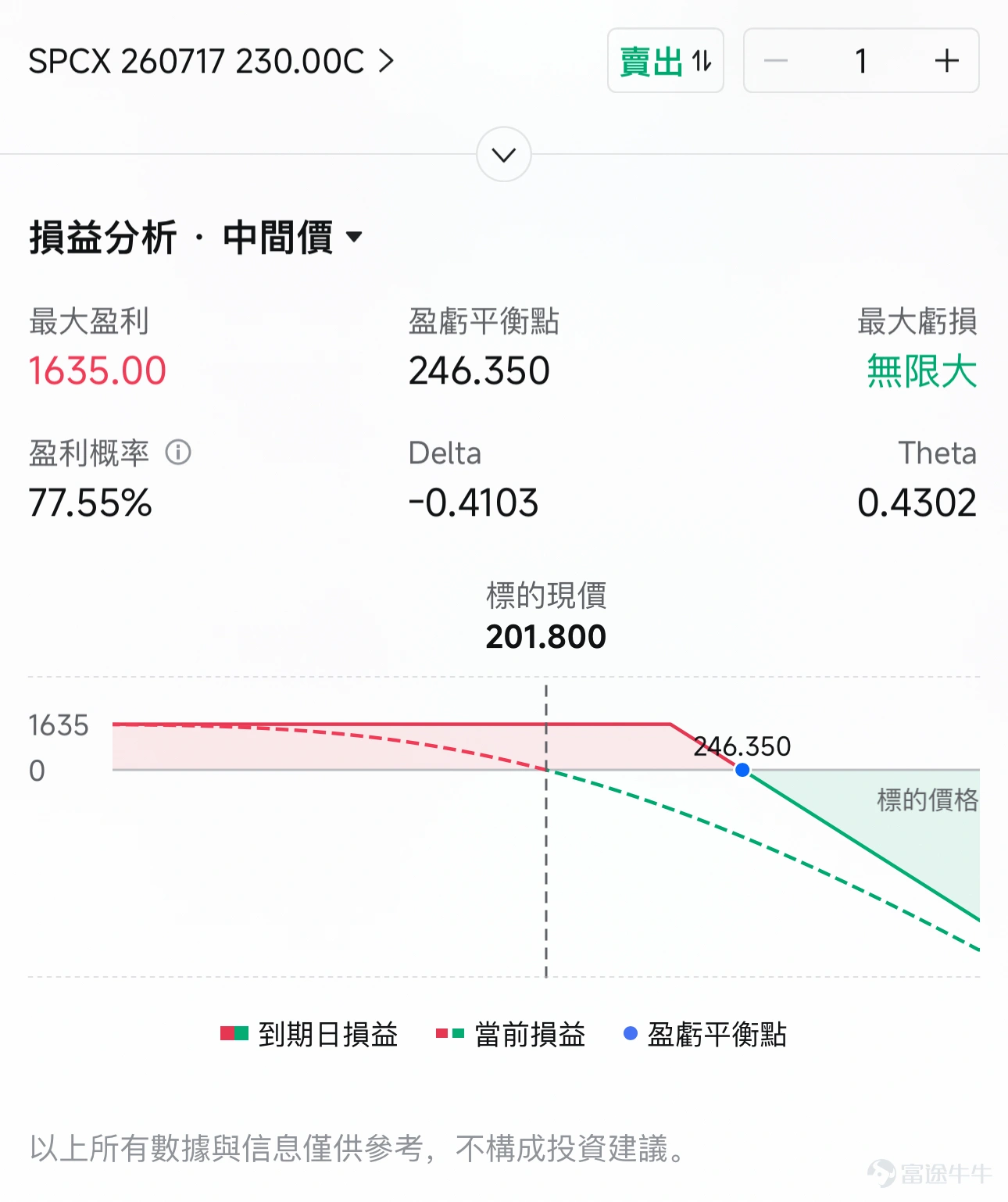
(The chart above illustrates the simulated profit and loss profile of this strategy at expiration. The on-screen graphic is for demonstration purposes only and does not constitute investment advice or any guarantee; market conditions change frequently, and the prices shown do not reflect actual market values.)
Suitable for:Investors who already hold SpaceX common stock and wish to collect option premium to lower their cost basis.
Suggested strike price: $230 (approximately 12% above the current share price, providing sufficient buffer)
Suggested expiration date: July 17, 2026
Estimated premium: approximately $1,635 per contract, reducing the cost basis by $16.35 per share
For option sellers, a compression in IV represents additional directionless profit—Even if the stock price remains unchanged, the sold call options will depreciate faster due to declining IV and time decay.
Strategy 2: Cash-Secured Put (Asset Allocation)
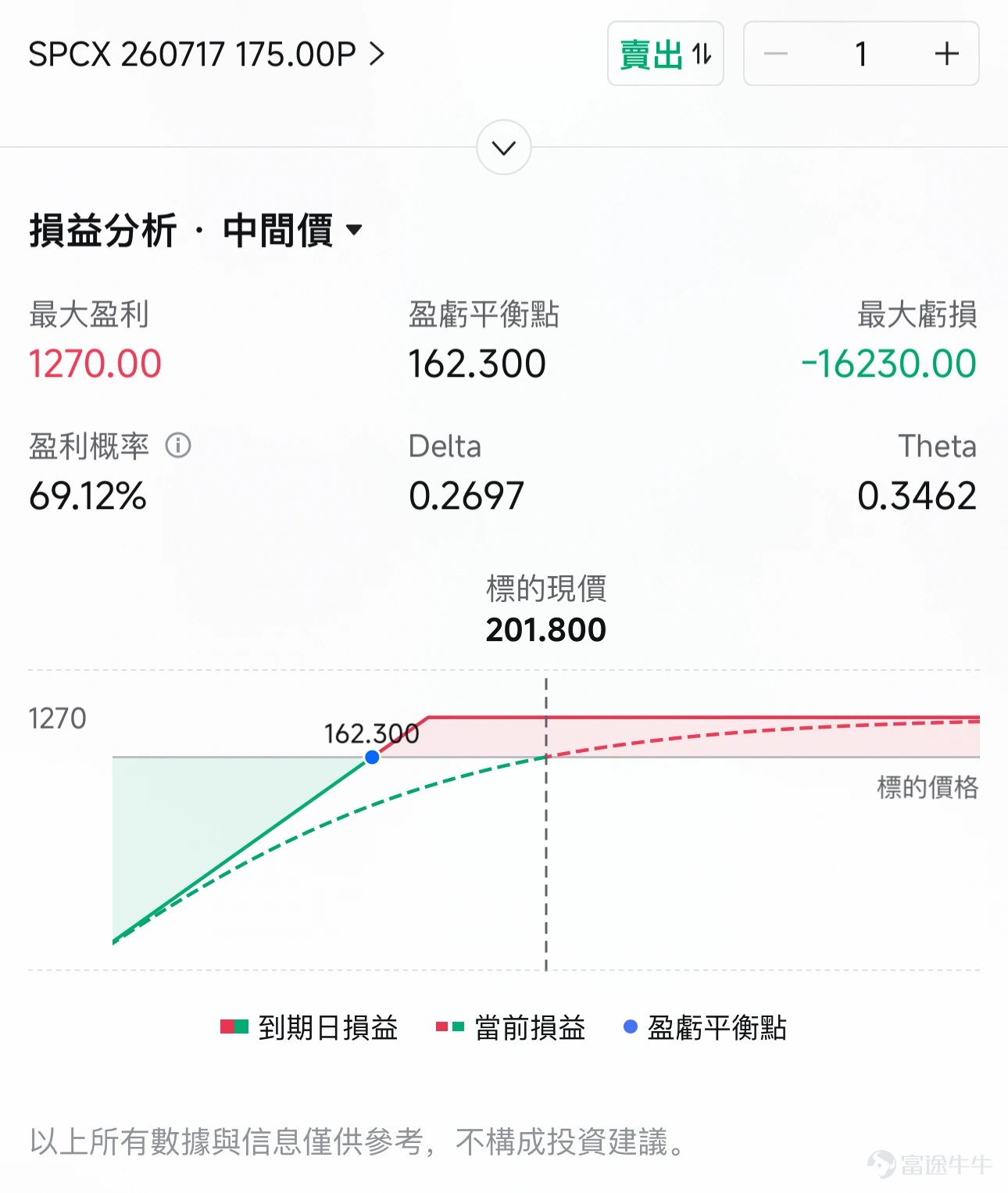
(The chart above illustrates the simulated profit and loss of this strategy at expiration. The design image displayed on screen is for demonstration purposes only and does not constitute any investment advice or guarantee; market conditions change frequently, and the prices shown do not reflect actual market values.)
Suitable for:Investors who are reluctant to chase higher prices and prefer establishing positions at lower levels during a SpaceX pullback, or those already holding cash positions seeking to collect option premiums.
Reference strike price: $175 (approximately 15% below the current share price and roughly 30% above the IPO price)
Suggested expiration date: July 17, 2026
Reference premium: approximately $1,270 per contract
Strategy 3: Collar Strategy (for underlying position risk management)
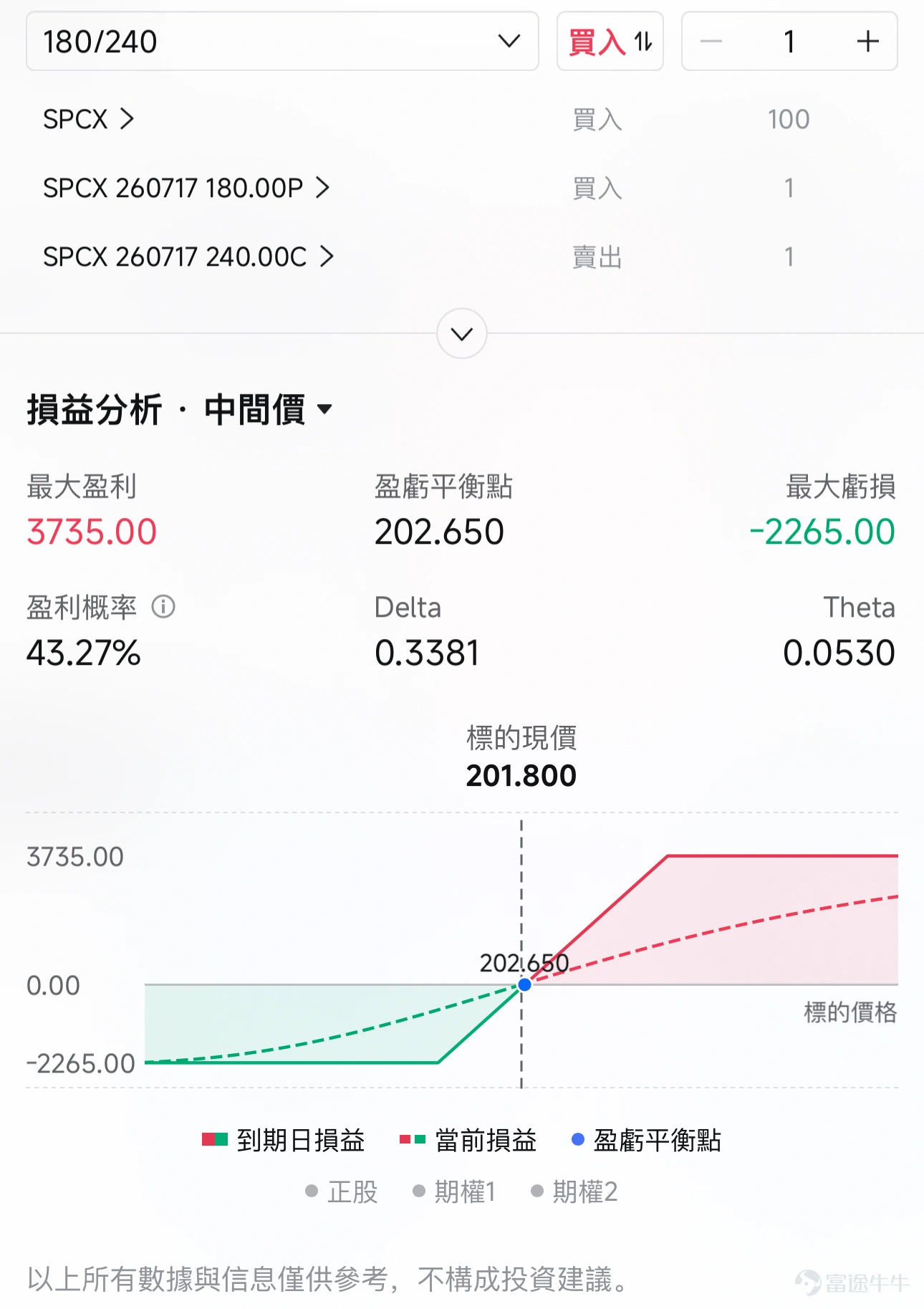
(The chart above illustrates the simulated profit and loss of this strategy at expiration. The design image displayed on screen is for demonstration purposes only and does not constitute any investment advice or guarantee; market conditions change frequently, and the prices shown do not reflect actual market values.)
Suitable for:Investors holding a substantial long position in SpaceX shares who wish to cap downside risk while reducing their cost basis.
Reference strike prices:
Leg 1 — Buy Put with strike price of $180
Leg 2 — Sell Call with strike price of $240
Suggested expiration date: July 17, 2026
In a high implied volatility (IV) environment, the premium received from selling call options can often fully offset the cost of buying put options at little or even near-zero net cost—commonly known as a 'zero-cost collar.'High IV significantly reduces the cost of passive 'insurance,' and this window will close as IV normalizes.
V. Key Upcoming Events for SpaceX
Catalyst 1: July 7 – Official Inclusion into the Nasdaq-100
SpaceX has qualified for fast-track inclusion into the Nasdaq-100, and passive funds (led by $Invesco QQQ Trust (QQQ.US)$ ) will complete their position-building before the effective date of July 7—The period leading up to July 7 represents a potential short-term peak in implied volatility, offering an attractive window to collect premiums via covered call and cash-secured put strategies.
Catalyst 2: Late July – Lock-up Expiry + Q2 Earnings Release
Approximately 10%–15% of shares held by early investors will become freely tradable in late July, and the Q2 earnings release window coincides with this lock-up expiry period (SpaceX has not yet announced the exact earnings date),which could trigger significant stock price volatility.
Option Risk Warning:An option is a contract that grants the holder the right—but not the obligation—to buy or sell an underlying asset at a predetermined price on or before a specified date. Option prices are influenced by multiple factors, including the current price of the underlying asset, the strike price, time to expiration, and implied volatility. Implied volatility reflects the market’s expectation of future price fluctuations over the life of the option and is derived by reverse-engineering the Black-Scholes pricing model. It is commonly used as a gauge of market sentiment. When investors anticipate greater volatility, they may be willing to pay higher premiums for options to hedge risk, leading to elevated implied volatility. Traders and investors use implied volatility to assess the relative attractiveness of option prices, identify potential mispricings, and manage risk exposure.
Disclaimer:This content does not constitute any offer, solicitation, recommendation, opinion, or guarantee of any securities, financial products, or tools. The risk of loss in trading options can be substantial. In some cases, losses may exceed the initial margin deposited. Even if you set contingent orders such as 'stop-loss' or 'limit' orders, these may not prevent losses. Market conditions may make such orders unexecutable. You may be required to deposit additional margin within a short period. If you fail to provide the required amount within the specified time, your open positions may be liquidated. However, you will still be responsible for any shortfall in your account. Therefore, before trading, you should study and understand options and carefully consider whether such trading is suitable for you based on your financial situation and investment objectives. If you trade options, you should be familiar with the procedures for exercising options and the rights and obligations upon exercise and expiration. Options trading carries extremely high risks and is not suitable for all investors. Investors should carefully readCharacteristics and Risks of Standardized Options。
Risk Disclaimer: The above content only represents the author's view. It does not represent any position or investment advice of Futu. Futu makes no representation or warranty.Read more


Comments (2)
to post a comment
42
135