
Options Plaza: Earnings Super Week is here! How to use options to capture both bullish and bearish o

Daily Options Seller Strategy | Micron Surges to New Highs; Brokerage Upgrades Spark Buying Frenzy—How Should Retail Investors Participate?
I. Market Barometer
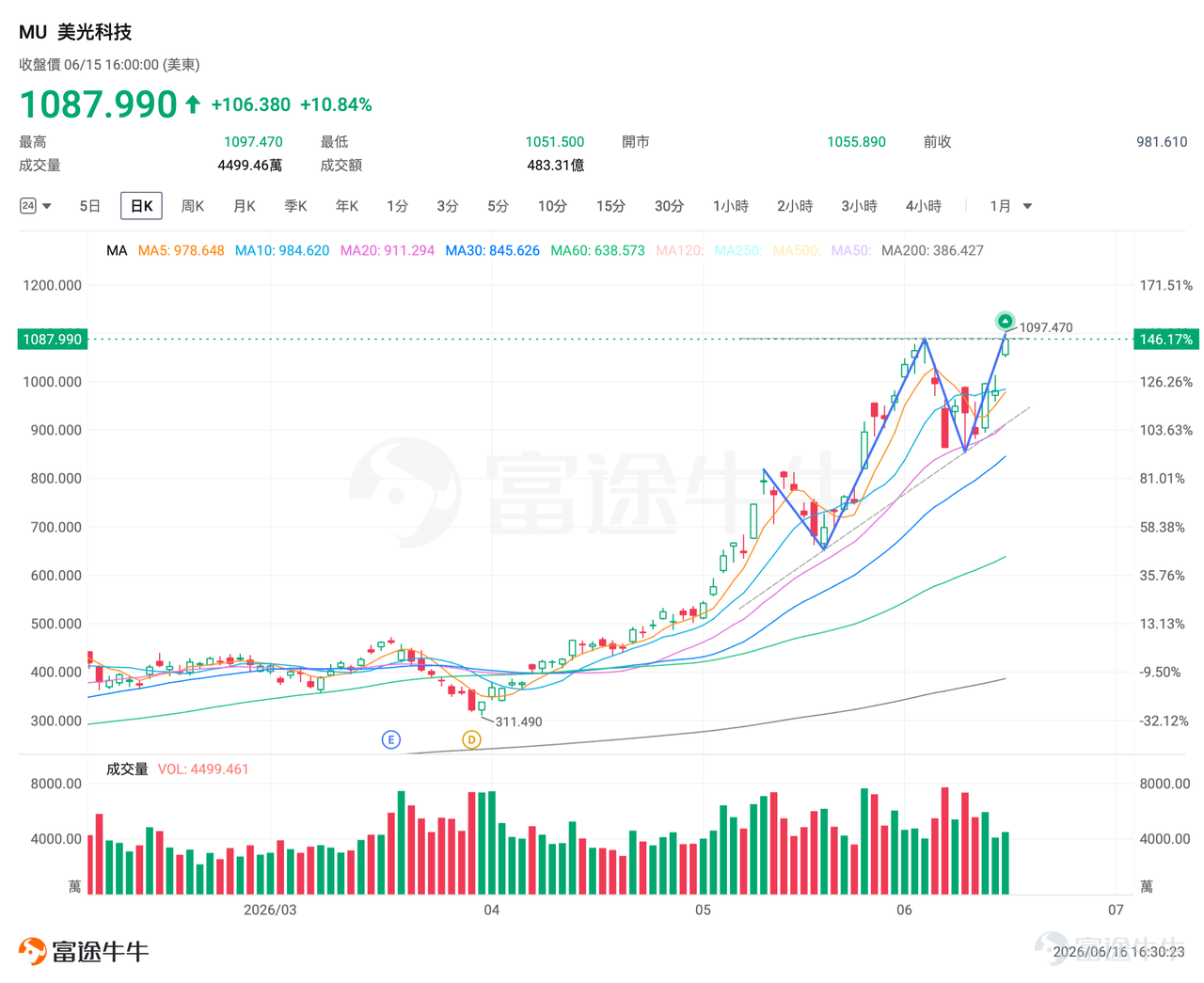
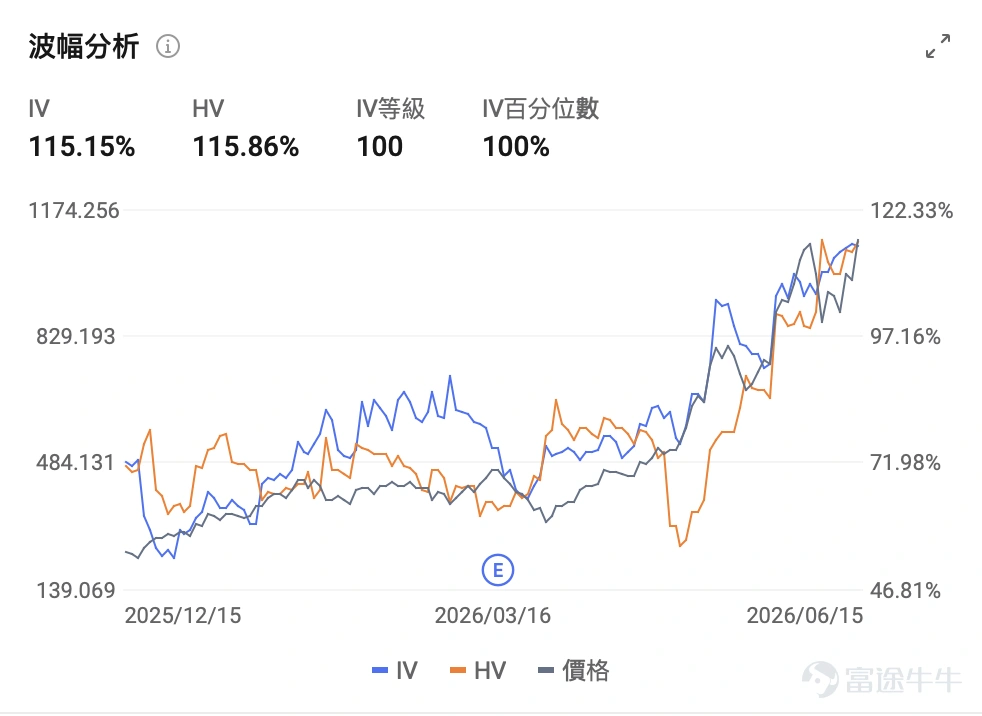
All three major U.S. equity indices rose across the board in the previous session, as easing U.S.-Iran tensions significantly boosted risk appetite, with the technology sector leading gains. $Micron Technology (MU.US)$ It surged 10.84% in a single day to close at USD 1,087.99, with implied volatility (IV) continuing to rise, creating a premium window for options seller strategies.
II. Focus on Hot Targets
$Micron Technology (MU.US)$: A flurry of target price upgrades from investment banks sparked strong buying interest, and gamma hedging demand propelled the stock to new highs.
$Micron Technology (MU.US)$ The stock surged 10.84% in the previous trading session, closing at USD 1,087.99. Trading activity remained highly robust throughout the day, with turnover reaching USD 48.331 billion.
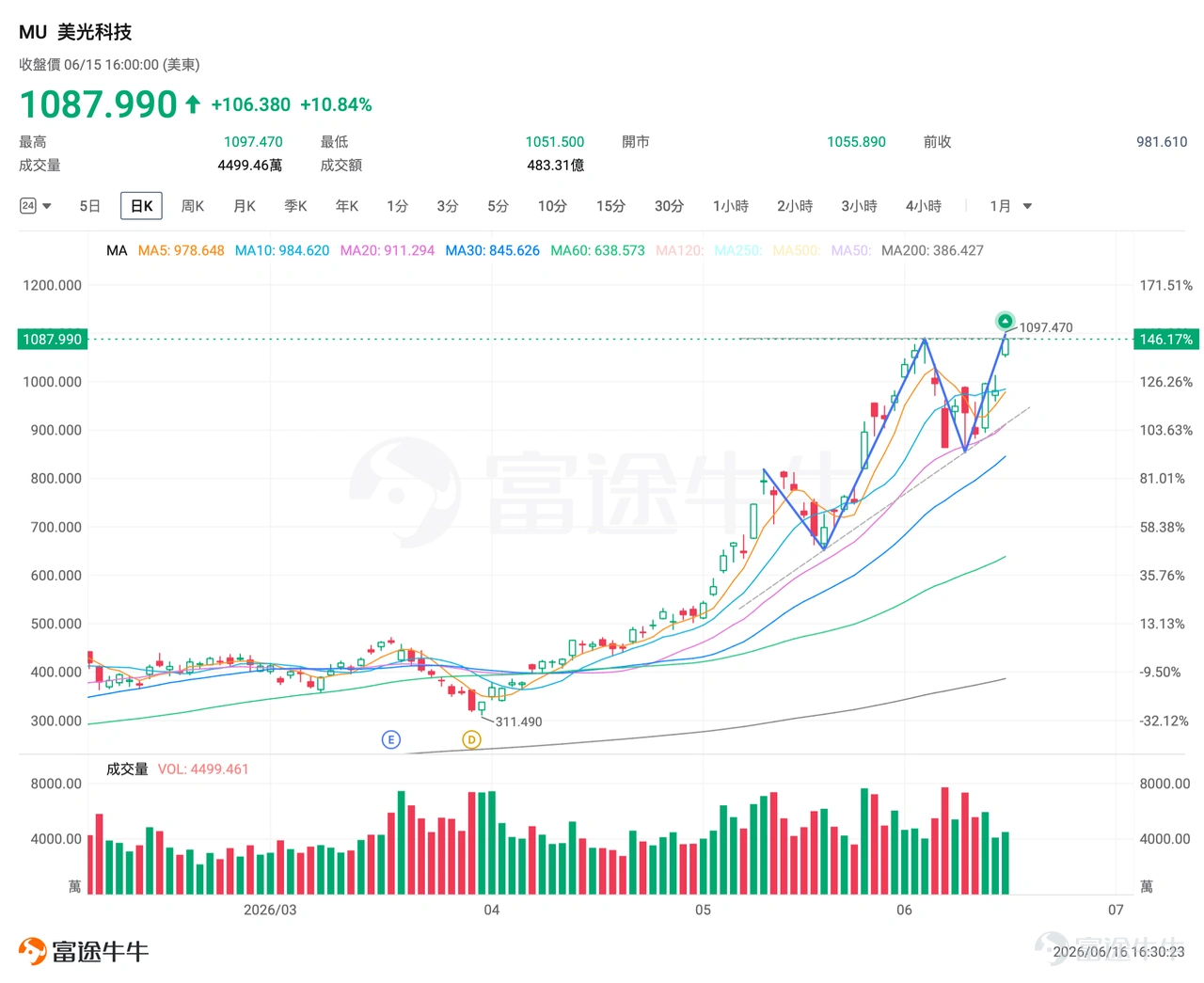
Recent daily candlestick patterns show that after briefly testing a short-term low of USD 864.01 on June 5, the stock quickly stabilized and rebounded, forming a sharp V-shaped recovery. The share price has not only reclaimed and firmly held above the psychologically and technically significant USD 1,000 mark but also hit an intraday high of USD 1,097.47—the highest level in recent periods.
Multiple major positive catalysts have converged, fully igniting market sentiment. On the macro front, improved expectations around geopolitical tensions have directly fueled a rapid recovery in global risk appetite. Fundamentally, market expectations for AI-driven memory chip demand continue to rise sharply, with industry consensus forecasting this robust AI memory demand cycle to persist through 2027.
Meanwhile, as earnings season approaches, bullish sentiment toward the memory sector’s upcycle has intensified further. Micron’s fiscal Q3 2026 earnings are scheduled for release after market close on June 24. The current elevated implied volatility reflects a 'pre-earnings sentiment premium.' In the options market, bulls aggressively breached the massive open interest wall at the USD 1,000 call strike, triggering substantial gamma-hedging buying pressure from market makers, which further accelerated the stock’s upward momentum.
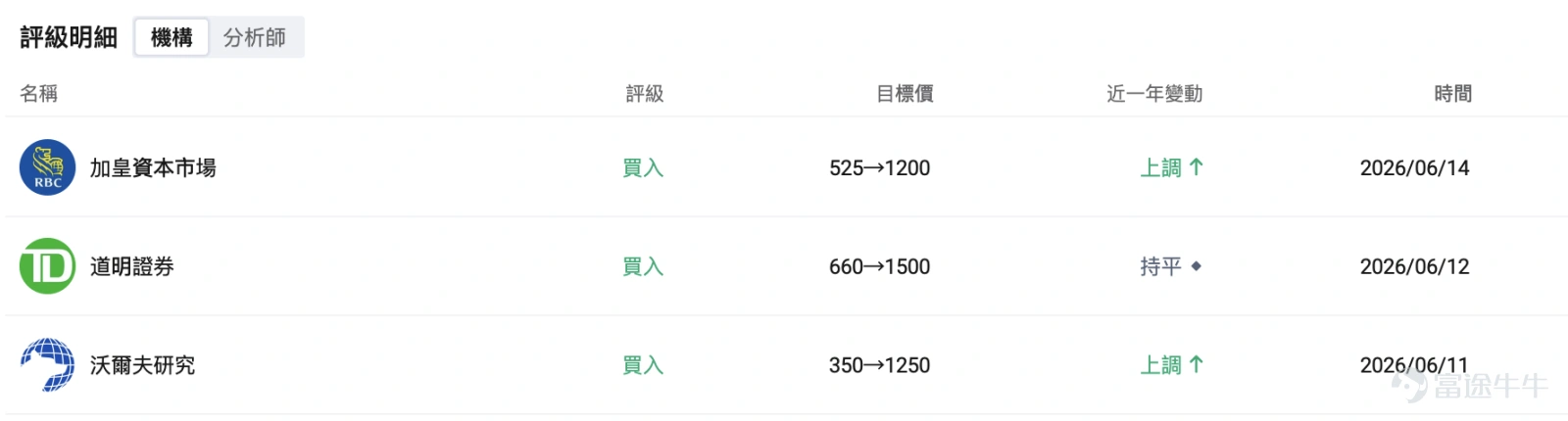
Wall Street investment banks remain overwhelmingly bullish on the stock, with numerous firms recently raising their price targets. According to the latest ratings and forecasts from 30 analysts, the highest target price has been sharply lifted to USD 1,750, while the average target now stands at USD 1,002.59. Several top-tier banks explicitly noted in their research reports that surging demand for high-bandwidth memory driven by the AI wave will provide solid long-term support for the company’s future earnings growth.
– TD Cowen raised its price target from USD 660 to USD 1,500 (more than doubling it);
– RBC Capital increased its price target from USD 525 to USD 1,200, maintaining an 'Outperform' rating, citing expectations that the DRAM upcycle could last another five to six quarters, with supply growth remaining subdued through the end of 2027;
– Wolfe Research lifted its price target from USD 550 to USD 1,250, expressing optimism about DRAM and NAND price increases in 2026 and 2027;
III. Seller Options Strategy
1. Cash Secured Put
Sell 1 contract of $Micron Technology (MU.US)$20260702 700P, Estimated margin requirement (for reference only): USD 70,000 (USD 700 × 100)
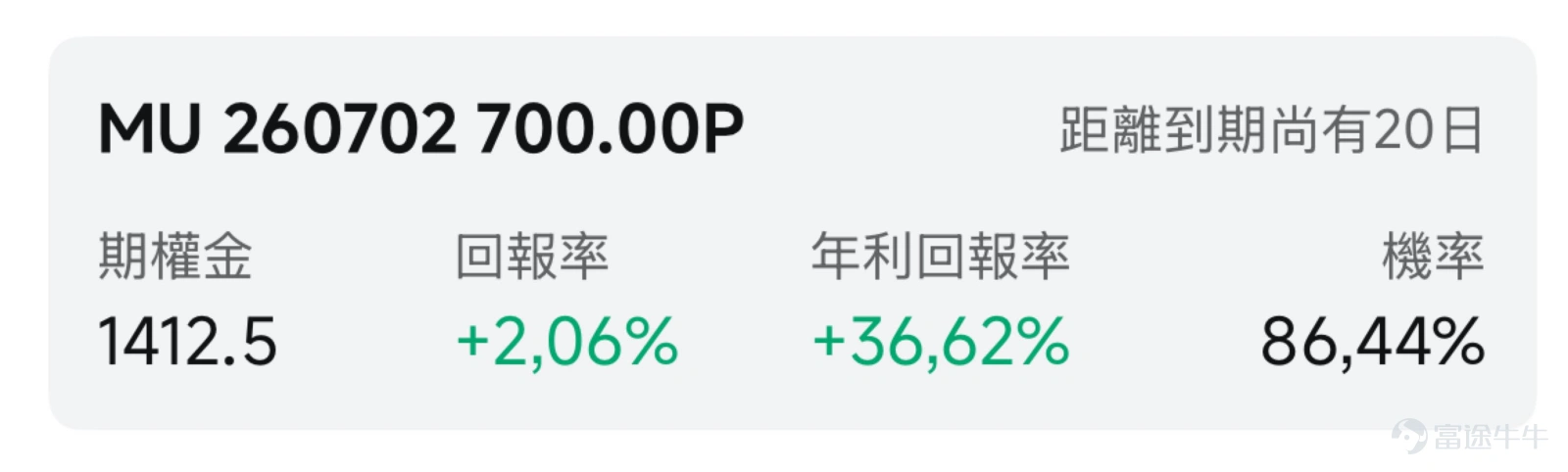
Opportunity filtering logic:
For investors who have not yet established a position but agree with Micron’s structural revaluation thesis, the current share price—combined with elevated implied volatility (IV) ahead of earnings—carries the risk of a post-earnings pullback due to the 'buy the rumor, sell the fact' dynamic.
However, investment banks have aggressively raised their price targets to $1,200–$1,750, and sequential increases in memory prices provide clear fundamental support. By selling puts, investors can collect substantial option premiums if the stock consolidates at current elevated levels or continues to rise; if the share price dips following earnings volatility toward the $700 strike price, they can still acquire the stock at a cost basis below the current market price.
2. Covered Call
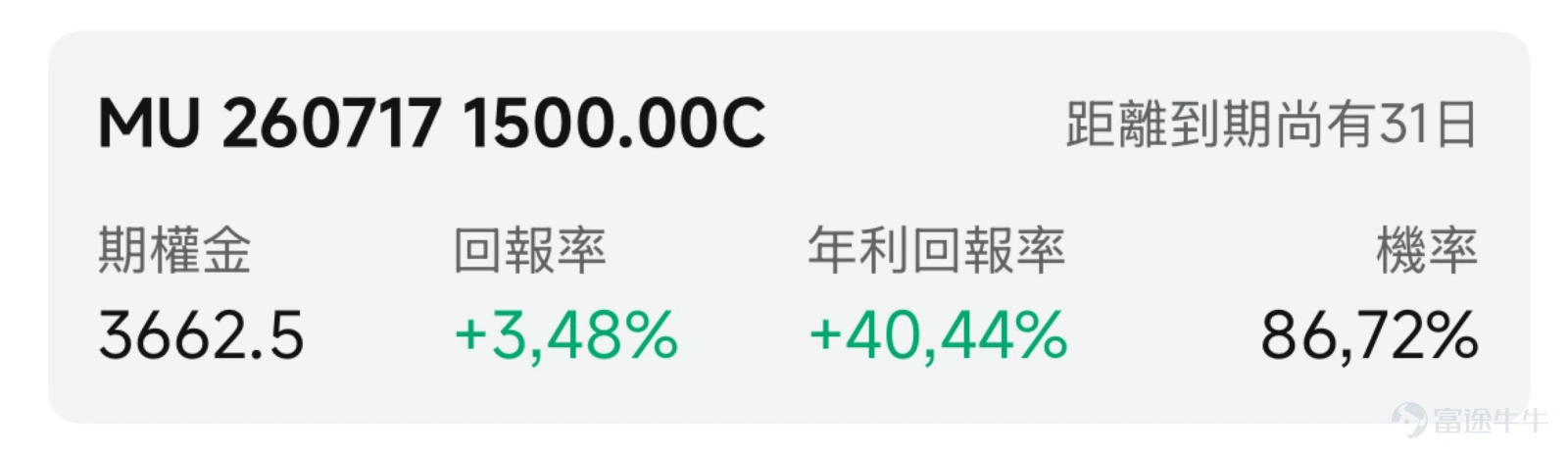
Opportunity filtering logic:
For investors already holding Micron shares with significant unrealized gains, implied volatility (IV) rank and percentile have both hit 100% after the stock’s sharp rally year-to-date, indicating that option premiums are trading at historical peaks.
Although investors remain bullish on the long-term valuation uplift driven by HBM demand, they are concerned about potential sideways consolidation ahead of earnings and a rapid post-earnings compression in implied volatility. In this scenario, selling covered calls allows them to collect premium income to lower their cost basis. If the stock consolidates near current levels, the premium offsets time decay; if the stock surges above $1,500 and the call is exercised, it effectively locks in profits near TD Cowen’s latest price target.
IV. Risk Control Reminder
Although the seller strategy has a high probability of success, investors must still manage risks effectively:
– Position management is key:The biggest risk for option sellers lies in black swan events. It is recommended that margin exposure for a single underlying should not exceed 20% of total capital. Never sell options beyond your capacity for the sake of greedy premiums.
– Timely rolling of covered call options: When a covered call option becomes deeply in-the-money (stock price far exceeds the strike price), and if the underlying stock is still viewed favorably, decisively 'roll' the position — that is, close the current option by buying it back and simultaneously sell an option with a later expiration date and a higher strike price to avoid having the stock called away at a low price.
– Cash-secured put options warn of 'left-tail risk':For cash-secured puts, if the stock price collapses due to deteriorating fundamentals (rather than a normal pullback), do not hold on stubbornly. At this time, stop losses should be executed, or 'rolling down' can be employed to buy time and wait for volatility to normalize.
Make good use of the options seller zone to understand the income strategies for selling optionsEarn option premiums!
Make good use of the options seller zone to understand the income strategies for selling optionsEarn option premiums!

Options Risk Warning
An option is a contract that grants the holder the right—but not the obligation—to buy or sell an underlying asset at a predetermined price on or before a specified date. Option prices are influenced by multiple factors, including the current price of the underlying asset, the strike price, time to expiration, and implied volatility. Implied volatility reflects the market’s expectation of future price fluctuations over the life of the option and is derived by reverse-engineering the Black-Scholes pricing model. It is commonly used as a gauge of market sentiment. When investors anticipate greater volatility, they may be willing to pay higher premiums for options to hedge risk, leading to elevated implied volatility. Traders and investors use implied volatility to assess the relative attractiveness of option prices, identify potential mispricings, and manage risk exposure.
Disclaimer
This content does not constitute any offer, solicitation, recommendation, opinion, or guarantee for any securities, financial products, or tools. The risk of loss in trading options can be substantial. In some cases, losses incurred may exceed the initial margin deposited. Even if you set contingency orders, such as 'stop-loss' or 'limit' orders, these may not necessarily prevent losses. Market conditions may make such orders unexecutable. You may be required to deposit additional margin within a short period. If you fail to provide the required amount within the specified time, your open positions may be liquidated. However, you will still be responsible for any shortfall in your account resulting from such liquidation. Therefore, before trading, you should study and understand options and carefully consider whether such trading suits you based on your financial situation and investment objectives. If you trade options, you should be familiar with the procedures for exercising options and the rights and obligations upon expiration. Options trading involves extremely high risks and is not suitable for all investors. Investors should read Characteristics and Risks of Standardized Options carefully before engaging in any options trading strategy.
Risk Disclaimer: The above content only represents the author's view. It does not represent any position or investment advice of Futu. Futu makes no representation or warranty.Read more

Comments
to post a comment
8
22