
Who will carry the torch for Alibaba's Agent?
"QoderWork ranks first among all of the group's AI tools in terms of daily active users, weekly active users, and token usage."
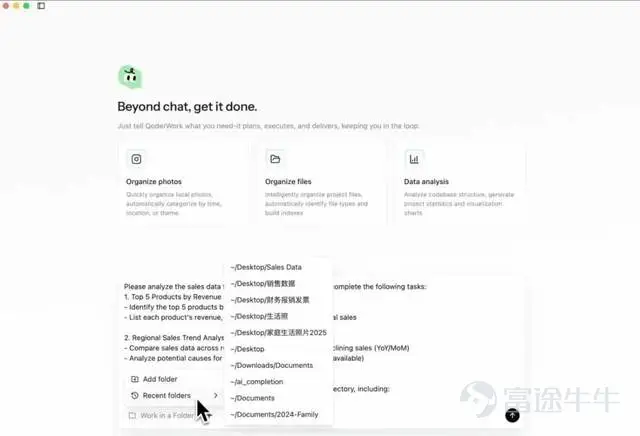
Last Friday, Alibaba CEO Eddie Wu made an appearance at QoderWork’s team meeting and shared these internal metrics. According to sources familiar with the matter who spoke to Zibai Bang, Wu mentioned during the meeting that QoderWork is becoming 'the interface connecting large models with the entire digital world,' and aims to assist every office worker by evolving into something akin to an operating system.
The timing of this statement is quite telling.
Around the same time, DingTalk had just gone through a personnel shake-up. CEO Wu Zhao and Vice President Ma Ruila both departed one after another, and a lengthy internal article concerning DingTalk’s management practices and the ONE project brought underlying issues accumulated over the past year into the spotlight.
Beyond management issues, divisions are emerging within Alibaba regarding its B2B agent strategy.
Chronologically, Wukong and QoderWork started almost from the same starting line. One grew out of DingTalk, backed by Alibaba’s most critical enterprise collaboration entry point; the other originated from Alibaba Cloud/Qoder and initially resembled a low-profile desktop agent. However, in terms of internal adoption and visibility within Alibaba, QoderWork has already taken the lead.
An Alibaba employee told Zibai Bang that they now use QoderWork almost exclusively and rarely open Wukong anymore.
From a user perspective, their capabilities overlap to some extent. However, QoderWork feels more intuitive to use, whereas Wukong seems more like an AI bot awkwardly embedded into DingTalk.
Industry competition is also accelerating in parallel. OpenAI has moved Codex and Agents to the forefront of ChatGPT, Tencent’s WorkBuddy has started including DAU and retention metrics in its earnings reports, ByteDance’s VolcEngine has captured nearly half of the MaaS (Model-as-a-Service) call volume, and is actively iterating its TRAE Work and Coze Enterprise Agent platforms.
Alibaba is not short of models, cloud infrastructure, or enterprise entry points. Qwen, Bailian, Alibaba Cloud, DingTalk, QoderWork, and Wukong each form part of Alibaba’s AI ecosystem in their respective roles.
The issue is that, on its path toward pushing the industry’s state-of-the-art (SOTA) boundaries, Alibaba needs a B2B agent product that can integrate these capabilities and be clearly visible to both internal users and the external market.
At present, that solution has yet to truly emerge.
A
Wukong once held high internal priority.
According to sources close to Alibaba, after Wukong’s establishment, Wu Zhao’s team aggressively pushed for its adoption across the group. Wu Zhao personally engaged with multiple business unit heads to encourage their teams to integrate relevant capabilities onto Wukong.
This aligns with DingTalk’s strategic shift over the past year toward becoming natively AI-driven.
Wukong was positioned as an enterprise-grade, AI-native work platform. Although it also has a standalone client application, its greatest value within Alibaba’s ecosystem lies in its ability to connect to DingTalk enterprise accounts, permissions, and application systems—leveraging DingTalk’s capabilities to handle tasks such as documents, meetings, spreadsheets, and collaboration.
Within Alibaba’s B2B landscape, DingTalk was originally the most natural front-end interface. It already hosts enterprise organizational structures, contact directories, approval workflows, meetings, and internal document applications—seemingly giving it a natural advantage in integrating AI agents into workplace scenarios.
However, based on internal usage feedback, Wukong has not fully realized this gateway advantage.
Some internal voices at Alibaba reported that when handling DingTalk documents, Wukong sometimes failed to distinguish whether new content should be appended to the original document or overwrite existing content; in some document edits, images were deleted and text turned into 'loading...' placeholders.
Some employees also mentioned that when they asked Wukong to send a message in a group chat and @ a specific colleague, the result was just plain text without triggering an actual @ notification.
It’s important to note that these tasks aren’t particularly complex for an agent. This seems to suggest an inherent tension between workplace collaboration tools and general-purpose agents.
General-purpose agents aim to 'complete tasks with a single command,' and Wukong has adopted a similar CLI-style approach. However, in enterprise workflows, many actions can’t prioritize speed alone. The numerous and intricate process nodes make it challenging to let AI drive workflows effectively.
More importantly, much of the work done on DingTalk isn’t standardized SOPs but rather fragmented interpersonal communication: chasing progress updates, verifying information, creating group chats, aligning messaging, forwarding files, and ad hoc coordination.
The automation brought by agents must be built upon core metrics of workplace collaboration—immediacy and accuracy.
This sense of disconnection is immediately apparent upon opening DingTalk today. The first thing users see is the AI chat interface, while the once-central messaging tab has been relegated to the second item in the primary menu.
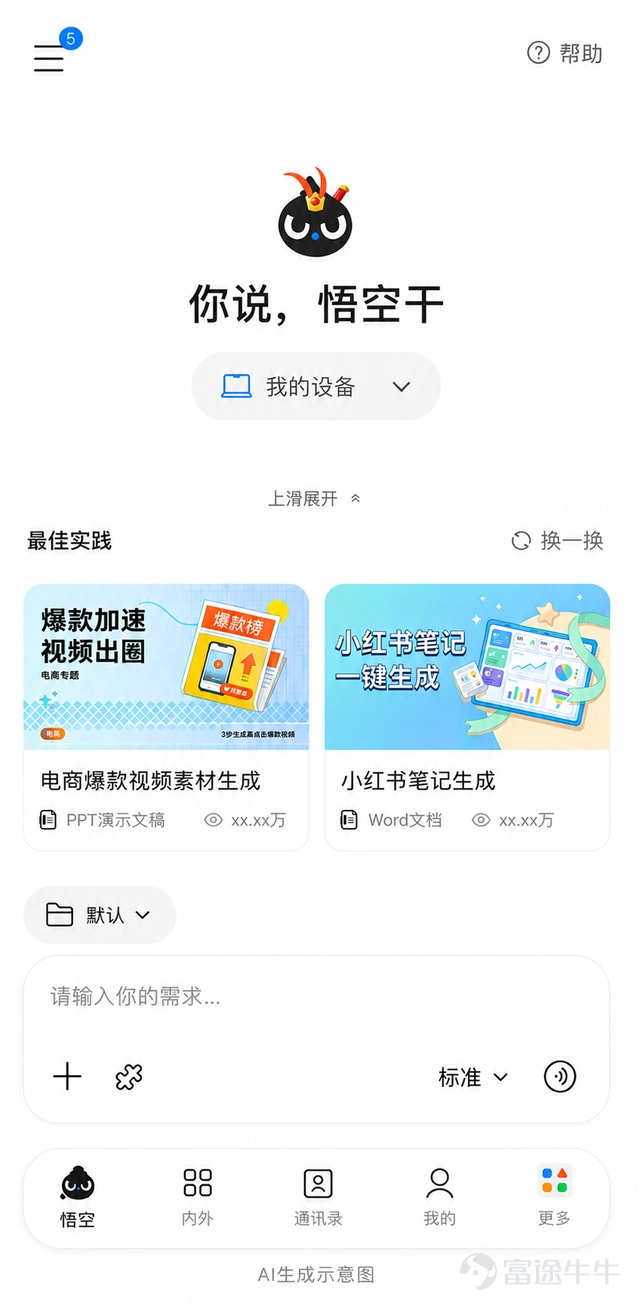
While understandable—as the DingTalk/Wukong team likely intends to elevate AI’s priority—this design compromises the immediacy of accessing work messages, a fundamental convenience expected from a workplace collaboration tool.
By contrast, QoderWork’s advantage lies in its identity as a general-purpose productivity agent.
According to insiders at Alibaba, when asked to generate a flowchart, Wukong typically outputs Markdown, whereas QoderWork more readily produces images or deliverables closer to final output.
Another insider noted that Wukong opens multiple browser tabs during automation tasks, and the feedback loop after task failure is unclear, making the experience feel more like 'remotely controlling a robot within DingTalk.'
This kind of feedback does not represent all users, but it highlights an issue: now that Alibaba already has QoderWork—a general-purpose productivity agent—internally, Wukong can hardly rely solely on DingTalk’s entry point to gain a natural advantage.
The collaborative office environment can nurture AI assistants, digital employees, and process automation, but it may not be the ideal place to directly grow a universal agent as the primary entry point.
For Alibaba, this is not merely an issue concerning DingTalk as a single product, but rather a matter of role allocation in its B2B agent strategy: the entry point closest to enterprise organizations and workflows may not necessarily develop universal agent capabilities first; meanwhile, the internal product that has already generated usage data has yet to occupy Alibaba’s most central enterprise gateway position.
Recent dramatic shifts in Alibaba’s and DingTalk’s business and organizational structures have started bringing this issue into the spotlight.
B
When Wukong was first launched, it was briefly seen by outsiders as Alibaba’s flagship B2B agent.
In March this year, Wukong debuted as an enterprise-grade AI-native work platform. Shortly afterward, Alibaba established the Alibaba Token Hub to integrate AI-related businesses including Tongyi Lab, MaaS, Qwen, and Wukong, placing Wukong within a higher-level AI commercialization framework.
At that time, Alibaba needed a product capable of connecting models, cloud infrastructure, and enterprise use cases.
Qwen provides model capabilities, Bailian offers model services and a development platform, Alibaba Cloud serves enterprise clients, and DingTalk handles organizational access. If Wukong succeeds, it could become the front-end interface on this chain that is closest to enterprises’ day-to-day operations.
Competition in B2B agents has moved beyond the launch phase and entered the era of metric-driven rivalry.
OpenAI’s direction is clear: push agents to the user’s most frequently used front-end interface. ChatGPT is now integrating Codex, agents, image generation, and third-party service entry points. Its logic is straightforward: to monetize model capabilities, they must enter users’ work interfaces.
This also signals the AI industry’s shift from model competition to product competition. In the early stages, vendors competed on model parameters, benchmark rankings, and API pricing; now, in the Agent era, competition has turned toward where users issue commands, where tasks are executed, and where results are delivered.
Domestic vendors are also rapidly diverging in their approaches.
Tencent has taken a lightweight front-end path. WorkBuddy integrates into users’ existing toolchains through desktop Agents, messaging entry points, and MCP connectors. Meanwhile, Tencent Cloud also offers ADP, an open Agent ecosystem platform that deeply integrates with enterprise AI use cases.
More importantly, Tencent has already started incorporating Agent products into its financial reporting narrative.
In its first-quarter earnings report, Tencent stated that WorkBuddy leads China’s productivity AI Agent services by DAU; CodeBuddy and WorkBuddy are still in early adoption phases but have achieved organic growth and high retention—active user retention exceeds 60%, and paying user retention exceeds 80%.
Tencent did not disclose specific DAU or revenue figures for WorkBuddy, but it provided product metrics understandable to capital markets: DAU, retention, and paying user retention.
This serves as a direct benchmark for Alibaba.
In the past, enterprise software competition was measured primarily by customer count, contract value, and ecosystem partners. Now, Agent products are being evaluated like internet products: daily active users, retention, paid conversion rates, and usage frequency.
ByteDance is pursuing a different path.
Products such as Volcano Engine, Doubao models, Coze Enterprise Edition, and TRAE Work form a chain from model services to Agent platforms and developer tools. These offerings are closely aligned with model, cloud, and Agent infrastructure teams, giving them easier access to resources like foundation models, multimodal capabilities, tool calling, MCP, and development frameworks.
At the model usage volume level, IDC data shows that in 2025, enterprise MaaS token usage in China reached 1,944 trillion tokens, with ByteDance's VolcEngine capturing a 49.5% market share and Alibaba Cloud at 28%.
In enterprise MaaS usage volume, ByteDance has secured a dominant position among domestic vendors.
Meanwhile, the relationship between agents and AI cloud services is becoming more direct.
If model capabilities remain confined to APIs, enterprises must identify their own application scenarios; if agent products succeed in the market, they can directly generate usage demand.
Whoever owns high-frequency agent entry points will find it easier to convert model capabilities into token consumption, cloud revenue, and customer stickiness.
Alibaba clearly understands it needs a flagship product, but currently, its strengths are fragmented across different business segments.
The models reside in Qwen, the cloud infrastructure in Alibaba Cloud, and the enterprise access point in DingTalk. Together, they form Alibaba’s AI landscape, yet they have not yet coalesced into a clearly identifiable B2B agent product in the external market.
The absence of a widely recognized agent ecosystem track record is precisely Alibaba’s current pressure point. Wu Yongming’s encouraging remarks last week to the QoderWork team appear to reflect this pressure candidly.
C
QoderWork has achieved the highest daily active users, weekly active users, and token usage within Alibaba, but this is still far from sufficient.
Capital markets care about only one thing: whether Alibaba’s AI investments can translate into external customers, token usage, paid revenue, and a clearer growth trajectory.
The volatility in Alibaba's share price reflects precisely the ongoing unwinding of such expectations.
At the stock price level, the market has already repriced Alibaba for its AI potential, but this repricing failed to sustain itself.
Since the beginning of the year, Alibaba saw a rapid rally driven by Qwen, cloud computing, and AI infrastructure investments. In February, when Alibaba announced plans to invest at least RMB 380 billion in cloud and AI infrastructure over the next three years, its share price surged more than 68% year-to-date.
By mid-June, however, Alibaba’s U.S.-listed shares had retreated to around USD 112. Since last week, the stock has declined for seven consecutive trading days, closing at USD 112.69 on June 11—over 40% below its 52-week high of USD 192.67.

This indicates that the market did assign an AI premium to Alibaba, but the positive sentiment failed to hold steady.
Earnings data also help explain this pressure.
According to previously released first-quarter results, Alibaba Cloud Intelligence Group reported revenue of RMB 41.626 billion, up 38% year-over-year, with external commercial revenue rising 40%. Revenue from AI-related products reached RMB 8.971 billion, accounting for more than 30% of external revenue for the first time.
However, in the same quarter, Alibaba Group reported total revenue of RMB 243.38 billion, up just 3% year-over-year, and posted an operating loss of RMB 848 million. While cloud and AI businesses are growing, profit pressures at the group level have led the market to keep questioning the return path on this AI investment cycle.
The money has already been spent; what the market now wants to see is whether these investments can attract more external customers, drive higher token usage, and generate additional revenue.
This is also Alibaba's SOTA anxiety.
Here, 'SOTA' doesn't just mean topping the model leaderboard—it means being recognized as the number-one product in the market.
Alibaba stands firmly in the top tier among Chinese AI companies, yet it still lacks a product that has achieved an undisputed number-one position in any critical battleground.
On the consumer side, Alibaba has Qwen.
According to QuestMobile data, in the first quarter of 2026, Doubao, Qwen, and DeepSeek ranked as China’s top three native AI apps, with monthly active users of 345 million, 166 million, and 127 million, respectively. Qwen narrowly edged out Yuanbao to secure a spot in the top tier of consumer-facing AI applications, but Doubao remains the clear industry leader ahead of it.
On the enterprise side, Tencent is accelerating its efforts in the Agent space.
Tencent disclosed progress on WorkBuddy in its first-quarter earnings report: by daily active users (DAU), WorkBuddy leads China’s productivity-focused AI Agent services; both CodeBuddy and WorkBuddy continue to grow organically, with active user retention exceeding 60% and paid user retention surpassing 80%.
Alibaba’s financial reports, however, offer little visibility into the real market performance of QoderWork and Wukong.
This lies at the heart of Alibaba’s SOTA anxiety.
Alibaba isn’t lacking in model updates or product initiatives. In June, QoderWork’s China version launched an AI Productivity Program, distributing tens of billions of free credits and introducing vertical workspaces for design, presentations, writing, and more. The latest iteration of Qwen is also enhancing capabilities in coding, debugging, office workflow automation, and multimodal Agent functions.
In June, QoderWork’s China version launched an AI Productivity Program, distributing tens of billions of free credits and rolling out specialized entry points such as design, presentation, and writing workspaces. It no longer packages Agents merely as chat interfaces but instead breaks tasks down into more specific office scenarios.
This step is critical, because enterprise users don’t lack AI-powered Q&A interfaces—they lack tools that can directly deliver results.
The writing workspace addresses proposals, meeting minutes, weekly reports, and documents; the presentation workspace handles reporting and showcasing; and the design workspace aims to fulfill image and visual asset needs. These are all high-frequency tasks in internet companies and represent scenarios where the value of AI adoption is easiest to measure.
This is also a key distinction between QoderWork and Wukong: rather than entering through enterprise organizational structures, QoderWork starts from individual productivity.
If Wukong seeks to solve ‘how AI integrates into enterprise workflows,’ QoderWork aims to address ‘how AI becomes an employee’s productivity tool.’
The former relies more heavily on organizational permissions; the latter can more easily first scale among individual users.
But for now, these are merely initial moves in the external market.
For Alibaba, anxiety over achieving state-of-the-art (SOTA) capabilities can ultimately only be alleviated through products. Even if its model capabilities remain stably in the top tier, only product-level innovation can demonstrate that this capability is being genuinely utilized.
QoderWork and Wukong now stand precisely at this juncture.
Whichever gains market validation first will become Alibaba’s clearest product anchor in the commercialization of AI.
Until then, Alibaba must keep refining its products and await the emergence of that answer. $Alibaba (BABA.US)$$BABA-W (09988.HK)$$BABA-WR (89988.HK)$$HKEX Secondary Listings (LIST1304.HK)$$Alibaba Ecosystem (LIST2118.US)$
Risk Disclaimer: The above content only represents the author's view. It does not represent any position or investment advice of Futu. Futu makes no representation or warranty.Read more
Comments
to post a comment
1