
Zhongji Xuchuang is now in hot IPO subscription! Around 80% of new listings in 2026 rose on their fi

【Investor Story】Conversation with Jia Ge: After a 100x Rollercoaster Ride, I Only Go All-In on High-Conviction Opportunities
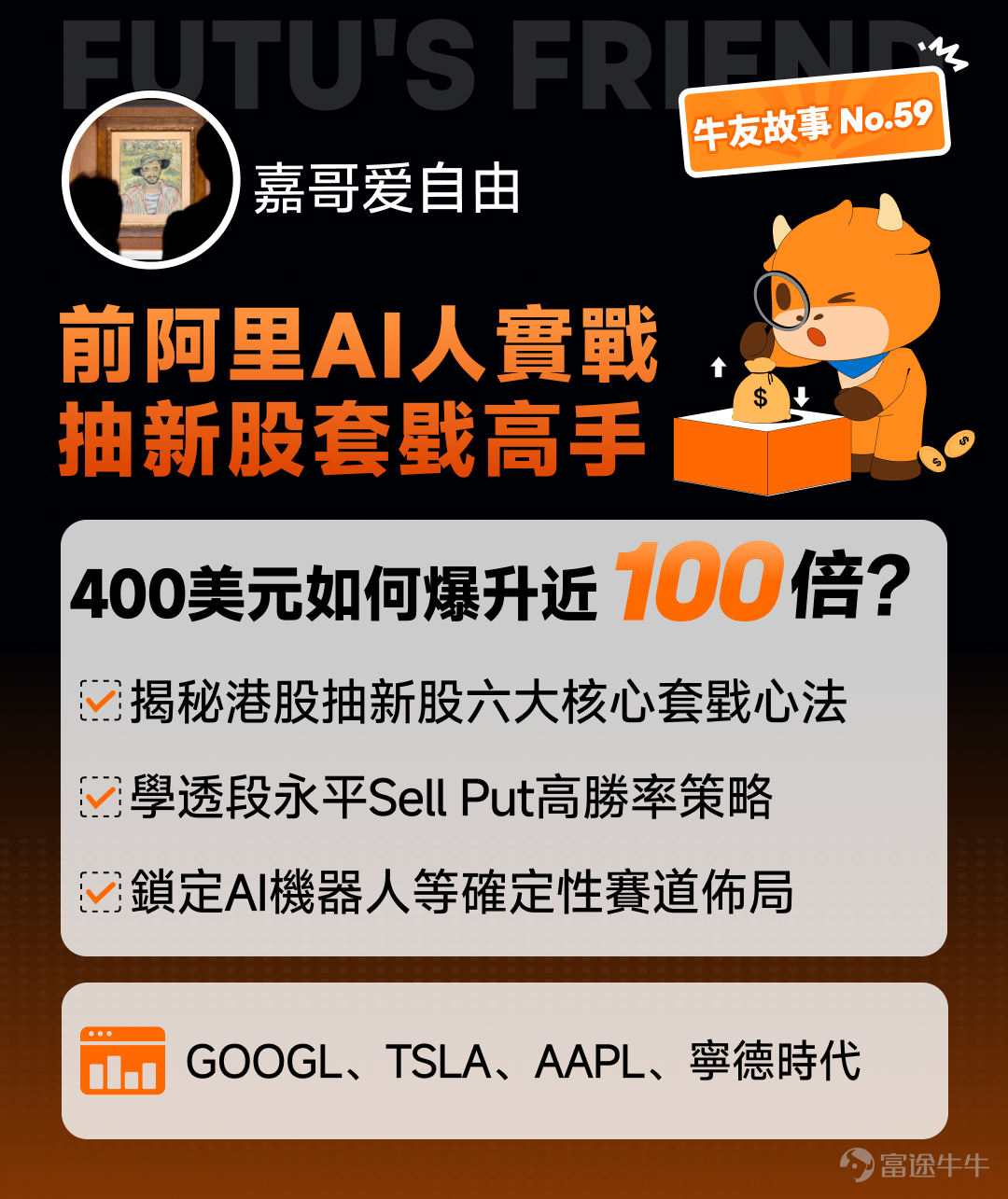
How did a $400 'lottery ticket' surge nearly 100-fold on paper in less than a month—and then almost drop to zero overnight?
A seasoned IPO arbitrage expert with over 20 brokerage accounts—how does he precisely identify institutional selling signals by comparing pre-market trading patterns?
From a technical analysis practitioner to a follower of Duan Yongping’s investment philosophy—how did this former AI professional at Alibaba discover the true essence of investing: 'only act when certainty presents itself'?
This edition of [Investor Story] features an AI professional with over ten years of investment experience and a background at tech giants like Alibaba.@嘉哥爱自由, sharing his transformation journey from a speculator to a value investor, along with practical insights honed through balancing IPO subscription arbitrage and long-term stock holding!
Friendly reminder: This article is rather long; it’s recommended to like and bookmark it for careful reading. There's a surprise waiting for you in the interactive section at the end!

I. The Investment Landscape of a Big-Tech AI Professional—Tech Sector Focus, IPO Arbitrage, and the Ironclad Rule of 'Don’t Touch What You Don’t Understand'
Q: Could you first introduce your investment background and primary areas of focus?
A: I majored in computer science and entered the IT industry after graduation, working at major tech firms like Alibaba on AI-related projects. I started dabbling in A-shares during college and officially entered the Hong Kong and U.S. stock markets in 2019. Over the years, I’ve used most mainstream investment instruments available in the market—including options, futures (both cash-settled and physical delivery), and currently, IPO subscriptions.
Counting broadly, I’ve had roughly ten-plus years of investment experience; specifically in Hong Kong and U.S. markets, it’s been about six or seven years. My investments are primarily concentrated in tech and AI sectors—areas I understand well—as well as consumer sectors that interest me. Even though I briefly ventured into unfamiliar areas like healthcare, I eventually stopped entirely—I’d rather pass on anything I don’t truly understand.
2. A $400 'Lottery Ticket'—The Thrilling Saga of FF’s 100x Surge and Near-Zero Collapse
Q: Over your years of investing, is there a particular trade that stands out as the most memorable? Could you share it with us?
Because I had prior experience founding an MCN and running livestream e-commerce, I came across one of Jia Yueting’s videos on Douyin—where he was sharing his story about building cars in the U.S. I immediately recognized it was professionally produced, which meant an MCN agency was managing his account, and he clearly intended to make moves on Douyin. At the time, FFAI’s stock price was only $0.04, just a hair’s breadth from delisting warnings. The market widely assumed he was finished—but I sensed he was still fighting, so I spent $400 to buy 10,000 shares, treating it like a lottery ticket, and then set it aside.
Less than a month later, during the 'Retail vs. Wall Street' short squeeze frenzy, FFAI got caught up in the momentum. The stock surged from $0.04 to over $3, giving me a paper profit of nearly RMB 300,000. Everyone in online communities was shouting price targets of $5 or even $10. I thought maybe it could hit $5, so I held and didn’t sell. But when I woke up the next day, it had already crashed back below $1—and eventually plummeted almost to zero. I entered with $400, saw a near 100x paper gain, and ultimately gave almost all of it back.

Q: What reflections or lessons did this experience leave you with?
A:The most immediate lesson is: don’t get greedy—lock in your profits when you can.This is especially true for story stocks with no fundamental support, driven purely by sentiment—you must strictly follow your trading discipline.
If I were to relive this moment today, I would definitelysell a portion of my position at the peak, secure my initial capital first, and then use the remaining profit to buy protective call options—letting the rest of the position continue to swing for the fences with limited risk.This way, you won’t miss out on subsequent gains by exiting too early, nor will you suffer a significant pullback.
A deeper insight is this: the real money in life is made by going all-in on high-conviction opportunities.Speculative plays with extremely high uncertainty—like FFAI—often yield limited profits even when successful, simply because position sizes are too small. Looking back at my account history, the few trades that generated substantial profits were large positions in major stocks; those small speculative bets, even if they returned 100x, contributed little due to minimal capital allocation.
III. The Ultimate Guide to IPO Subscription Arbitrage – Six Core Elements and the Gray Market Code
Q: You’re quite experienced in subscribing to Hong Kong IPOs. Could you share your methodology?
A: IPO subscription primarily hinges on several core factors:
① Fundamentals:How strong are the stock’s fundamentals? Is it aligned with currently hot market themes?
② Institutional Allocation:Check whether institutional subscriptions are enthusiastic;
③ Cornerstone Investors:Institutional investors with a 6-month lock-up period, ranked as follows: top-tier international > top-tier domestic > industry funds > upstream/downstream partners
④ Anchor Investors:Can be understood as cornerstone investors without a lock-up period
⑤ Greenshoe Option:Large IPOs typically have greenshoe support on the first trading day, valid for 30 days. Short-term traders often buy at a discount in the grey market and sell to the greenshoe for arbitrage; $SERES (09927.HK)$ This is a classic example, including recent ones such as $DAJIN (01081.HK)$
⑥ Discount:For A+H share listings, examine the discount of the offer price relative to the A-share price;

The current market is almost in a 'no-brainer rush' state—a very clear golden window that I expect to last until 2027.
The IPO underperformance rate is extremely low—investors don’t even need to scrutinize fundamentals. But I believe this market condition is unhealthy and will inevitably run into trouble sooner or later. Only after several consecutive underperforming IPOs might the market gradually return to rationality.
Moreover, the most important mindset when subscribing to new IPOs is: never obsess over selling at the absolute peak. There’s a common saying among IPO investors: 'Selling early always guarantees profit.'No one can tell you the perfect time to sell—it simply doesn’t exist. Our goal in subscribing to IPOs is arbitrage; just stick to your predetermined strategy—whether selling in the grey market or on listing day is perfectly fine. Those who try to time the exact peak will inevitably end up losing out.
Q: During the grey market phase, how do you assess price trends and decide when to sell?
A:First, I check whether the grey market price appreciation meets my expectations. If it significantly exceeds expectations, I’ll take profits immediately.
Then, I compare grey market price movements across several brokers to see if they’re consistent or show clear divergence—this helps determine whether the current sellers are retail investors or institutions.
For example, $ALSCO POOLING (02649.HK)$ , during the grey market phase, Futu’s grey market price appeared very high, but by the official market open the next day, institutions had already exited, leaving retail investors trapped at the top.
Second, if the grey market performance meets or falls short of expectations, it’s also crucial to observe the price action pattern to decide whether to sell in the grey market:
Scenario 1: Steady upward price movement—no need to rush selling in the grey market; hold until listing day for further observation;
Scenario Two: A sharp rally followed by a rapid pullback and continuous decline—requires cautious handling.
Third, assess inclusion expectations—check whether the price gain is approaching the threshold for index inclusion.
The core principle remains: it’s fine to act when you’re near the right entry point. Obsessing over catching the absolute peak will inevitably lead to repeated mistakes in future trades.

When subscribing to new IPOs, I opened accounts with nearly every broker available in Hong Kong—around twenty or so.
After using them, I found that Futu offered a noticeably better overall experience—one tier above the rest—with an intuitive interface and abundant promotions, so I’ve stuck with it ever since.
① What matters more to me is whether the features are user-friendly and whether the information is comprehensive.
② Futu’s AI-assisted features are very well implemented; using AI to analyze financial reports is extremely convenient and far more targeted than general-purpose large language models.
③ The community aspect is also well done—there are indeed many high-caliber investors actively exchanging insights, creating a great atmosphere and interactive experience.

Investing involves risks; this material is for reference only and does not constitute investment advice. Investors should make decisions based on their own risk tolerance and use AI-related tools with caution.
IV. From Technical Trader to Value Investor: Internalizing Duan Yongping’s Philosophy and the Wisdom of Selling Puts
Q: You admire Duan Yongping’s investment philosophy—how has it influenced you? And what’s your view on 'copying top investors’ moves'?
A: I used to be a technical analyst—I studied all kinds of candlestick patterns, indicators, and quantitative methods. Later, I realized that in today’s increasingly institutionalized and quant-driven markets, those approaches are becoming less and less effective.
After shifting to fundamental research, I found Duan Yongping’s investment philosophy especially well-suited for Chinese investors: he has entrepreneurial experience, is familiar with both Eastern and Western markets, invests across A-shares, Hong Kong stocks, and U.S. equities, and is particularly generous in sharing his insights. Most importantly, he can explain complex investment principles in plain, simple language—that’s the mark of a true master.
I deeply agree with his core principles: 'Buying a stock is buying a business,' 'Don’t invest in what you don’t understand,' 'Never short sell,' and 'Never use leverage.' I was also impressed by his use of selling put options—collecting premiums while patiently waiting to buy great companies at desired prices during pullbacks.
But I wouldn’t blindly copy his trades—your capital size, holding horizon, and depth of understanding about companies are completely different from his.He can hold a stock steadfastly for ten or even twenty years; if you follow him in, you might capitulate and sell at a loss after just one year. Two years later, when the stock soars, he’s still holding—but you’ve long been out of the game.
The most classic example is Tencent: $TENCENT (00700.HK)$ Duan Yongping started consistently buying Tencent at HK$400. Many people followed his lead. When it later dropped to the HK$200s, those followers began criticizing him. Yet Duan said he was actually happier when the price fell—because he could buy more shares at the same price. Later, Tencent rose to HK$700. Now it’s back around HK$400, and Duan has stated he hasn’t sold a single share.
The same goes for Kweichow Moutai: $Kweichow Moutai (600519.SH)$ His Moutai shares are non-sale items—he buys more whenever he has cash flow. He holds Moutai for long-term dividend income, and even his charitable donations are made in Moutai stock, with the condition that recipients may not sell the shares but can only collect dividends. This mindset and long-term vision simply cannot be replicated by those who merely copy his trades.
When learning from masters, focus on their philosophy and thinking frameworks—not on blindly mimicking their trades.
Q: Regarding options trading, what do you primarily focus on? Have you learned any profound lessons?
A:I mainly sell puts. It has a high win rate and clear logic—requiring only attention to the probability of assignment and annualized return. It’s simple to execute and doesn’t require constant monitoring, which suits my pace well.
Duan Yongping put it well: 'Buying options is gambling; selling options is investing.' I strongly agree. Buying options inherently has a low win rate and demands accurate predictions on both direction and timing, making it very difficult—not something I’d recommend casual investors try lightly.
My most profound lesson came from an options trade $Duolingo (DUOL.US)$ ahead of Duolingo’s earnings announcement. At the time, I had just started selling puts and was riding a streak of profits, which made me overconfident. Seeing elevated implied volatility ahead of earnings and attractive premiums for selling puts, I decided to take a gamble. I set the strike price at around 80% of the stock price, thinking it was safe enough. But after earnings, the stock plunged sharply and dropped below my strike price. I hadn’t done deep enough research on Duolingo and lacked the confidence to take delivery of the shares, so I eventually closed the position at a loss.
That experience cemented Duan Yongping’s advice in my mind: ‘Only sell puts on stocks of companies you truly admire. Don’t take on the risk of a company you don’t understand just for small gains.’ I still occasionally slip up on this principle, so I need to keep reminding myself.
V. Positioning Philosophy and Future Strategy — Preserve Cash, Bet on Certainty, and Wait Patiently for Opportunities
Q: How are you currently allocating your portfolio? What positions do you currently hold?
A: 20% in Hong Kong stocks, 50% in U.S. stocks, and 30% in cash held in a money market fund, which I use for IPO subscriptions and options arbitrage.
I’m strongly against going fully invested. I’ve also been continuously reducing my Hong Kong equity exposure and shifting toward U.S. stocks.
Buffett can stay fully invested because his insurance subsidiaries generate a steady stream of premium cash flows annually, eliminating the need to hold reserve cash. As ordinary investors, we must keep a certain percentage in cash—I recommend 30%.
First, to have the capacity to buy high-quality stocks at low prices during sharp market declines or black swan events;
Second, to avoid running out of funds precisely when you need capital most—being fully invested leaves you extremely vulnerable during market volatility.
I started deploying into AI relatively early, but embarrassingly, I sold my memory stocks too soon. $NVIDIA (NVDA.US)$I didn’t hold on, but I’ve kept holding $Alphabet-A (GOOGL.US)$ , which operates seven businesses each with over $2 billion in daily active users and annual revenue exceeding $10 billion—the fundamentals are extremely solid. Its ad revenue continues to grow, it has strong in-house TPU hardware capabilities, and it’s deeply positioned in cloud computing, quantum computing, and other areas, making it an exceptionally well-balanced AI beneficiary stock overall.
I also hold $Qualcomm (QCOM.US)$ ,I believe Qualcomm is significantly undervalued. It offers a solid dividend, has core competitive advantages, and presents a high risk-reward ratio.
My current U.S. equity holdings mainly include $Alphabet-A (GOOGL.US)$、 $Tesla (TSLA.US)$、 $Apple (AAPL.US)$major tech names, while for Hong Kong-listed stocks, I remain bullish long-term on $CATL (03750.HK)$ , one of the most internationally recognized tech companies among A+H shares. It consistently ranks among the top two in terms of H-share premium, with southbound capital holding RMB 300 billion (compared to Kweichow Moutai’s RMB 80 billion) and foreign ownership steadily increasing. All its IPO cornerstone investors were top-tier global institutions, and recently, I noticed it led the Series A round for DeepSeek—an exceptional combination of vision and execution capability that’s truly rare.
Pop Mart $POP MART (09992.HK)$ I went through a wild rollercoaster—watching it drop from 350 to 150 without selling. I admire this company’s corporate culture and remain bullish long-term. Duan Yongping recently increased his stake to 6%. That he bought this company was something I could anticipate—he favors good companies at cheap prices. When Pop Mart traded at 40x P/E, he said, 'I don’t understand it'; once it dropped to 14x P/E, he immediately 'got it.' Great company, great management, great business model—but above all, it has to be cheap. That’s the key principle for master investors.
Regarding memory chips (storage), I’ve always viewed this as a cyclical industry. Right now, there’s nearly unanimous optimism—everyone from retail investors to mainstream media is talking about it, and recommendation articles are everywhere. This kind of 'consensus-driven peak' is a warning signal worth heeding. Personally, I wouldn’t chase memory stocks at these levels. However, if you’re already in a profitable position, holding on isn’t unreasonable; but if you haven’t entered yet, it’s better not to chase the rally.
Q: Looking ahead, which sectors deserve attention?
A: The most certain direction remains AI. Anthropic reached a $1 trillion valuation in just five years—such speed itself is a wealth code. Anthropic is set to go public in the second half of the year, and as long as the valuation isn’t too high, I’ll likely buy in.
① AI Robotics:This is the next highly promising赛道 (sector). In the future, every household may own robots for various purposes, and this industry will surely produce companies with massive market caps. Candidates include Tesla, Figure AI, and Unitree Robotics. You could also invest in the broader ecosystem—for example, companies recently highlighted by the 'white-haired woman,' such as $Leader Harmonious Drive Systems (688017.SH)$ , etc.;
② AI-driven pharmaceuticals and biotech:If someday a company uses AI to cure cancer, that would be a truly disruptive opportunity;
③ Space exploration: $SpaceX (SPCX.US)$ went public on June 12, currently valued at approximately $2 trillion, with its stock trading at $169 per share. From a long-term perspective, this price is still within a reasonable range; however, in the short term, the valuation appears elevated, with a fair value likely between $1 trillion and $1.5 trillion.
However, as a company under Elon Musk, it typically carries a certain premium, especially given the vast growth potential and limitless possibilities in the commercial space sector. For a more conservative approach, it’s advisable to wait 1–2 months after its IPO, allowing market sentiment to normalize and the stock price to fully adjust before entering a position.
④ Quantum Computing:I think the strongest one is $Alphabet-A (GOOGL.US)$ , which I hold a position in; among small-cap stocks, $IonQ Inc (IONQ.US)$ uses ion-trap technology—after researching it, I found it acceptable for a small speculative position.
Q: Do you have any final words for fellow investors in Bull Bull Community?
I’d like to share a few proverbs I deeply admire:
① Buying a stock means buying a business—Before buying, ask yourself: Would I be willing to pay to own this entire company? Only buy if the answer is yes;
② Never invest in what you don’t understand—Every day, the market has stocks that inexplicably surge, and every day there are voices shouting, 'Quick, jump in!' Listening to others and buying stocks you don’t understand not only makes losses likely, but even if they rise, you won’t be able to hold onto them.
③ Never short—Staying bearish without shorting rarely makes money; occasional wins are just luck. Even institutional players rarely short the market these days.
④ Avoid leverage—As long as you avoid leverage, even if you incur losses, you can always start over.
Everyone understands these principles intellectually, yet few actually follow them when trading. Only after paying tuition through your own losses and failures will you suddenly realize one day: someone had already told you this long ago. The greatest truths are the simplest—it really is that straightforward.
In investment markets, it’s always been about 'believing early—if you believe early, you lead those who believe later.' By the time everyone in the market is cheering, it’s often time to exercise caution.
From a $0.04 'lottery ticket' that soared nearly 100-fold on paper before almost collapsing back to zero, to an IPO arbitrage expert who opened more than 20 brokerage accounts, and eventually to a devoted value investor deeply studying Charlie Munger’s and Duan Yongping’s philosophies—this former big-tech AI professional’s investing journey shows us: the market never lacks opportunities; what’s missing is the discipline and patience to act only when certainty presents itself. As he repeatedly emphasizes: 'Buying a stock means buying a business—never buy what you don’t understand.' Everyone seems to get it, but truly living by it is the ultimate moat for navigating market cycles.
[Interactive Giveaway]
Share your thoughts on this article in the comment section. The first 150 fellow investors who write over 30 words and make reasonable points will receive 66 points.
If you find this article inspiring for your investment, feel free to @ your friends to read it together~
Event deadline: From now until July 5, 2026
If you have more suggestions for our column, feel free to leave a comment! Follow@牛友有料到Stay tuned for the next [Investor Story]!
Disclaimer: Content provided by@嘉哥爱自由Accept@牛友有料到compiled from an interview, with images provided and authorized for use by@嘉哥爱自由The case studies in this article are for reference only and do not constitute any investment advice. The information presented does not imply any recommendation regarding specific industries or indicators. Any discussion or description of individual stocks reflects the personal opinion of the user only, does not constitute a recommendation to buy or sell any stock, and does not represent Futu's position or professional advice. Past performance of individual stocks does not indicate future results. The stock market involves risks; please invest with caution.
Risk Disclaimer: The above content only represents the author's view. It does not represent any position or investment advice of Futu. Futu makes no representation or warranty.Read more


Comments (209)
to post a comment
390
175