
While everyone is talking about AI, another class of assets is quietly attracting capital
Right now, the AI wave is sweeping across the globe with transformative force, reshaping industrial landscapes. Large models, computing power, and chips have successively taken center stage in markets, as tech stocks continually redefine investor perceptions.
Meanwhile, some seemingly 'traditional' assets are also quietly gaining strength.
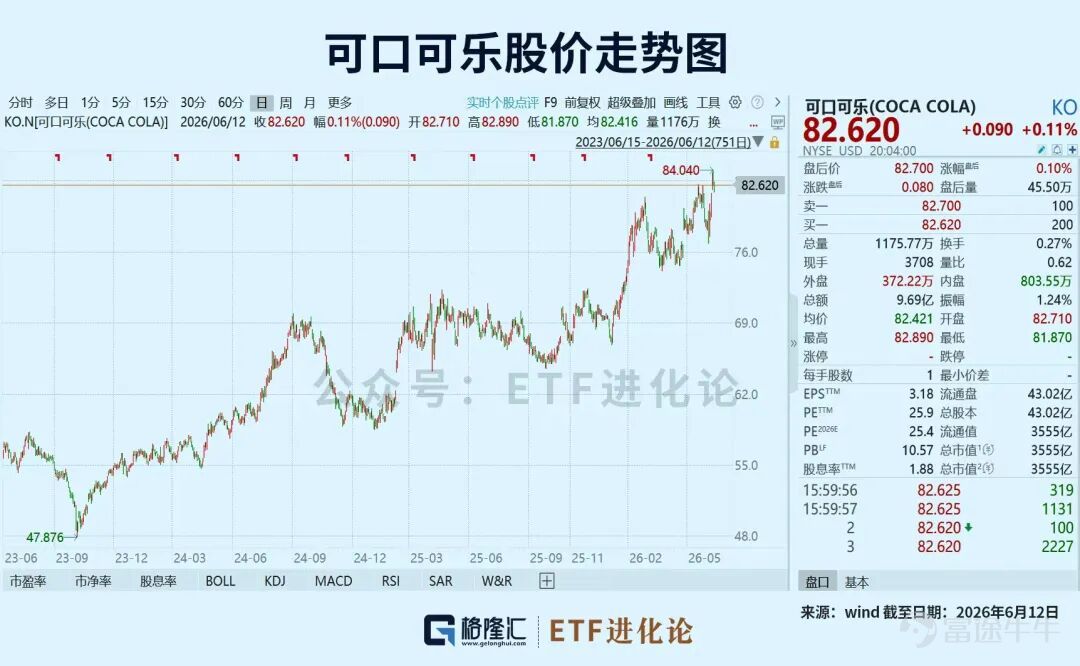
Recently, Coca-Cola’s share price hit a new all-time high. This consumer giant, with over a century of history, continues to attract global capital even in the AI era.

This seems to remind the market of one fact: there has never been just one narrative in capital markets.
01
In the AI era, another long-term force is 'rising'
Every technological revolution gives rise to new star companies, yet firms that can consistently generate cash flow and distribute profits to shareholders always retain their place.
If AI represents an offensive strategy, then dividend-paying assets resemble a long-standing force on the other side of the market.
Viewed over extended historical cycles, whenever technological revolutions enter deeper phases, markets not only unlock substantial growth potential but also often experience valuation volatility and style rotation.
The sweeping wave of AI embodies a forward-looking growth narrative, whereas companies like Coca-Cola exemplify an alternative, enduring path—delivering shareholder returns through stable operations and consistent dividends.
Markets have never been a stage for a single investment style.
The core characteristic of the dividend style lies in sharing corporate earnings through long-term, stable cash dividends.
One of the most classic examples in this regard is Buffett's investment in Coca-Cola.
Between 1988 and 1989, Buffett’s Berkshire Hathaway invested approximately $1.02 billion to acquire Coca-Cola shares. Over time, Coca-Cola’s steadily growing cash flow and consistent dividends have continuously generated returns for Berkshire. By 2025, Coca-Cola is expected to pay Berkshire annual dividends exceeding $800 million.
In retrospect, the cumulative dividends received over the years have already far exceeded the original investment cost.
This model of sharing corporate earnings through continuous cash dividends forms a key foundation for the enduring presence of the dividend style.
Whether the market focuses on the internet, mobile internet, or today’s AI, behind every wave of technological innovation, dividend-paying assets have participated in the long-term evolution of capital markets in their own distinct way.
If Buffett's investment in Coca-Cola exemplifies a classic case of dividend investing, then in China's A-share market,the CSI Dividend Index serves as one of the key windows for observing Chinese dividend-paying assets.
In recent years, as China's economy has gradually shifted toward high-quality development, market attention to capital returns, cash flow quality, and shareholder returns has continued to rise. An increasing number of industries are transitioning from 'chasing scale' to 'pursuing efficiency,' and from 'growth at all costs' to 'balancing growth with returns.'
Meanwhile, a low-interest-rate environment has also become a significant macroeconomic backdrop.
As risk-free yields continue to decline, the importance of stable dividend capacity and dividend yield is naturally being reassessed by the market. Against this backdrop, the CSI Dividend Index has been frequently mentioned.
According to data, the CSI Dividend Index selects listed companies from the Shanghai and Shenzhen stock markets with relatively high cash dividend yields, consistently stable dividend payments, and sufficient size and liquidity as its constituents.
Public data shows that since its inception, the CSI Dividend Index has delivered relatively steady long-term compound growth, with a substantial portion of its returns stemming from consistent dividends rather than solely from valuation expansion.
This return model, heavily reliant on cash flows and dividends, represents a distinct long-term characteristic that differs from growth-oriented strategies.
02
Over RMB 2.1 billion in net inflows have poured into the CSI Dividend ETF (China Merchants) year-to-date.
While AI has emerged as the market’s dominant theme, dividend-paying assets continue to attract sustained investor interest.
Data shows,ChinaAMC CSI Dividend ETF (515080)It has recorded net inflows of RMB 1.086 billion over the past 20 trading days and RMB 2.155 billion year-to-date, with its latest assets under management reaching RMB 11.092 billion.

ChinaAMC CSI Dividend ETF (515080) is a representative ETF that tracks the CSI Dividend Index. This index selects 100 stocks from the Shanghai and Shenzhen stock markets with relatively high cash dividend yields, stable and continuous dividend histories, and sufficient size and liquidity, and is weighted by dividend yield.
The constituents of the CSI Dividend Index are not static.In less than seven years since 2019, all of the index’s top 10 holdings have been replaced, and the sector composition has shifted from real estate toward banking, coal, and transportation sectors.
This dynamic adjustment reflects the ongoing evolution of China’s high-dividend asset landscape.
As of June 12, the dividend yield of the CSI Dividend Index stood at 5.17%, compared to approximately 1.74% for the 10-year government bond yield, with the spread between the two near the upper end of its typical range since 2018.

In terms of valuation, the CSI Dividend Index currently trades at a price-to-earnings (P/E) ratio of 8.68x, maintaining its characteristic profile of high dividend yield and low P/E ratio.
Regarding dividends, 99% of the index’s constituents have already announced their 2025 dividend plans, with total declared cash dividends exceeding RMB 990 billion. Historically, the dividend payout ratio of index constituents has generally remained stable between 33% and 45%.
On June 15, 2026, China Asset Management Co., Ltd. issued an announcement regarding itsChinaAMC CSI Dividend ETF (515080) will initiate its 17th dividend distribution since listing, and its second dividend of 2026.。According to the announcement, the fund plans to distribute RMB 0.20 per 10 fund units. The record date is June 17 (this Wednesday), the ex-dividend date is June 18, and cash dividends will be paid on June 24.
Following this distribution, the cumulative dividend for ChinaAMC CSI Dividend ETF since listing will reach RMB 4.20 per 10 fund units, maintaining its quarterly dividend assessment rhythm initiated in 2024.
Additionally, since inception, ChinaAMC CSI Dividend ETF (515080) has delivered a cumulative return of 109.94%, outperforming its benchmark by 75.58%, with an annualized return of 12%.

(All content in this article consists solely of objective data and information and does not constitute any investment advice.)
Beyond dividend capacity, dividend yield, and valuation levels, market participants also monitor supplementary indicators to assess shifts in style strength when evaluating dividend-paying assets—one such closely watched metric is the '40-day return spread.'
03
What does it mean when the 40-day return spread turns negative?
Historical data shows that over the past five-plus years, holding the CSI Dividend Total Return Index for one year from any random starting point yielded positive returns more than 95% of the time, with an average annualized return of approximately 8.5%.
In addition to these long-term statistical insights, the 40-day return spread offers a perspective for observing short-to-medium-term shifts in the relative strength of the dividend style.
Although the name of this indicator may sound somewhat complex, its underlying logic is actually quite straightforward.
It calculates the returns of the CSI Dividend Total Return Index and the Wind All-A Index over the past 40 trading days separately each day, then subtracts the latter from the former.
The resulting figure is what's known as the '40-day return spread.'
In essence, it measures the relative strength of the dividend style compared to the broader A-share market over the most recent 40 trading days.
If the return spread is positive, it indicates that dividend-paying assets have outperformed the market average over the past 40 trading days; if negative, it suggests that dividend assets have underperformed the market during this period.
Historically, this indicator does not merely track price movements up or down but acts more like a mirror reflecting shifts in market style.
When sectors such as technology and growth rally rapidly, capital tends to concentrate in high-beta assets, causing the dividend style to lag temporarily—during which the 40-day return spread often declines or even turns negative. Conversely, when market focus shifts back to cash flow, dividends, and valuation, the dividend style may regain investor attention.
Therefore, the 40-day return spread effectively reflects the relative positioning between different market styles.
What’s even more noteworthy are its historical statistical characteristics.
Based on historical backtesting data from the past five years, the 40-day return spread exhibits a relatively clear mean-reversion pattern.
In simple terms, when the dividend style has significantly outperformed or underperformed the broader market, it typically reverts gradually toward its long-term average afterward.
Historical backtesting results show a certain degree of statistical correlation between the 40-day return spread and subsequent performance of dividend-style assets: when the return spread falls into a relatively low range, dividend assets have historically had a higher probability of delivering relatively strong returns afterward; conversely, when the spread is in a higher range, their historical performance has tended to revert toward the long-term mean.
It should be emphasized that this relationship stems from historical statistical observations and does not constitute a forecast of future market performance, but it does offer a unique perspective for assessing the relative positioning of dividend assets.
As of June 12, the CSI Dividend Index’s 40-day return spread indicator declined to -0.55%.

From a historical distribution perspective, this indicator has now fallen into a relatively low range seen in recent years, meaning that over the past 40 trading days, the CSI Dividend Index has underperformed relative to the Wind All-A Index.
For the market, this is more akin to an objective record of an ongoing style rotation process.
Looking back at China’s A-share market over the past few years, whenever tech-growth styles gained favor, dividend-paying assets often temporarily receded into the background; yet when the market refocused on cash flow and shareholder returns, dividend styles reemerged into investors’ view.
This is also a long-standing phenomenon in capital markets: no single investment style can remain center stage indefinitely.
AI represents innovation and growth, while dividends represent cash flow and returns. The former reflects the market’s imagination about the economy’s future potential, whereas the latter embodies companies’ current ability to generate value.
Global market experience suggests that these two styles often coexist over the long term, with investor attention shifting between them in response to changes in economic cycles and market conditions.
As an ETF tracking the CSI Dividend Index, ChinaAMC CSI Dividend ETF (515080) serves as an important vehicle for observing the performance of Chinese dividend assets. As of now, the fund has over RMB 11 billion in assets under management and charges an annual management fee of 0.2%, which is among the lowest for products tracking the same benchmark.
Scroll up and down to view the full risk warning:
The author's professional registration number is A20260413000375. This document presents solely objective data and information and does not constitute any investment advice. The content reflects only the current market situation, which may change in the future and should not be construed as investment advice or recommendation of any kind. Past performance of indices is not indicative of future results and does not guarantee fund returns or constitute any investment advice. The indices have a limited operating history and therefore may not reflect all phases of market development. Index funds are subject to tracking error, and past fund performance is not indicative of future results. Please read legal documents such as the Fund Contract and Offering Memorandum before purchasing any fund product, and select products appropriate to your risk tolerance, investment objectives, and other personal circumstances. Investment involves risk; please proceed with caution.
Risk Disclaimer: The above content only represents the author's view. It does not represent any position or investment advice of Futu. Futu makes no representation or warranty.Read more

Comments
to post a comment
1