
The first batch of college students who founded robotics startups have already raised hundreds of millions of dollars.
The robotics sector is now welcoming a new breed of CEOs:They haven’t even graduated yet, but have already founded their own robotics companies and secured hundreds of millions of dollars in funding.
Just recently, a 25-year-old Tsinghua doctoral student secured over RMB 500 million in funding. His name is Qin Shentao, born in 2001, and he is currently pursuing a Ph.D. at Tsinghua University’s School of Vehicle and Mobility. In his third year of the doctoral program, he founded OriginFlow, an embodied intelligence company, which has just completed a RMB 500 million Pre-A funding round.
In early 2025, when Qin Shentao launched his startup, another embodied intelligence company named Zeroth Robotics spun out of Tsinghua University’s AI & Robotics Lab. Its founder is Min Yuheng, a current master’s student at Tsinghua. Today, just 18 months later, the company has raised capital five times and has reached Series A.
Liu Songming, also currently a Ph.D. candidate at Tsinghua, founded Jiangxian Tech, an embodied intelligence startup, during his doctoral studies. Within just six months of its founding, the company secured RMB 500 million in angel investment from Meituan, Shunwei Capital, and other institutions. Most recently, it completed another Pre-A funding round led by Shunwei Capital.
Similar stories are unfolding across multiple universities in China. Chen Hao, a direct-track Ph.D. student in the School of Mechanical Engineering at Shanghai Jiao Tong University (Class of 2022), founded Yingkan Zhiyi, an embodied intelligence company, last year before even graduating. Within half a year, the company secured three rounds of funding and recently closed a Pre-A round worth tens of millions of RMB from Yuanhe Capital. Qi Lu’s MiraclePlus has also invested in the company twice.
A very clear shift is evident: in the past, founders in the robotics sector were typically industry veterans, professionals transitioning from fields like autonomous driving, or academic researchers such as university professors, whereasnow, many of the new robotics founders haven’t even graduated yet—and capital is already chasing them.
Broadening the view, this trend of 'youthification' in the AI industry has even reached high schools. Hot money isn’t just chasing college and doctoral students—tech giants are now recruiting high schoolers too.
A
To understand this wave of student CEOs, Qin Shentao serves as a particularly instructive case study.
Qin Shentao was born in 2001 in a mountain village in Jincheng, Shanxi Province. He excelled academically from an early age and was regarded by teachers and classmates alike as a model student. In 2019, he enrolled in the School of Mechatronics Engineering at Harbin Institute of Technology.
Harbin Institute of Technology can be considered a key talent incubator for China’s robotics industry:China's first arc-welding robot was developed here, and Academician Cai Hegao and others established the nation's earliest doctoral program in robotics at this institution. Founders of robotics companies such as Leju Intelligence, Woan Robotics, and Standard Robots all graduated from here.
It was also here that Qin Shentao demonstrated a strong interest in robotics, conducting research projects focused on force-sensing systems for legged robots and subsequently winning top prizes, including first place in the National Undergraduate Digital Design Competition for Mechanical Products and first place in the National Undergraduate Mathematical Modeling Contest.
Qin Shentao also excelled academically; since enrollment, he has scored above 90 in over 40 courses, with several nearly perfect, consistently ranking first in his major.
Outstanding individuals are always hardworking. During the summer break of his sophomore year, Qin Shentao stayed on campus to work on research projects, participating in perception-related studies within his research group. In his junior year, he became the first undergraduate student at Harbin Institute of Technology to receive both the President’s Medal and the May Fourth Youth Medal simultaneously.
Qin Shentao had achieved success in academics, competitions, and research—so what next? This was a question he constantly pondered.
His answer to himself was: "I’ve always wanted to create a closed-loop integration among academic study, scientific research, and innovation entrepreneurship.Often, people excel in only one of these areas. But if your thinking is clear and you can grasp the essence and core of things, these three elements are actually one and the same—I can unify them into a single cohesive whole and succeed in all three."
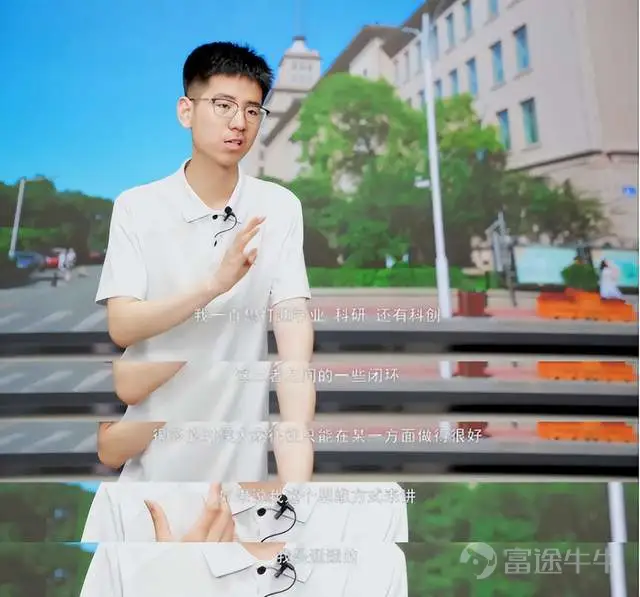
Source: Official WeChat account of Harbin Institute of Technology
Guided by this philosophy, Qin Shentao encountered entrepreneurship for the first time at Harbin Institute of Technology. During college, he founded and led the 'Tiandao' team. Their project, 'Multi-Robot Collaborative System for Future Smart Communities,' was admitted into HIT’s Student Entrepreneurship Incubation Park and connected with the State Key Laboratory of Robotics and Systems, securing funding and project mentorship.
In his senior year, Qin Shentao also joined the Shenzhen Institute of Sci-Tech Innovation, co-founded by Professor Li Zexiang, and participated in the startup incubation program run by Qi Lu’s MiraclePlus. According to 'Investor Network,' Qin already had a vague idea at the time for a foundation model based on neural interfaces. Although some investors were willing to fund him, Qin chose not to launch the venture yet, as he believed the timing wasn’t right and there wasn’t a compelling application scenario to serve as an entry point.
After graduating from Harbin Institute of Technology, Qin Shentao pursued further studies, enrolling in a Ph.D. program at Tsinghua University's School of Vehicle and Mobility. In August 2025, during his third year of doctoral studies, Qin decided to start a company named OriginFlow, entering the embodied intelligence sector.
At that time, the embodied intelligence field was booming both domestically and internationally, with industry focus shifting toward training embodied intelligence models. However, a common bottleneck emerged: insufficient and inaccurate data supply for training large models. The entire industry was waiting for better data.
Existing solutions on the market mainly fell into two categories: one involved real-robot teleoperation data, which was too costly; the other used simulation data, which was cost-effective but always suffered from a gap between simulation and reality.
Qin Shentao took a different approach, deciding to build his data collection method from the ground up based on the principles of surface electromyography (sEMG) technology.
Just one month before Qin Shentao registered his company, in July 2025,Meta had just published a technical breakthrough: a non-invasive neuromotor interface integrated with a wristband that made 'mind-controlled' interaction a reality.The underlying technology relied on surface electromyography (sEMG), interpreting human motor commands by reading electrical signals generated by muscles.
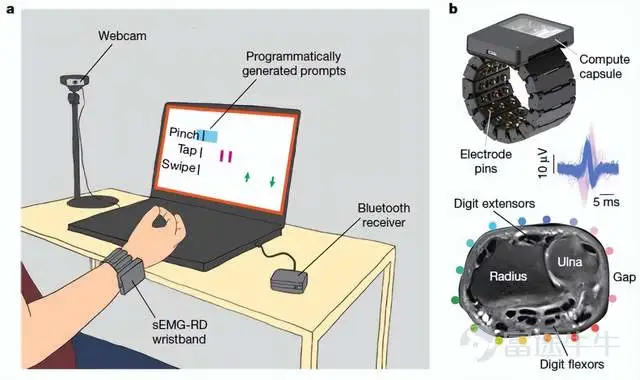
sEMG wristband (Source: Meta)
OriginFlow also adopted sEMG-based technology as its foundation. The company developed a data acquisition framework called NeuroScale, using a non-invasive motor neural interface to capture surface electromyography (sEMG) signals from the skin, then translating those signals into hand-motion data through its proprietary model.
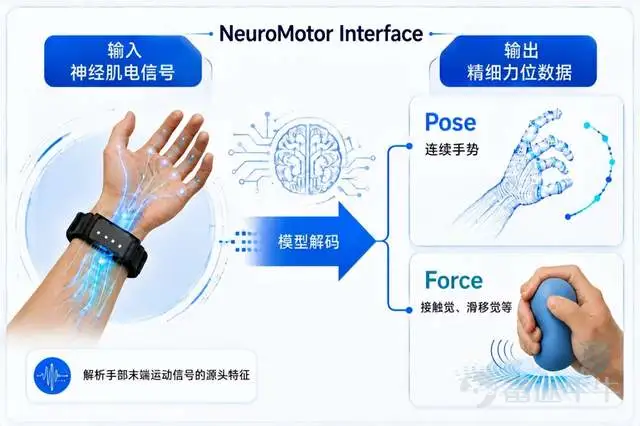
Image source: OriginFlow
This path is currently not widely pursued in China.
In just a few months, Qin Shentao swiftly secured multiple rounds of funding. According to Qichacha, between December 2025 and May 2026—within half a year—OriginFlow completed three funding rounds up to the Pre-A stage, backed by as many as ten investors. Among them, BlueRun Ventures and Oasis Capital repeatedly made substantial investments amounting to tens of millions of yuan.
‘A born entrepreneur,’ is how Cao Xi, founding partner of Monolith Capital, describes Qin Shentao. Now, this young man from a rural village in Shanxi stands at the forefront of the embodied intelligence sector at just 25 years old.
B
There are many others like Qin Shentao in this industry,They work on the front lines of research, engaging with cutting-edge technological developments, learning while honing their skills through practice, and eventually launching startups at the right moment.
Born in 2000, Min Yuheng founded Lingcifang Robotics while still pursuing his master’s degree at Tsinghua University.
In 2020, Min Yuheng was selected for Chongqing University’s Mingyue Innovation & Entrepreneurship Experimental Class, where he studied under Li Zexiang. This university program is explicitly designed to cultivate entrepreneurs, with only two core courses: advanced mathematics and university physics.
There, Min Yuheng chose robotics engineering, embarking on his entrepreneurial journey, and Li Zexiang became one of the most influential figures in Min’s startup endeavors.
Min Yuheng’s first entrepreneurial attempt came during the second semester of his freshman year, when he entered the commercial cleaning robot sector. However, the market was already crowded with established players, leading to intense competition and ultimately the failure of this venture.
The second was an ice-making machine project, with Min Yuheng serving as CTO. The project was highly successful and is still operating in Shenzhen, having secured Series A funding. Although Min Yuheng exited midway, this experience gave him deep insights into entrepreneurship.
Afterward, Min Yuheng began contemplating where the opportunities lay in the industry. At the time, he was in the process of securing a direct admission to graduate school from his undergraduate program. After several months of observation,he concluded it was the embodied intelligence sector—a historic wave potentially surpassing the scale of the internet.
Min Yuheng thus chose Tsinghua University. In April 2024, he joined the Tsinghua AI & Robotics Laboratory.
Those admitted to this lab are already exceptionally talented, but Min Yuheng stood out—he had entrepreneurial experience and understood both the market and commercialization. Within less than a month, he convinced eight senior labmates to join him in launching a startup.
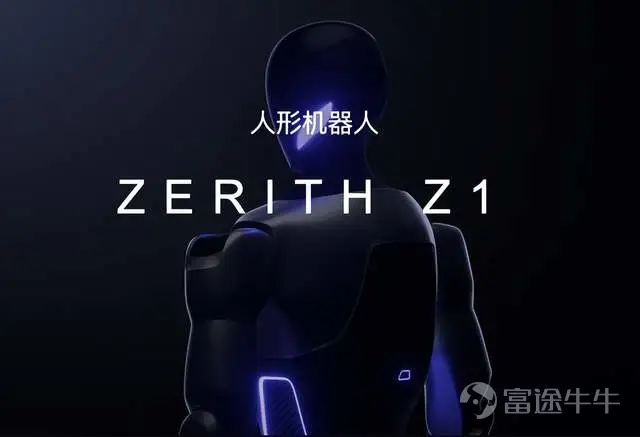
The core team of Lingcifang was formed at that time. In October 2024, the team unveiled its first humanoid robot, the Z1. In January 2025, Min Yuheng officially founded Lingcifang Robotics, focusing on developing versatile home robots with cleaning capabilities. Within six months of founding, the company completed three rounds of financing and has now raised hundreds of millions of RMB through its Series A round.
Source: Lingcifang Robotics official website
Also in 2025, Liu Songming, who was pursuing his Ph.D. at Tsinghua University's ISRLab, founded Jiangxian Technology.
Liu Songming originally gained guaranteed admission to Tsinghua’s Department of Chemical Engineering after winning a gold medal in the National Chemistry Olympiad. However, driven by his passion for computer science, he eventually transferred to the Department of Computer Science. In his junior year, he met Professor Zhu Jun, who introduced him to the field of AI. During his Ph.D. studies, Liu continued to work under Professor Zhu Jun.
Liu Songming also boasts an impressive resume: he ranked first in his class from freshman to junior year; in 2022, he received the Tsinghua University Undergraduate Special Award—its highest undergraduate honor, granted to only ten students university-wide—and has authored multiple first-author papers at top international conferences such as ICML and NeurIPS.
After starting his own company, he released a highly dexterous, high-degree-of-freedom embodied model capable of fine manipulation—such as unscrewing bottle caps with both hands—within just four months. His startup, Xian Technology, completed four rounds of funding up to its Pre-A round within six months of founding, attracting investments from Wang Xing and Lei Jun.
Amid this wave of student CEOs, similar stories are unfolding across more universities.
Chen Hao, a Ph.D. candidate at Shanghai Jiao Tong University, followed a similar path. As a direct-track doctoral student, he published four papers in top-tier journals during his Ph.D. studies. While still in school, he founded Yingkan Zhiyi, an embodied-intelligence flying robotics company and the world’s first firm focused exclusively on embodied intelligent flapping-wing robots.
In November 2025, just six months after its founding, the company secured seed funding from MiraclePlus (formerly Y Combinator China). In April 2026, MiraclePlus participated again in its angel round. Then in May of this year, it raised a Pre-A round from Origin Ventures.
Shenyang Lindong Bionic Technology Co., Ltd., a company developing underwater intelligent robots, was founded in February 2024 by Chu Yichen, a Ph.D. student at the School of Mechanical Engineering and Automation at Northeastern University. In spring 2024, it was selected for the MiraclePlus startup program and received $300,000 in funding from MiraclePlus.
There are even younger founders who launched companies while still undergraduates. Duan Yubing, founder of Pingkong Niezao Robotics and a 2022 undergraduate student at the School of Mechanical Engineering and Automation at Northeastern University, registered his company in August 2024 and secured a Seed+ round from MiraclePlus in March this year.
Many such young entrepreneurs have entered the embodied intelligence field before graduation and already secured funding. Reviewing their journeys, certain commonalities begin to emerge: they all encountered mentors or supportive peers who guided them.
For instance, many founders mention Li Zexiang, who has a particular preference for investing in student teams and previously successfully incubated DJI. Similarly, Qi Lu, founder of MiraclePlus, is passionate about backing young talent and frequently gives talks at universities to identify promising individuals. Another example is Liu Songming, who met Professor Zhu Jun during college—the latter helped him discover the innovative challenge he had long dreamed of pursuing.
Mentors are merely guides; whether these young founders succeed ultimately depends on themselves.Because what truly propels these young people from the lab into the commercial battlefield is their own industry insight and the courage to go all-in.
It’s easy to understand why young people are drawn to the embodied intelligence sector—it’s an emerging industry with low maturity and no dominant giants yet, offering ample room for their ambitions. Wang Xingxing, who is about to take Unitree Robotics public on China’s A-share market, originally entered the quadruped robotics field precisely because he had a clear vision: an emerging area like this is well worth exploring for students and young people, as it hasn’t yet matured and competition isn’t overly fierce.
Recognizing this opportunity, these student CEOs—who haven’t even graduated yet—applied their academic knowledge to address industry pain points, seized the right timing, and carved out a path right in front of seasoned industry veterans.
C
Faced with the tides of the era, young people refuse to remain mere spectators. Correspondingly, the focus on—and competition for—young talent has expanded beyond embodied intelligence to encompass the entire AI field.
Guo Hangjiang, a 22-year-old senior at Beijing University of Posts and Telecommunications, developed the AI product MiroFish in just ten days using only a laptop and less than RMB 10,000 of personal savings. The product topped GitHub’s global trending chart and secured a RMB 30 million seed investment from Chen Tianqiao of Shanda Group.
The hunt for exceptionally young prodigies isn’t limited to venture capital circles—the entire AI industry is racing to secure young faces. A prime example is 17-year-old Shenzhen high school student Chen Guangyu, who joined Moonshot AI.
Nowadays,Domestic internet giants are engaged in even fiercer competition for AI talent, extending their recruitment efforts from university students down to middle schoolers.Tencent has opened its summer internship program globally to middle school students aged 13–18, involving them in cutting-edge projects like artificial intelligence. ByteDance launched its 'ByteCamp' bootcamp and 'Zhichun Innovation Center,' recruiting high school researchers aged 16–18.
Across the Pacific, this trend is even more intense. Silicon Valley tech firm Palantir directly hired high school graduates, selecting 22 out of 500 applicants. These hires receive a monthly salary of USD 5,400 and an annual full-time salary of USD 170,000 upon conversion—so compelling that some candidates turned down Ivy League admissions.The company’s CEO even went so far as to declare that 'American universities are failing.'
Moreover, according to 'Logic Thinking,' Google, Meta, and OpenAI collectively hired over 300 young individuals between 2024 and 2025 who hadn’t completed college—including some hired straight out of high school.
Why are big tech firms bypassing college students to compete for high schoolers?
Behind this shift is a talent strategy driven by the accelerating pace of AI innovation. Academician Zheng Qinghua of the Chinese Academy of Engineering pointed out thatthe iteration cycle of artificial intelligence technology is measured in months, while educational systems take five to ten years to update.
Therefore,Companies are opting for a more efficient approach—stepping directly into talent development by customizing training programs for their specific needs.High schoolers recruited by Palantir are required to study philosophy and history; Tencent’s program emphasizes: 'We’re not looking for skilled labor—we’re after high-potential individuals. We value innovative thinking, learning agility, and a passion for solving problems.'
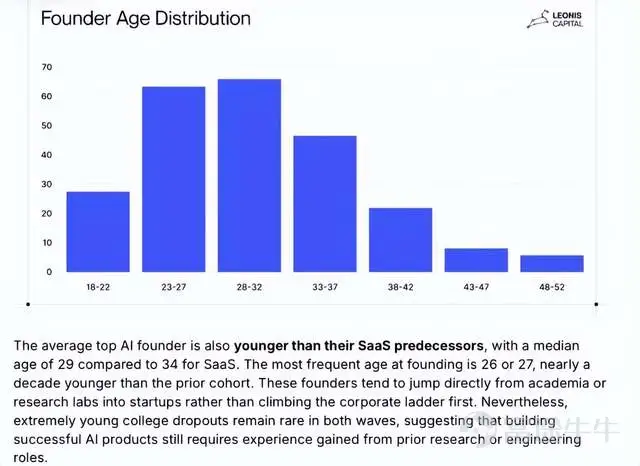
In fact, compared with the previous generation of internet entrepreneurs, talent across the entire AI industry is significantly younger. In November last year, venture capital firm Leonis released a report showing that the average age of AI startup founders is 29—nearly ten years younger than their predecessors—and most transitioned directly from academia or research labs into entrepreneurship.
Source: Leonis Report
However, the problem is evident. The Leonis report also notes that amid this entrepreneurial wave,extremely young college students remain rare, indicating that building AI products still requires accumulated experience through research and professional roles.
The embodied intelligence sector faces a similar dilemma: it needs young talent close to the technological frontier, yet confronts a practical challenge—how to convince the market to trust these founders who haven’t even graduated yet?
Standing before industry veterans as students, it was no easy task to earn investors’ trust. Precisely because of this, those student CEOs who ultimately succeeded against the odds often bore even greater pressure.
Looking back at their entrepreneurial journeys, past experiences proved crucial. Some were serial entrepreneurs; others met mentors during their studies—but without exception, they were all exceptionally capable individuals who could withstand immense pressure.
What kept them going might also have been a deep passion.Wang Xingxing, passionate about robotics, founded Unitree Robotics; Peng Zhihui, intrigued by robots, eventually entered the embodied intelligence field after many twists and turns, establishing Agibot.
An Investment Focus report captured a telling detail: Qin Shentao once had a late-night, in-depth conversation with his co-founder, during which he realized, 'This is something I must do in my lifetime.'As Liu Songming put it when answering Lei Jun’s question about the experience of entrepreneurship: 'Passion is the guiding light that carries you through long, dark winters.' $Siasun Robot&Automation (300024.SZ)$$Robotics (LIST2653.US)$$AI (LIST0535.SH)$$Artificial Intelligence (LIST2136.US)$$Artificial Intelligence (LIST23586.HK)$$Technology (LIST20763.US)$$Technology (LIST20840.HK)$
References
"Investors Are Rushing to Back a Tsinghua Gen-Z Founder," Investment Focus
"Packed with Insights: How a Harbin Institute of Technology Academic Star Built an Integrated Model of Learning, Reflection, and Innovation," Harbin Institute of Technology
"In Conversation with Min Yuheng of Lingcifang: How Should We View Students from Technical Disciplines Pursuing Entrepreneurship?" AI Tech Review
"The Collapse of College Students and the Rise of Super High Schoolers" – Logic Thinking
"Tencent Launches Summer Internships for Middle Schoolers, Geely Directly Hires High School Students—What Signal Is This Sending?" – Shanghai Observer
"Exclusive: Top-Tier VC Backs for Third Consecutive Round—Post-2000 Tsinghua University Special Award Winner Raises Hundreds of Millions Again" – ChinaVenture
Risk Disclaimer: The above content only represents the author's view. It does not represent any position or investment advice of Futu. Futu makes no representation or warranty.Read more

Comments
to post a comment
1