
SpaceX officially joins the Nasdaq 100—can it spark a rebound rally?

SpaceX takes center stage tonight: with limited shares available and capital rushing in, keep a close eye on these key points before jumping in!
$SpaceX (SPCX.US)$ will officially list on Nasdaq tonight, with a set IPO price of $135 per share, offering 556 million shares for a base fundraising amount of $75 billion,implying a post-listing market capitalization of approximately $1.77 trillion, roughly in line with the valuations of $Tesla (TSLA.US)$($1.5 trillion) and $Broadcom (AVGO.US)$ ($1.8 trillion).If underwriters fully exercise the over-allotment option of 83.33 million shares, the final fundraising amount will increase further.
This article reviews historical precedents to assess how the stock might perform on its debut day, key exit windows to monitor going forward, whether the listing could weigh on the broader U.S. market, and how much room remains for trading in related shadow stocks after the IPO.
Are you optimistic about SpaceX's stock performance on its listing day? Share your views and trading plans in the comments section and exchange insights with fellow investors.
1. How much could the stock rise on day one? With less than 5% of shares freely tradable, scarcity sets the floor, while sentiment sets the ceiling.
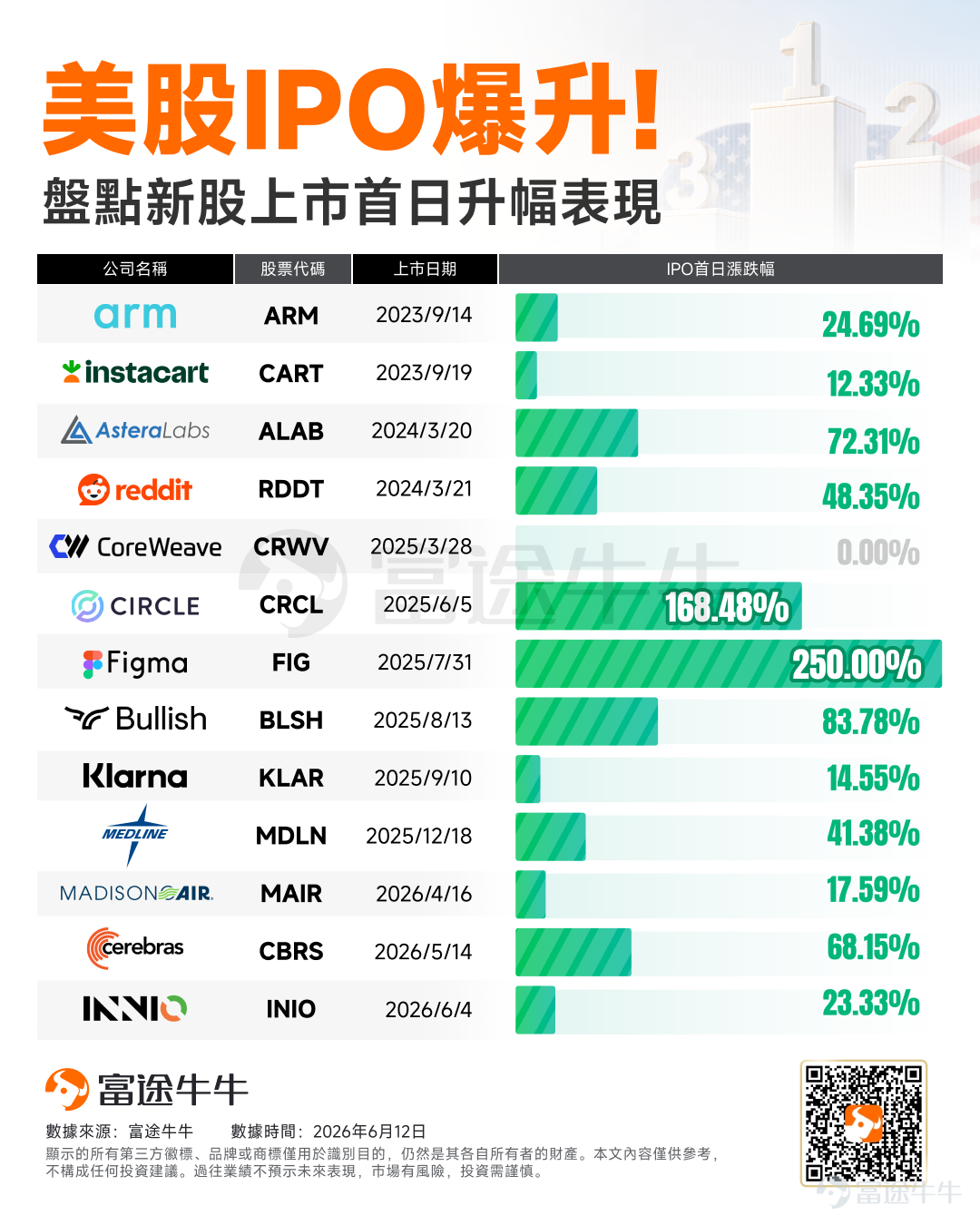
An analysis of major U.S. tech IPOs in recent years—with valuations exceeding $100 billion—reveals consistent patterns in investor behavior and pricing dynamics, indicating that mega growth-tech IPOs have already established a predictable post-listing price trajectory.Historically, on their listing day, stocks have generally risen, supported by cornerstone investors providing a floor and fresh capital rushing in; shares in scarce, high-quality sectors typically saw substantial first-day gains.
![$SpaceX (SPCX.US)$ will officially list on Nasdaq tonight, with a set IPO price of $135 per share, offering 556 million shares for a base fundraising amount of $75 billion,implying a post-listing market capitalization of approximately $1.77 trillion, roughly in line with the valuations of $Tesla (TSLA.US)$($1.5 trillion) and $Broadcom (AVGO.US)$ ($1.8 trillion).If underwriters fully exercise the over-allotment option of 83.33 million shares, the final fundraising amount will increase further. This article reviews historical precedents to assess how the stock might perform on its debut day, key exit windows to monitor going forward, whether the listing could weigh on the broader U.S. market, and how much room remains for trading in related shadow stocks after the IPO. Are you optimistic about SpaceX's stock performance on its listing day? Share your views and trading plans in the comments section and exchange insights with fellow investors.[Smile] 1. How much could the stock rise on day one? With less than 5% of shares freely tradable, scarcity sets the floor, while sentiment sets the ceiling. An analysis of major U.S. tech IPOs in recent years—with valuations exceeding $100 billion—reveals consistent patterns in investor behavior and pricing dynamics, indicating that mega growth-tech IPOs have already established a predictable post-listing price trajectory.Historically, on their listing day, stocks have generally risen, supported by cornerstone investors providing a floor and fresh capital rushing in; shares in scarce, high-quality sectors typically saw substantial first-day gains. SpaceX’s scale is already approaching that of the world’s leading tech giants...](https://nnqimage.futunn.com/sns_client_feed/900080/20260612/web-1781253445100-KTbYTWt6ht.png?area=1&is_public=true&imageMogr2/ignore-error/1/format/webp)
SpaceX is now approaching the scale of the world's leading tech giants, yet its base offering comprises only 556 million shares, representing an initial free-float ratio of approximately 4.25%. Even if the full over-allotment option is exercised, the initial free-float ratio would still be only around 4.89%.
This means that although SpaceX has a notional market capitalization of USD 1.77 trillion, only about USD 75 billion to USD 86.25 billion worth of shares will actually be available for trading in the market during the initial listing period.
With a free float of less than 5%, the share price of such a highly anticipated new listing is easily driven upward by incoming capital.Index providers, through fast inclusion mechanisms, have compressed tens of billions of dollars in passive buying into just a few weeks following the listing.
It is important to distinguish between two types of buying demand.
The first type consists of investors who have already received IPO allocations.Large sovereign wealth funds, long-term strategic investors, and certain institutional accounts typically do not rush to sell on day one. SpaceX also allocated as much as 30% of its IPO shares to retail investors—a significantly higher proportion than traditional large IPOs. Reportedly, BlackRock alone sought to subscribe for at least USD 5 billion worth of shares.
The second type comprises investors who did not receive sufficient IPO allocation and must buy in the secondary market.This group includes active growth funds, AI-themed funds, high-net-worth individuals, and retail investors.The price elasticity on the first day is primarily determined by them.
If the IPO allocation ratio is very low, the first batch of trades after the market opens often exhibits clear price-chasing behavior.
Second, how will it perform after listing? What exit and profit-taking levels should investors closely monitor going forward?
SpaceX’s post-listing price action is unlikely to revolve around a single date.
It is more likely to go through four distinct phases: initial price discovery on day one, index-driven buying momentum, validation from its first earnings report, and multiple rounds of lock-up expirations.Each phase has clear observation signals. The first day relies on limited float and aggressive capital rushing in; index inclusion acts like a second-stage booster, extending the short-term trading window.
The intraday high on day one isn’t particularly important,the closing price carries more reference value.If SpaceX closes near its intraday high, it indicates that price-chasing capital remains dominant. If it opens high but steadily declines afterward, closing significantly below the peak—even if still ending the day higher—it suggests that primary-market enthusiasm is being eroded by early profit-taking.
Observation Point 1: After the three waves of index-related buying begin landing in mid-June, does the stock price continue rising?
Index-driven buying typically materializes within one to three weeks after listing. Under current fast-entry mechanisms, CRSP, FTSE Russell, and certain S&P Total Market indices may adjust as early as five trading days post-listing; MSCI’s large-cap IPO fast inclusion process takes approximately ten trading days; and the Nasdaq-100’s new rules allow qualifying mega-IPOs to enter the index after fifteen trading days.
![$SpaceX (SPCX.US)$ will officially list on Nasdaq tonight, with a set IPO price of $135 per share, offering 556 million shares for a base fundraising amount of $75 billion,implying a post-listing market capitalization of approximately $1.77 trillion, roughly in line with the valuations of $Tesla (TSLA.US)$($1.5 trillion) and $Broadcom (AVGO.US)$ ($1.8 trillion).If underwriters fully exercise the over-allotment option of 83.33 million shares, the final fundraising amount will increase further. This article reviews historical precedents to assess how the stock might perform on its debut day, key exit windows to monitor going forward, whether the listing could weigh on the broader U.S. market, and how much room remains for trading in related shadow stocks after the IPO. Are you optimistic about SpaceX's stock performance on its listing day? Share your views and trading plans in the comments section and exchange insights with fellow investors.[Smile] 1. How much could the stock rise on day one? With less than 5% of shares freely tradable, scarcity sets the floor, while sentiment sets the ceiling. An analysis of major U.S. tech IPOs in recent years—with valuations exceeding $100 billion—reveals consistent patterns in investor behavior and pricing dynamics, indicating that mega growth-tech IPOs have already established a predictable post-listing price trajectory.Historically, on their listing day, stocks have generally risen, supported by cornerstone investors providing a floor and fresh capital rushing in; shares in scarce, high-quality sectors typically saw substantial first-day gains. SpaceX’s scale is already approaching that of the world’s leading tech giants...](https://nnqimage.futunn.com/sns_client_feed/900080/20260612/web-1781254193188-eT8nbvYBub.png?area=1&is_public=true&imageMogr2/ignore-error/1/format/webp)
Morningstar analysts reviewed investment prospectuses of 6,006 U.S.-registered mutual funds and 5,100 ETFs, identifying 3,203 distinct benchmarks covering roughly $41.1 trillion in assets under management.Based on this, FT Alphaville estimates that rapid index inclusion and benchmark-tracking requirements could generate approximately $14.2 billion in allocation demand for SpaceX. This demand is expected to arrive in roughly three tranches: June 19, June 26, and July 3—currently seen as the three most significant passive funding windows.
– Around June 19: approximately $8.5 billion
– Around June 26: approximately $1 billion
– Around July 3: approximately $4.7 billion
Alphaville also estimates thatif SpaceX were able to gain rapid inclusion into the S&P 500, passive buying could increase by an additional $11 billion. However, the S&P 500 has not currently relaxed its eligibility criteria for SpaceX.Conversely, if index providers strictly adhere to their existing rules, buying demand might amount to only about $1 billion—meaning that adjustments to index rules have effectively generated an additional $13.2 billion in allocation demand.
A common misconception is equating 'index funds must buy' with a guaranteed rise in share price.While index funds do need to allocate capital, existing shareholders, short-term traders, and profit-taking investors also know precisely when these inflows will occur. The more transparent the funding schedule, the more likely the market is to front-run it—and price reactions can be more immediate as a result.
If SpaceX’s stock has already rallied significantly before June 19, and then fails to reach new highs despite the potential $8.5 billion in passive buying materializing, this often signals that active sellers are beginning to absorb passive demand.
If the index shows strength on June 19, begins weakening around June 26, and then exhibits significant volume without further price gains around July 3, it suggests that the catalyst-driven rally is nearing its end.
Observation Point 2: Lock-up expiration date—the second full trading day after Q2 earnings disclosure
SpaceX does not have a single lock-up expiration 'cliff' like traditional IPOs. Instead, it has spread what would otherwise be a concentrated supply shock into staggered share releases over several months.
SpaceX has not yet announced the specific date for its first Q2 earnings release.According to the prospectus, eligible shareholders may begin selling up to 20% of their restricted shares as early as the second full trading day following the Q2 earnings announcement;If, during the relevant observation period prior to the Q2 earnings release, the stock price trades at least 30% above the offering price for at least five trading days, eligible shareholders may sell an additional 10% of their restricted shares ahead of the standard lock-up expiration.
This is another interesting aspect of SpaceX’s trading structure: strong share price performance attracts more momentum-driven capital while simultaneously unlocking larger potential selling pressure.
Based on institutional calculations using the updated S-1/A filing, the initial standard release could involve up to approximately 912 million Class A shares, representing a market value of roughly $123.1 billion at $135 per share; the additional 10% price-triggered release could involve about 456 million shares, or roughly $61.5 billion.
Elon Musk and certain key investors are subject to a longer lock-up period of approximately 366 days and are excluded from the initial early release. These figures represent shares that are 'eligible for sale' and do not imply that all shareholders will immediately sell. After excluding Musk and other long-term holders, actual selling pressure will likely be lower than the headline unlockable amount.
Following the initial lock-up expiration, additional tranches of restricted shares will be released on days 70, 90, 105, 120, and 135, respectively. The Q3 earnings announcement will then trigger another round of releases, with the remaining shares gradually becoming eligible for sale around the 180-day mark.
III. How Will Shadow Stocks Perform After SpaceX Goes Public?
Shadow stocks typically enjoy their most favorable phase before the parent company goes public. SpaceX’s IPO will establish a new valuation anchor for the entire space economy and erode the scarcity premium that shadow stocks previously enjoyed exclusively.
When investors cannot directly buy SpaceX shares, they turn to RKLB, ASTS, RDW, LUNR, PL, and BKSY to express bullish sentiment on the space economy. These companies benefit from an additional substitute premium. Bull Bull Classroom has previously summarized SpaceX-related concept stocks:
![$SpaceX (SPCX.US)$ will officially list on Nasdaq tonight, with a set IPO price of $135 per share, offering 556 million shares for a base fundraising amount of $75 billion,implying a post-listing market capitalization of approximately $1.77 trillion, roughly in line with the valuations of $Tesla (TSLA.US)$($1.5 trillion) and $Broadcom (AVGO.US)$ ($1.8 trillion).If underwriters fully exercise the over-allotment option of 83.33 million shares, the final fundraising amount will increase further. This article reviews historical precedents to assess how the stock might perform on its debut day, key exit windows to monitor going forward, whether the listing could weigh on the broader U.S. market, and how much room remains for trading in related shadow stocks after the IPO. Are you optimistic about SpaceX's stock performance on its listing day? Share your views and trading plans in the comments section and exchange insights with fellow investors.[Smile] 1. How much could the stock rise on day one? With less than 5% of shares freely tradable, scarcity sets the floor, while sentiment sets the ceiling. An analysis of major U.S. tech IPOs in recent years—with valuations exceeding $100 billion—reveals consistent patterns in investor behavior and pricing dynamics, indicating that mega growth-tech IPOs have already established a predictable post-listing price trajectory.Historically, on their listing day, stocks have generally risen, supported by cornerstone investors providing a floor and fresh capital rushing in; shares in scarce, high-quality sectors typically saw substantial first-day gains. SpaceX’s scale is already approaching that of the world’s leading tech giants...](https://nnqimage.futunn.com/sns_client_feed/900080/20260612/web-1781253692688-jmGLmriGf3.jpeg?area=1&is_public=true&imageMogr2/ignore-error/1/format/webp)
Once SpaceX officially lists, this premium will gradually contract. Capital can now flow directly into SPCX, and shadow stocks will need to reassert their fundamental business value. Short-term price action may unfold under three scenarios.
1、If SpaceX surges on its first trading day and closes strongly: shadow stocks rally initially, then face capital diversion
If SpaceX surges sharply on its first trading day and closes near the session's high, sentiment in the space economy sector could continue to build.
$Rocket Lab (RKLB.US)$ As the industry’s clear number two, it typically attracts strong investor attention, $Redwire (RDW.US)$ 、 $Intuitive Machines (LUNR.US)$ 、 $Planet Labs PBC (PL.US)$ and $BlackSky Technology (BKSY.US)$ its short-term price elasticity could be even greater. Subsequent index inclusions after the IPO will continually remind the market of SpaceX’s market cap and industry dominance, leaving room for event-driven trades in shadow stocks.
However, the risk remains that capital could rotate back from shadow stocks to SpaceX itself, as the market’s peak excitement often coincides with the highest premiums on substitutes.
2、If SpaceX opens high but closes lower or breaks below its offering price: high-beta shadow stocks face the greatest risk
If SpaceX opens significantly higher but quickly pulls back, it suggests the market is only willing to pay a limited premium for its scarcity.
Smaller-cap stocks with higher sentiment elasticity—such as RDW, LUNR, PL, and BKSY—are more prone to rapid capital outflows. RKLB and ASTS have clearer business identities and may hold up relatively better, though they will still struggle to fully avoid sector-wide valuation compression.
3、If SpaceX sees only a modest gain or trades sideways, the market will refocus on individual stock fundamentals.
– $Rocket Lab (RKLB.US)$ Trading will refocus on Neutron rocket development progress, launch cadence, and space systems orders. Its business is highly comparable to SpaceX’s, but its valuation already embeds strong growth expectations.
– $AST SpaceMobile (ASTS.US)$ The key focus will be the deployment timeline and commercialization pace of satellite-to-cellphone connectivity. Its investment thesis aligns more closely with next-generation communications infrastructure, positioning it in both competitive and co-expansion dynamics with SpaceX.
– $Redwire (RDW.US)$ and $Intuitive Machines (LUNR.US)$ Reliant on government contracts, NASA programs, and mission execution.
– $Planet Labs PBC (PL.US)$ signed a 1.2 GW fuel cell power contract with $BlackSky Technology (BKSY.US)$ Investors will then assess satellite data monetization, defense-sector clients, and subscription revenue realization. All these companies stand to benefit from increased capital spending in the space industry, but they should not be simplistically viewed as long-term substitutes for SpaceX post-IPO.
– $Tesla (TSLA.US)$ Its link is even weaker—it may benefit from sentiment spillover tied to Elon Musk’s assets but has no direct exposure to SpaceX’s revenue or profits. Any Tesla rally driven by the SpaceX IPO would largely reflect sentiment-driven capital correlation.
Fourth, could this 'capital drain' weigh on the broader U.S. equity market? Historically, market performance around IPO booms has generally been favorable.
The market is concerned that SpaceX raising $75 billion in a single offering could force funds to sell other tech stocks to make room for the new shares.
Historical data does not show that large IPOs necessarily mark the beginning of a market index decline.
According to institutional statistics, based on 12 waves of U.S. IPO booms since 1990 and a sample of the 15 largest U.S. IPOs by size, the results show thatOn the listing day of major IPOs, the S&P 500 rose with a probability of 53.3%, posting an average gain of approximately 0.25%; over the following 20 trading days, the probability of the index rising increased to 71.4%.
![$SpaceX (SPCX.US)$ will officially list on Nasdaq tonight, with a set IPO price of $135 per share, offering 556 million shares for a base fundraising amount of $75 billion,implying a post-listing market capitalization of approximately $1.77 trillion, roughly in line with the valuations of $Tesla (TSLA.US)$($1.5 trillion) and $Broadcom (AVGO.US)$ ($1.8 trillion).If underwriters fully exercise the over-allotment option of 83.33 million shares, the final fundraising amount will increase further. This article reviews historical precedents to assess how the stock might perform on its debut day, key exit windows to monitor going forward, whether the listing could weigh on the broader U.S. market, and how much room remains for trading in related shadow stocks after the IPO. Are you optimistic about SpaceX's stock performance on its listing day? Share your views and trading plans in the comments section and exchange insights with fellow investors.[Smile] 1. How much could the stock rise on day one? With less than 5% of shares freely tradable, scarcity sets the floor, while sentiment sets the ceiling. An analysis of major U.S. tech IPOs in recent years—with valuations exceeding $100 billion—reveals consistent patterns in investor behavior and pricing dynamics, indicating that mega growth-tech IPOs have already established a predictable post-listing price trajectory.Historically, on their listing day, stocks have generally risen, supported by cornerstone investors providing a floor and fresh capital rushing in; shares in scarce, high-quality sectors typically saw substantial first-day gains. SpaceX’s scale is already approaching that of the world’s leading tech giants...](https://nnqimage.futunn.com/sns_client_feed/900080/20260612/web-1781252850703-Cp0bRdhtK0.png?area=1&is_public=true&imageMogr2/ignore-error/1/format/webp)
A review of the top 100 largest U.S. IPOs by net proceeds since 2000 also found that liquidity disruptions caused by large IPOs often occur in advance.The S&P 500 declined by an average of about 4% from 60 days before the IPO to the listing date, and posted a median gain of approximately 3% over the subsequent 60 days. The median excess return of large IPO stocks relative to the S&P 500 over the 60 days following listing was around 11 percentage points, with most gains concentrated in the first week after listing.
These data suggest that SpaceX may trigger localized portfolio rebalancing, but it is unlikely that a single IPO alone would alter the medium-term direction of the U.S. equity market.
Conclusion
SpaceX’s listing appears more like the starting point of a new pricing phase for the space economy. Its official public debut serves as a significant catalyst for industry valuations and signals that premium valuations for substitutes may gradually narrow. In the short term, it may still benefit from sector sentiment, but divergence is likely to intensify over the medium term. Ultimately, only companies that can consistently deliver on orders, revenue, and commercialization progress will sustain their market momentum.
Risk Disclaimer: The above content only represents the author's view. It does not represent any position or investment advice of Futu. Futu makes no representation or warranty.Read more


Comments (101)
to post a comment
329
907