
SpaceX officially joins the Nasdaq 100—can it spark a rebound rally?

Daily Options Seller Strategy | Inclusion in Nasdaq-100 and SpaceX IPO Catalyst Drive RKLB Up Nearly 9% in Pre-Market: How to Trade Options Amid Exponential Inflows?
I. Market Barometer
All three major U.S. equity indexes rose collectively in the previous trading session, with the commercial space sector continuing to heat up on the back of the SpaceX IPO catalyst. $Rocket Lab (RKLB.US)$ Fueled by inclusion in $NASDAQ 100 Index (.NDX.US)$ the stock surged 9.26% in a single day on this major positive news, offering options sellers a premium window amid high market sentiment.
II. Focus on Hot Targets
RKLB: Nasdaq-100 Inclusion Sparks Frenzied Buying
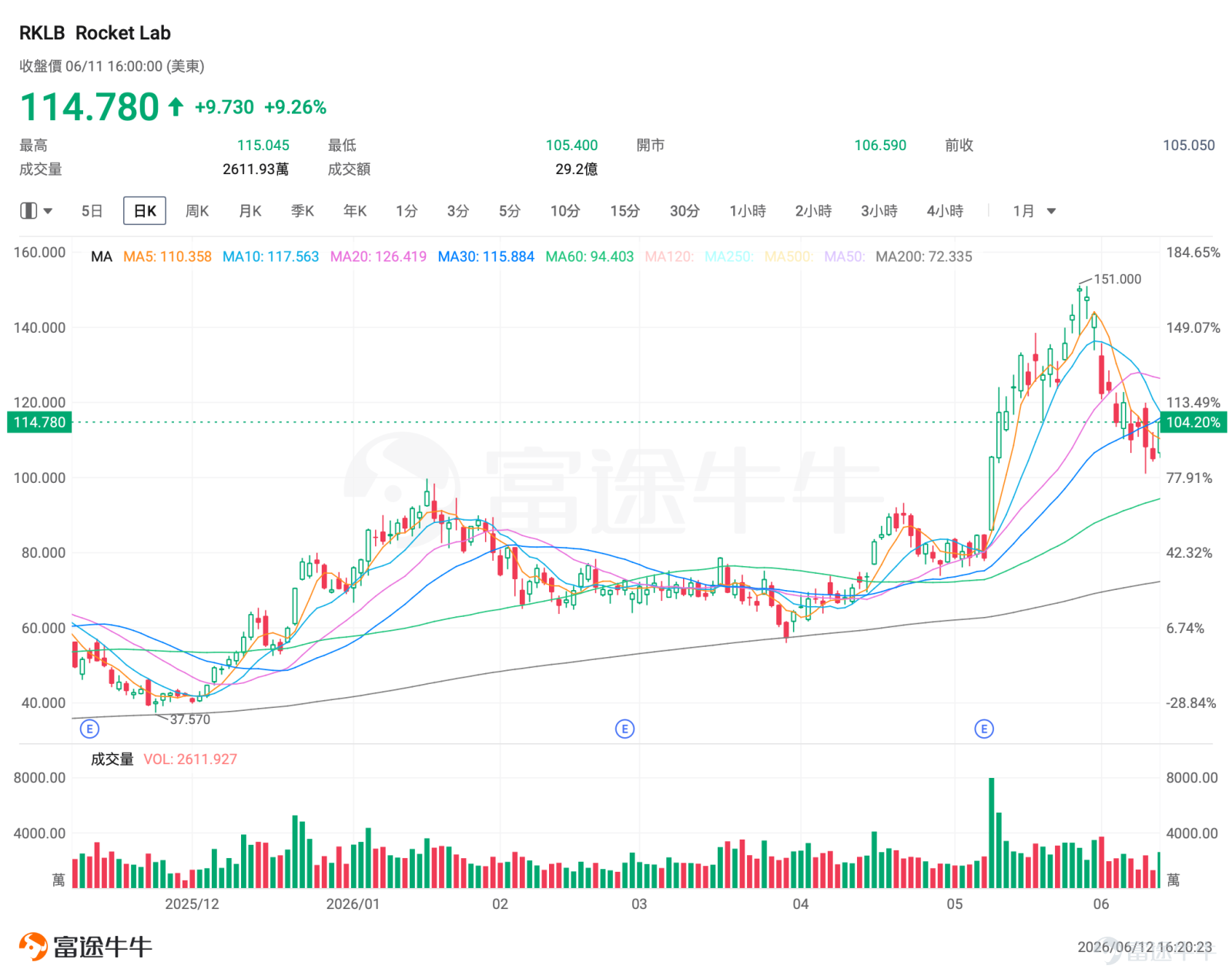
$Rocket Lab (RKLB.US)$ The stock rose 9.26% on the previous trading day (June 11) to close at $114.78, with trading volume hitting $2.92 billion—double that of the prior day. It continued to climb nearly 9% in pre-market trading today.

Looking at the daily candlestick chart over the past 30 trading days, the stock reached a short-term high of $151 in late May, followed by a period of pullback and consolidation. Recently, the share price has staged a strong rebound off the support level around $105, accompanied by significantly higher trading volume. The current price action shows a clear stabilization and recovery pattern, with initial resistance seen in the $120–$125 range.
Two major catalysts have recently driven the stock's strong performance. First, Nasdaq officially announced it would add $Rocket Lab (RKLB.US)$ and other companies to $NASDAQ 100 Index (.NDX.US)$ , a move that has attracted significant passive fund inflows. Second, mounting market expectations for SpaceX's massive IPO have ignited investor enthusiasm across the entire space exploration sector, prompting both retail and institutional investors to position themselves early.
Based on ratings from 12 Wall Street analysts, 75% currently assign a 'Strong Buy' rating, while 25% recommend 'Hold,' reflecting an overall optimistic sentiment. The average price target is $106.78, with the highest target reaching $132.00.
III. Seller Options Strategy
1. Cash Secured Put
Sell 1 contract of $Rocket Lab (RKLB.US)$July 17, 2026 $80 Put; estimated margin requirement (for reference only): $80 ($80 × 100)

Filtering logic:
Currently, the underlying asset is benefiting from dual catalysts—the anticipated mega-IPO in the sector and its inclusion in a key index—driving extremely active trading sentiment and keeping its options’ implied volatility elevated relative to historical levels. This has made premium income from selling options particularly attractive.
Given the generally optimistic market sentiment, investors can consider selling puts to steadily collect time decay premium as long as the underlying maintains strong sideways movement or undergoes a typical pullback. Should assignment occur, they would acquire the underlying shares at a valuation offering a reasonable margin of safety—making this strategy suitable for long-term investors who are bullish on the sector’s future growth and willing to accumulate positions gradually at lower levels.
2. Covered Call
Holding 100 shares $Rocket Lab (RKLB.US)$Underlying stock: Sell 1 contract of RKLB July 17, 2026 $170 call

Filtering logic:
For investors already holding Rocket Lab shares, despite maintaining a long-term bullish view on the company's value following the recent surge—driven by its inclusion in the Nasdaq-100 and the anticipated SpaceX IPO—they should remain cautious about potential capital rotation risks after SpaceX goes public.
Selling calls at this point allows investors to collect option premiums, thereby lowering their cost basis. If the stock price consolidates within the current high range, the premium income can effectively offset time decay. If the price continues to rally strongly above $170 and the option is exercised, it would still represent a successful profit-taking exit near an all-time high.
IV. Risk Control Reminder
Although the seller strategy has a high probability of success, investors must still manage risks effectively:
– Position management is key:The biggest risk for option sellers lies in black swan events. It is recommended that margin exposure for a single underlying should not exceed 20% of total capital. Never sell options beyond your capacity for the sake of greedy premiums.
– Timely rolling of covered call options: When a covered call option becomes deeply in-the-money (stock price far exceeds the strike price), and if the underlying stock is still viewed favorably, decisively 'roll' the position — that is, close the current option by buying it back and simultaneously sell an option with a later expiration date and a higher strike price to avoid having the stock called away at a low price.
– Cash-secured put options warn of 'left-tail risk':For cash-secured puts, if the stock price collapses due to deteriorating fundamentals (rather than a normal pullback), do not hold on stubbornly. At this time, stop losses should be executed, or 'rolling down' can be employed to buy time and wait for volatility to normalize.
Make good use of the options seller zone to understand the income strategies for selling optionsEarn option premiums!
Make good use of the options seller zone to understand the income strategies for selling optionsEarn option premiums!

Options Risk Warning
An option is a contract that grants the holder the right, but not the obligation, to buy or sell an asset at a fixed price on a specific date or at any time before that date. The price of an option is influenced by various factors, including the current price of the underlying asset, the strike price, time to expiration, and implied volatility. Implied volatility reflects the market’s expectations for the level of volatility in the option over a future period. It is a data point derived inversely from the Black-Scholes option pricing model and is generally regarded as an indicator of market sentiment. When investors anticipate greater volatility, they may be more willing to pay a higher price for options to hedge risks, resulting in higher implied volatility. Traders and investors use implied volatility to assess the attractiveness of option prices, identify potential mispricings, and manage risk exposure.
Disclaimer
This content does not constitute any offer, solicitation, recommendation, opinion, or guarantee for any securities, financial products, or tools. The risk of loss in trading options can be substantial. In some cases, losses incurred may exceed the initial margin deposited. Even if you set contingency orders, such as 'stop-loss' or 'limit' orders, these may not necessarily prevent losses. Market conditions may make such orders unexecutable. You may be required to deposit additional margin within a short period. If you fail to provide the required amount within the specified time, your open positions may be liquidated. However, you will still be responsible for any shortfall in your account resulting from such liquidation. Therefore, before trading, you should study and understand options and carefully consider whether such trading suits you based on your financial situation and investment objectives. If you trade options, you should be familiar with the procedures for exercising options and the rights and obligations upon expiration. Options trading involves extremely high risks and is not suitable for all investors. Investors should read Characteristics and Risks of Standardized Options carefully before engaging in any options trading strategy.
Risk Disclaimer: The above content only represents the author's view. It does not represent any position or investment advice of Futu. Futu makes no representation or warranty.Read more

Comments
to post a comment
7
7