

Who says humanities graduates are useless? Both Altman and Amodei are furiously writing policy essays.

Don’t dismiss it—writing long-form essays actually turns out to be far more useful than it appears.
Over the past few months, both OpenAI and Anthropic have taken a distinctly 'liberal arts' turn.
OpenAI released a policy agenda addressing youth protection, workforce transition, and global standards; published an industrial policy document emphasizing that the AI era must be human-centered, expand opportunity, and share prosperity; and on the very same day it secretly filed its S-1, it also published an article titled 'Built to Benefit Everyone: Our Plan,' embedding the company’s future within the narrative of making AGI benefit everyone.
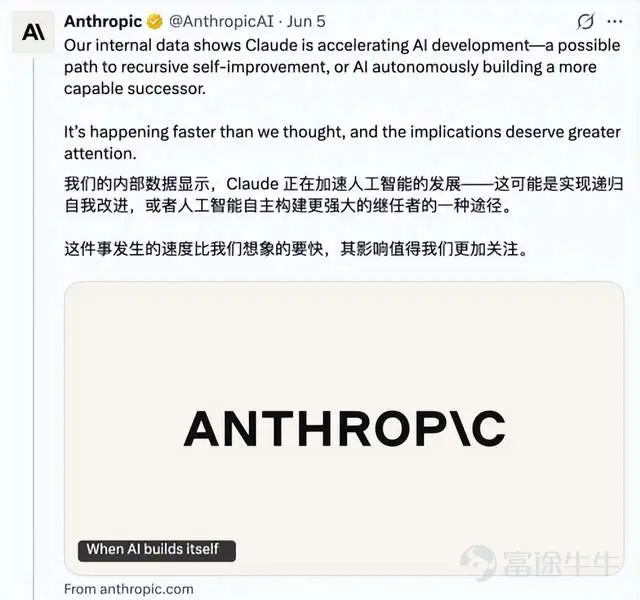
Anthropic hasn’t been idle either—it established the Anthropic Institute to examine how powerful AI systems might impact society; published an article on recursive self-improvement, warning that as AI begins assisting in building the next generation of AI, the world needs to understand this inflection point in advance; and deployed Claude in biological research settings to explore how AI agents can enhance bioinformatics workflows and accelerate scientific discovery.
Technology is certainly paramount, but technology alone isn’t enough—on the eve of their IPOs, the most valuable AI companies are all telling stories.
Because when AI companies go public, they’re not just selling models.
They’re also selling a narrative about who gets to define the future.
01
Model capabilities address questions of performance,
Narratives address questions of trust.
In the AI race, models are the most direct form of communication.
Context length, reasoning ability, coding performance, API pricing, latency, and stability are all factors the market can directly perceive. Whether a model is strong or not, users will vote with their feet.
OpenAI and Anthropic have reached where they are today primarily because they built sufficiently powerful models.
But as a company approaches the eve of its IPO, merely speaking through models is no longer enough.
An IPO essentially prices the future—the investors aren’t buying what the company has already achieved, but rather its growth potential over the next ten or twenty years.
And once decisions involve the 'future'—aspects that cannot yet be directly verified—trust becomes the foundation of every choice.
The future of AI companies is difficult to fully explain using traditional financial metrics. While they exhibit rapid revenue growth, their costs are also extremely high; despite massive user bases, their business models remain in flux.
Meanwhile, model iteration is accelerating, and the performance gap between companies is narrowing—no firm can guarantee its current advantage will last. Enterprise clients are coming on board, but competition remains fierce. Looking outward, issues such as regulation, copyright, security, youth protection, and labor market disruption could all alter the company’s growth trajectory.
In such a highly uncertain industry, 'narrative' becomes especially critical.
Of course, this so-called narrative carries a hint of wordplay, but it cannot be pure fiction. Rather, it functions as a company's explanatory framework for its own future. The company must answer the market: Who am I? Where do I stand? What risks do I understand? What opportunities do I possess? And why should investors place their bets on me over others?
Capital markets have always operated this way—investors don’t just buy financial statements; they also buy narratives.
Electric vehicle companies talk about energy transition, cloud computing firms discuss digital infrastructure, chipmakers frame their stories around compute cycles, and platform companies emphasize network effects. Although narratives alone cannot replace actual performance, they shape how the market interprets that performance, how much short-term losses it tolerates, and how it prices long-term growth.
AI companies are no different.
If OpenAI and Anthropic were merely two providers of large language model services, both would be evaluated under the same product-centric valuation logic: How much subscription revenue do they generate? What are their API gross margins? Can they reduce compute costs? How long can they sustain their model advantage? And will enterprise customers switch to competitors?
Regardless of whether the product is called ChatGPT, Claude, or Gemini, and regardless of whether the entry point is a chatbot, an API, a coding agent, or an enterprise platform—as long as they remain model vendors—the market will keep asking the same question: What makes you irreplaceable? Why must it be you?
Therefore, both are positioning themselves as something bigger than just model providers. OpenAI embeds itself in narratives around AGI infrastructure, public policy, and Q&M Dental access to intelligence, while Anthropic frames itself within the context of safe AI, trustworthy agents, and systemic risk governance.
Although the two companies tell different stories, they face the same fundamental challenge. Both are trying to convince capital that they are not just another model service that could be easily substituted, but rather indispensable infrastructure for the coming AI era.
The sudden emphasis on storytelling right before an IPO isn’t because technology has become less important. Quite the contrary—it’s precisely because the technology is so significant that the narrative gains credibility.
A company’s technical capabilities determine whether it even qualifies for a seat at the table, while its narrative shapes how the market perceives its position there.
At this stage, blogs, policy recommendations, research reports, and long-form essays on values are all ways to compete for market trust.
02
One emphasizes risk; the other emphasizes participation.
Both OpenAI and Anthropic are telling stories—but not the same kind of story. In other words, they’ve cultivated distinct personas, each of which happens to find a counterpart in traditional Chinese Confucian culture.
Anthropic appears to be crafting itself as 'the sober voice in an age of risk'—a refreshing, scholar-official-style presence.
Its narrative follows a consistent pattern: AI will grow increasingly powerful, agents will become more useful, but the closer they get to operating in the real world, the more critical it becomes for someone to foresee risks, set boundaries, and reinforce foundations in advance. Anthropic casts itself as the actor endowed with both cutting-edge AI capabilities and profound responsibility—the one who remains clear-headed while everyone else is intoxicated.
To other AI companies, however, Anthropic probably resembles that top student from school who finishes homework quickly and then insists the problems were too easy, urging the teacher to assign more.
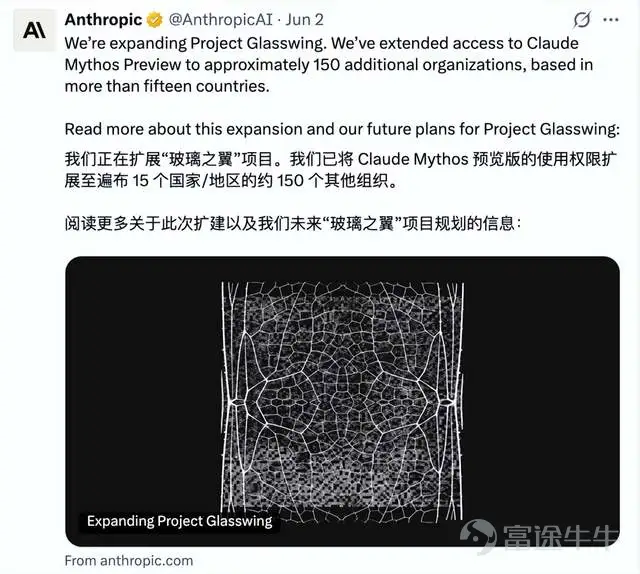
"Project Glasswing" is a quintessential example.
According to Anthropic, the project aims to evaluate the role of next-generation AI tools in defensive cybersecurity and help critical software ecosystems proactively identify and patch vulnerabilities. Initially, it provided a select group of vetted partners access to Claude Mythos Preview—an exceptionally powerful model deemed 'too dangerous to release publicly.' Later, Anthropic expanded the program to over 15 countries and approximately 150 new organizations, though each had to meet stringent security requirements before gaining access.
From a narrative standpoint, through this project, Anthropic simultaneously demonstrates capability and restraint: the model is powerful enough to reshape cybersecurity, yet precisely because of that power, it cannot be released openly—it can only be entrusted to vetted partners operating within secure frameworks.
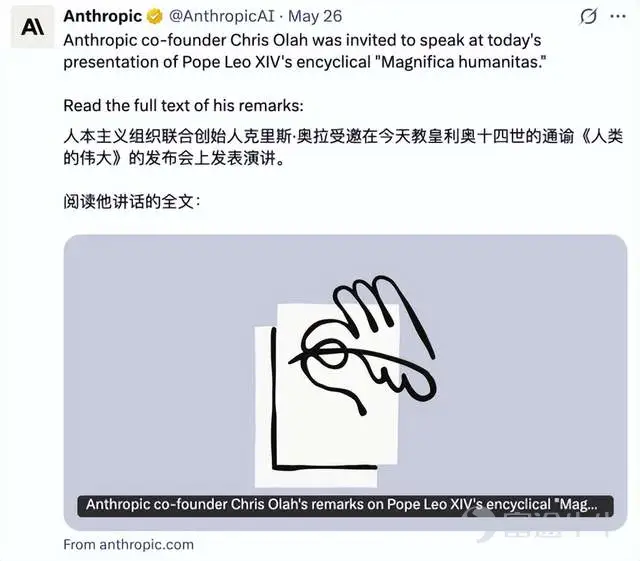
Another example is Pope Leo XIV’s encyclical on AI, 'Magnifica Humanitas.' Anthropic co-founder Chris Olah was invited to the Vatican to attend the encyclical’s launch event and deliver a speech, after which Anthropic published his full remarks on its official website.
On the surface, religious ethics may seem distant from an AI model company, but for Anthropic, such occasions are highly significant. It does not aim solely to engage with developers, enterprise clients, and investors—it also seeks dialogue with religious communities, ethicists, and public institutions, representing more traditional societal forces.
This move aligns with its May initiative titled 'Widening the Conversation on Frontier AI.' Anthropic stated that over recent months, it has been organizing dialogues with diverse groups because the challenges posed by AI concern not only engineers but also educators, religious leaders, labor organizations, democratic institutions, and the general public.
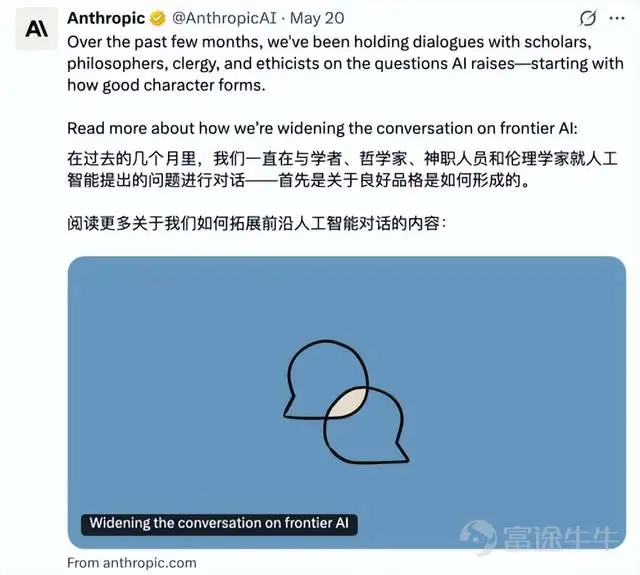
If the 'Glass Wings' project demonstrates capability coupled with restraint, this approach reflects a more engaged, pragmatic stance: those who wield transformative technological power must enter the realm of public order, submit to ethical scrutiny, and assume corresponding responsibilities.
Unlike OpenAI, which has ChatGPT as a mass-market entry point, Anthropic’s primary arena remains closer to developers and enterprise use cases. However, ahead of its IPO, it must broaden its audience to include wider societal groups.
Because what it seeks is not just financial trust but also social license. It wants to convince the outside world that it is not merely a model company operating in isolation, but a responsible steward of AI governance—one willing to place AI within a broader social framework for discussion and subject it to public-value scrutiny.
There’s also that technical blog post discussing recursive self-improvement, and nearly all media coverage emphasized its 'call for a pause in AI development'—a narrative that is indeed compelling. Yet the blog post actually illustrated how an increasing share of Anthropic’s internal code is now written by Claude, how Claude is accelerating progress, and how Anthropic in turn argues that capability growth itself constitutes a risk.
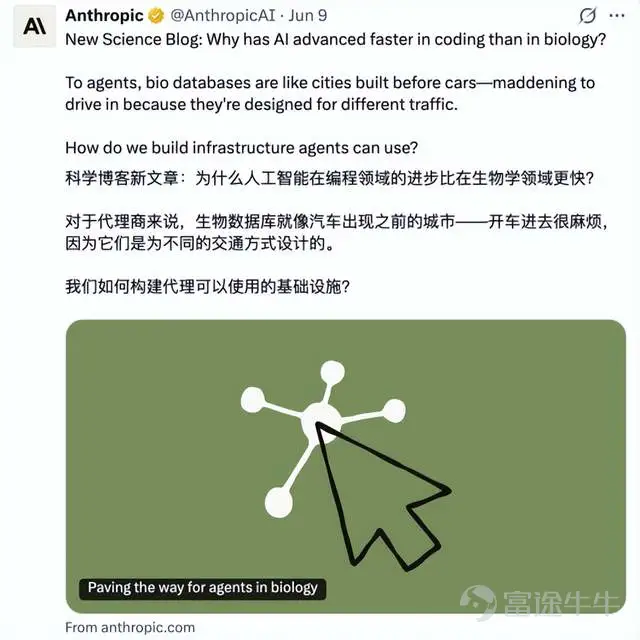
In a recent engineering blog post, Anthropic also placed Claude in a biological research context, discussing how AI agents can help scientists more reliably retrieve viral sequence data and improve bioinformatics workflows. On the surface, it reads like a scientific agent article, but beneath lies Anthropic’s familiar messaging: our model is powerful, and we are advancing scientific discovery. If the model’s performance proves insufficiently stable, Anthropic naturally frames the issue within the narrative that 'scientific infrastructure simply isn’t ready yet for the agent era.'
Although it is undeniably capable, in some sense its posture comes across as overly bold—even bordering on self-righteousness, carrying a hint of aloof pride in its own clarity and achievements.
But this is also very much in line with Anthropic's consistent style.
OpenAI is no less ambitious in this regard.If Anthropic seeks to project the aloof image of a 'concerned sage,' OpenAI’s narrative resembles that of a 'statesman for a new era of intelligence.'
Its story differs from Anthropic’s message of 'We see the dangers, so we must issue warnings.' Instead, OpenAI says, 'This will transform everyone, so we must help shape the rules of the future.'
Thus, OpenAI released a public policy agenda addressing safety, youth protection, workforce transitions, and global standards—positioning itself squarely within the policymaking discourse. It also published an industrial policy framework for the age of intelligence, proposing a human-centered approach that emphasizes expanding opportunity, sharing prosperity, and building more resilient institutions in the AI era.
In its document 'Our views on AI policy and political advocacy,' OpenAI further explained how it engages in AI policy and political advocacy, stressing that the future of AI should not be dictated by any single company or organization but should be co-shaped by governments, researchers, workers, civil society, independent experts, and the public.
Ahead of the G7 summit, OpenAI launched a Global Youth AI Safety Initiative, calling for the creation of dedicated institutions to foster international collaboration and ensure young people can use AI more safely and equitably.
These initiatives appear interspersed among product updates and may seem tangential to its models, yet they are indispensable to OpenAI. Rather than portraying itself as 'the one who understands risks best,' OpenAI aims to position itself as 'an active builder of a new social order.'
Using a familiar historical analogy, OpenAI’s philosophy somewhat resembles that of a 'Wang Anshi of the United States': seeking to embed its values and technology into the foundational rules of future society through influence over legislation, international cooperation, and industrial design.
On the very day it confidentially filed for an IPO, OpenAI also published a piece titled 'Built to benefit everyone: our plan,' reaffirming its mission to benefit all humanity—a narrative entirely consistent with its broader strategy.
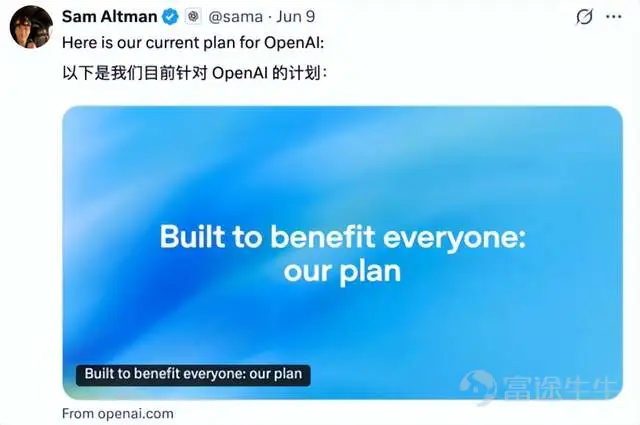
According to OpenAI’s own statements, if AI develops properly, it can become the foundation for boosting productivity, creativity, scientific advancement, and economic opportunity—a message that sounds far more palatable than Anthropic’s 'elitist narrative.'
OpenAI has always tried to position itself not merely as a model company but as a broader public infrastructure provider. ChatGPT isn’t just a chat product—it’s envisioned as everyone’s intelligent gateway to the future; Codex isn’t just a coding tool—it’s a new interface for knowledge work; and OpenAI itself isn’t merely a commercial entity but a participant in shaping institutional frameworks for the age of intelligence.
Regardless of whether its 'suggestions' are heeded, OpenAI certainly goes to great lengths to project an image of caring about the public and sharing prosperity.
Even in minor product communications, one can discern the differences between OpenAI and Anthropic.
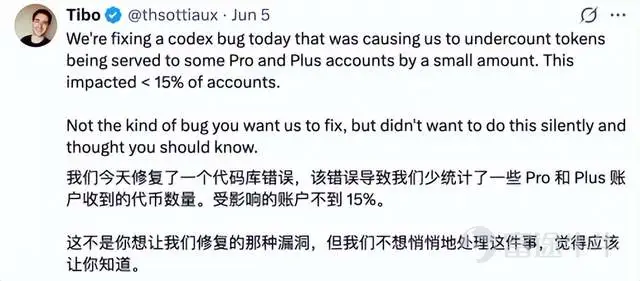
On June 5, Tibo posted on X that the team was fixing a bug in Codex that day. The bug had caused the system to undercount the actual token consumption for some Pro and Plus accounts, affecting fewer than 15% of accounts.
In other words, this bug actually benefited certain users—they were charged for fewer tokens than they actually used. After the fix, token usage for these accounts will be accurately reflected.
Tibo therefore added explicitly: 'This isn’t the kind of bug you’d want us to fix, but we didn’t want to handle it quietly—we felt you should know.'
Behind such communication lies a clear articulation of platform values: while the platform certainly has the right to adjust its rules, users at least deserve to know when those rules change.
OpenAI proactively disclosed a fix that users wouldn’t welcome, whereas Anthropic has recently drawn user complaints precisely because many experience changes abruptly—often discovering them only while using the product.
Highlighting one’s own strengths while subtly underscoring another’s weaknesses is also a storytelling technique.
03
Narrative is also a moat
An AI company preparing to go public must convince the market that its future position will be greater than what its current products suggest.
OpenAI consistently talks about AGI, Q&M Dental as an intelligent gateway for all, public policy, and its mission to 'benefit all of humanity,' positioning itself within the imagination of next-generation infrastructure. Anthropic repeatedly emphasizes safety, trustworthy agents, systemic risk, and frontier AI governance, placing itself as the foundational layer of safety in a high-risk world.
Although their narratives differ, both companies are striving to achieve the same goal: convincing capital that their value won’t vanish due to a single model catching up, a round of price wars, or a competitor’s product update.
Narrative cannot replace revenue and profit, but it shapes how the market interprets them.
The same massive expenditure on computing power may be seen merely as cost pressure if the company is perceived as an ordinary model provider—but if viewed as a builder of future infrastructure, it is more readily interpreted as a long-term investment.
Similarly, safety research holds limited value if treated merely as an add-on feature; however, when framed within frontier AI governance and corporate trust, it becomes part of a company’s moat.
Capital markets buy not only a company’s current state but also its vision of future order—and this vision influences how regulators and customers perceive the company.
The larger an AI company grows, the less it can rely solely on product iteration to solve problems. Issues like youth protection, copyright disputes, labor market disruption, cybersecurity, and applications in healthcare, education, finance, and national security inevitably place these firms at the center of public discourse.
Whether it’s OpenAI’s public policy documents, governance blueprints, and youth safety initiatives, or Anthropic’s safety narrative, societal engagement, and trustworthy agents, both are attempting to convince external stakeholders that they are proactive and reliable.
This kind of messaging gives the company something critically important: patience.
The more regulators believe you understand risk, the more likely they are to give you room to experiment; the more enterprise clients trust your long-term governance capabilities, the more willing they are to entrust you with their most critical workflows; and the more users believe you’re committed to explaining changes in rules, the more likely they are to stick around during product volatility.
Stories cannot erase problems. Service outages remain outages, quota changes remain changes, and model degradation remains degradation. Users won’t forgive all experience issues just because of a lengthy values-driven article, and enterprise clients won’t overlook real risks simply because of a statement like “we prioritize safety and responsibility.”
But consistent storytelling changes how outsiders interpret those problems.
If a company’s public image is sufficiently clear, external observers are more likely to view a product friction as an adjustment during growth rather than a fundamental loss of control.
Conversely, if a company hasn’t built trust over time, even a minor change could be interpreted as platform abuse of power, quietly tightening services, or a lack of transparency toward users.
Storytelling ultimately comes back to people.
When top researchers, engineers, and product managers choose a company, they certainly consider compensation, resources, and technical strength—but they also care deeply about what they’re actually contributing to. OpenAI’s answer is building AGI to transform everyone’s lives; Anthropic’s answer is developing powerful AI more safely to prevent the future from being derailed by recklessly advanced technology.
Viewed purely through the lens of vision, one attracts those who want to change the world, while the other draws those who want to protect it.
In short, storytelling is not just a sugary coating wrapped around technology. For AI companies preparing to go public, it has already become part of their business model.
It affects valuation, regulation, customers, talent, and whether the public continues to trust the company when incidents occur.
On the surface, OpenAI and Anthropic are writing blog posts, publishing policy recommendations, and discussing values. What they’re really competing for is the right to define artificial intelligence.
Whoever frames AI as infrastructure is more likely to receive an infrastructure-like valuation; whoever frames AI as a safety issue is better positioned to become a risk governance leader; whoever frames AI as a public issue gains easier access to policy discussions; and whoever frames AI as关乎全人类的 future can more readily portray commercial expansion as a public mission.
By the eve of their IPOs, it’s their models that determine whether they even get a seat at the table.
And it’s their narrative that determines how much of the future the market is willing to bet on them. $Artificial Intelligence (LIST2136.US)$$Artificial Intelligence (LIST23586.HK)$$Technology (LIST20763.US)$$Technology (LIST20840.HK)$$Star Tech Companies (LIST2518.US)$$Staffing & Employment Services (LIST2496.US)$
Risk Disclaimer: The above content only represents the author's view. It does not represent any position or investment advice of Futu. Futu makes no representation or warranty.Read more
Comments
to post a comment