
Hong Kong stocks pull back—how will they perform in the second half of the year?
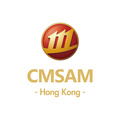
Market Weekly Report | June 1–7, 2026
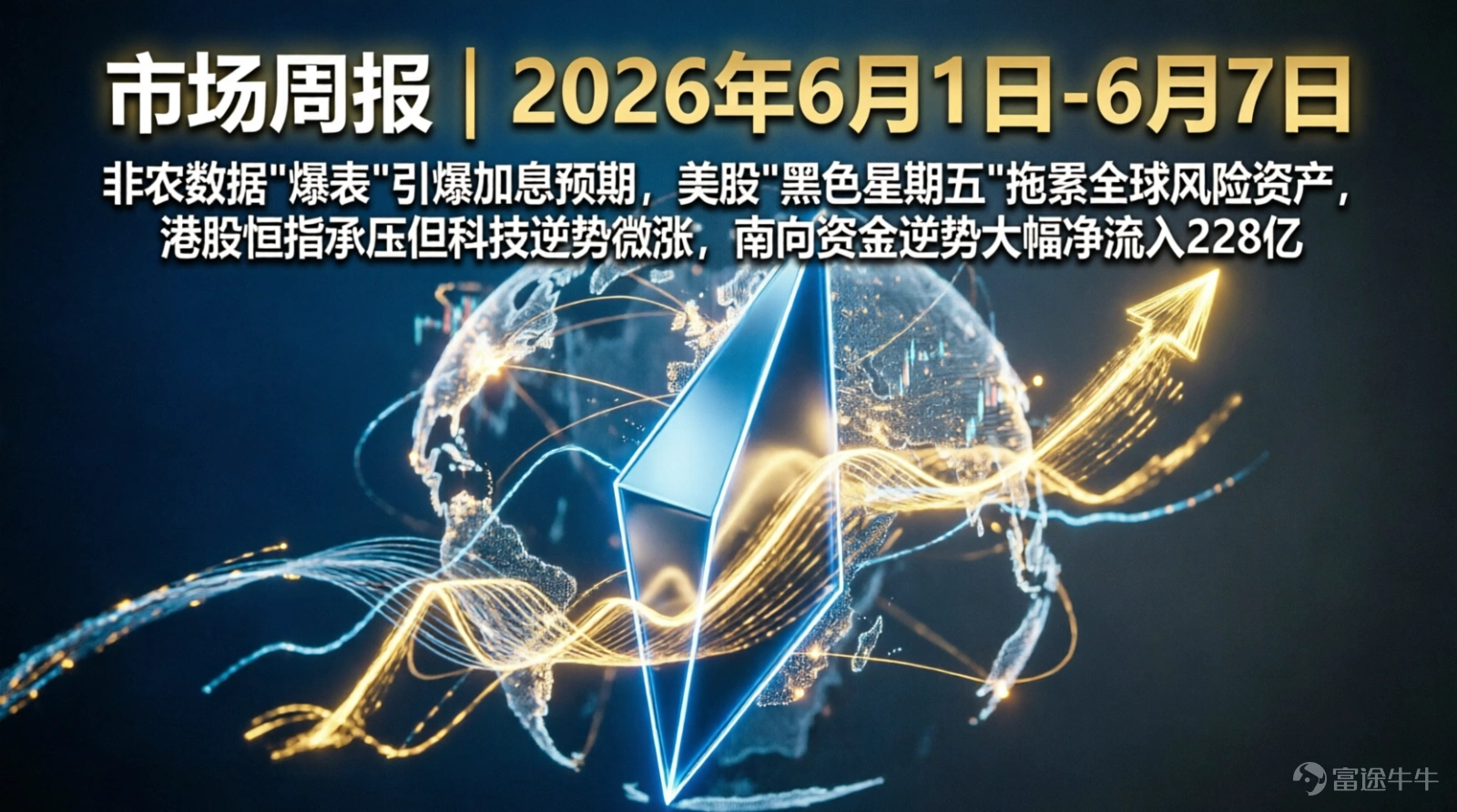
Stronger-than-expected nonfarm payroll data reignited rate hike expectations, with a 'Black Friday' sell-off in U.S. equities dragging down global risk assets; Hong Kong’s Hang Seng Index came under pressure, though tech stocks edged higher, supported by substantial southbound capital inflows of HK$22.8 billion.
1. Overview of the Global Macroeconomy
The key theme for global markets this week is"renewed rate hike expectations"—May 2026 U.S. nonfarm payroll data significantly exceeded expectations, acting as the catalyst for a global adjustment in risk assets. U.S. tech stocks suffered a 'Black Friday,' South Korea’s KOSPI triggered a circuit breaker, and gold prices tumbled more than 3% in a single day.
On the U.S. front, in May 2026,nonfarm payrolls added 172,000 jobs, far surpassing the market expectation of 85,000, with the combined figures for the first two months revised upward by 93,000. The three-month average of monthly job gains reached a robust 188,000. The unemployment rate held steady at 4.3%, and the labor force participation rate remained unchanged at 61.8%. Following the release of the data,markets fully priced in one Fed rate hike this year, with the probability of a rate hike in October rising to 63%. Implied rate hikes from fed funds futures for December increased from 0.67 to 1.03. Jerome Powell’s successor, Kevin Warsh, will chair his first FOMC meeting in mid-June, and markets expect the committee to adopt a hawkish stance to prevent inflation expectations from rising.
In the Asia-Pacific region,South Korea's KOSPI index plunged 5.54% on June 5, 2026, closing at 8,160.59, triggering a circuit breaker during trading—the first such occurrence due to a sharp drop since 2020.The Nikkei 225 fell 1.31% on June 5 to close at 66,588.12。
Domestically,China’s A-share market exhibited a structural divergence characterized by "tech retreat and dividend strength". The STAR 50 Index tumbled 4.74% for the week as crowded tech trades—whose concentration had exceeded 45%—began unwinding. The coal sector led the market with a weekly gain of approximately 6.3%, followed by communications (+4%) and oil & petrochemicals (+2.5%), as defensive assets gained strength amid broader weakness. Daily trading volume remained around RMB 2.9 trillion, but the proportion of advancing stocks continued to decline.
II. Performance of Global Asset Classes
Key themes this week: stronger-than-expected nonfarm payrolls triggered a tightening trade, US tech stocks sold off sharply, the dollar and Treasury yields rose, gold dropped significantly, and crude oil traded sideways near recent highs.
On the equity side,, sending US equities into a "Black Friday" sell-off.The S&P 500 fell 2.59% for the week to close at 7,383.73,The Nasdaq declined 4.68% for the week to close at 25,709.43,The Dow Jones Industrial Average dropped 0.32% for the week to close at 50,866.78. On Friday alone, the Nasdaq plunged 4.18%, the S&P 500 fell 2.64%, and the Dow dropped 1.35%, amid heavy selling in technology stocks. In Asia-Pacific markets, South Korea's KOSPI tumbled 5.54% on Friday, triggering a trading curb, while Japan's Nikkei 225 declined 1.31%. In China's A-share market,the Shanghai Composite Index fell 1.00% for the week to close at 4,027.74,the CSI 300 declined 1.54% for the week,the ChiNext Price Index dropped 1.98% for the week,and the STAR 50 Index fell 4.74% for the week。
In commodities, with crude oil prices fluctuating at elevated levels.Brent crude traded in a wide range between $91 and $99 per barrel during the week, crude oil prices surged to as high as $99 per barrel on Wednesday but retreated to $93.09 per barrel by Friday, pressured by a stronger dollar. WTI crude settled at $90.54 per barrel on Friday. Overall, oil prices remained elevated amid heightened U.S.-Iran tensions and uncertainty surrounding the Middle East situation.COMEX gold plunged sharply, dropping 3.10% in a single day on Friday to $4,365.3 per ounce, weighed down by a stronger dollar and rising expectations of interest rate hikes following better-than-expected nonfarm payroll data.
In bonds, U.S. Treasuries faced a fresh wave of selling.The yield on the 10-year U.S. Treasury note rose to 4.52–4.53%,The 2-year U.S. Treasury yield surged 13 basis points to 4.17%, marking its largest single-day increase in 14 months. A market repricing of Federal Reserve rate hike expectations drove yields higher across the curve.
In terms of exchange rates,, the dollar strengthened significantly.The dollar index rose 0.65% on Friday to 100.08, reclaiming the 100 mark.The US dollar strengthened steadily against the Chinese yuan throughout the week, reaching an intraday high of 6.7888 on Friday.
III. Weekly Review of the Hong Kong Market
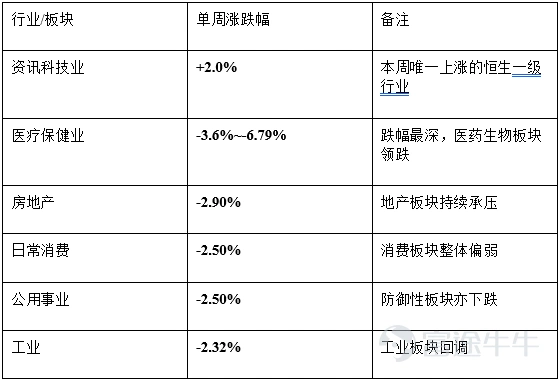
Hong Kong equities this week exhibited"Hang Seng under pressure, tech slightly up, high-dividend stocks leading gains"a pattern of structural divergence. The Hang Seng Index declined, dragged down by sectors such as healthcare and real estate, while the Hang Seng Tech Index edged up slightly, supported by gains in select AI hardware stocks.
Index Performance
The Hang Seng Index fell 0.88% for the week, closing at 24,961.95;The Hang Seng Tech Index rose 0.09%, closing at 4,888.39;The Hang Seng China Enterprises Index gained 0.13%, closing at 8,436.63. By sub-index,The Hang Seng Mainland China High Dividend Yield Index (+1.0%) and the Hang Seng China Enterprises Index (+0.9%) led the gains,The Hang Seng Composite SmallCap Index (-2.1%) posted the largest decline. Year-to-date, the Hang Seng Mainland China High Dividend Yield Index has delivered the strongest return (+10.4%), while the Hang Seng Tech Index has seen the steepest decline (-11.4%).
Industry sector gains and losses
Stock Highlights
Top four gainers among Hang Seng Tech Index constituents: Lenovo Group (+26.4%), Sunny Optical (+13.1%), Kingdee International (+11.1%), Meituan-W (+9.1%). Lenovo Group continued its strong rally, extending last week’s momentum driven by AI PCs and Hang Seng Tech Index weighting adjustments, while Sunny Optical benefited from improving sentiment across the AI hardware supply chain.
The Hong Kong IPO market remains active,YiFei Technology’s IPO received subscription demand exceeding 10,000 times, setting a new record; year-to-date Hong Kong IPO fundraising has surpassed HK$150 billion.。
Capital conditions
Southbound capital recorded net inflows of HK$22.821 billion this week,, rebounding sharply from last week's level (approximately HK$8 billion), signaling a clear improvement in market liquidity. As of June 5, southbound capital has posted net inflows of HK$58.6 billion over the past 30 trading days. Year-to-date, cumulative net purchases by southbound capital have exceeded HK$280 billion, averaging nearly HK$3 billion per day.
On a daily basis, southbound capital recorded net purchases exceeding HK$7 billion on June 1 and over HK$8 billion on June 2, reflecting substantial inflows at the start of the week. Funds primarily flowed into high-dividend defensive sectors and AI-driven technology growth stocks, with certain hard-tech leaders continuing to receive significant allocation increases.
Hong Kong Exchanges’ average daily turnover stood at HK$328.236 billion, down HK$46.549 billion from the previous period.
IV. Outlook for the Market Ahead
Next week, the market enters"Super Event Week", with multiple variables converging, volatility is expected to intensify.
Key calendar
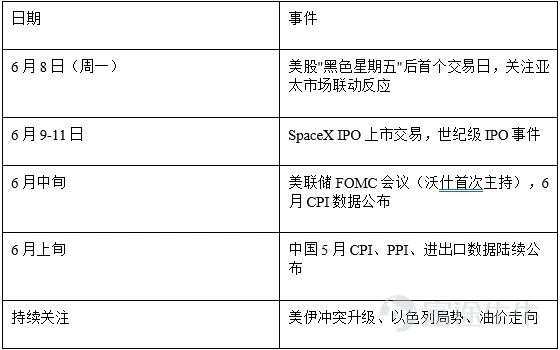
Core Thesis
Global markets are undergoing a dual shock from "renewed rate hike expectations" and "unwinding of tech overcrowding". The U.S. May nonfarm payrolls data significantly exceeded expectations, completely reversing prior rate cut bets, with markets now fully pricing in one rate hike this year. This exerts systemic downward pressure on globally high-valued tech assets—Nasdaq fell -4.68% for the week, Korea’s KOSPI triggered a circuit breaker, and China’s STAR50 index dropped -4.74%, all reflecting the same underlying dynamic.
For Hong Kong stocks,the Hang Seng Index still faces near-term downside pressure(it already declined 2% on June 8 to 24,459 points), butthe Hang Seng Tech Index has shown relative resilience during this correction—rising slightly by +0.09% this week despite the global tech selloff, with valuations now down more than 20% from historical highs.
Southbound capital recorded a substantial net inflow of HK$22.8 billion this week, in sharp contrast to the net outflow in May, indicating that domestic capital has been increasing positions against the market downturn in Hong Kong equities, with the medium- to long-term trend of higher allocations remaining intact.
Allocation strategy
1. AI hardware and semiconductors remain the core theme for the medium term, but short-term volatility risks warrant caution.. The fundamental driver of expanding global AI computing demand remains unchanged, but technology trade concentration has already exceeded 45%. Coupled with rising expectations of overseas rate hikes, near-term valuation pressures have intensified, suggesting investors should accumulate on dips rather than chase rallies.
2. High-dividend defensive positioning is becoming increasingly attractive.. The Hang Seng High Dividend Yield Index rose 1.0% this week, leading the market amid broader weakness, and is up 10.4% year-to-date. Dividend-rich sectors such as coal, telecommunications, and oil & gas exhibit clear advantages during rate-hike cycles.
3. Watch for expectation-adjustment opportunities following the Fed’s FOMC meeting outcome.. Current rate-hike expectations may have already peaked; if June CPI data eases or US-Iran negotiations make progress—driving oil prices lower—monetary tightening expectations could moderately ease.
4. Robust Hong Kong IPO activity is creating structural opportunities.. Hong Kong IPO fundraising has exceeded HK$150 billion year-to-date, with Yifei Technology seeing 10,000x subscription demand—a clear sign that investor enthusiasm for high-quality new economy listings remains strong.
Risk Warning
⚠️ The Fed’s June FOMC meeting turned more hawkish than expected. | Escalating U.S.-Iran tensions drive oil prices higher | SpaceX IPO siphons global tech capital | Korean market circuit breaker triggers chain reaction | Crowding in tech stocks has not yet fully unwound
Disclaimer: This report is for internal discussion purposes only and does not constitute investment advice.
Data sources: AlphaPai database and publicly available market data
$CMS Hang Seng Tech Index ETF (03423.HK)$ $BABA-W (09988.HK)$ $TENCENT (00700.HK)$ $XIAOMI-W (01810.HK)$ $NTES-S (09999.HK)$ $MEITUAN-W (03690.HK)$ $KUAISHOU-W (01024.HK)$ $SMIC (00981.HK)$ $BYD COMPANY (01211.HK)$ $JD-SW (09618.HK)$ $LI AUTO-W (02015.HK)$ $TRIP.COM-S (09961.HK)$ $XPENG-W (09868.HK)$ $BIDU-SW (09888.HK)$ $LENOVO GROUP (00992.HK)$ $HAIER SMARTHOME (06690.HK)$ $JD HEALTH (06618.HK)$ $KINGDEE INT'L (00268.HK)$ $SUNNY OPTICAL (02382.HK)$ $BILIBILI-W (09626.HK)$ $MIDEA GROUP (00300.HK)$ $SENSETIME-W (00020.HK)$ $KINGSOFT (03888.HK)$ $ALI HEALTH (00241.HK)$ $HUA HONG GRACE (01347.HK)$ $TONGCHENGTRAVEL (00780.HK)$ $BYD ELECTRONIC (00285.HK)$ $ASMPT (00522.HK)$ $NIO-SW (09866.HK)$ $HORIZONROBOT-W (09660.HK)$ $TME-SW (01698.HK)$
Risk Disclaimer: The above content only represents the author's view. It does not represent any position or investment advice of Futu. Futu makes no representation or warranty.Read more


Comments
to post a comment
2
2