
Options Sir Breaks Down the Hot Topic | Long-Term vs. Short-Term Bets in the High-Stakes AI Gamble—Have You Really Understood Oracle’s Earnings Report?
After the U.S. market close on June 10, Eastern Time, $Oracle (ORCL.US)$ released its latest earnings report. As of the time of writing, Oracle shares fell more than 10% in after-hours trading, trading at $180.98.
I. Earnings Summary

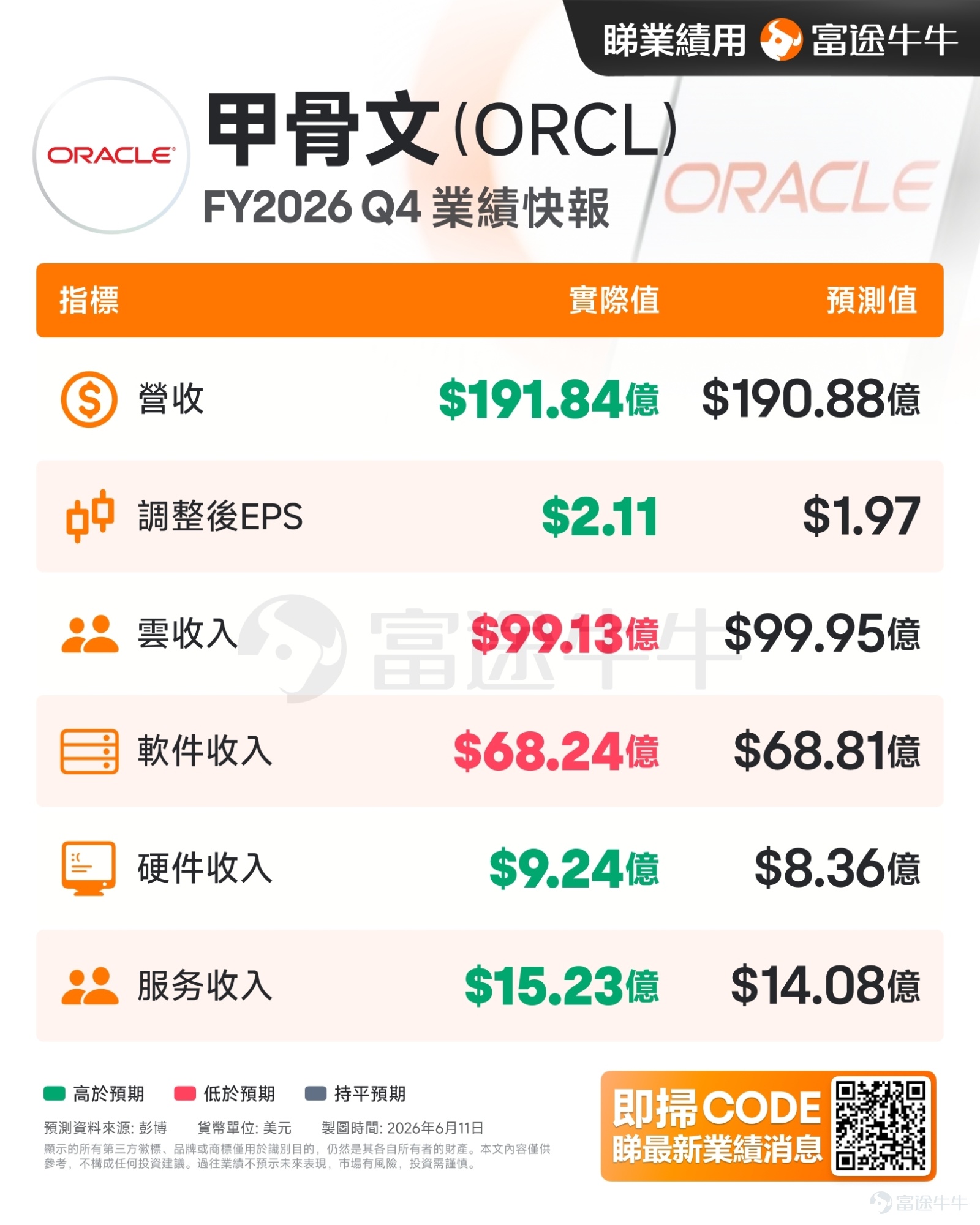
Revenue and Profitability (Beat Expectations):Total revenue of $19.2 billion, up 21% year-over-year, exceeding expectations by $110 million.Non-GAAP EPS of $2.11, up 24% year-over-year, beating expectations by $0.14.This marks a rare quarter for Oracle in recent years where profit growth outpaced revenue growth, driven by the concentrated impact of efficiency measures implemented this quarter, including the layoff of thousands of employees earlier in the year.
Cloud Business (Explosive OCI Growth):Cloud infrastructure (IaaS/OCI) revenue was $5.8 billion,up 93% year-over-year.This is not due to a low base effect from the prior year, but reflects genuinely rapid growth in delivered computing capacity—Global GPU utilization stands at 97.5%. Cloud applications (SaaS) revenue reached $4.1 billion, growing 10%.Traditional software revenue was $6.8 billion, down 2% year-over-year.
Remaining performance obligations (backlog size stunned the market):Remaining performance obligations (RPO) at the end of the quartersoared to $638 billion, up 363% year-over-year, with a sequential increase of $85 billion in a single quarter—a figure nearly 10 times Oracle’s projected full-year revenue for fiscal year 2026. Of the $638 billion, approximately $75 billion consists of customer prepayments or bring-your-own-hardware (BYOH) contracts, covering leading AI clients such as OpenAI, Microsoft Azure, xAI, and Meta.
Summarizing on an annual basis,Oracle’s total revenue for fiscal year 2026 was $67.4 billion, up 17% year-over-year. Cloud infrastructure revenue for the full year was $18.1 billion, growing 77%. Operating cash flow was $32 billion, up 54% year-over-year.However, free cash flow was impacted by full-year capital expenditures of negative $23.7 billion, which is also Oracle's biggest concern for the market and investors.
Second, earnings were strong—so where’s the problem?
The issue lies in the capital expenditure guidance and financing plan.
Actual FY2026 capital expenditures:Full-year capital expenditures of $55.7 billion, of which approximately $8 billion was offset by customer prepayments/BYOH, resulting in net cash outlays of approximately $48 billion and full-year free cash flow of negative $23.7 billion.The financing structure is heavily debt-oriented—$43 billion in borrowings versus $5 billion in equity, placing leverage at the edge of investment-grade credit ratings.
FY2027 guidance:Estimated full-year net cash capital expenditures of approximately $70 billion, with external financing of approximately $40 billion (down $8 billion from 2026) and new ATM equity offerings of $20 billion.
Where is the key risk in this guidance?
First, the $20 billion at-the-market equity offering carries unclear dilution impact.Oracle has not disclosed its specific capital expenditure cadence, which was the most frequently asked question by institutional investors during this quarter’s earnings call, and no clear answer was provided.
Second, negative free cash flow will persist and is likely to widen.A net cash capital expenditure of $70 billion corresponds to a revenue target of $90 billion, making it highly probable that Oracle’s free cash flow in FY2027 will be more negative than the -$23.7 billion reported in FY2026. Oracle’s current rationale is: spend now, collect revenue in FY2028 and FY2029. This logic hinges on several assumptions—large customer contracts remaining intact, data centers being delivered on schedule, and AI compute demand not experiencing a sharp decline—each of which carries significant uncertainty.
Third, there is no guidance regarding margin recovery.Data centers under construction and in ramp-up phases will continue to weigh down gross margins due to depreciation, energy, and labor costs. Margins are expected to rebound only once facilities reach full operational capacity. Management responded to this concern by stating margins would 'naturally recover once at full production,'but did not provide a specific quarterly timeline,which represents a critical information gap.
Fourth, legacy software business lacks a stabilizing floor.On-premises software license revenue declined 2% year-over-year, and the trend of customers migrating to the cloud will only accelerate, not slow down.This means that if OCI experiences any quarterly growth below expectations, Oracle has no other business segment capable of filling the gap in the short term.
III. Key Takeaways from the Earnings Call
This quarter’s earnings call was led by three executives: Co-CEO Clay Magouyrk (Cloud Infrastructure), Co-CEO Michael Sicilia (Applications Software), and new CFO Hilary Maxson.
Magouyrk: Delivery speed is the key variable
Magouyrk provided a very specific set of delivery figures: In fiscal year 2026, Oracle completed the construction and delivery of over 1.2 gigawatts (GW) of data center capacity;and in the upcoming Q1 of FY2027, the company expects to deliver approximately 1 GW in a single quarter—equivalent to the total delivered throughout the entire prior year. This demonstrates that Oracle is accelerating across the entire delivery chain, from construction and procurement to commissioning.
Sicilia: AI agents—demand shifts from quantitative to qualitative change
Sicilia’s core assessment is that enterprise customers are shifting their use of AI from 'testing the waters' to 'running real business operations.'This year, Oracle has delivered more than 1,000 AI agents within its own enterprise software suite, with over 300 Fusion ERP customers having gone live.Notably, Oracle Health (the Cerner healthcare IT system acquired by Oracle) launched an AI-powered patient care system and expects this to drive double-digit growth for the segment in FY2027. Cerner had been a drag on Oracle’s performance over the past two years; if this turnaround materializes, it would represent an additional positive catalyst. Separately, Oracle is introducing a new pricing model: 'token bundles' that allow enterprise customers to pre-purchase AI compute capacity, similar to how mobile phone plans offer prepaid data packages. This quarter, 33 enterprise customers made such purchases—a modest scale for now, but highly significant in terms of strategic direction.Once scaled, this approach would enable Oracle to lock in future cash flows earlier.
Maxson: ROIC justification provided, dilution concerns sidestepped
The new CFO’s primary task was to justify the massive capital expenditures. Her core argument was that once Oracle’s data centers reach full-capacity 'steady state,' the company expects to achieve a return on invested capital (ROIC) in the high 20% range. Fixed-price contracts with cost pass-through protections ensure that rising hardware costs won’t directly erode margins.However, on the issue of dilution from the $20 billion at-the-market (ATM) equity offering, Maxson offered no details on the issuance pace or expected price range, instead pivoting back to the ROIC argument. This evasion prompted follow-up questions from analysts and was a direct contributor to post-market share price weakness.
Overall: Oracle’s long-term thesis in this earnings report is internally consistent—with nearly $640 billion in backlog orders and accelerating delivery speeds, near-term AI computing demand shows no signs of abating.Yet real near-term financial pressures also exist:persistently negative free cash flow, lack of transparency around equity dilution plans, and unclear timing for margin recovery. Fiscal Year 2027 will be a year when these two narratives run in parallel and pull against each other. The current divergence in Oracle’s share price essentially reflects differing answers to the question: 'How long are investors willing to wait?'
IV. Technical Analysis

Having analyzed fundamentals and news sentiment, let’s now turn to technicals.
As of the time of writing, Oracle’s stock price stood at $180.98.with the trend clearly weakening— Over the past 10 days, the price has declined unidirectionally from its high of $250.25,The price has already broken below the MA20 ($206.09) and MA50 ($183.41) support levels, with a bearish MACD crossover, indicating that the medium-term structure has been compromised.
On key levels, since the dynamic MA50 support has been breached,the next critical support level to watch closely is the lower Bollinger Band at $166.15. Whether Oracle can swiftly reclaim and firmly hold above both the MA50 and MA20 will serve as the key confirmation signal for initiating a rebound.
V. Options Trading Strategies
1. If you already hold Oracle shares and remain bullish on its long-term prospects but are uncertain about potential short-term downside risk,

(The design images shown on screen are for illustrative purposes only and do not constitute any investment advice or guarantee; market conditions change rapidly, and displayed prices may not reflect actual market values.)
you can purchase a short-term put option to hedge your position. Should the stock price decline due to short-term sentiment, this put option would partially offset losses from the stock’s depreciation.
2. If you do not currently hold Oracle shares but wish to acquire them at an attractive price,

(The design images shown on screen are for illustrative purposes only and do not constitute any investment advice or guarantee; market conditions change rapidly, and displayed prices may not reflect actual market values.)
you may sell a put option below the current market price, provided you maintain sufficient margin. If the stock price falls below the strike price and the put option is exercised, you can use your margin to acquire the shares at a lower effective cost. Additionally, consistently selling options allows you to collect premium income.
Note: Option sellers must ensure they have adequate margin before implementing this strategy; otherwise, forced liquidation of the account could result in unnecessary losses.
Finally, here's a small perk for fellow Futubull investors, welcome to claim it.Options Beginner Pack
*This event is exclusive to invited HK users. Click to learn more.Detailed event rules>>
Market conditions are complex and volatile,Options StrategyOverwhelmed by choices? Futubull helps you build a portfolio in three steps.Options Strategymaking investing simple and efficient!

Option Risk Warning:An option is a contract that grants the holder the right, but not the obligation, to buy or sell an asset at a fixed price on a specific date or at any time before that date. The price of an option is influenced by various factors, including the current price of the underlying asset, the strike price, time to expiration, and implied volatility. Implied volatility reflects the market’s expectations for the level of volatility in the option over a future period. It is a data point derived inversely from the Black-Scholes option pricing model and is generally regarded as an indicator of market sentiment. When investors anticipate greater volatility, they may be more willing to pay a higher price for options to hedge risks, resulting in higher implied volatility. Traders and investors use implied volatility to assess the attractiveness of option prices, identify potential mispricings, and manage risk exposure.
Disclaimer:This content does not constitute any offer, solicitation, recommendation, opinion, or guarantee of any securities, financial products, or tools. The risk of loss in trading options can be substantial. In some cases, losses may exceed the initial margin deposited. Even if you set contingent orders such as 'stop-loss' or 'limit' orders, these may not prevent losses. Market conditions may make such orders unexecutable. You may be required to deposit additional margin within a short period. If you fail to provide the required amount within the specified time, your open positions may be liquidated. However, you will still be responsible for any shortfall in your account. Therefore, before trading, you should study and understand options and carefully consider whether such trading is suitable for you based on your financial situation and investment objectives. If you trade options, you should be familiar with the procedures for exercising options and the rights and obligations upon exercise and expiration. Options trading carries extremely high risks and is not suitable for all investors. Investors should carefully readCharacteristics and Risks of Standardized Options。
Risk Disclaimer: The above content only represents the author's view. It does not represent any position or investment advice of Futu. Futu makes no representation or warranty.Read more


Comments
to post a comment
9
20