
A new IPO hit in September, how do you plan to allocate funds?
The $60 billion sugar-free tea's 'successor': How has Chinese-style wellness water quietly risen to prominence?
Over the past decade, sugar-free tea has driven the most comprehensive 'de-sugaring' education campaign in China’s beverage market, propelling the category to surpass RMB 60 billion in market size. But now that 'zero sugar, zero calories' has become standard, consumers are asking: beyond being unsweetened, what else can this bottle offer me?
Chinese-style functional wellness water is providing the answer. According to Forward Industry Research Institute’s newly released 'Insight Report on Trends in China’s Chinese-Style Functional Wellness Water Industry (2026)', this segment has progressed from an initial conceptual phase into a 2.0 stage defined by quality competition. Market size has surged 35-fold since 2022 and is projected to grow more than sixfold over the next five years. Heyziran, a brand under Genki Forest, leads the market by a wide margin with over 50% share across both online and offline channels, thanks to its full industrial chain integration, establishing itself as the defining brand of the 2.0 era.

From 1.0 to 2.0: Conceptual hype fades as quality-driven players begin reshaping the market
As China’s 'Healthy China' strategy continues to deepen, consumer demand for beverages labeled 'no additives', 'sugar-free', and 'functional' keeps rising. Chinese-style functional wellness water, positioned around 'light wellness', has quickly emerged as a new growth engine for the beverage industry.
Let’s briefly review the evolution of herbal wellness water: starting in 2018, brands like Keyang and Shou Quan Zhai pioneered the category, marking the conceptual infancy (1.0 phase) of the industry. Between 2023 and 2024, major players such as Yuanqi Forest’s Haozizai, Haowangshui, and Yili significantly ramped up their investments. By 2025, legacy giants including Nongfu Spring, Master Kong, and Uni-President entered the market en masse—signaling the official transition into the 2.0 phase. The competitive focus has shifted from marketing concepts to genuine ingredients, robust production processes, and transparent trust-building.
Data confirms this turning point: in 2023, the segment grew by over 350% year-over-year. From 2024 to 2025, driven by scaled production from leading brands, intensified efforts from emerging players, and entry by traditional giants, the market size surged 35-fold compared to 2022. Traditional Chinese herbal wellness water has evolved from a niche segment into a core growth category within the beverage sector.

Simultaneously, both production capabilities and information transparency have advanced across the industry. The share of brands producing in-house rose from 21% to 34%, while the proportion disclosing ingredient origins increased from 47% to 55%. The market now exhibits a 'one dominant leader with multiple strong contenders' structure—Haozizai leads decisively with over 50% market share, followed by Haowangshui, Keyang, and Qingshang in the second tier.
After sugar-free tea, why herbal wellness water?
Over the past decade, sugar-free tea accustomed consumers to a refreshing 'zero sugar, zero calorie' taste profile and cultivated a large cohort of health-conscious young users who scrutinize ingredient labels. But as 'sugar-free' became standard, consumers began asking deeper questions.
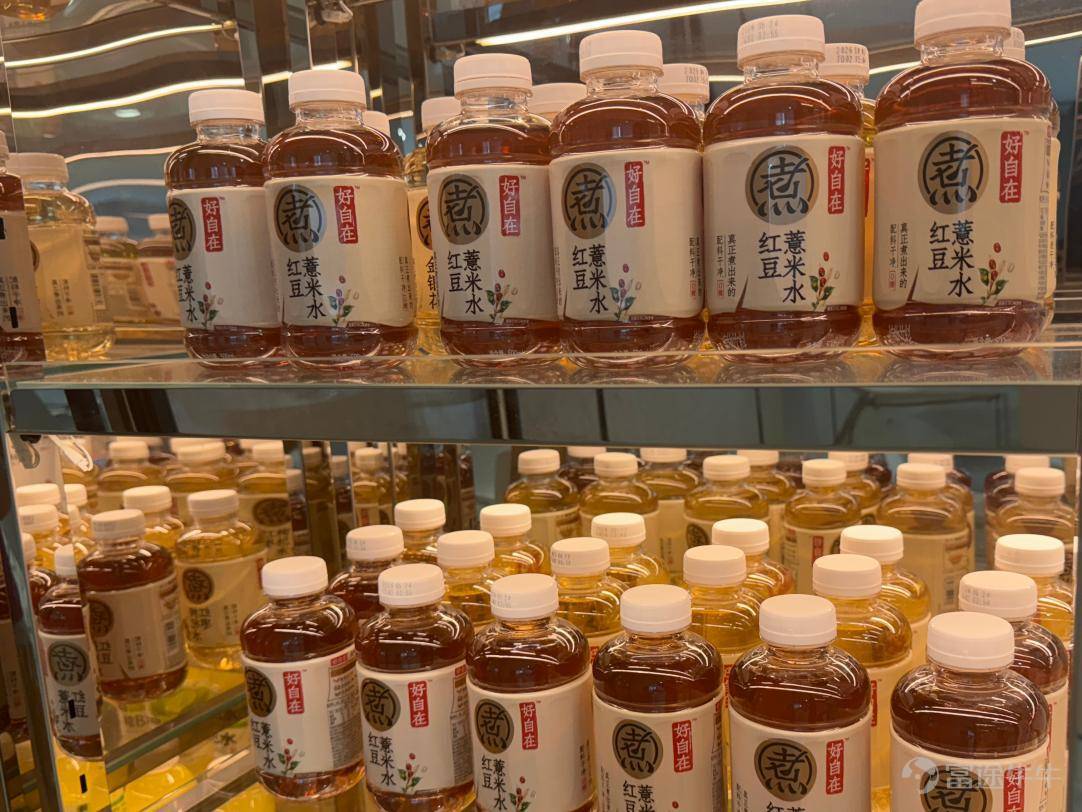
Reports indicate that consumers are no longer satisfied with mere 'sugar removal' and are instead seeking more precise 'functional nourishment.' Traditional Chinese herbal wellness water meets this demand perfectly—it retains the clean ingredient list of sugar-free tea but goes a step further by incorporating 'food-as-medicine' ingredients to deliver tangible functional benefits. Red bean and Job’s tears water for dampness removal, red date and goji berry water for qi replenishment, mung bean water for heat relief… These time-honored dietary wellness traditions are now conveniently packaged in portable bottles, enabling young consumers to effortlessly 'drink wellness' just as they would sip sugar-free tea.
Data validates this trend: herbal wellness water shares a highly overlapping consumer base with sugar-free tea, primarily health-conscious women aged 18–44. However, herbal wellness water attracts an even younger demographic, with a higher concentration of high-potential consumers aged 27–36. Among those who have already purchased, nearly 80% plan to increase consumption frequency, and over 80% believe herbal wellness water will become an everyday beverage just like sugar-free tea.

Looking ahead, the market is expected to transition from rapid expansion to steady growth over the next five years. With its dual positioning as both 'functional' and a 'water alternative,' herbal wellness water is poised for leapfrog growth in the coming years.
Notably, herbal wellness water contains no caffeine, allowing for more flexible consumption throughout the day—Haozizai’s red bean and Job’s tears water to restore vitality after late nights, a morning cup of tangerine peel and hawthorn water to cut through midday greasiness, or nourishing red date and goji berry water in the afternoon. Spanning from college students to middle-aged and elderly wellness seekers, it enjoys a broader consumer foundation than sugar-free tea.
Yuanqi Forest's Haozizai Builds Its Moat: From Bean Farms to Simmering Processes, Creating Barriers Through Heavy Asset Investment
As the industry enters its 2.0 era, ingredient traceability, production processes, and corporate standards have become core dimensions of competition. Haozizai’s leadership stems from heavy asset investments across three strategic areas.
Haozizai has deeply embedded itself in key sourcing regions such as Northeast China’s pearl red bean growing areas and Guizhou’s coix seed bases. Through cooperative 'bean farm' agreements and seed-breeding contracts, it secures authentic, high-quality ingredients at the source. Within red bean and coix seed products, Haozizai explicitly discloses 'Northeast China pearl red beans' and 'Guizhou coix seeds'; for red date and goji berry products, it specifies 'Xinjiang naturally sun-dried red dates' and 'Ningxia goji berries'; and for mung bean products, it identifies 'organic mung beans from core production zones in Heilongjiang, Northeast China.' Such comprehensive disclosure of ingredient origins across all product categories is rare in the industry. The broader market is now following suit: brands disclosing ingredient origins have increased from nine to twenty-three, with their share rising from 47% to 55%. Haozizai is a clear pioneer of this trend.

Haozizai’s commitment to traditional simmering techniques represents another core investment in quality. By employing vigorous boiling followed by gentle simmering, it fully unlocks the aroma and nutrients of ingredients while preserving their complex nutritional profile and rich flavor. Combined with intelligent temperature control and sterile cold-filling technology, Haozizai achieves large-scale production without preservatives—addressing the longstanding pain points of traditional Chinese herbal beverages: poor shelf life and subpar taste.
On standard-setting, most mainstream Chinese wellness beverages adhere to the national standard 'Plant-Based Beverages.' Haozizai goes further by implementing stricter internal corporate standards built on top of national requirements, ensuring higher product quality and offering consumers greater peace of mind.
Growth Logic in a Hundred-Billion-Yuan Market Segment: Functionality-Driven Demand and Accelerating Daily Consumption
Consumer choices clearly reveal the market’s growth drivers. Functional benefits and premium ingredient quality are the primary reasons users are willing to pay premium prices. Surveys show that over 60% of buyers are willing to pay more for functional benefits perceived as 'good for the body,' and over 50% are willing to pay extra for 'more expensive ingredients.' Only fewer than 10% believe the price should align with that of unsweetened tea.

In terms of consumption scenarios, the top three most frequent uses are as a healthy alternative to plain water during daily work or study, post-exercise rehydration and recovery, and replenishing energy after late-night overtime—far surpassing basic thirst-quenching needs. Consumers place greater importance on health attributes such as 'clean labels' and 'zero sugar, zero fat' than on external factors like branding or packaging. This indicates that Chinese wellness beverages are transitioning from novelty purchases to everyday staples, becoming a normalized choice for an increasing number of people.
Looking ahead, the substitution rate of Chinese wellness beverages for unsweetened drinks is expected to rise from 8.2% to 24%. Anchored by a dual-value proposition of 'health benefits + pure water replacement,' the segment’s long-term growth trajectory is clear. As China’s 'Healthy China' strategy deepens, the concept of food-medicine synergy continues to gain traction, and health-conscious consumption awakens in lower-tier cities, Chinese wellness beverages are well-positioned to replicate the channel penetration path previously taken by unsweetened beverages, unlocking substantial growth potential.
Risk Disclaimer: The above content only represents the author's view. It does not represent any position or investment advice of Futu. Futu makes no representation or warranty.Read more
Comments
to post a comment