
Options Sir Breaks Down the Hot Topic | Capital Is Actively 'Buying Insurance'—Has the AI Trading Logic Changed? A Quick Guide to Major Banks’ Views
Market action yesterday: indices saw limited declines, but individual stocks experienced extreme volatility.
Monday's semiconductor rebound did not last long.
Ahead of the market open yesterday, $PHLX Semiconductor Index (.SOX.US)$ it briefly showed notable strength, but profit-taking by investors quickly overwhelmed buying interest aimed at recovery after the opening bell, $Micron Technology (MU.US)$ shifting from pre-market strength to a sharp intraday plunge that at one point dragged down the entire semiconductor supply chain. A rapid bounce-back occurred near the close, leaving the final decline appearing modest—though the intraday price path was extremely volatile.
While the broader indices appeared to undergo merely a consolidation, individual stocks and options markets nearly experienced a full-scale shakeout.
As we noted in yesterday’s article titled 'Option Sir Breaks Down Hot Topics | Semiconductors Prop Up US Market Rebound! Is the Pullback Over?',“Monday’s rebound was far from smooth—it did not reflect synchronized risk appetite across the entire market. Many institutions were already long AI and semiconductor positions; Friday’s sharp selloff followed by Monday’s rebound gave them an opportunity to hedge their exposure.”
Secondly, SemiAnalysis’s discussion regarding delays in the mass production timeline for 800VDC and CPO triggered repricing across optical communications, CPO, and data center power-related segments. $Lumentum (LITE.US)$$Coherent (COHR.US)$ On the macro front, CPI, PPI, and Federal Reserve policy expectations remain unresolved. Additionally, liquidity diversion concerns stemming from SpaceX’s potential mega-IPO have further heightened market anxiety over capital reallocation away from tech stocks.
After this round of semiconductor sell-off, what do major banks think?
The divergence among major banks centers on three key questions: whether positioning has become too crowded, whether valuations are stretched, and whether AI-related capital spending can truly translate into profits.
1. The Cautious Camp: Semiconductors haven’t lost their dominant theme status, but short-term cooling is needed.
BofA recently warned thatUS tech trades are already showing numerous risk signals. There’s clear divergence in strength within the tech sector,with some technical indicators entering overbought territory.Current positioning in tech stocks—particularly semiconductors—is already very crowded, making short-term volatility prone to amplification.
Goldman Sachs Prime Services’ observations align closely with this trend. Hedge funds have recently taken profits in semiconductor and equipment stocks.This signal shouldn’t be interpreted as institutions fully exiting AI; it resembles more of a risk rebalancing after rapid gains. Over the past period, AI chips, memory, optical communications, and equipment stocks have accumulated substantial returns. It’s unsurprising that institutions are locking in some profits ahead of macro data and earnings verification.
2. Bulls: AI demand has not been disproven; after the pullback, structural selection matters more
UBS remains positive on the memory supply chain, particularly bullish on Micron’s position in AI memory. Its core rationale is that Agentic AI and upgrades in AI server configurations continue to drive demand for high-end DRAM and HBM. The current memory cycle differs from traditional cycles—demand stems from structural upgrades in AI servers, while supply expansion remains relatively slow, leaving room for further earnings upside.
Morgan Stanley also continues to list semiconductors and related equipment as top picks in its European strategy.The key point of this view lies in the continued transmission of AI capital expenditure to equipment companies. Equipment leaders like ASML remain critical in the supply chain—as long as AI data center construction does not genuinely slow down, demand for advanced nodes, memory capacity expansion, and related equipment will remain supported.
Bulls still believe AI-related capital spending will persist, with orders continuing to support segments such as memory, advanced packaging, optical interconnects, and semiconductor equipment. Bears, however, argue that after the rapid run-up, semiconductors have entered a phase of high valuations, high crowding, and low tolerance for error. Unless earnings continue to beat expectations, investors will likely reduce risk exposure first.
Bullish and bearish views are not entirely contradictory—they simply reflect observations of the same market cycle from different time horizons. However, most major banks still affirm the underlying demand driven by AI, viewing semiconductors as one of the most important assets of the AI era.。
Options market anomalies: In a high-volatility environment, demand for protection has clearly intensified, but investors have not yet exited
Options hedging can further amplify volatility. When ETF rebalancing, quant model shifts, and short-term stop-loss triggers coincide, even a fundamentally unchanged blue-chip stock can be traded as a high-beta instrument.
Short-dated options on AI semiconductors are already very expensive. When implied volatility is elevated, investors can be wrong on timing and theta decay even if they’re right on direction—especially with 0DTE and short-dated contracts, which are highly vulnerable to intraday whipsaws (sharp drops followed by rallies, or vice versa).
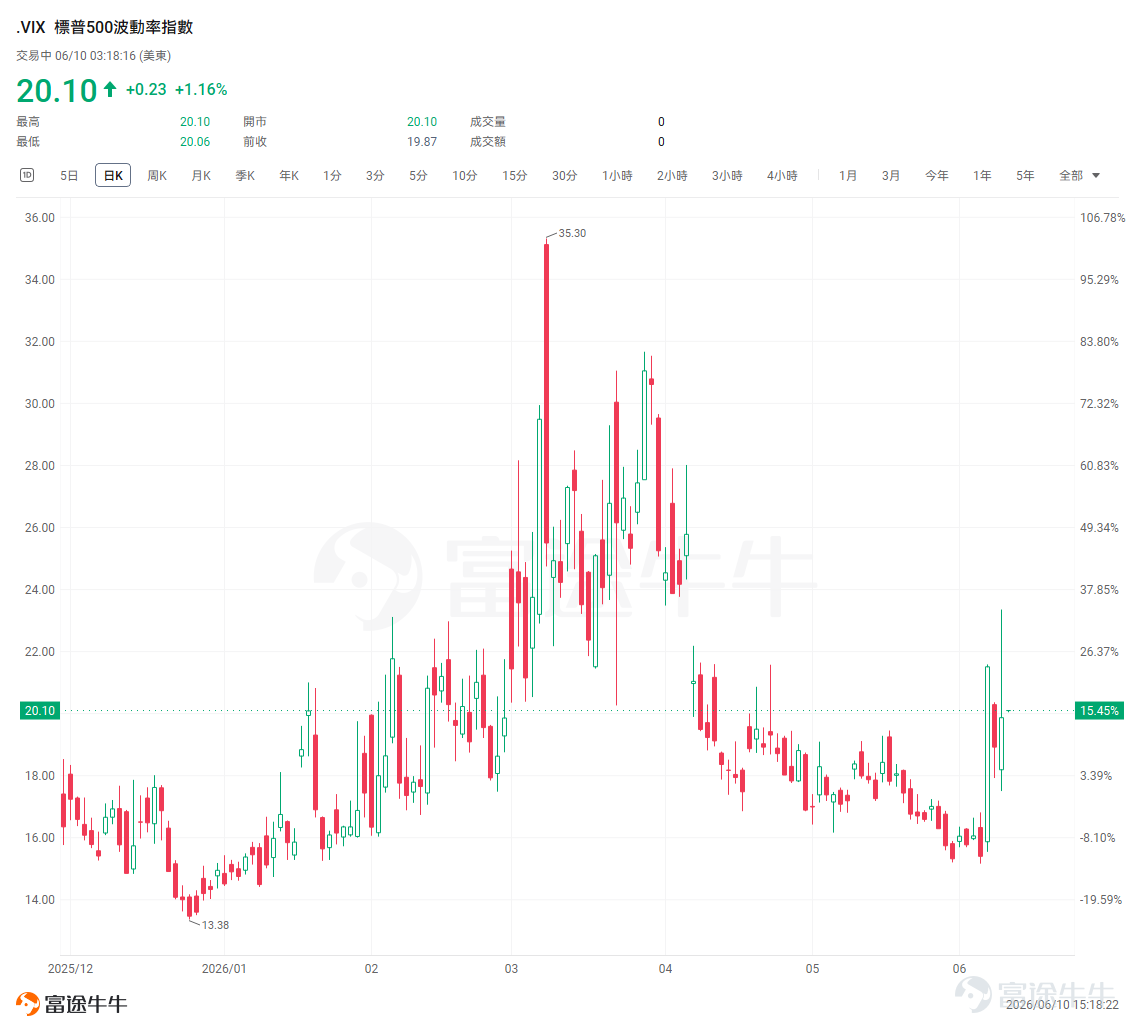
Yesterday $CBOE Volatility S&P 500 Index (.VIX.US)$ Intraday, it reached a high of 23.34—the highest since April 7—and closed near 20. This indicates that the low-volatility environment has been broken, and capital is starting to buy protection again. Meanwhile, tech stocks saw deep intraday losses, with the S&P technology sector一度 dropping 5.5%. The Philadelphia Semiconductor Index, after rising 3% in early trading,一度 fell 8.6% before ultimately closing down 1.9%.

According to Cboe data, the total Put/Call Ratio on June 9 was 0.96, and the equity Put/Call Ratio was 0.62,while the index Put/Call Ratio stood at 1.11, indicating that hedging activity is primarily concentrated on the index side., with significant call volume still evident at the single-stock level.Investors appear to be acting more like this: they don’t necessarily want to liquidate their stock positions but are seeking to insure their portfolios by using $SPDR S&P 500 ETF (SPY.US)$ 、 $Invesco QQQ Trust (QQQ.US)$ ETFs of this type to hedge against broad-based tech and index risk.
$Micron Technology (MU.US)$ Implied volatility reached 102.80%, while historical volatility stood at 103.81%. Both IV Rank and IV Percentile are at the 100% level. Yesterday, call options traded approximately 409,000 contracts, while puts traded around 322,000 contracts, yielding a traded Put/Call Ratio of 0.79;however, the open interest Put/Call Ratio reached 1.32.
First,Trading during the session was not uniformly bearish; call activity remained highly active. Many investors were betting on a late-session rebound, bounce-back, or short squeeze.Second, existing positions already contain substantial put protection, suggesting that after the prior sharp rally, position holders have started worrying about potential pullbacks.Short-term speculation and protective hedging are simultaneously crowded, amplifying the stock price path through options-based hedging.

(1) Heavily positioned with unrealized gains: You can use a Collar to add an extra layer of protection to your holdings.
For investors who already hold semiconductor stocks or ETFs and have substantial exposure, the Collar structure remains suitable.
The approach involves holding the underlying stock or ETF while simultaneously buying a protective put at a lower strike and selling an out-of-the-money call at a higher strike, using the premium received from the call sale to partially offset the cost of the put.
This strategy suits two types of investors. The first group already has significant unrealized gains and does not want to liquidate core positions due to short-term volatility. The second group believes in the medium- to long-term AI-semiconductor thesis but is concerned that CPI data, interest rate expectations, geopolitical risks, or earnings events could further amplify market swings.
The advantage of a Collar is its relatively manageable hedging cost, while the drawback is that it caps some upside potential. If semiconductors rebound sharply, the sold call will limit gains. Thus, it is better suited for investors who want to retain their positions but avoid being fully exposed. $Marvell Technology (MRVL.US)$ For example:
(The figure below illustrates the simulated profit and loss scenario of this strategy on the expiration date. The design image displayed on the screen is for demonstration purposes only and does not constitute any investment advice or guarantee; market conditions fluctuate frequently, and the prices shown do not represent actual values.)

(2) Already long on AI and concerned about future volatility: Protective puts on ETFs still hold value.
If you already hold individual semiconductor stocks and do not wish to reduce each position individually in the short term, consider using protective puts on broad-sector ETFs such as QQQ, SMH, or SOXX for portfolio-level hedging.
The goal of this strategy is not to bet against semiconductors but to provide a buffer for your portfolio. Current market pressure stems not just from individual companies but from a confluence of macroeconomic data, interest rate expectations, tech stock valuations, crowding in AI trades, and options-driven hedging activity. Hedging with a sector ETF is simpler and less costly—both in terms of capital and management complexity—than buying puts on each individual stock.
It should be noted thatProtective puts are not cheap in a high-volatility environment.When implied volatility has already risen, the cost of buying protection becomes higher. Therefore, investors do not necessarily need full coverage; they can opt for partial hedging—for example, covering only a portion of their position or buying puts with lower strike prices—positioning the strategy as 'protection against extreme moves' rather than fully locking in drawdowns.
A more prudent approach is to extend the protection period beyond key events, such as the release of CPI, PPI, FOMC decisions, or critical corporate earnings reports. This avoids a situation where protection is purchased just before the event concludes, leaving the portfolio still exposed during a high-volatility window. For example, $Invesco QQQ Trust (QQQ.US)$ For example:
(The figure below illustrates the simulated profit and loss scenario of this strategy on the expiration date. The design image displayed on the screen is for demonstration purposes only and does not constitute any investment advice or guarantee; market conditions fluctuate frequently, and the prices shown do not represent actual values.)

(3) Going long from an empty or light position: Buying short-dated options outright carries high risk; it’s better to wait for confirmation first.
For investors holding empty or light positions, even if they are correct on AI semiconductors over the medium term, short-dated options may still incur losses due to poor entry timing, time decay, and a subsequent drop in implied volatility.
If key stocks can hold their critical support levels, show improved buying interest toward the close, and if CPI data and interest rate expectations no longer weigh on growth stocks, investors could consider using a bull call spread with 3- to 6-week expirations to participate in the rebound.
The approach involves buying one at-the-money or slightly in-the-money call while simultaneously selling another call at a higher strike price. This allows participation in the upside while reducing the premium cost compared to buying a naked call outright. The downside is that upside gains are capped, making this structure suitable for environments where a rebound is expected but a sharp, one-sided rally in the short term is unlikely.
Take MU, a highly volatile semiconductor stock, as an example: a bull call spread is currently more suitable than buying short-dated naked calls. Given its high inherent volatility and elevated implied volatility, naked calls demand precise timing. If the stock pulls back before rallying, short-dated options may have already suffered significant losses. While the spread structure caps some of the potential upside, it better controls costs and is more appropriate for a choppy, recovery-oriented market environment. For example, $Micron Technology (MU.US)$ For example:
(The figure below illustrates the simulated profit and loss scenario of this strategy on the expiration date. The design image displayed on the screen is for demonstration purposes only and does not constitute any investment advice or guarantee; market conditions fluctuate frequently, and the prices shown do not represent actual values.)

Finally, Option Sir brings a small perk for fellow investors, welcome to claim it.Options Beginner Pack
*This event is exclusive to invited HK users. Click to learn more.Detailed event rules>>
Market conditions are complex and volatile,Options StrategyOverwhelmed by choices? Futubull helps you build a portfolio in three steps.Options Strategymaking investing simple and efficient!

Option Risk Warning:An option is a contract that grants the holder the right, but not the obligation, to buy or sell an asset at a fixed price on a specific date or at any time before that date. The price of an option is influenced by various factors, including the current price of the underlying asset, the strike price, time to expiration, and implied volatility. Implied volatility reflects the market’s expectations for the level of volatility in the option over a future period. It is a data point derived inversely from the Black-Scholes option pricing model and is generally regarded as an indicator of market sentiment. When investors anticipate greater volatility, they may be more willing to pay a higher price for options to hedge risks, resulting in higher implied volatility. Traders and investors use implied volatility to assess the attractiveness of option prices, identify potential mispricings, and manage risk exposure.
Disclaimer:This content does not constitute any offer, solicitation, recommendation, opinion, or guarantee of any securities, financial products, or tools. The risk of loss in trading options can be substantial. In some cases, losses may exceed the initial margin deposited. Even if you set contingent orders such as 'stop-loss' or 'limit' orders, these may not prevent losses. Market conditions may make such orders unexecutable. You may be required to deposit additional margin within a short period. If you fail to provide the required amount within the specified time, your open positions may be liquidated. However, you will still be responsible for any shortfall in your account. Therefore, before trading, you should study and understand options and carefully consider whether such trading is suitable for you based on your financial situation and investment objectives. If you trade options, you should be familiar with the procedures for exercising options and the rights and obligations upon exercise and expiration. Options trading carries extremely high risks and is not suitable for all investors. Investors should carefully readCharacteristics and Risks of Standardized Options。
Risk Disclaimer: The above content only represents the author's view. It does not represent any position or investment advice of Futu. Futu makes no representation or warranty.Read more


Comments
to post a comment
19
19