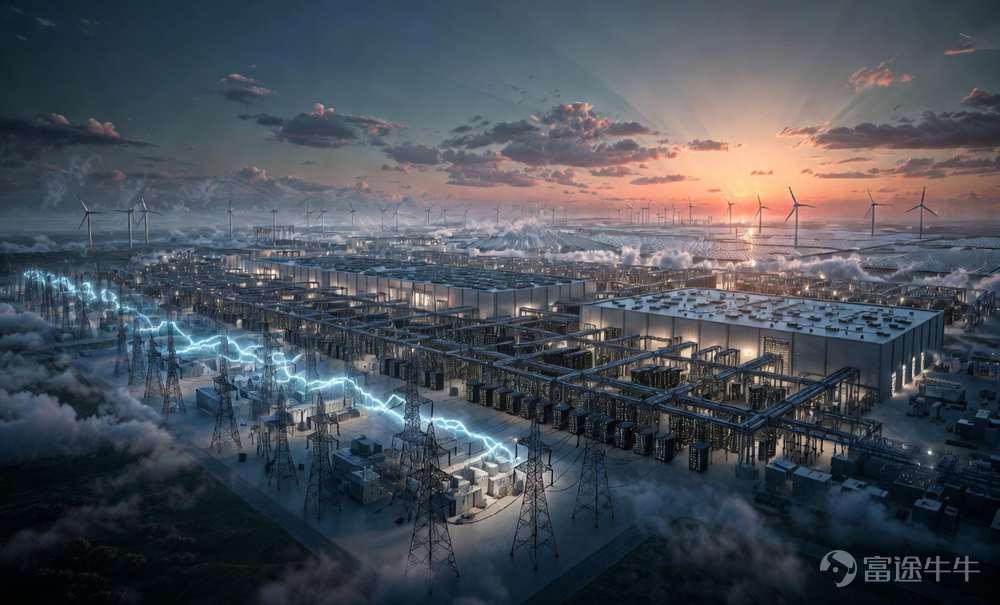

Billions in financing: Bitcoin miners collectively pivot to AI

Author | Wu Talk Blockchain
TL;DR:
Miners are collectively transforming into AI infrastructure providers: Publicly listed North American Bitcoin mining companies are undergoing a dramatic identity shift—from highly volatile, strongly cyclical 'mining firms' tightly tied to cryptocurrency prices—to repositioning themselves as energy infrastructure operators and AI data center platforms, securing billions of dollars in project financing and long-term contracts.
Core competitive advantage lies in large-scale power access and rapid deployment capability: The fundamental reason AI cloud service providers choose to partner with miners is that miners possess the scarcest resources in the AI era—ready grid interconnection, mature substation and power transmission/distribution infrastructure, and rapid deployment capabilities—which significantly shorten GPU cluster deployment timelines.
Leading firms have locked in massive long-term agreements: Representative miners such as Core Scientific, Hut 8, Iris Energy, and TeraWulf have formed deep partnerships with top-tier AI clients, signing long-term IT capacity leasing agreements totaling hundreds of megawatts. For some companies, the base term value of these long-term contracts reaches multi-billion-dollar levels, with even higher potential including renewals.
Evolving financing structures are driving a shift in valuation logic: Miners are increasingly adopting project-level debt financing, triple-net (NNN) leases, and take-or-pay clauses. This transition aligns their revenue models more closely with traditional data center REITs, prompting capital markets to reprice them from commodity-cycle companies to infrastructure assets with stable cash flows.
The transformation faces significant tests from high capital requirements and execution risks: while embracing infrastructure-as-a-service, mining firms also confront substantial retrofitting capital expenditures (in the range of millions to tens of millions of dollars per MW), excessive customer concentration, and challenges in transitioning from pure compute deployment to AI technology operations. Current market valuations are predicated on successful future delivery; if execution falls short of expectations, the valuation logic could reverse.
Industry context: Halving pressure coincides with surging demand for AI infrastructure
In 2026, publicly listed Bitcoin mining companies in North America are undergoing a notable identity shift.
Once viewed by capital markets as highly volatile, strongly cyclical entities tightly coupled to Bitcoin prices—'mining companies'—they now frequently appear in discussions about AI data centers, power infrastructure, and energy asset revaluation. From long-term AI colocation contracts and multi-billion-dollar financings to ultra-long-term lease agreements, a cohort of traditional miners is attempting to reposition itself as energy infrastructure operators and AI data center platforms.
This shift is no accident—it results from two simultaneous forces: on one side, persistently pressured Bitcoin mining economics following the 2024 Bitcoin halving; on the other, rapidly expanding demand for AI infrastructure.
After the 2024 Bitcoin halving, miners’ profitability has been further squeezed. Many publicly traded miners face significant pressure on their all-in sustaining costs—including energy, depreciation, interest, taxes, and equipment—amid Bitcoin price volatility. An increasing number of miners are now seeking diversified growth paths.
Meanwhile, demand for AI training, inference, and high-performance computing is growing rapidly, and large-scale data centers are encountering new constraints—not a shortage of GPUs, but a lack of power, grid interconnection capacity, and ready-to-deploy infrastructure. For hyperscalers and AI cloud providers, even abundant capital does not guarantee the ability to complete hundreds of megawatts of campus-scale development within a reasonable timeframe. This supply-demand mismatch has conferred new strategic value on mining firms that possess mature power infrastructure, existing industrial campuses, and large-scale grid interconnection capabilities.
The real question isn’t whether these companies can succeed in AI—but why capital markets are willing to provide them with billions of dollars in financing. The answer lies in their control over one of the scarcest resources in the AI era: the ability to rapidly deliver large-scale power and infrastructure.
Repricing from 'mining machines' to 'power assets'
Over the past few years, the market’s valuation framework for miners has been clear: they were essentially high-leverage Bitcoin beta plays. When Bitcoin prices rose, miners often exhibited amplified upside; at halving events, profit margins contracted; and during price declines, they entered survival mode. For most investors, miners have long resembled highly cyclical commodity-like assets, with core variables consistently tied to Bitcoin price, network difficulty, and energy costs.
However, the AI boom is disrupting this cycle.
AI training, inference, and high-performance computing demand enormous computing power, but the more fundamental bottleneck isn’t actually GPUs themselves. What’s truly scarce is the large-scale, stable power supply, grid interconnection capacity, substation and power transmission infrastructure, industrial land, cooling systems, and rapid deployment capability needed to support GPU clusters. These are precisely the assets that North American mining companies have been continuously investing in during previous bull cycles. Their large-scale mining facilities—originally built to chase Bitcoin hash rate—are now being revalued as foundational infrastructure for AI. For an increasing number of miners, business models are evolving from simply selling hash rate toward offering power capacity and data center capacity.
Why AI clients are willing to partner with mining companies
For hyperscalers and AI cloud service providers, partnering with mining companies isn’t just about relatively cheaper electricity prices. Their core bottleneck today is this: even if they can procure GPUs, they may still be unable to secure sufficient grid interconnection capacity or immediately available data center space within a reasonable timeframe. Compared to building from scratch, mining companies—with their existing grid connections, industrial parks, and mature power infrastructure—can significantly shorten deployment timelines. Thus, what the market is buying isn’t just electricity itself, but 'rapidly deployable, large-scale power capacity.'
More importantly, in today’s North American data center market, the truly scarce resource is shifting from GPUs themselves to 'time-to-power.' For large AI clusters, waiting years to complete grid approval processes, build transmission infrastructure, and develop campuses often means missing critical model training cycles and commercial windows. In contrast, some mining firms already possess scalable grid interconnections, established campuses, and hundreds of megawatts of latent development capacity—enabling them to compress deployment timelines from years into a much shorter period. In this context, AI clients aren’t just purchasing power capacity; they’re acquiring the ability to rapidly deploy and continuously scale infrastructure.
Case study breakdown: contracts, financing, and valuation shifts
Core Scientific (CORZ)
Core Scientific’s (CORZ) long-term partnership with CoreWeave was an early landmark deal. The contracted capacity has expanded to approximately 590 MW of critical IT load, with the base-term contract value recently disclosed at roughly $8.7 billion+. With further capacity additions, total potential revenue is expected to exceed $10 billion. On July 2025, CoreWeave announced an all-stock acquisition of CORZ (valued at around $9 billion), but the deal was officially terminated on October 30, 2025, after shareholders declined to approve the merger agreement. CORZ continues to operate independently and is actively advancing its HPC/AI business.
Hut 8 (HUT)
A standout example of execution excellence. Hut 8 has signed long-term leases with leading AI clients: a 15-year, 245 MW IT capacity lease at its River Bend campus, with a base-term contract value of $7 billion (potentially higher with renewals); and an additional 15-year, 352 MW IT capacity lease at its Beacon Point campus in Texas, valued at $9.8 billion in the base term. Together, these represent 597 MW of contracted AI capacity and a combined base-term contract value of approximately $16.8 billion. The company finances development through project-specific funding and uses a triple-net lease structure to enhance long-term cash flow predictability. The market is increasingly revaluing the company based on its long-term cash flows and infrastructure characteristics.
Iris Energy / IREN
The company has signed an agreement with Microsoft to deploy approximately 200 MW of IT load at its Childress 750 MW campus, under a five-year contract valued at approximately $9.7 billion (equating to roughly $1.94 billion annually, based on company disclosures and market estimates). This deployment arrangement is accelerating the company's transformation into an AI cloud infrastructure provider, prompting the market to reassess its valuation increasingly through the lens of long-term contracted revenue and infrastructure-like cash flow characteristics. The company has also signed a hardware procurement agreement with Dell and is leveraging its renewable energy advantages to advance deployments.
TeraWulf (WULF)
TeraWulf’s (WULF) HPC/AI business is gradually becoming one of the company’s key growth drivers. The company has partnered with Fluidstack on initiatives including a 168 MW AI computing joint venture at the Abernathy campus (backed by a 25-year contract generating approximately $9.5 billion in contracted revenue), and has completed project financing to support AI infrastructure development, accelerating its transition toward an AI data center platform.
Summary
Industry-wide, publicly disclosed AI-related contracts, projected project revenues, and market estimates have already reached the tens-of-billions-of-dollars scale. For some leading companies, AI-related revenue contributions are beginning to rise, and their financing structures are increasingly incorporating project-level debt, long-term notes, and infrastructure financing instruments—reinforcing an infrastructure-oriented valuation framework.
Most AI projects are expected to be progressively delivered and come online between 2026 and 2027. As of mid-2026, full deployment has not yet been completed, and actual revenue contributions remain in an early ramp-up phase.
The True Logic Behind the Financing Surge: Infrastructure-Based Valuation
What’s most noteworthy about this recent wave of financing activity isn’t the size of the contracts themselves, but rather the evolving structure of the financing.
Historically, mining companies relied heavily on equity financing, equipment-backed loans, or cyclical financing instruments tied closely to Bitcoin price volatility, resulting in funding costs deeply correlated with cryptocurrency market swings. However, as certain miners begin securing long-term AI colocation agreements, ultra-long-term leases, and data center projects with clearly defined cash flow profiles, capital markets are starting to apply a different valuation logic to these assets.
Some companies are now accessing project-level debt financing, non-recourse or credit-enhanced structures, triple-net long-term leases, and take-or-pay contractual arrangements. The core significance of these financing tools lies not merely in 'raising more capital,' but in the fact that their revenue streams are becoming more long-term and predictable—increasingly resembling the cash flow characteristics of traditional infrastructure assets.
This means the market is attempting a valuation shift for mining companies: moving them away from typical commodity-cycle businesses and gradually toward infrastructure assets and growth-oriented energy platforms. What the market is really betting on isn’t whether these companies can become the next OpenAI, but whether they can consistently deliver hundreds of megawatts of power capacity and do so with rapid deployment capabilities. The recurring keywords in contracts are rarely 'models'—instead, they’re 'power capacity,' 'IT load,' and 'interconnection.'
The risks are equally real and substantial.
Market optimism does not mean risks have vanished. On the contrary, the AI transformation itself could become one of the most capital-intensive and execution-challenging transitions in mining companies’ history.
First is capital expenditure pressure. Converting mining facilities into high-density AI data centers is far more complex than simply swapping out equipment—it requires more sophisticated cooling systems, higher-density power architectures, and significant upfront construction investments. Depending on project specifications, the build-out cost per megawatt can reach several million to tens of millions of dollars. This means that even with financing secured, the pace of project delivery will directly impact returns and balance sheet stress.
Second is customer concentration risk. Many current contracts rely heavily on a small number of hyperscalers, AI cloud providers, or large foundation model companies. Should deployment timelines slow, customer demand shift, or AI infrastructure investment enter a correction phase, the value of long-term contracts could be reassessed. Moreover, while miners have historically excelled at ASIC deployment, electricity cost management, and facility operations, running hyperscale AI infrastructure demands new sales capabilities, technical operations frameworks, and more complex partner ecosystems.
To some extent, the high valuations currently assigned by the market are effectively pricing in successful execution over the coming years. If delivery speed, customer demand, or financing conditions change, this valuation re-rating thesis carries significant reversal risk.
A deeper question: Are mining companies still mining companies?
If selling power capacity over the long term generates more stable cash flows than selling hashrate alone, if long-term leasing models offer greater revenue predictability, and if infrastructure valuations continue to trade at premiums over traditional mining multiples, then a more fundamental question arises: Will these companies still be Bitcoin miners in the future?
Over the past few years, the market has viewed mining firms as classic cyclical assets, with core variables being Bitcoin price, network difficulty, and energy costs. But as more companies increasingly build business models around power capacity, data center campuses, and long-term infrastructure contracts, their revenue structures, financing approaches, and investor narratives are all undergoing transformation.
The Bitcoin halving may not have ended the growth thesis for these companies; instead, it is forcing miners to redefine themselves. Some leading players may ultimately evolve into infrastructure platforms centered on AI data center operations, others may maintain a hybrid 'mining plus AI' model, while slower-moving firms will likely remain exposed to traditional mining cycles.
This transformation may ultimately determine not only the fate of mining companies themselves but could also become a key case study for how energy assets are repriced in the AI era.
From this perspective,What capital is truly buying may never have been computing power itself, but rather the underlying capabilities—electricity, land, network connectivity, and infrastructure—that enable the sustained delivery of computing power.
Appendix: This article is based on publicly disclosed company announcements, regulatory filings, financial reports, and market materials. Contract values, revenue potential, and development capacity mentioned herein are primarily derived from company disclosures; certain figures represent cumulative revenue potential over the contract term or management guidance and do not reflect confirmed revenue. The content of this article is for research and discussion purposes only and does not constitute investment advice. Market conditions change rapidly; please refer to each company’s latest official disclosures for up-to-date information.
Risk Disclaimer: The above content only represents the author's view. It does not represent any position or investment advice of Futu. Futu makes no representation or warranty.Read more

Comments
to post a comment
1
1