Optical communication stocks lead the rebound; will the AI optical cycle continue?

A new bottleneck in AI computing power fiercely sought after by tech giants! Corning receives backing from Amazon and NVIDIA—what opportunities in the fiber optics industry deserve attention?
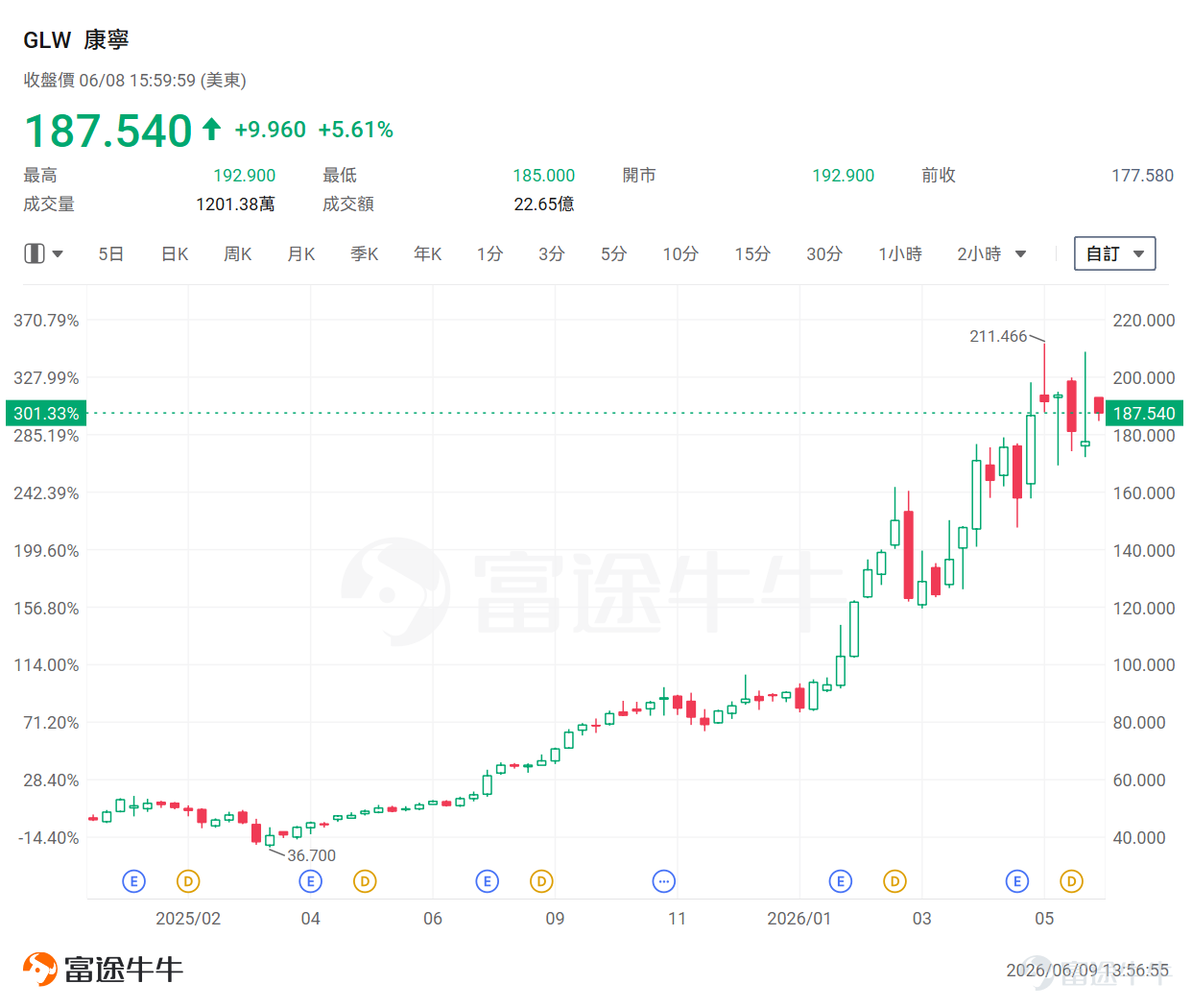
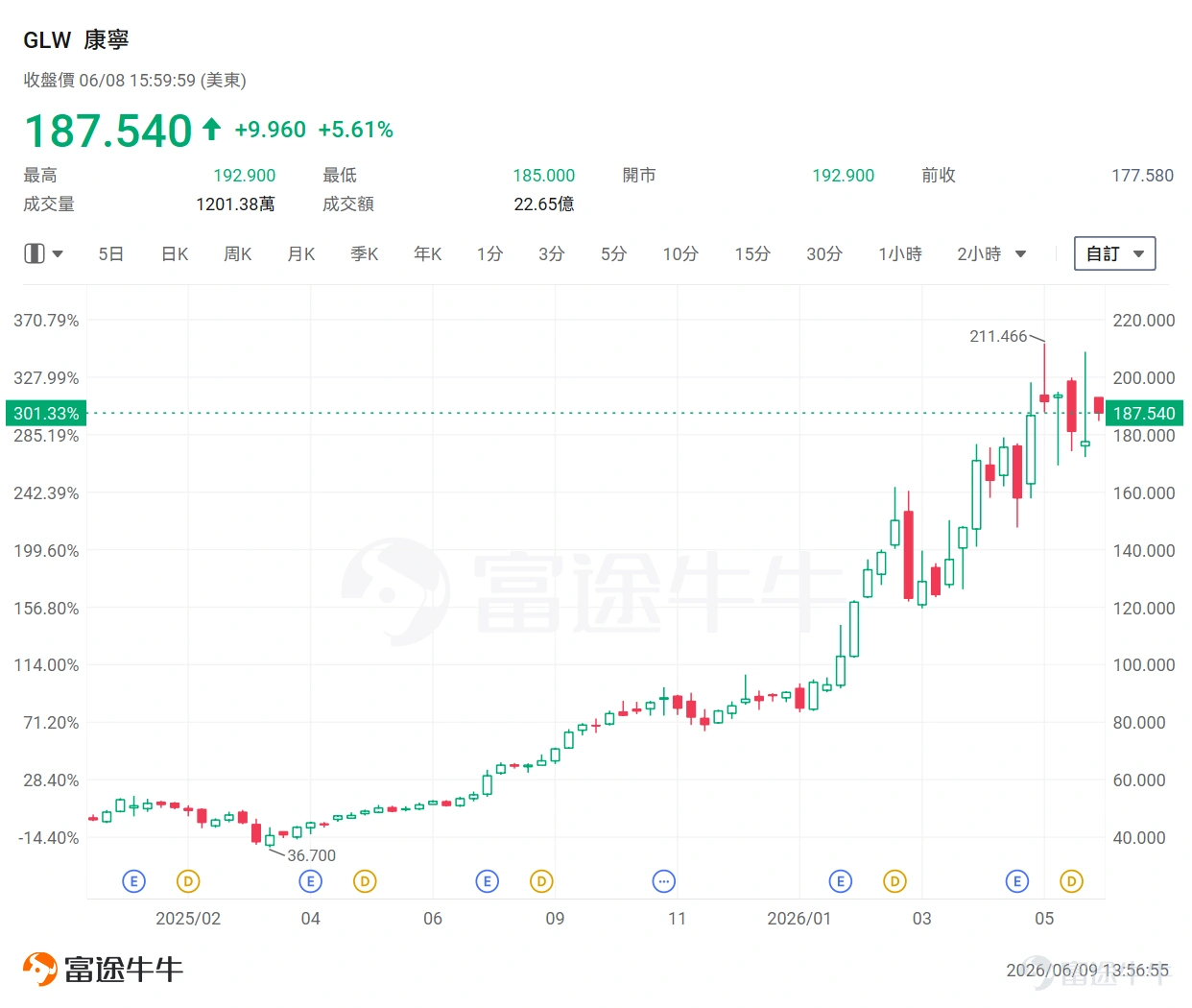
On Monday, $Corning (GLW.US)$ once again became the absolute focal point of capital markets. Boosted by the positive news of a multi-billion-dollar long-term contract officially announced by the company and $Amazon (AMZN.US)$ , Corning’s share price surged more than 5% in a single day. Since the beginning of this year, Corning’s stock has already doubled; if we extend the timeframe back to early 2025, its cumulative gain reaches nearly threefold.
The immediate catalyst for this sharp rally was Amazon's massive procurement plan.Reportedly, Amazon will pay Corning billions of dollars to purchase optical fiber to connect and support its rapidly expanding network of data centers across the United States.
--
--
--
Corning’s meteoric rise in capital markets stems not from short-term speculative hype but from a fundamental reshaping of the underlying dynamics of the global optical fiber market. Amid the explosive growth of AI computing power, optical fiber has evolved into a core hardware component that determines the upper limit of cluster computing capacity. In this article, we will provide fellow investors with an in-depth analysis of optical fiber’s critical role in the AI era and highlight the most competitive core assets and supply chain leaders worth watching closely.
AI Empowerment: The Optical Fiber Industry Enters a 'Computing Power Era' and Undergoes Valuation Reassessment
Historically, demand for optical fiber was primarily tied to broadband expansion (especially fiber-to-the-home deployments) and telecom operators’ capital expenditure cycles. Traditionally, roughly 70–80% of global optical fiber demand came from telecom operators. Under this model, the historical compound annual growth rate (CAGR) of global optical fiber demand was only about 2%.
However, this demand structure is undergoing a dramatic shift. According to a UBS Group report, the optical fiber market is rapidly tilting from telecom applications toward data center applications. Today, enterprise and data center demand for optical fiber has reached parity with traditional telecom demand and has officially become the primary engine driving industry growth. As GPU bandwidth scales exponentially, enterprise and data center demand for optical fiber is surging at a CAGR of approximately 48%. This insatiable appetite for extreme bandwidth is accelerating the replacement of traditional copper cabling with optical fiber.
In short,The optical fiber industry is no longer confined to traditional communication transmission—it is transforming into indispensable 'AI infrastructure.' Behind this shift lies an AI investment theme that many investors have yet to fully recognize.
So why have AI data centers become 'fiber eaters'?The massive fiber consumption by AI data centers fundamentally stems from the insatiable demand of GPU compute clusters for extreme bandwidth and ultra-low latency. In its report, UBS Group precisely breaks down the drivers of intra-data-center fiber demand into the following three dimensions:
Data Center Interconnect (DCI):As AI compute clusters continue to scale, a single data center can no longer meet the enormous training and inference demands. Cloud service providers and AI companies must interconnect multiple data centers to build larger-scale compute networks. Fiber demand related to DCI is expected to experience explosive growth by 2029. Key drivers include upgrades to existing network nodes, new branch connections to additional data centers, and the deployment of entirely new long-haul backbone fiber routes.
Scale Out: Currently, the vast majority of fiber demand in AI data centers is used for horizontal scaling out—that is, networking within the data center itself. As NVIDIA’s GPU architecture evolves from Hopper to Blackwell and then to Rubin, the growth rate of GPU network bandwidth has significantly outpaced advances in underlying transmission capabilities (SerDes). To overcome this bottleneck, systems ultimately need to multiply the number of optical fiber lanes to increase aggregate bandwidth.
Scale Up: When compute node scale exceeds the physical limits of a single rack, the surging bandwidth demands between GPUs—and the increased distances from cross-rack connections—are expected to drive a full transition from copper cabling to fiber optics. Notably, compared with scale-out architectures, scale-up designs can increase the per-GPU optical component content by as much as 2 to 9 times.
Combining these trends, as fiber density in scaling networks rises significantly,UBS Group estimates that by 2028, fiber demand driven solely by 'Scale Out' could surge to a level comparable to that of 'Scale Up'.
Tech Giants Rush to Secure Supply Amid Capacity Concerns: Corning's 'Long-Term Contracts' Moat
In fact, Amazon is not the only recent tech giant heavily committing capital to secure ties with Corning.Amid surging AI computing demand, Corning—the world’s largest optical fiber producer with roughly 20% global market share—has seen its production capacity become a core contested resource in the market:
Meta pledges $6 billion to expand capacity (January this year):Meta announced it would invest up to $6 billion by 2030 to support Corning’s expansion of its optical fiber plant in Hickory, North Carolina. Once completed, this facility will become the world’s largest optical fiber cable manufacturing site.
NVIDIA signs deep strategic partnership (May this year):Corning has reached a major collaboration agreement with NVIDIA, the leader in AI computing, to build three new factories dedicated to optical products in North Carolina and Texas. This move will increase Corning’s U.S.-based manufacturing capacity for optical interconnect products tenfold and boost fiber optic production capacity by over 50%.
As a key part of the agreement, NVIDIA also received Corning stock purchase rights worth a total of $3.2 billion (including the right to buy up to 15 million shares at $180 per share), plus a $500 million prepaid warrant allowing it to purchase an additional 3 million shares.
Which companies in this industry deserve attention?
The optical fiber industry is not a fully fragmented market.
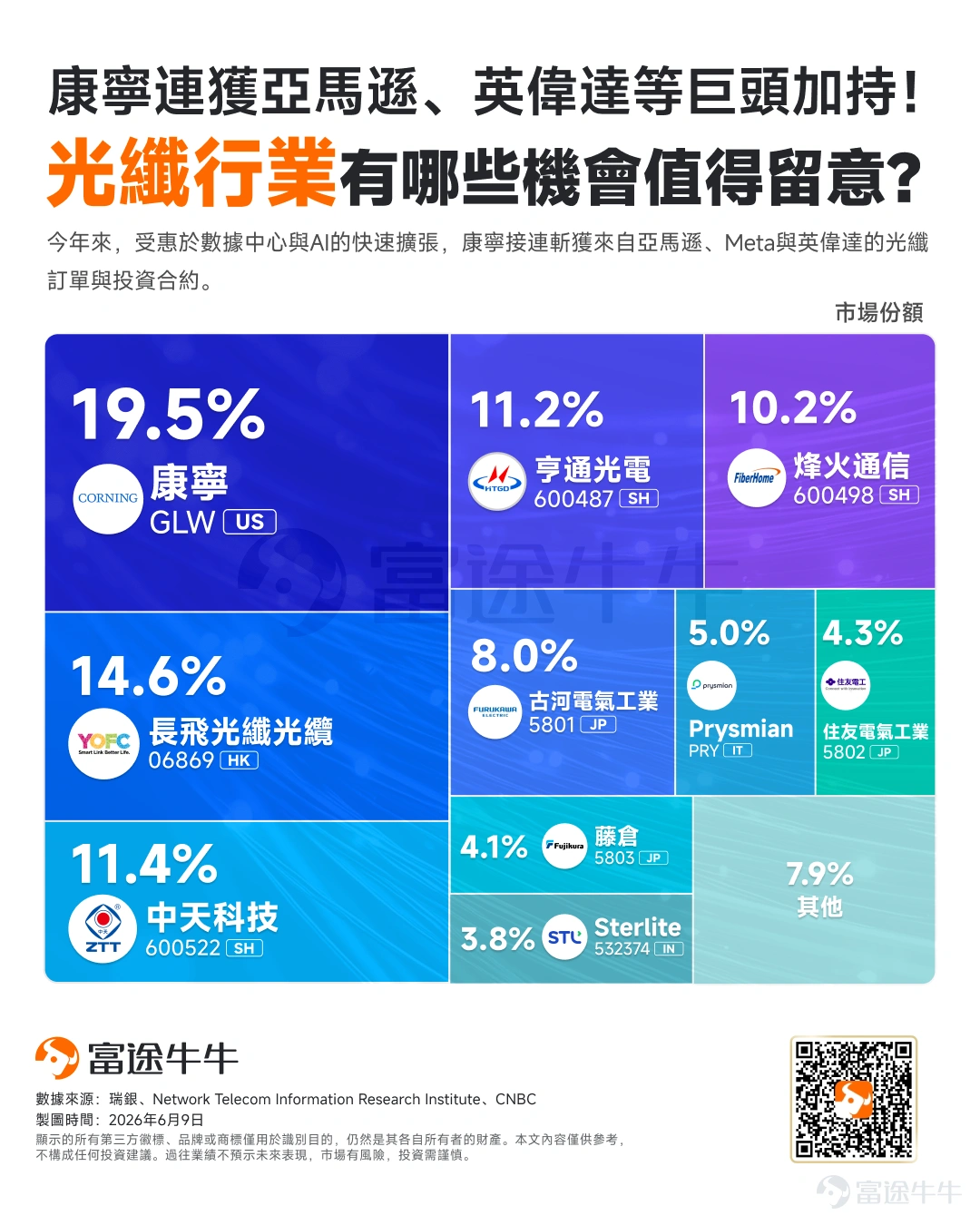
UBS Group noted that among global optical fiber manufacturers, $Corning (GLW.US)$ is the largest player, with a global market share of approximately 20%; Chinese manufacturers collectively account for nearly half of global shipment volumes, including $YOFC (06869.HK)$ 、 $Hengtong Optic-Electric (600487.SH)$ 、 $Fiberhome Telecommunication Technologies (600498.SH)$Wait.
--
--
--
1. Global leader: Corning
$Corning (GLW.US)$ With a market share of 19.50%, Corning, as the world's largest optical fiber manufacturer, stands to benefit the most from the current AI infrastructure build-out. It possesses full vertical integration capabilities—from optical fiber preforms and cables to connectors—and its product portfolio spans both inside and outside data centers.
Leveraging its strong technological expertise, Corning was the first to adopt a 'long-term agreement (LTA)' strategy, recently securing consecutive long-term orders from tech giants such as Meta, Amazon, and NVIDIA to ensure baseline demand for its capacity expansion plans.
2. China’s top four optical fiber producers: Massive capacity and export powerhouses
Chinese companies together hold about half of the global optical fiber market share, primarily benefiting from China's extensive fiber-to-the-home (FTTH) deployments and telecom network build-outs.
$YOFC (06869.HK)$Market share: 14.60%: The market leader in China. Notably, Yangtze Optical Fiber & Cable (YOFC) is at the forefront of commercializing next-generation 'Hollow Core Fiber (HCF)' technology, an advanced solution that significantly reduces latency.
$Jiangsu Zhongtian Technology (600522.SH)$Market share: 11.40%:In addition to traditional fiber optic cables, Zhongtian Technology also holds strong competitiveness and market share in submarine cables and new energy sectors such as energy storage and offshore wind power.
$Hengtong Optic-Electric (600487.SH)$Market share: 11.20%:Also a globally leading fiber optic cable manufacturer, Hengtong—similar to Zhongtian Technology—has deeply established capabilities in subsea communications (submarine fiber optic cable systems) and can handle the entire project from manufacturing to installation.。
$Fiberhome Telecommunication Technologies (600498.SH)$Market share: 10.20%:Backed by a Chinese central state-owned enterprise, it is not only a fiber optic cable producer but also a major telecommunications equipment manufacturer specializing in the R&D and production of optical communication transmission systems.
3. Japan’s top three wire and cable manufacturers: leaders in ultra-high-density cables
Although Japanese companies have lower individual market shares compared to U.S. and Chinese giants, they hold a significant competitive edge in 'ultra-miniature connectors' and 'ultra-high-density cables'—products currently in highest demand by AI data centers. To comply with U.S. domestic manufacturing regulations, they are actively expanding local production capacity in the United States.
$Furukawa Electric (5801.JP)$Market share: 8.00%: Owns brands such as Lightera and offers ultra-high-density fiber optic cables with up to 13,824 fibers.
$Fujikura (5803.JP)$Market share: 4.10%Like Furukawa, Fujikura also offers cables with up to 13,824 fibers and leads the industry in 'spatial density'—the number of fibers per millimeter of cable diameter. It is also one of the designated suppliers under U.S. government trade agreements.
Fujikura President Naoki Okada recently stated in an interview that the company’s business performance for the first fiscal quarter (April–June 2026) has been strong, saying, 'I believe results will exceed guidance.' Regarding the risk of insufficient hydrogen supply for fiber production, the company is actively managing the situation using inventory, and as of the first fiscal quarter, the impact on operations has been limited. He revealed that Fujikura is currently receiving fiber orders from nearly all major U.S. hyperscale cloud service providers, causing tight supply-demand conditions for AI data center fiber products. The company is implementing price increases, and some customers have already accepted the higher prices.
$Sumitomo Electric Industries (5802.JP)$Market share: 4.30%In next-generation interconnect technologies such as co-packaged optics (CPO), it has established partnerships with leading chip design companies like NVIDIA.
4. Other international manufacturers
Prysmian market share: 5.00%Headquartered in Italy, Prysmian is a global cable giant. In the fiber optics segment, it sources approximately 30% of its bare fiber externally and is actively pursuing contracts with hyperscale data center customers to support its plan to expand U.S. production capacity by 40–50%.
Sterlite market share: 3.80%An Indian fiber optics manufacturer, Sterlite has aggressively expanded into the North American market in recent years and recently announced a long-term supply agreement for fiber connectivity products with an unnamed U.S. hyperscaler.
Overall, Corning dominates the North American AI data center market, Japanese manufacturers closely follow with their ultra-high-density technology, and Chinese manufacturers lead infrastructure network deployment across Europe and Asia.
Summary: AI is redefining fiber optics, ushering in a new era of 'computational neural networks'
In short, driven by the explosive growth of AI computing power, the fundamental investment logic of the fiber optic industry has undergone an irreversible qualitative shift. It is no longer merely a traditional communication cable dependent on cyclical capital expenditures from telecom operators, but has fully evolved into a 'computational neural network' that determines the performance ceiling of AI data centers.
From a competitive landscape perspective, future market opportunities will exhibit clear structural differentiation:
Corning's 'long-term contract' moat: Through deep integration with North American tech giants (Amazon, Meta, NVIDIA) and domestic capacity expansion, Corning has secured base-load demand for the next several years, making it the most certain core investment target in this AI wave.
Japanese manufacturers' 'technology premium': With ultra-high-density and miniaturized connector technologies, they precisely address AI data centers’ dual constraints of space and bandwidth, securing an irreplaceable strategic position in high-end niche markets.
Chinese manufacturers’ 'scale and frontier positioning': Leveraging production capacity that accounts for half of the global total, they not only lead infrastructure upgrades across Europe and Asia but are also actively advancing next-generation technologies such as hollow-core fiber (HCF) and submarine cables, demonstrating remarkable full-chain resilience.
For investors, the 'AI-driven revaluation' of the fiber optic industry has only just begun. Going forward, whoever can masterultra-high-density transmission technology, haslong-term agreements (LTAs) with major clients, and possessesa flexible global manufacturing footprint—will continue to enjoy valuation premiums in this AI compute arms race. This optical communications theme, hidden behind GPUs and servers, is undoubtedly one of the most promising golden tracks worth deep exploration in the capital markets.
Risk Disclaimer: The above content only represents the author's view. It does not represent any position or investment advice of Futu. Futu makes no representation or warranty.Read more


Comments (2)
to post a comment
35
93