
Focus on COMPUTEX 2026! Will the entire AI supply chain ignite?

NVIDIA Enters the PC Market, Reshaping the PC Ecosystem—Will the AIPC Supply Chain See a Revaluation? | In-Depth Analysis | Research Report | AI Sector
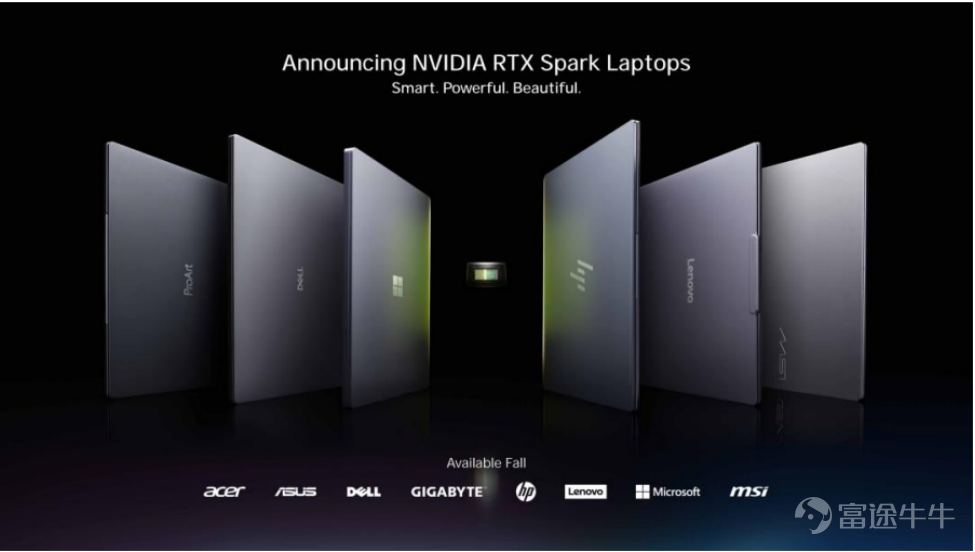
Last week $NVIDIA (NVDA.US)$ CEO Jensen Huang officially announced the company's entry into the PC processor market, unveiling the RTX Spark system-on-chip (SoC) for the Windows platform, driving AI capabilities from cloud data centers down to personal devices. The market is broadly optimistic about the long-term growth prospects of the AIPC segment, with three core rationales: First, the AIPC industry has entered a new development cycle, accelerating the adoption of device-cloud协同 (device-cloud synergy) models; second, on-device AI penetration continues to rise, with hardware upgrades and an explosion in application ecosystems jointly fueling strong sector momentum; third, the combination of decentralized computing power and unified ecosystem development is triggering a revaluation across multiple segments of the supply chain. Institutions are currently focusing on the core AIPC supply chain, particularly bullish on five key areas: Arm-based SoC chips, high-end high-frequency PCBs, high-bandwidth memory, ODM full-system manufacturing, and display panels. $NVIDIA (NVDA.US)$ The N1/N1X series chips continue to empower Microsoft's AI ecosystem, which is constantly maturing. Upgrades in on-device computing power and increases in overall device value will advance in tandem, allowing domestic supply chains to deeply benefit from the dual advantages of scaling orders and technological iteration.
NVIDIA’s entry reshapes the PC ecosystem—could the AIPC supply chain see a revaluation of its worth?
On June 1, at NVIDIA’s GTC conference, Jensen Huang’s keynote speech once again stunned the global computing industry. With the official unveiling of the RTX Spark superchip (internally codenamed N1X), this AI giant—the world’s most valuable company—has formally sounded the charge into the core PC processor market. Huang explicitly stated this marks 'the first complete redesign and reinvention of the PC industry in 40 years.'
NVIDIA’s move into the PC space is far more than a simple horizontal business expansion—it represents a decisive strategic step in building its 'cloud-to-edge integrated' AI ecosystem. Huang previously likened the AI industry to a 'five-layer cake,' with NVIDIA firmly controlling the foundational chip layer (GPU) and continuously extending upward into infrastructure layers. The newly launched N1X chip innovatively integrates a Blackwell-architecture GPU with an Arm-based Grace CPU, effectively bringing NVIDIA’s data-center-proven 'GPU-accelerated computing + unified memory' paradigm down to the consumer device market. Its core objective is to capture the local entry point for 'Agentic AI.' As AI evolves from generative dialogue toward autonomous task execution, demand for low-latency response, data privacy, and locally controlled computing power is surging explosively. Notably, just two days before this launch, Microsoft, NVIDIA, and Arm jointly announced 'A New Era for PCs,' paving the way for the commercial rollout of N1/N1X chips through deep ecosystem collaboration.
Institutional investors are broadly optimistic about the medium- to long-term growth prospects of the AIPC sector, based on three core rationales: First, AIPC has entered a new phase driven by both technological advancement and product innovation, accelerating the adoption of cloud-edge协同 architectures. Second, on-device AI penetration continues to rise rapidly, with hardware upgrades and AI application breakthroughs jointly fueling high industry momentum. Third, the shift of computing power to the edge and the construction of a unified ecosystem will drive a revaluation across multiple segments of the PC supply chain.
Figure 1: NVIDIA’s RTX Spark Superchip Unveiled

Source: COMPUTEX 2026 (Taipei International Computer Show)
– COMPUTEX 2026: Global AI Leaders Gather, AIPC Takes Center Stage
From June 1 to 5, COMPUTEX 2026 was held grandly in Taipei under the theme 'AI Together,' attracting global tech giants including NVIDIA, AMD, Intel, Qualcomm, and Arm, making it the largest event in the show’s history. AIPC emerged as the star of the exhibition, with major vendors unveiling their latest AIPC products and technologies. The most impactful announcement came from NVIDIA founder and CEO Jensen Huang, who introduced the RTX Spark superchip. In his keynote, Huang stated:"For the past forty years, people have operated computers by clicking and typing. With RTX Spark and Microsoft Windows, users will simply state their needs, and the PC will automatically complete the task. This is the first time in four decades that the entire PC product line is undergoing a comprehensive, disruptive redesign."
*Edge-Cloud Collaboration Accelerates Commercialization, AIPC Enters a Golden New Growth Cycle
NVIDIA, in collaboration with Microsoft and Arm, has officially launched a new generation of Arm-based PC platforms, ending Qualcomm's exclusive dominance in the Windows on Arm ecosystem. This marks a pivotal shift in the AIPC industry—from single-vendor leadership to a new phase of multi-player co-development. The core innovation of RTX Spark lies in its first-ever deep integration of enterprise-grade Blackwell GPUs into PC processors, coupled with high-speed CPU-GPU interconnectivity via NVLink-C2C technology. Additionally, its 128GB unified memory architecture enables smooth local execution of large AI models, laying the hardware foundation for widespread adoption of personal AI agents. With exceptional power efficiency, it decisively addresses the long-standing industry pain point of high power consumption in traditional x86 architectures, making it ideally suited for edge-side AI computing scenarios that demand large memory capacity and low power usage. Meanwhile, Microsoft’s Copilot+ PC ecosystem continues to mature, driving explosive growth in demand for on-device AI inference. Complex agent tasks can now run directly on the device, significantly reducing reliance on cloud computing resources. Industry consensus holds that this deep tripartite ecosystem synergy will substantially enhance edge-side compute supply and optimize system-level operational efficiency, accelerating AIPC’s transition from early conceptual validation to large-scale commercial deployment and positioning it as a key driver of edge-cloud collaborative development.
In terms of performance advantages, NVIDIA’s RTX Spark chip significantly outperforms traditional x86 platforms across multiple dimensions: its 1 PFLOPS of on-device AI compute power is 3–4 times that of current mainstream x86-based AIPCs, enabling smooth execution of larger-scale local large language models; its 128GB unified memory architecture resolves the longstanding bottleneck of separate CPU and GPU memory in conventional PCs, greatly boosting large model inference efficiency; developers can seamlessly migrate data center AI applications to edge devices thanks to NVIDIA’s comprehensive AI software ecosystem, including CUDA and TensorRT; and the Arm-based CPU offers inherent power efficiency advantages, enabling high-performance AI computing even in ultra-thin laptop form factors.However, the x86 camp is not standing idle—both Intel and AMD plan to launch next-generation AIPC processors in the second half of this year, further intensifying investment in on-device AI compute capabilities. The PC market is thus poised to solidify into a competitive duopoly between the NVIDIA-Arm alliance and the Intel-AMD camp.
Figure 2: Performance of NVIDIA’s RTX Spark Superchip

Source: COMPUTEX 2026 (Taipei International Computer Show)
*AIPC Market Size and Outlook: Transitioning from Concept to Mainstream with Vast Market Potential
AIPC refers to the next generation of personal computers embedded with NPU (Neural Processing Unit) compute power capable of running large AI models locally. As AI technology rapidly evolves and hardware costs continue to decline, AIPC is accelerating its shift from proof-of-concept to mass adoption. Multiple authoritative institutions unanimously predict that 2026 will be the critical inflection point for widespread AIPC adoption: according to Gartner, global AIPC shipments will reach 143 million units in 2026, with market penetration rising from 31.0% in 2025 to 54.7%, surpassing traditional PCs for the first time to become the market mainstream. Canalys data shows that global AIPC penetration was only 18% in 2024, indicating the industry is still in its early commercialization phase, but is expected to reach 70% by 2028, corresponding to a compound annual growth rate (CAGR) of 44% in unit sales—a clear sign of strong industry growth elasticity.
The explosive growth of the AIPC market is driven by a powerful convergence of technological breakthroughs, rising demand, and policy support. On-device AI compute capabilities have leaped forward—with next-generation AIPC chips like NVIDIA’s RTX Spark pushing edge compute into the petaflop range, making local execution of hundred-billion-parameter large models a reality. Demand for personal AI agents is surging, as these intelligent agents—capable of autonomously executing complex tasks—significantly boost productivity and have become a key driver for consumer upgrades. Meanwhile, leading software vendors such as Microsoft, Adobe, and Blender have completed AI-native overhauls of their applications, providing rich real-world use cases for AIPC. On the policy front, China’s State Council explicitly designated 2026 as a critical year for AI terminal adoption in its 'Opinions on Deepening the “AI+” Initiative,' setting a target of 70% penetration for next-generation smart terminals (including AIPC) by 2027, offering robust institutional support for industry development.
Currently, AIPC remains in an early 'AI-enhanced' stage—essentially adding AI-assisted capabilities on top of traditional PC functionality. In the future, AIPC will fully evolve toward being 'AI-native,' with both hardware architecture and software ecosystems undergoing systemic reconstruction centered around AI: at the hardware level, CPU, GPU, and NPU will deeply integrate into a unified AI compute architecture; at the interaction level, user interfaces will shift from traditional clicking and typing to natural language; at the application level, AI agents will become the primary application paradigm, enabling users to accomplish most tasks through intelligent agents; and in terms of security and privacy, on-device AI computation will become the dominant trend, fundamentally safeguarding user data security and privacy.
Figure 3: AIPC is one of the key applications of large AI models

Source: AI PC Industry White Paper
– Which investment opportunities within the sector should investors pay attention to?
AIPC is entering a golden new development cycle, with the current strongest and most certain first growth curve driven by an on-device compute upgrade cycle triggering hardware replacement. Global mainstream PC vendors are accelerating their AIPC product rollouts, having already launched over 200 AIPC models as of Q1 2026. Gartner forecasts that global AIPC shipments will reach 143 million units in 2026, with penetration rising from 31.0% in 2025 to 54.7%, surpassing traditional PCs for the first time to become the market mainstream. The core driver behind this industry inflection point is the leapfrog improvement in on-device AI computing power: next-generation AIPC chips, exemplified by NVIDIA’s RTX Spark, deliver on-device AI performance at the 1 petaflop (1PF) level—more than 10x higher than the previous generation—enabling local execution of large models with hundreds of billions of parameters. Meanwhile, average AIPC selling prices are expected to decline from $1,200 in 2024 to around $800 by 2026, removing cost barriers to mass adoption.As a core application extension of AIPC technology, the on-device/cloud collaborative agent economy is now benefiting from dual tailwinds of technological advancement and demand growth. With Microsoft, NVIDIA, and Arm jointly releasing PC agent standards, use cases such as personal digital assistants, enterprise intelligent office solutions, and industrial smart maintenance are set to accelerate deployment. China’s on-device agent economy is projected to experience rapid market expansion over the next 5–10 years.
In terms of investment opportunities, we recommend focusing on leading companies in core segments of the AIPC supply chain: in the ODM segment, $Huaqin Co.,Ltd. (603296.SH)$ has already achieved full coverage across the four major platforms—NVIDIA, Intel, AMD, and Qualcomm—and leads the industry in platform adaptability, with deep partnerships with global PC leaders including Lenovo, Dell, and HP Inc. $GIGADEVICE (03986.HK)$ In upstream chips, domestic MCU leader $Boe Technology Group (000725.SZ)$ 、 $Tcl Corporation (000100.SZ)$ is proactively developing on-device NPU chips and stands to benefit significantly from the surge in on-device AI compute demand; in displays and interaction, the world’s second-largest panel maker $LENOVO GROUP (00992.HK)$ will fully capture incremental demand driven by AIPC display upgrades; in structural components, global consumer electronics structural component leader Lens Technology (6613.HK) is a core supplier of glass and metal structural parts for AIPC devices; among branded OEMs, the company deeply collaborating with NVIDIA
Disclaimer: The information provided in this report, or any investment or potential transaction related thereto, is subject to the applicable laws and regulatory requirements of your jurisdiction, and you are solely responsible for compliance with such laws and regulations. The content of this report is for reference only and does not constitute any investment advice. Our company has made every effort to ensure the accuracy of the financial information provided, but assumes no responsibility or provides any form of guarantee for the accuracy, completeness, or effectiveness of all or part of the content. We will not be liable for any errors or omissions. Please also note that securities and virtual asset prices can fluctuate, especially given the extremely high risks associated with virtual assets, and investors should exercise caution and assume investment risks on their own.
———————————————————————
About the author:
Victory Securities – Hong Kong’s Leading Virtual Asset Broker
Victory Securities (HKEX: 08540), rooted in Hong Kong for over 50 years, is a fully licensed, integrated brokerage offering comprehensive financial services. It provides four core business lines—wealth management, asset management, virtual assets, and capital markets—to individual investors, institutional clients, high-net-worth individuals, and corporations, earning numerous awards and essential operating licenses across the Asia-Pacific region. In 2023, Victory Securities became the first Hong Kong broker to hold SFC licenses for virtual asset trading, advisory, and asset management services, and received SFC approval to offer virtual asset trading and advisory services to retail investors, providing a one-stop compliant platform for Bitcoin and Ethereum trading, conversion, and fiat on/off-ramps.
Risk Disclaimer: The above content only represents the author's view. It does not represent any position or investment advice of Futu. Futu makes no representation or warranty.Read more

Comments
to post a comment
2